To avoid these ads, REGISTER NOW!

Steel Recipes/Grades

HolisticPerformance

Well-known member
Joined
Jan 24, 2009
Messages
104
Location
LKY
So this is not 100% tool related, but I think it fits here pretty well. Obviously there are different grades of steel, different types of steel, and of course casting methods, forgings, heat treatings. We all get that, but, how would you guys say steel varies from country to country? My thought comes from y old shop manager (idiot) from a german car dealership - I happened to be working on a Japanese SUV that day (relatively new), and he steps under the car with me and says ''gotta love Jap Steel, rusts worse than anything....."


Any truth to a statement like this? Why might steel mixtures from different regions of the world vary: Cost, Material, QC?
 
To avoid these ads, REGISTER NOW!

speed bump

Well-known member
Joined
May 28, 2008
Messages
6,317
Location
Butte Montana
Steel mixtures to some extent vary from country to country on proprietary stuff but stuff like straight A36 steel generally is pretty close to the same stuff as far as properties go unless the QC is gone to hell. As an example we had some A36 steel straps in our strengths of materials testing lab that while it held 36ksi it stretched out like taffy which isn't what its supposed to do.
 

Stuey

Well-known member
Joined
Jan 8, 2008
Messages
11,034
Location
28m above sea level
Oh, goodness. This may be a bit naive, but I think it is safe to assume that the same exact same type of steel sourced from different countries *should* be identical or strongly comparable.

Different varieties of steel are manufactured differently to provide specific physical and/or chemical properties. If the type of steel used to produce a Japanese car is the same as the type used to produce an American car, the properties *should* not vary.

There are many reasons why a company might go with one steel over another, but I wouldn't know. Perhaps the corrosion resistance of one type of steel resulted in a slight lack of strength or hardness. An engineer might then look to use a less corrosion resistant steel in favor.

Saying that "Jap steel rusts worst than anything" could be true, but if it is, I guarantee that the choice of steel was an intentional one.

Just a thought - perhaps if true, less corrosio/rust resistance is endured for greater weldability?

Edit: As Speed Bump said, it's not supposed to vary. In an ideal world where melamine is mixed into infant formula instead of milk anything is possible. I would think that the auto standardizing bodies would impose minimum property requirements and then regularly check for compliance. Or is this an invalid assumption?
 
Last edited:

Vulturej

Well-known member
Joined
Mar 6, 2009
Messages
541
Location
Illinois
A lot of truth to that statement. At my company we buy a lot of Italian machinery. They were getting their steel from an eastern European supplier, we have 2 main types of machines one's with 8" tie rods & the other with 4" tie rods. They all started snapping like twigs. And all the stainless components were rusting. We were getting frustrated it's a bit*h changing out a 8" 3000 lbs tie rod, so we sent a bunch of samples to a metallurgy lab and sure enough all the results were inferior grade steel. The machinery company replaced all the problem components, @ a cost of 10 million +. Needless to say they buy there steel from Germany now.
 

Stuey

Well-known member
Joined
Jan 8, 2008
Messages
11,034
Location
28m above sea level
That's [the ongoing theory as to] what happened with the Titanic... engineers specified a particular grade of rivets in the designs, but cheaper and weaker rivets were used for parts of the construction.
 

Merkava_4

Banned
Joined
Dec 26, 2007
Messages
14,518
Location
Clovis, CA.
This is the kind of information I wish was available through Google: Where every product was made and the exact address of where it's made at. I should be able to get a full run down of all the steel companies in the world with full product identification and their street address.
 

-B-

Well-known member
Joined
Feb 4, 2009
Messages
1,567
Location
Northshore of Boston
That's [the ongoing theory as to] what happened with the Titanic... engineers specified a particular grade of rivets in the designs, but cheaper and weaker rivets were used for parts of the construction.


That is incorrect it was bad plate steel it was too brittle from too much copper in the mixture. It was not noticed because there were no ongoing mandatory audit of materials for passenger oceanic vessels at the time .


I deal with a lot of the exotic super steels some are better then others, some look great on paper but fail miserably in the real world. Too much reliance on what an engineer can prove mathematically on paper and in a lab is a bad thing.
 
OP
H

HolisticPerformance

Well-known member
Joined
Jan 24, 2009
Messages
104
Location
LKY
I deal with a lot of the exotic super steels some are better then others, some look great on paper but fail miserably in the real world. Too much reliance on what an engineer can prove mathematically on paper and in a lab is a bad thing.


We are a feeble being. Goes back to the original sin.
 
To avoid these ads, REGISTER NOW!

Stuey

Well-known member
Joined
Jan 8, 2008
Messages
11,034
Location
28m above sea level
That is incorrect it was bad plate steel it was too brittle from too much copper in the mixture. It was not noticed because there were no ongoing mandatory audit of materials for passenger oceanic vessels at the time .
By any chance do you know of any document or periodical in which the weak rivet theory was dismissed? I am/was under the impression that this theory is still valid, at least as a partial contributing factor.

Yes, steel fails because Eve ate an apple.
Hey now, don't be taking this thread into a religious direction! :lol_hitti
 

Theo

Well-known member
Joined
Oct 8, 2007
Messages
475
Location
Oakville, On Canada
I cut A LOT of steel and get to see material from all over the world.

My experience is that steel qualities and properties can vary by both country of origin and manufacturer.

In other words two pieces of H13 can be made across the street from one another and have differing properties.
 

speed bump

Well-known member
Joined
May 28, 2008
Messages
6,317
Location
Butte Montana
By any chance do you know of any document or periodical in which the weak rivet theory was dismissed? I am/was under the impression that this theory is still valid, at least as a partial contributing factor.


Hey now, don't be taking this thread into a religious direction! :lol_hitti

Its not the theory that bad rivets are what sunk the Titanic the theory is it contributed to the rapid sinking but not event itself. The overall failure appears to be caused by bad metallurgy overall. Ductile/brittle failures weren't all that well understood back then (I believe the most common test (the Charpy impact test) didn't come along until 1913 and it was French so its highly unlikely that people in Britain were using it to any great extent amd even then they might not of thought of the implications of it.). Also if you look at a lot of things that we consider common knowledge for materials now and ways to understand what is going on with various materials behaviors it wasn't until the late 70s before the science of metallurgy became much of science, to quote something I heard the other day about certain civil stuff but applies to this as well "You start here, then it get hokey a bunch of hand waving and magic happens and out pops this equation that just happens to work". For a long long time people didn't really know how a lot of metallurgical properties went but they could try different things to see if it worked or not. Unfortunately one of those trying different things just happened to be the Titanic.

If your interested in seeing what this looks like (and I have so Dry Ice tomorrow) i'll break some pieces in the Charpy impact tester to try and show the differences between these for you and how much less energy it takes to break steel once it gets cold. (if I had some better stainless than 304 I could show you some really really fun breaks when it gets cold).
 

The Rusty Gear

Well-known member
Joined
Feb 15, 2006
Messages
359
Location
Edmonton, Canada
Do you know how many "types" of steel are out there????

When you buy a steel, you buying to a specification. When you buy ASTM A36 Steel (previous example) you are buying a plate steel whch meets certain chemical requirements (Carbon, Manganese, Phosphorous, Sulfur and Silicon), can meet certain strength requirements (36 ksi yield, 58-80ksi ultimate strength) with a minimum level of elasticity (Elongation before breaking)

Beyond that the steel manufacturer can do whatever they want to the steel as long as they meet those requirements. In this case, you can have extra copper or aluminum in the steel, low impact resistance etc because those are not controlled by the specification.

If you are worried about corrosion, strength, elasticity etc etc, you specify a different material. One which has a minimum nickel or chrome content, higher strength requirement etc.

If "Japenese steel rusts worse than anything" it is because the steel specified by the Japanese manufacturer was less corrosion resistant than one specified by a comparable American Manufacturer, and not due to slopy manufacturing or bad practices.

Same thing with stainless steels. American made 410 stainless steel will rust a heck of alot faster than a Chinese 316 Stainless steel. It comes down to what was specified.

Comparing apples to apples (same grades of steel) you should find very little variability between country of origin.
 

The Rusty Gear

Well-known member
Joined
Feb 15, 2006
Messages
359
Location
Edmonton, Canada
I cut A LOT of steel and get to see material from all over the world.

My experience is that steel qualities and properties can vary by both country of origin and manufacturer.

In other words two pieces of H13 can be made across the street from one another and have differing properties.

That is true, but they should both meet the same minimum requirements. ie they both should have a minimum impact resistance of 8 ft*lbs at -40, but two different heats from the same manufacturer could have H13 with values of 8 FT*lbs and 20 FT*lbs respectively. They should both do the job of H13, but if you really wanted something with 20 ft*lbs to begin with, you should specify a different grade.

I used to be Quality Manager at a foundry, so I saw this variability daily. Sometimes you get "extra" but you should always be getting at least the "minimum" of the specified steel.
 
Last edited:

jpilgrim

Well-known member
Joined
Jan 27, 2009
Messages
237
Location
SF Bay Area
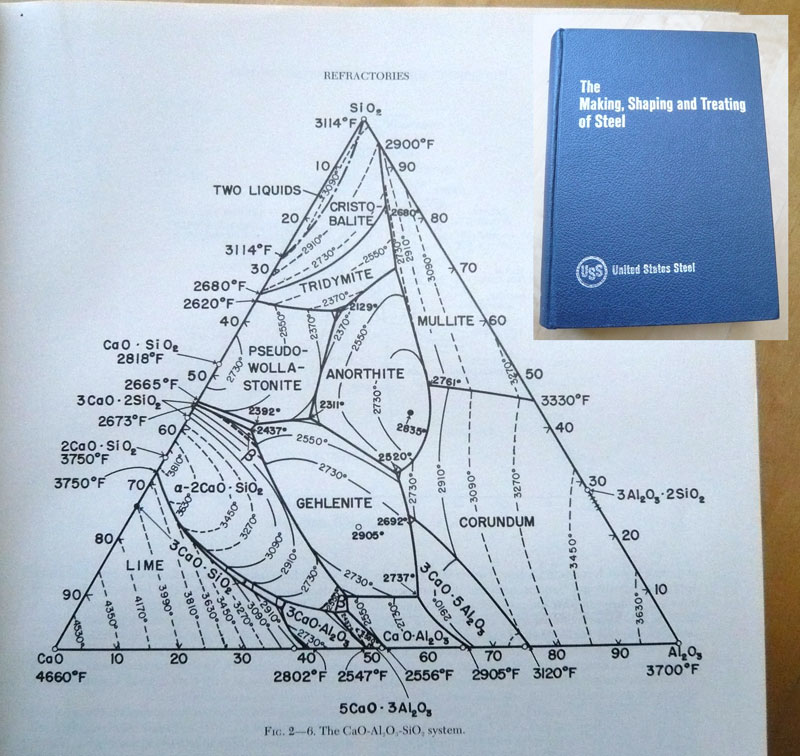
I found this book at an estate sale this weekend:
steelmaking.jpg

The guy worked as an engineer at Bethlehem Steel.
I picked up the book to try to learn about steel, but as that one graph shows, there's a lot to learn...1420 pages!
 

toadjammer

Well-known member
Joined
Apr 14, 2007
Messages
296
Location
WI
And to throw all of this for a loop, steel in the same chemical state (exact same percentage of impurities and alloy's) will act differently when anealed or hardend and temperd at different temps. and different processes. There really is alot to understand about metalurgy. In fact some steels actually expand when hardened, I believe two of them are A-2 and H-13. Some of the ideas behind Japanese cars rusting out quickly years ago tend to be of the nature of how they handled the scrap that they used. I believe from things I have read in the past that their furnaces and processes didn't remove all of the oxides and impurities to produce steel without some iron oxide in it. That contributed, but also some of the ways that the cars where built without care as to how salt and water stays inside the body panels(american cars have had and still do have some issues with this also)
 

Stuey

Well-known member
Joined
Jan 8, 2008
Messages
11,034
Location
28m above sea level
I found this book at an estate sale this weekend:
steelmaking.jpg

The guy worked as an engineer at Bethlehem Steel.
I picked up the book to try to learn about steel, but as that one graph shows, there's a lot to learn...1420 pages!
lol at the terniary phase diagram. *grabs a 10 foot pole and slowly backs away from the evil*
 
To avoid these ads, REGISTER NOW!
Top Bottom