You don't need a ridge beam or any poles if you want to construct a typical stick framed gable roof. A stick framed gable roof transfers all of its load to the outside walls of the structure. There seems to be a tremendous amount of confusion about this topic, as it is a question asked over and over again on GJ. Some of the confusion is in terminology... stick framed roof assemblies typically utilize a ridge BOARD, not a ridge BEAM. A ridge board simply facilitates the construction of the frame and is not needed for any structural purpose, it's just a place to nail the tops of the rafters while you're framing the building. Collar ties, as you noted must be installed to oppose the spreading force applied to the outside walls. You have cut your wall height to 8 feet but want an additional 2 feet of ceiling height, you would run your collar ties at 10 feet and your interior ceiling would have a "break" along each wall which would present itself as an angled ceiling section. Collar ties that run at the height of the top plate of the wall are called ceiling joists. In a shallow pitch application on a small building, ceiling joists may suffice as collar ties. Typically, when ceiling joists are used, an additional set of collar ties are installed about a third of the way down from the ridge on every other bay.
A ridge beam, on the other hand, is a structural element meant to carry the load of the roof to both gable walls of the building and the rafters are in turn "hung" from them. This type of construction is used when you want a "cathedral" ceiling type of structure.
There are any number of books available at your library and at HD and Lowes than can explain the framing details fully.
The good news is that you do not need a ridge beam or ridge poles, all you need is to develop a rafter pattern, cut your rafters and use a ridge board. You will probably end up with 2x8 rafters, use a 2x8 for your ridge board and hold the bottom of the ridge board even with the bottom of your plumb cut of the rafters, this will leave the top of the ridge board recessed from the tops of your rafters and this detail forms the ideal space for air flow to your ridge vent. Good luck!


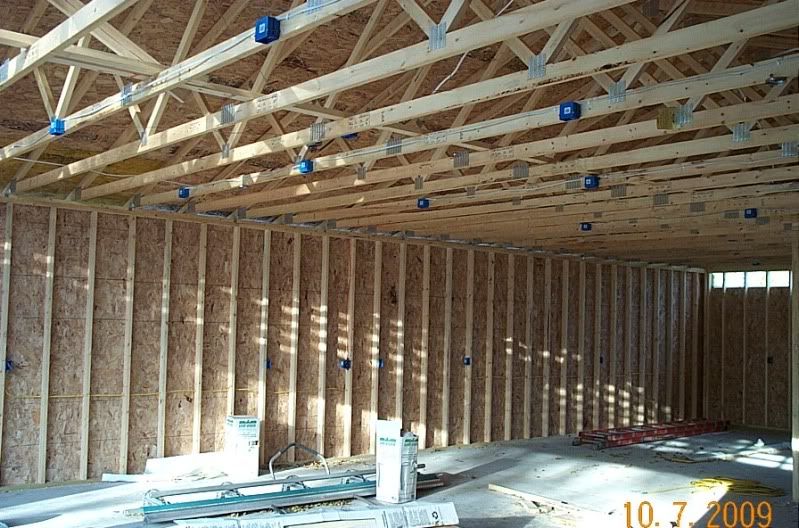


 With a proper ridge beam you will need a crane and an engineered beam which won't be cheap. All that stick building is not going to be easy on the body either. I tried to get some local truss builders to make a raised tie truss but they couldn't do it with their software. Perhaps the snow loads preclude that design up here. Trusses are the strongest and easiest to construct IMHO. You're still going to need 3 or 4 guys for the better part of a day. Good luck!