To avoid these ads, REGISTER NOW!

Stick welding vertical up

earthmover1980

Well-known member
Joined
Oct 16, 2015
Messages
125
Location
South West Michigan
Hello all,
I am a seasoned welder with lots of real world experience mainly doing repairs. I really struggle with stick welding vertical up. I have read a lot and am well aware that vertical up is the proper technique for thick pieces. I have no difficulty welding down no matter what the thickness or rod selected. I can make those vertical down welds strong and smooth. I have welded 2 excavator thumbs on doing vertical down with 7018 5/32 using my Lincoln Ranger 8. I usually set it at about 175 amps. Have had excellent results. I'm getting ready to weld mounts for a hydraulic thumb on a Volvo 220 excavator. I want to eventually learn vertical up to do things proper. So I tried more practice vertical up welds...Ugly! Got pissed and reassured myself with some pretty vertical down beads. Does anyone here with experience in vertical welds see any harm in my vertical down technique? I've tried many different methods and techniques practicing up, with piss poor results. Tried Lincoln's weave patterns, the z pattern, and the upside down A vertical up again with poor results at best. I do no code welding, nothing gets tested. All of my welds I must warrant to be of sound quality, and to hold given the circumstances. So, my question is: is my Vertical Down technique acceptable?
 
Last edited:
To avoid these ads, REGISTER NOW!

brownbagg

Well-known member
Joined
Mar 20, 2006
Messages
5,208
7018 run a little hot and move quick, if you cant move quick you going have to turn it down a little so the weld will freeze quicker
 

ReggieR

Banned
Joined
Jun 21, 2018
Messages
331
Location
Vinton
Welding tips and tricks video on tube. Just keep in mind it is STILL a drag technique. Even uphill.90 in or a litlle drag up and lots of variables.I prefer 3/32 even on heavy materials. I'd rather do muti pass than deal with high amps and a thick rod when it comes to uphill.
 

Lwel9226

Well-known member
Joined
Jun 7, 2014
Messages
764
Location
So Oregon
Up weld, done properly, will be much stronger than down weld.....
Try 1/8 rod @112-115 amps.... works well for me.... Never had much luck with larger rods and higher amps.....

LynnW
 

sberry

Banned
Joined
Jun 18, 2005
Messages
35,747
Location
Brethren, Michigan
You likely need some instruction. In a school they work on this till it's right. Down can be good but there can be problems with fusion and inclusions.
I welded some brackets on a machine the other day and even though I could have turned it saved some handling work and I really need a little practice. I could even tell by the time I got past a few rods I was picking up.
Vertical is really where the rubber hits the road so to speak and it can be difficult to be consistent. This is a demo, not perfect. I should have snapped a couple pics the other day, a couple of my last ones were pretty nice.
Ź and weaves have a pause in them. When you see a dot in one of those drawings it is a pause.
I had a guy come a while back who was having a problem with this, in about an hour or so was significantly better. The only problem with video instruction is that they show the right way to do it. As odd as that sounds what it means is we often hyper exaggerate some of the movements in the demo process to illuminate the technique, once the concept is understood then we can go back to right.
 

Attachments

  • 7018 vert 2p.JPG
    7018 vert 2p.JPG
    26.6 KB · Views: 242
Last edited:

joe49

Well-known member
Joined
Sep 25, 2009
Messages
1,883
Location
Tonica, Il
First try stringer welds. Clean and ground metal, rod is pointing up hill, then run beads and adjust amps till you can carry the puddle up hill.

Second cover pass, weave side to side, at both ends of your weave pause in the same spot (I like to go at least to were the edge of the rod is just past the edge of the previous pass). Hold the pause until you see the puddle flow out and fill in past the electrode. Then move back to the other side of the weld and repeat the process.

Third if you are unable to hold the puddle up you can add a whip or if the metal is to thin for the heat you're putting into it, go to a smaller rod or actually stop the weld and allow the metal to cool then continue doing stop and goes to complete the weld.

Fourth. Down hand is only allowable on first pass and only on some 7018 types not all. In field 5P or 6011 is the go to if you are needing to down hand.

Fifth. All rules can be broken. You show up and are stuck following some hack, who has turned a simple job into a cluster ****. Say a large badly cut and large gap and of course you are only carrying 5/32 7018. Well run them down hand till you can close the gap. Then go back to doing it correct.

Sixth. If you can position your weldment vertical leaning away from 90 degrees will allow a easier, larger, and faster deposit of weld.

Seventh. Your work isn't a pond it's a river . Things change, Adapt to the conditions.
 

Oregon rock crusher

Well-known member
Joined
Jun 28, 2016
Messages
1,904
Location
West of Salem
This may not help you but here it is. When I first started welding verticle seemed hard. I was trying to form a bead and pull it up the weldment and getting goobers which I then had to run downhill over them to smooth up. Finally I realized that the bead took care of itself and started watching above the rod and steadily moving up and controlling how much penetration I was getting. Sure enough the beads improved dramatically. With verticle it's not where you've been, it's where your going. Now I always weld verticle with the rod angled up "cutting" the way to where I'm headed. Works for me. Ed.
 

BD1

Well-known member
Joined
Mar 18, 2007
Messages
4,602
Location
north side
Been welding pipe forever. We always go uphill with 7018 . Downhill can Trap slag . It may be easier making side to side movements instead of straight up.Practice with 3/32 7018 . Most of our pipe welding uses this for 6'' schedule 40 and down.The smaller rod is easier to control.
 

Mgdoug3

Well-known member
Joined
Mar 2, 2018
Messages
1,391
Location
KY
I agree with trying a 3/32 rod. It's a lot easier to control and makes me look like a good welder. I'm not a professional but I do weld on repairs and have some people call me. I learned with trial and error, reading and videos.Then lots of practice. My biggest hurdle was my welder. I would try text book settings and burn through the metal. I eventually learned to lower my amps and my welds starting improving drastically. Since then I always practice first on scrap metal if I'm trying a different welder.

If I need to weld something to hold, I whip and pause with a 6011 then cap it with a 7018.
 

sberry

Banned
Joined
Jun 18, 2005
Messages
35,747
Location
Brethren, Michigan
6011 in the root only helps with fusion or penetration and sometimes root fill.
In fact joint may be stronger with 7018 provided its installed correctly.
One time way back in the day I want in with about half a jag on. The customer or company had their own test booth. The guy, "Ted" was kind of a knob and self proclaimed welder of sorts was the man. It was a stupid simple T and was sposed to get 3 passes, first being a 6010 and after I get in the booth and about ready to go Tee takes a hike. So instead of 10 I bend the joint open a little and super smoke a 18 in the root.
By the time he gets back it looks like pass 2 and I burn the last one on. I was about half in the bag and it looked a little sloppy but passable and he takes it to a press for a break.
It was burned so deep and hot was almost homogenous. He is trying to flatten it, he was still working on it, dripping sweet and swearing about 20 minutes in to a 2 minute job they wanted to get a simple look in to for fusion.
He said something to our boss, someone told me it was the only one didn't break out like it was sposed to. I still remember him, don't think he remembered me later when I met him again but still recall him sweating, stopping for smoke, trying to bust that plate. Swearing, jumping around.
 

Mgdoug3

Well-known member
Joined
Mar 2, 2018
Messages
1,391
Location
KY
I like the 6011 for the penetration. 6010 is hard to find in stores around here. I have tried several different rods but now I use 6011 and 7018 99% of the time.
 

dr_clyde

Well-known member
Joined
Jan 7, 2009
Messages
6,433
Location
Holland, MI
I like the 6011 for the penetration. 6010 is hard to find in stores around here. I have tried several different rods but now I use 6011 and 7018 99% of the time.

6010 isn't carried by your local welding supply? That's very strange, as 6010 is an incredibly common rod, industry standard and called out by lots of WPS sheets.
 

Mgdoug3

Well-known member
Joined
Mar 2, 2018
Messages
1,391
Location
KY
Closest welding supply store is probably an hour away, through downtown traffic. Rural King, TSC, and local hardware stores are 30 minutes away or less. I could always order online but I don't do anything related to code and 6011 has always worked for me. I weld on farm equipment or build farm attachments, mostly for myself. If I'm helping someone, they care more about getting it fixed not what rod I used.
 

sberry

Banned
Joined
Jun 18, 2005
Messages
35,747
Location
Brethren, Michigan
Agree, the 10 is bought at the welding supply. When I started out used 10 cause its what they used on the big job and was used to it, but got a Maxstar and converted to 11 and still use it. Doesn't make any difference to me, its close enough the same to do what we do with it and I might even like it a little better for lotso restarts with the same rod. They seem to light a little faster and can always give a couple to buds with AC only machines.
 

sberry

Banned
Joined
Jun 18, 2005
Messages
35,747
Location
Brethren, Michigan
I actually have used 18 on seal welds and light material with poor fits running down. Nice finish and really fast and hot.
 

Attachments

  • 7018 down2.JPG
    7018 down2.JPG
    33.3 KB · Views: 83

Mgdoug3

Well-known member
Joined
Mar 2, 2018
Messages
1,391
Location
KY
I never have tried 7018 downhill. My main welder is a Thermal Arc 161 and is suppose to be able to use 6010 but I've heard conflicting stories. I know 6011 works so I just stick to it.

Before I really put in the effort and practice, if I had to weld up and down, I would grab a 6011, turn up the heat and weld downhill. I started to do more repairs and eventually upgraded to a AC/DC instead of just a buzz box. I've learned welding is a great skill to have but it takes practice.
 

sberry

Banned
Joined
Jun 18, 2005
Messages
35,747
Location
Brethren, Michigan
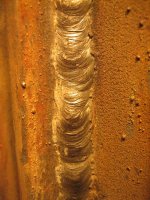
It's hard to fake being a good vert up welder. Here is a big ole fatty on rusty ole steel with old rod on some old junker.
 

Attachments

  • 7018 old rod.JPG
    7018 old rod.JPG
    81.7 KB · Views: 94
Last edited:

rustyjames

Well-known member
Joined
Dec 28, 2008
Messages
1,077
Location
central nj
Been welding pipe forever. We always go uphill with 7018 . Downhill can Trap slag . It may be easier making side to side movements instead of straight up.Practice with 3/32 7018 . Most of our pipe welding uses this for 6'' schedule 40 and down.The smaller rod is easier to control.

From what I've learned is that 7018 is uphill only. Key points to remember (For 7018) is using lower amps, rod angle and travel speed. You have to increase with the travel speed as you progress because the material is getting hot. On heavier material a weave, either a Z, or semi circular, with a slight pause on each side is preferred.
 

fnieto

Well-known member
Joined
Aug 27, 2013
Messages
1,401
Location
Tucson,Arizona
1/8" 7818 slightly lower amps (115) tight arc and slight consistent weave. Vert down in critical project is a no no. Practice like you play, it will come to you.
 
To avoid these ads, REGISTER NOW!

BD1

Well-known member
Joined
Mar 18, 2007
Messages
4,602
Location
north side
Generally the heat setting for 5p 6010 1/8'' is the same for 3/32'' LoHi 7018.
That's why we use those exclusively. Machines could be 500' away so we use one setting for both rods. Normally uphill on all passes. sometimes a guy will run 6010 down but 7018 is always uphill.
 

Attackcammel

Active member
Joined
Feb 26, 2013
Messages
41
Op what problems are you having is the weld dropping out on you are you just having trouble just flattening the weld out? What's going on? Some pics might help us help you
 

bczygan

Well-known member
Joined
Nov 4, 2009
Messages
22,002
Location
DETROIT! Arsenal of Scrappers
I just did a vertical up in class, with 3/32 6010 and a whip and pause.

Found it a lot easier than on the flat. Just got a speed going. that didn't outpace the puddle, or let it get too hot and droop.

Bill
 

sberry

Banned
Joined
Jun 18, 2005
Messages
35,747
Location
Brethren, Michigan
In ones mind it can be tempting to want to use 3/32 10 or 11. I bought some when I got my Max, used about 1 rod and went back to the 1/8 I use for decades. An arc length error 25 percent the diameterof the rod isn't as fussy with bigger rod,,, if that make sense, not sure I word it right but a guy really has to be a lot steadier with that little rod. Not such a deal when I was younger and well practiced but a guy can really tell if he doesn't do it for a bit. Really good consistent whip and pause is something a guy needs to keep on for critical work.
 

sqznby

Well-known member
Joined
Oct 26, 2013
Messages
982
Location
Coastal NC
Hello all,
I am a seasoned welder with lots of real world experience mainly doing repairs. I really struggle with stick welding vertical up. I have read a lot and am well aware that vertical up is the proper technique for thick pieces. I have no difficulty welding down no matter what the thickness or rod selected. I can make those vertical down welds strong and smooth. I have welded 2 excavator thumbs on doing vertical down with 7018 5/32 using my Lincoln Ranger 8. I usually set it at about 175 amps. Have had excellent results. I'm getting ready to weld mounts for a hydraulic thumb on a Volvo 220 excavator. I want to eventually learn vertical up to do things proper. So I tried more practice vertical up welds...Ugly! Got pissed and reassured myself with some pretty vertical down beads. Does anyone here with experience in vertical welds see any harm in my vertical down technique? I've tried many different methods and techniques practicing up, with piss poor results. Tried Lincoln's weave patterns, the z pattern, and the upside down A vertical up again with poor results at best. I do no code welding, nothing gets tested. All of my welds I must warrant to be of sound quality, and to hold given the circumstances.

So, my question is: is my Vertical Down technique acceptable?

You're certainly not going to be running a vertical up pass at the same rate and heat range as you would going down.
Turn down your machine to around 105 +- use an 1/8 rod and practice. Go at different speeds with your weave and you'll find the sweet spot.

To answer your question. No, it is not acceptable in structural welding. Every thumb I have welded on was always vertical. In fact whenever speaking of structural and vertical, it is always expected up, never down. You'd just about get laughed at if you mentioned welding down doing any type of structural welding.
 

FSrepair&fabrication

Well-known member
Joined
Jul 28, 2017
Messages
908
Location
maryland
7018 is always vertical up. you want to point the rod almost straight up and go side to side of the joint. Ignore the puddle and keep moving at a consistent speed. If you try to watch the puddle it will lie to you- it looks like the weld is drooping and piling up when its really just the slag. I like to run a little hotter- around 120-125 amps use a high tap setting with a low rheostat setting (best arc characteristics for lo hy) by running hotter i can weld as fast as i can without getting undercut and help avoid sticking the rod which seems to happen when you weld slower at lower heat.
 

royce

Well-known member
Joined
Jun 22, 2014
Messages
3,103
Location
fairbanks ak
A few points;
LH rod can be ran uphill or downhill
Most structural procedures call for uphill.
There are tank procedures that allow running downhill on the cap.
In the pipeline industry, on X-70, 80 and 90 they have been running Lh downhill on the stringer beads for a lot of years.
Kobelco make a downhill Lh that puts in a stringer that looks like it is heli-arced
Running Lh downhill does not necessarily trap slag.
Tensile and charpy values are not necessarily higher running uphill,as a matter of fact, running downhill with smaller passes can give finer grain structure and may negate the necessity to stress relive on thicker sections
In the end, with the right parameters, LH can be successfully ran either way.

Royce
 

bczygan

Well-known member
Joined
Nov 4, 2009
Messages
22,002
Location
DETROIT! Arsenal of Scrappers
Latest welds:

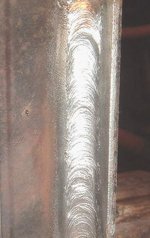
Left - 3/32 6010 90A DCEP vert up inverted T

Right - 3/32 6010 90A DCEP vert up zig zag

Bill
 

Attachments

  • 6010 vertup inv T.jpg
    6010 vertup inv T.jpg
    71.2 KB · Views: 70
  • 6010 vert upzigzag.jpg
    6010 vert upzigzag.jpg
    85.8 KB · Views: 69
Last edited:

sberry

Banned
Joined
Jun 18, 2005
Messages
35,747
Location
Brethren, Michigan
Work on one thing at a time. Perfect the whip and pause. I know there are other variations with 6010 but I never use them. Do very little multiple pass with it. It might be lacking in my education, same for weaves with 13. I just don't do it enough. 18, got a couple thousand hours probably and a fair amount under critical inspection.
 

sberry

Banned
Joined
Jun 18, 2005
Messages
35,747
Location
Brethren, Michigan
A few points;
LH rod can be ran uphill or downhill
Most structural procedures call for uphill.
There are tank procedures that allow running downhill on the cap.
In the pipeline industry, on X-70, 80 and 90 they have been running Lh downhill on the stringer beads for a lot of years.
Kobelco make a downhill Lh that puts in a stringer that looks like it is heli-arced
Running Lh downhill does not necessarily trap slag.
Tensile and charpy values are not necessarily higher running uphill,as a matter of fact, running downhill with smaller passes can give finer grain structure and may negate the necessity to stress relive on thicker sections
In the end, with the right parameters, LH can be successfully ran either way.

Royce
Yes, I also have used 18 3/32 on pipe and it is nice for control especially if a guy is well practiced. On some of the down and thicker larger work the use of larger electrode can improve quality as its a bit easier to keep consistent arc length.
It really helps to get practice on the same joints all the time. I was working on some big job when Innershield was breaking in. For guys used to lo hy it was like super steroids and the rod didn't get hot and you didn't need to start stop in poor spots.
We were running it all day in all positions and falling asleep doing it. Dave Black from AWS would come down,,,, or up in this case on occasion and over look it a little and look over some of the testing where we were simply repetitious and doing several of the same joints a day for months.
The grain, the deposit quality, clarity was super good, they even singled some out and kept pictures.
 
Last edited:

bczygan

Well-known member
Joined
Nov 4, 2009
Messages
22,002
Location
DETROIT! Arsenal of Scrappers
Work on one thing at a time. Perfect the whip and pause. I know there are other variations with 6010 but I never use them. Do very little multiple pass with it. It might be lacking in my education, same for weaves with 13. I just don't do it enough. 18, got a couple thousand hours probably and a fair amount under critical inspection.

I would like to perfect things, but the course is accelerated, and as soon as I get a task halfway decent, the instructor says "Move on" to the next one.

We only have a couple of weeks left and I missed the first 4 sessions.

So I'm staying in the lab all day Thursday (9AM until 9PM) for the next two weeks. Hoping to get more practice and finish the course.

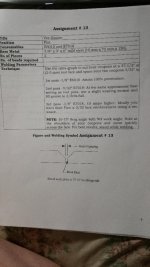
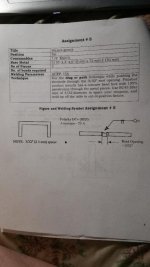
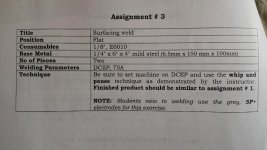
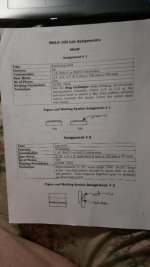
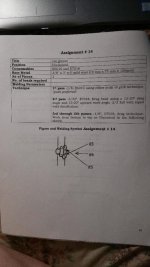
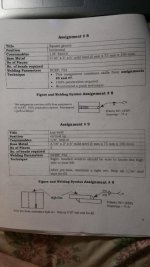
Here are the assignments. I'm working on 12.

Bill
 

Attachments

  • Ass7.jpg
    Ass7.jpg
    69.8 KB · Views: 23
  • Ass6.jpg
    Ass6.jpg
    83.8 KB · Views: 22
  • Ass4.jpg
    Ass4.jpg
    63.6 KB · Views: 20
  • Ass3.jpg
    Ass3.jpg
    66 KB · Views: 23
  • Ass2.jpg
    Ass2.jpg
    113.9 KB · Views: 25
  • Ass1.jpg
    Ass1.jpg
    66.4 KB · Views: 27
Last edited:

sberry

Banned
Joined
Jun 18, 2005
Messages
35,747
Location
Brethren, Michigan
What I meant was there are a lot of variations, inverted t, circular,,, none of which I use and often see work half asset with an attempt at every way it can be done and they don't learn any of them well enough to be proffecient. Focus on whip and pause with this electrode and try to stay with 1/8, no one uses that little **** with that.
The only time I have ever seen 3/32 whip rod used on a real job was so highly specialized that most will never face it, there are a few doing sheet metal studs too and that uses a form of whip and pause.
For roots with it, critical roots, it's been tried. They tried it on some job I was on and had a real problem, some inspector type or engineer wrote it up. Fit and gap had to be so perfect, guys were not used to it, they want to 1/8 and fixxed a lot of problems. BTW, ,,,,,,, before someone blows a gasket this is a generalization.
 

FSrepair&fabrication

Well-known member
Joined
Jul 28, 2017
Messages
908
Location
maryland
3/32 6010/11 is handy for stitching thin stuff together like tarp poles on a trailer or sheetmetal or exhaust. Ive never used it on anything that required a semi critical weld. But Ill be the first to admit I havent seen or done everything, so im sure like sberry said there are certain scenarios where it could be used.

60 series rod is kinda tricky, Ive learned over time that there is no “right” technique for running it. Ive kinda developed my own method of dab the rod in the puddle, whip it away in a circular motion ahead of the puddle, come back around and dab again. Works great running downhill and has that beautiful fish scales look I love about 6010.
 

bczygan

Well-known member
Joined
Nov 4, 2009
Messages
22,002
Location
DETROIT! Arsenal of Scrappers
I suspect that much of the training in this course will never be used exactly as the assignments are laid out.

But I can see that they are giving us a variety of rods to use, exposing us to multiple ways to manipulate the electrodes and various positions. Plus training in stacking beads and making cover passes.

It's not meant to make us expert in any one setup or method.

I used some 7024 the other day and some 7018 yesterday, and they were way easier than the 6010. Maybe that's what they are doing, making us do the hard ones, so the easy ones are done better.

In any case, I'm glad to be able to burn lots of rod and weld lots of steel for free.

Bill
 

bczygan

Well-known member
Joined
Nov 4, 2009
Messages
22,002
Location
DETROIT! Arsenal of Scrappers
7018 is always vertical up. you want to point the rod almost straight up and go side to side of the joint. Ignore the puddle and keep moving at a consistent speed. If you try to watch the puddle it will lie to you- it looks like the weld is drooping and piling up when its really just the slag. I like to run a little hotter- around 120-125 amps use a high tap setting with a low rheostat setting (best arc characteristics for lo hy) by running hotter i can weld as fast as i can without getting undercut and help avoid sticking the rod which seems to happen when you weld slower at lower heat.

All the above was true for me yesterday!

I was REALLY surprised when I saw the giant black blobs below where I was welding. It did turn out to be slag, hiding nice flows underneath. And a little extra power also helped.

The instructor also gave me a tip. He said to change rods after a stick. It really helped prevent multiple sticks.


Bill
 

bczygan

Well-known member
Joined
Nov 4, 2009
Messages
22,002
Location
DETROIT! Arsenal of Scrappers
Just to make myself feel bad, I took a photo of a test piece a guy did to get re-certified.

One instructor can test for certification, and this was a former student of the college.

So if he can do this, maybe there is some hope for me.

Bill
 

Attachments

  • Tig test.jpg
    Tig test.jpg
    116.3 KB · Views: 63

sberry

Banned
Joined
Jun 18, 2005
Messages
35,747
Location
Brethren, Michigan
I used some 7024 the other day and some 7018 yesterday, and they were way easier than the 6010. Maybe that's what they are doing, making us do the hard ones, so the easy ones are done better.
This happens. When I was young and learning didn't really fully use or appreciate 6010. I liked the finish of lo hy when I was young and it was so easy to make good fat shiney beads it impressed. I am as much or more of a 6011 guy today than ever.
 

Jackfre

Well-known member
Joined
Dec 26, 2010
Messages
4,407
Location
N CA
I enjoyed reading this thread. I did a lot of welding on power houses, refineries ,etc in the 70's early 80's. I loved 7018 because you could make it look so pretty, once you got your hand. The 6010 cover pass can be difficult. Best, prettiest, weld I ever saw was on Bellevue PH, S of Omaha. Young guy did a 24" XH horizontal cover pass with 6010. It was about 2.5" across and it was laced so that it was just...perfect. Perfect, in every way! I can see it still. I could pass about any test anywhere back in the day. That is long passed. I stick to mig these days as I don't have a stick machine.
Make sure you rod is dry and hot if you can. It's amazing what a little time in the oven can do for old 60 or 70 rod. Rod angle and not a very pronounced weave. Net/net, there is no substitute for what you are doing and that is practice, practice, practice. You'll get it, if it doesn't drive you crazy first.
 
To avoid these ads, REGISTER NOW!
Top Bottom