
You are using an out of date browser. It may not display this or other websites correctly.
You should upgrade or use an alternative browser.
You should upgrade or use an alternative browser.
Stilsons
- Thread starter HeelSpur
- Start date

y'sguy
Well-known member
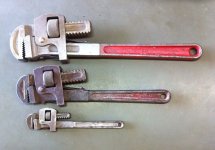
Nice collection! I just discovered one in my stash today that I need to look at closer, Don't know a thing about them, except there purpose.
d42jeep
Well-known member
d42jeep
Well-known member
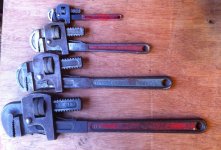
I have a total of zero Barcalos--schweet.How about some Barcalo Stillsons?
-Don
d42jeep
Well-known member
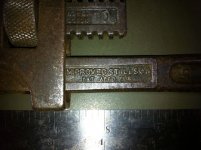
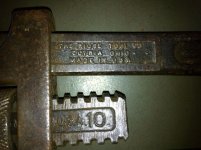
Thanks. Everybody usually thinks of The Ridge Tool Company (Ridgid) as the maker of their popular heavy duty line of pipe wrenches but here is an improved Stillson that they made.
-Don
-Don
Attachments

d42jeep
Well-known member
d42jeep
Well-known member
Re: Stillsons
I found a 10” pipe wrench this morning marked Improved Stillson with the Ridge patent number. It most have been a contract wrench because unlike the wrench I posted above, there is no Ridge brand on the opposite side.
-Don
Thanks. Everybody usually thinks of The Ridge Tool Company (Ridgid) as the maker of their popular heavy duty line of pipe wrenches but here is an improved Stillson that they made.
-Don
I found a 10” pipe wrench this morning marked Improved Stillson with the Ridge patent number. It most have been a contract wrench because unlike the wrench I posted above, there is no Ridge brand on the opposite side.
-Don
Attachments



Last edited:
Miss the Pontiacs
Well-known member
Are the names of pipe wrench and Stillson interchangeable? I and everyone that I know call it a pipe wrench.
Provincial
Well-known member
My grandfather called every pipe wrench a "Stillson."
d42jeep
Well-known member
I think in the early days there were so many companies making pipe wrenches under license from Walworth (the original maker of Stillson wrenches) that the term came into wide usage sort of like Kleenex for tissue. Personally, I’ve always called them pipe wrenches as well.
-Don
-Don
Attachments
-
 F3E4F5BB-F9D8-4ADD-8EE5-9AA1F9DD2D51.jpg150.9 KB · Views: 10
 -
 39C4E3CF-B207-42CC-9E1A-B1CD16AF4CDB.jpg148 KB · Views: 8
 -
 2FA88519-87E4-4EFE-B4DD-9C8543CB45D6.jpg149.3 KB · Views: 9
 -
 5D754001-F983-45E4-BA89-CE625DD9F305.jpeg109.8 KB · Views: 14
 -
 F6B10433-F11C-4962-BEB4-24F3A684F67E.jpeg72.2 KB · Views: 13
 -
 E2F9065A-260B-4B54-84B6-B3C572FA4476.jpg74.3 KB · Views: 10
 -
 6DD3EB01-375A-433C-9084-A01B2ECA1C81.jpg151.9 KB · Views: 7
four.cycle
Well-known member
d42jeep said:"...in the early days there were so many companies making pipe wrenches under license from Walworth (the original maker of Stillson wrenches) that the term came into wide usage sort of like Kleenex for tissue..."
^ I'd definitely agree with you on that one.

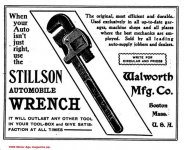
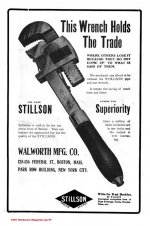
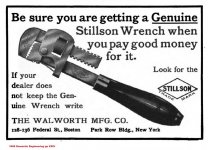

I only have a few of those things... one of them is a big "Winchester".
Attachments
-
 1910 Hardware Dealers Magazine Walworth Stillson ad pp 259.jpg65.6 KB · Views: 5
 -
 1908 Domestic Engineering Walworth Stillson ad pp XXIV.jpg93.5 KB · Views: 4
 -
 1907 Hardware magazine Walworth Stillson ad pp 57.jpg83.9 KB · Views: 4
 -
 1905 Motor Age magazein Walworth Stillson ad pp.jpg83.5 KB · Views: 5
 -
 Walworth Mfg. Co. 706 Main St. 1876.jpg148.8 KB · Views: 4
four.cycle
Well-known member
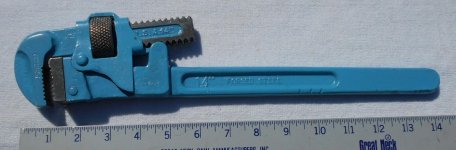



d42jeep
Well-known member
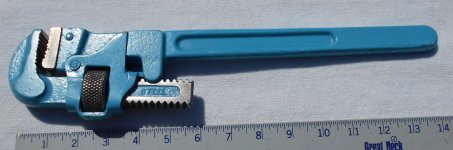
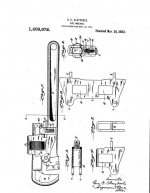
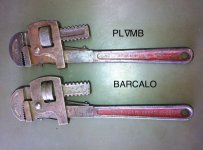
Here are a few more brands.
-Don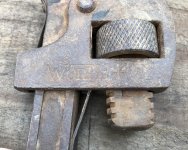

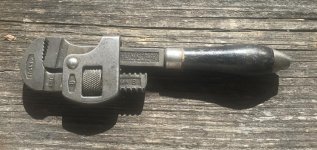

-Don
Last edited:
Private Lugnutz
Well-known member
I'm not even sure what "hinged" in this context would mean, HeelSpur, but the feature that distinguished the classic Ridge (RIDGID) pipe wrench from the Stillson was always the relationship of the adjusting nut to the housing for the dynamic jaw. The Stillson adjusting nut was captive in the middle of the housing. The Ridge was behind it. All of Thewes following patents were aimed at stabilizing the dynamic jaw because of that. The first thing he added was a little piece of steel behind the housing that the threaded part of the dynamic jaw rode in. The next four patents were all aimed at improving the spring-based mechanism inside the housing that applied pressure on the dynamic jaw to keep it square to the static jaw.
It's funny. I appreciate classic RIDGID pipe wrenches and have dedicated no small amount of thought into dating them (see Sticky Index), but it wouldn't be inaccurate to say that the original design left the dynamic jaw much looser than a Stillson (which always had the housing provide two points of contact for the moving jaw), or that every improvement was an attempt to make up for the objective defect of the dynamic jaw not being fully enclosed by the housing, like a Stillson. Why did they become so popular? Why did they eventually become just as synonymous with pipe wrenches as the original design Thewes had to avoid or infringe on? It's an interesting topic.
Anyway, as Don already alluded to, at some point Ridge decided they would also offer a Stillson style pattern (full housing), changed the spring yet again, and called it "Improved."
It's funny. I appreciate classic RIDGID pipe wrenches and have dedicated no small amount of thought into dating them (see Sticky Index), but it wouldn't be inaccurate to say that the original design left the dynamic jaw much looser than a Stillson (which always had the housing provide two points of contact for the moving jaw), or that every improvement was an attempt to make up for the objective defect of the dynamic jaw not being fully enclosed by the housing, like a Stillson. Why did they become so popular? Why did they eventually become just as synonymous with pipe wrenches as the original design Thewes had to avoid or infringe on? It's an interesting topic.
Anyway, as Don already alluded to, at some point Ridge decided they would also offer a Stillson style pattern (full housing), changed the spring yet again, and called it "Improved."
woody 73
Well-known member
I did this one back in 2016 some more information in case anyone was interested:
https://www.garagejournal.com/forum/showthread.php?t=335857
https://www.garagejournal.com/forum/showthread.php?t=335857