To avoid these ads, REGISTER NOW!

Stone facade and driveway question

PCustoms

Well-known member
Joined
Jul 23, 2011
Messages
22,193
Location
VT
Ok, trying to button up some long standing outdoor projects this spring. Planning on doing a faux stone facade on the front of the walkout basement (will blend siding/concrete/retaining wall).

1). How are people running gravel/stone driveways up to this material? Any issues with splash, frost etc?
2). What's the proper rock/stone for a driveway? Used a lot of crushed slate and seen "crushed bluestone" elsewhere but for some reason around here either term gets a blank stare.
 
To avoid these ads, REGISTER NOW!

Firebrick43

Well-known member
Joined
May 12, 2015
Messages
13,971
Location
West central Indiana
I would pour a short apron if it’s an actual drive way up to it so the traffic doesn’t exert pressure against the faux stone. Probably wise to stop the faux stone a few inches above final grade and use stucco with fiberglass mesh from the faux stone to a few inches below grade.
 

duneslider

Well-known member
Joined
Jan 20, 2013
Messages
2,245
Location
Riverton, Utah
Ok, trying to button up some long standing outdoor projects this spring. Planning on doing a faux stone facade on the front of the walkout basement (will blend siding/concrete/retaining wall).

1). How are people running gravel/stone driveways up to this material? Any issues with splash, frost etc?
2). What's the proper rock/stone for a driveway? Used a lot of crushed slate and seen "crushed bluestone" elsewhere but for some reason around here either term gets a blank stare.
Stone is pretty regional. I just ask for a crushed stone suitable for driving/parking and ask what colors they have. Around here we get brownish, or greyish usually.
 
OP
P

PCustoms

Well-known member
Joined
Jul 23, 2011
Messages
22,193
Location
VT
I would pour a short apron if it’s an actual drive way up to it so the traffic doesn’t exert pressure against the faux stone.

I want to, but money/time is probably going to prevent it. Ideally I'd pour a 10x20 approach with a little walkway or maybe even 20x20.

Faux stone manufacturers usually have install instructions on how much clearance they want the stone above any surface to allow for weep.

Duh. Probably read the instructions a few times since I've looked at them and can't recall. Thanks for the reminder!

Stone is pretty regional. I just ask for a crushed stone suitable for driving/parking and ask what colors they have. Around here we get brownish, or greyish usually.

Tons of stuff listed, but every time I ask I get "yeah, this won't be good for that". Found some crushed blue/green slate a little north of here, $450 trucking for each load, plus materials!
 

mm08822

Well-known member
Joined
Jan 13, 2012
Messages
5,841
Location
NJ
Bluestone is probably regional as in NE PA vs. crushed slate as in Granville, NY area and eastward of that.

If you are paving over a stone base, you want a base that drains, so washed 3/4" stone. If the stone will be the driving surface with no intentions of paving over it, then "crusher run" (fines through 3/4") will suffice. Geomesh or equivalent fabric may be helpful if there is a lot of soil movement (pumping mud) causing ruts.

Providing a drainage perimeter to collect and divert water from getting under the stone base will always help.

You could use foam expansion joint material under the first coarse of veneer to keep the stone from getting below it if subject to heaving. Place a layer in front of it and trim once final driveway surface is down.
 
To avoid these ads, REGISTER NOW!
OP
P

PCustoms

Well-known member
Joined
Jul 23, 2011
Messages
22,193
Location
VT
I was talking about just something 12-18” deep that could be poured via bag mix easily.

Of course you could always add to it later but at least the forces would be isolated.

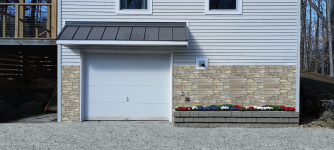
I was thinking that, IIRC it's only 12' against the driveway. I'm thinking maybe I could do a small raised planter in front, and just keep the faux stone above that. Mulch wouldn't be an issue against it, and would add some "depth" to the area.

Instructions on this material are kind of vague, doesn't really say how far to keep it above ground...
 
OP
P

PCustoms

Well-known member
Joined
Jul 23, 2011
Messages
22,193
Location
VT
@CN Spots helped me out with some photoshop last year, and again this weekend. Think I've settled on something similar to this:

1000003225.png

I really can't come up with an alternative wainscoting material, and the faux stone I've been looking at is foam based so will add some r-value to the uninsulated concrete.

May have finally found some decent driveway stone, waiting on a call back this week.
 

larry4406

Well-known member
Joined
Jan 27, 2006
Messages
18,942
Location
Northern Virginia
I managed construction of a house where we poured it with smooth concrete forms (no brick design). The customer wanted a parged appearance so the mason applied it. Nice texture to it. Was painted which I was concerned regarding possible long term maintenance.

Fine stones like crusher run (we call it 21A here) has very small stones smaller than the size of the old Chiclets mini-gum (how many of you remember that!). These fines get stuck in the grooves of your tires and on your shoes and carry into the garage (and house if you don't take your shoes off).

Stones in your shoes destroy your floors. Stones in the tires, well you sweep the garage periodically.

We had 21A for around 7 years at our last house before we poured a concrete apron on top. It compacts and makes a nice driveway surface. It does not drain near as well as say #57, so make sure your grade is correct!

Whatever faux stone/veneer you apply, I would stop it inline with the lip of your garage apron if you plan on stoning, paving, concreting to that elevation at some time in the future. Should that occur, place your expansion joint material and then proceed.

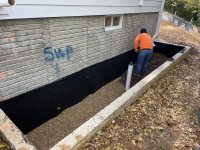
The planter box looks nice. If you do that, consider waterproofing the house foundation within the limits of the inside of the planter box and provide the planter with weep holes. Many of our houses we have to address storm water (roof drainage) and a popular method is to build planter boxes contiguous with the house foundation. Downspouts are ported to these boxes. Special materials are installed to act as filtration beds and finally nutrient growth on the top to support the selected plant species. Thus, we seal the foundation wall exterior. Example below.
1774817595504.jpeg
1774817623187.jpeg
 
OP
P

PCustoms

Well-known member
Joined
Jul 23, 2011
Messages
22,193
Location
VT
@larry4406 thanks, would not have thought about waterproofing. This time last year that was a framed wall...

I plan to glue 2" foam to it, inside the planter/hidden. Any suggestions on what I can get a gallon of? Planter will be stacked blocks, I believe there is natural spacing so plenty of weeping
 
Last edited:

larry4406

Well-known member
Joined
Jan 27, 2006
Messages
18,942
Location
Northern Virginia
@larry4406 thanks, would not have thought about waterproofing. This time last year that was a framed wall...

I plan to glue 2" foam to it, inside the plater/hidden. Any suggestions on what I can get a gallon of? Planter will be stacked blocks, I believe there is natural spacing so plenty of weeping
Wow! Tore out a framed wall and replaced with concrete! Quite the project.

For small foundation waterproofing repairs, we use Henry’s Roofing cement. Comes in a gallon can (box store blue or orange). When warm (leave in the sun for several hours) it’s quite easy to roll or brush. Wear gloves is hard to clean off! Throw brush/roller away when done.

No experience with exterior foundation foam (insulation?).

When we have planter boxes on fronts of homes that have stone or brick veneer, we don’t run the veneer into the planter box. The veneer stops at the sill box level.


1774820587368.jpeg

1774820883356.jpeg
 
OP
P

PCustoms

Well-known member
Joined
Jul 23, 2011
Messages
22,193
Location
VT
Wow! Tore out a framed wall and replaced with concrete! Quite the project.

Yep.

When I bought the place I ripped out the drafty door and framed it in real quick for the winter. Several winters later I poured the stem wall and re-framed it all, as the center section was untreated 2x4 at ground level. Wasn't as bad as I expected but still wasn't good to last.

Also replaced the 2 windows and did the eyebrow.

For small foundation waterproofing repairs, we use Henry’s Roofing cement. Comes in a gallon can (box store blue or orange). When warm (leave in the sun for several hours) it’s quite easy to roll or brush. Wear gloves is hard to clean off! Throw brush/roller away when done.

No experience with exterior foundation foam (insulation?).

When we have planter boxes on fronts of homes that have stone or brick veneer, we don’t run the veneer into the planter box. The veneer stops at the sill box level.


1774820587368.jpeg

1774820883356.jpeg

Easy enough to get Henry's, and yes, quite familiar with the mess. The faux stone veneer will stay at the top of the planter (saves $$ too) and I'll run some pink foam inside to get some insulation.
 
To avoid these ads, REGISTER NOW!
Top Bottom