To avoid these ads, REGISTER NOW!

Storage platform framing question

Black Frog

Well-known member
Joined
Sep 27, 2011
Messages
134
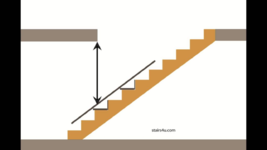
I have an attached garage with workspace on our new build house. One of my requirements for the new build was basement access from the garage. Love it, can't imagine being without the basement stairs from the garage after this. But one thing it does create is some 'dead space' in the upper part of the stairwell.

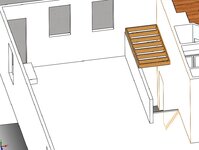
I was thinking of framing in a platform from the knee wall to the garage/house wall (see first picture), about 9-10' long and the width of the stairwell. It would give me approximately 40 sq feet of additional storage space. Use that for storage of lighter things, nothing too crazy heavy. I would still have 10' of vertical clearance from the end of the platform to step below. The basement is a walk-out basement, so things can also be brought in that way as well.

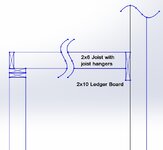
My question is about how position the ledger board on the garage wall. Place it below the joists so that the joists are resting on the 2x10 ledger, and then blocks in between the joists (picture 2). Or, have the ledger at the joist height and use joist hangers (picture 3)? I'm thinking that resting the joists on the ledger would be better for load carrying, but maybe it would be just fine with hangers too.

Input? This platform to me would be an ideal place to put an air compressor too! Up out of the way, and not chewing up valuable floor space.
 

Attachments

  • plat2.jpg
    plat2.jpg
    112.2 KB · Views: 75
  • plat3.jpg
    plat3.jpg
    55.1 KB · Views: 57
  • Plat4.jpg
    Plat4.jpg
    48.8 KB · Views: 57
To avoid these ads, REGISTER NOW!

steaks&anvils

Well-known member
Joined
Oct 15, 2016
Messages
2,470
Location
Colorado
If you put an air compressor there, will it vibrate the wall and be annoying to people on the other side of the room?
 

Git

Well-known member
Joined
May 18, 2008
Messages
6,894
Location
S Cal
I think I would go with the joist hangers. A 2 x 6 is going to want to move (cup, etc) and the joist hanger will help prevent it. Also go with some blocking in-between
 
OP
B

Black Frog

Well-known member
Joined
Sep 27, 2011
Messages
134
If you put an air compressor there, will it vibrate the wall and be annoying to people on the other side of the room?

I thought of that too. The people on the other side of the wall is me and the wife. I was going to put some vibration isolation mounts under the compressor if I do ever put it up there. Not sure I will do install it there, but it was an idea....
 

bad_idea

Well-known member
Joined
Jun 11, 2011
Messages
4,329
Location
Pasquotank, NC
I would not install the air compressor up there, not a good environment for a compressor. You want cool air going into the compressor - the compression of the air adds in enough heat. Also the vibration is not good for the structure, best to have that on concrete. I could see separating the pump and motor from the tank. Stick the tank up in the rafters and put the pump and motor on a foundation tucked under the workbench. Close in the area under the bench with insulation for noise and a fan to blow air through the enclosure. Or stick the whole works under a lean to on the outside of the shop. Stick the noise outside for the neighbors.
 

K'ledgeBldr

Well-known member
Joined
Aug 22, 2011
Messages
1,925
Location
Johns Creek, GA
1624049905759.png
If this is a "permanent" installation- remember your headroom clearance- 6'-8".
I would do the joists on top of the ledger. Ledger mounted directly to studs (cut out drywall). Better yet; being able to nail the joists to the studs, even better.
 

65ranchero

Well-known member
Joined
Dec 16, 2020
Messages
5,060
Location
Danville, VT left NJ forever
I think you will have to cut the sheet rock enough to get the joist back enough ( ( such as being able to move the joist in a further 1/2 ") but that just me!
As far as the compressor, having it in the corner will probably cause extra acoustic issues and how are you going to get it up there?
 

shoot summ

Well-known member
Joined
Jun 8, 2010
Messages
2,948
I would make the entire frame out of 2x6 all screwed together. Set it in place, lag bolt to the studs, screw a sheet of 3/4" ply onto it and call it good. If you feel like you need to support it on the stud wall side lag bolt a 2x4 under the 2x6 frame, screw another 2x4 on top of that to support the 2x6 joist if you feel like you need it.
 
OP
B

Black Frog

Well-known member
Joined
Sep 27, 2011
Messages
134
I would have 10' of headroom clearance at the end of the platform, so that isn't an issue. I think having the joists land on top of the knee wall studs is more important than cutting into the main wall drywall to screw to those studs. I'm not sure the knee wall studs and main wall studs would line up, I will see. The main wall goes beyond that corner, I'm not sure which way they laid out the 16" o.c. pattern.

That's why I like the idea of using a ledger board, I'm not tied to stud placement within the main wall, and can make sure I am putting my joists over the knee wall studs for support.
 
Last edited:
To avoid these ads, REGISTER NOW!

gasgas17

Well-known member
Joined
Nov 7, 2009
Messages
443
Location
Nova Scotia, Canada
If the knee wall has a double top plate it makes no difference if the joists land over the studs. I would not even be too concerned about cutting out the drywall. Just use the newer style torx head lag screws to fasten the ledger to the wall. 2 per stud and make sure one of the 2 are in the bottom 3rd of the ledger. Use joist hangers on the bedroom wall side. Its really just a big shelf. Don't over think it. Definitely not a place for a compressor. Your wife will thank you.
 

Michigan Mike

Well-known member
Joined
Sep 12, 2012
Messages
449
Location
Kalamazoo Mi.
If you cut drywall to hang joists or to fasten your ledger or rim joist you will compromise the fire rating of what is in all likelyhood a fire wall between house and garage. I would lag bolt the board to the wall and use joist hangers.
 
OP
B

Black Frog

Well-known member
Joined
Sep 27, 2011
Messages
134
Fire rating of drywall if cut into it, hadn't even thought of that. Thanks.

Thank you for all the input!
 
OP
B

Black Frog

Well-known member
Joined
Sep 27, 2011
Messages
134
Just to update…. Luckily we took tons of pictures as we built the house to reference back to for any updates or projects. So very glad I did. I knew there was some electrical wiring in the main wall behind where I was considering attaching the ledger board.

Referencing pictures and doing some calculations for sill plate, floor trusses, subfloor thickness, and measuring up to the outlet on the inside wall, that electrical line lands perfectly right where I wanted to attach my ledger board. Ugh....

1.5” sill plate + 20” floor trusses +.75” subfloor + approx. 20” to bottom of blue cooktop outlet box in pics = 42.25”. My knee wall is 40” off the foundation. So the top of the knee wall is equivalent to a couple inches below the outlet box in the picture. You can see the interior corner post for the garage to the right of the outlet box.

I’m not going to risk possibly hitting that electric line with the 5” LedgerLok screws. They recommend 3 or 4 per stud (depending on 2x8 or 2x10), that’s a whole lot of chances to hit that line in that area. Nope.

So now I’m back to thinking I’ll have to install the ledger board lower and have the joists sit on top. Block in between the joists. Lowering the ledger board will avoid any of that electric line.
 

Attachments

  • wallplate.jpg
    wallplate.jpg
    204.4 KB · Views: 46

FordTruckWench

Well-known member
Joined
Jan 8, 2015
Messages
539
Location
California
My question is about how position the ledger board on the garage wall. Place it below the joists so that the joists are resting on the 2x10 ledger, and then blocks in between the joists (picture 2). Or, have the ledger at the joist height and use joist hangers (picture 3)? I'm thinking that resting the joists on the ledger would be better for load carrying, but maybe it would be just fine with hangers too.

Your problem is essentially the same as needing to support a floor in a balloon framed structure. In the balloon framed houses of yore, a 1x4 was let into the wall studs. The floor joists then extended into the wall cavity, sitting on top edge of the 1x4. This was apparently considered strong enough.

Note that one reason balloon framing is no longer used is that the wall and floor cavities end up all open and connected which allows fire to spread easily through the structure! Another problem is a high point load between the 1x4 and the joist - if either starts rotting, the floor will sag.

My suggestion (borrowing a little from balloon framing): Remove a rectangle of drywall exposing the wall from your platform level down to the existing bottom plate. Sister cripple studs to each wall stud. Rest you platform joists on top of those studs. Add tons of blocking to prevent fire from spreading through the wall and floor cavities. Then reinstall the drywall. This way there is no unsightly ledger and you can store, um, lead cylinders on the platform.

(Actually, it might be even better to sister a cripple stud on both sides of each wall cavity and place a "top plate" across them.)
 
OP
B

Black Frog

Well-known member
Joined
Sep 27, 2011
Messages
134
This is a garage-to-house wall, so not only drywall, but there also a layer of OSB in there too.... If I put in cripple studs, that doesn't help avoid the existing electric line in that area. I'd have to notch out each joist on the end to go around the electric line.
 

FordTruckWench

Well-known member
Joined
Jan 8, 2015
Messages
539
Location
California
This is a garage-to-house wall, so not only drywall, but there also a layer of OSB in there too....

OK, now I understand the picture better.

If I put in cripple studs, that doesn't help avoid the existing electric line in that area. I'd have to notch out each joist on the end to go around the electric line.

It looks like the yellow romex goes across the work area, turns upward, and ends at something (not yet installed.) If you open up one side of the wall, you could fish out the wire, do the framing, drill new holes, and rerun the wire.
 
OP
B

Black Frog

Well-known member
Joined
Sep 27, 2011
Messages
134
It looks like the yellow romex goes across the work area, turns upward, and ends at something (not yet installed.) If you open up one side of the wall, you could fish out the wire, do the framing, drill new holes, and rerun the wire.

These were pictures from when we built, that line has been connected and in use for many months. That line goes up to an undercabinet outlet strip. Opening the wall up that much may be more than I'd like to get into just to move an AC line and redo all the OSB and drywall..... What I am thinking of doing it just cutting out drywall/OSB where the ledger board would go with joists using hangers (not under the joists). I could see and mark where the AC line is on each stud. I could avoid the lag screws hitting the AC line then. The ledger would not be sticking out as far on the garage wall then as well. I think that would be a cleaner/neater install than putting the ledger underneath the joists.
 
To avoid these ads, REGISTER NOW!
Top Bottom