Hi,
I was trying to get the garage in order yesterday, taking advantage of the relative "warmth" and putting away outside Christmas lights, etc.
I have a lot of those orange "outside" extension cords that I was using to run Christmas lights.
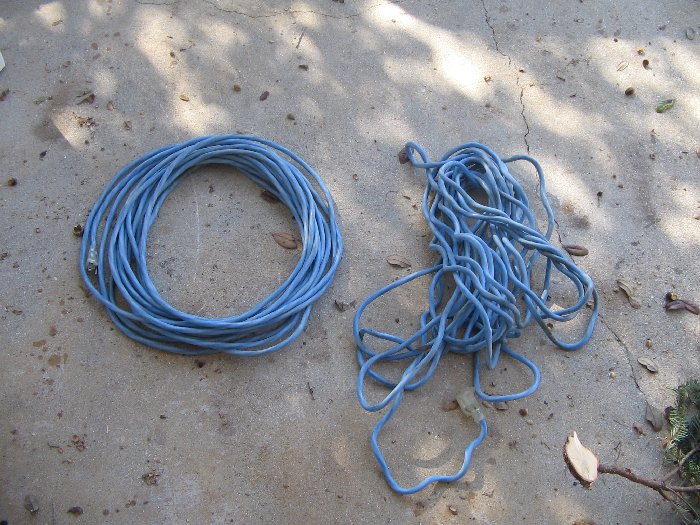
I start wrapping these things up using the standard "elbow to palm wrap" but I end up with a mess, I have a few that must be seventy five feet, no way can I wrap those into a neat coil.
Well... You
CAN, but it gets tricky with longer/heavier cables. The key is to compensate for the wire's natural twist (due to the underlying stranded wires, which are themselves twisted) as you go by twisting the cable a bit with each successive loop. If you pay attention, the cable itself will indicate which way it "wants" to twist; don't fight it, accommodate it -- and DON'T use your elbow. This still won't produce a "perfect" coil; but it's about the best you're going to do "freehand".
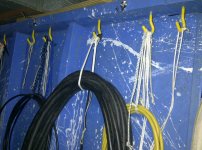
What do you gents do, any neat tricks or ideas to keep cords organized?
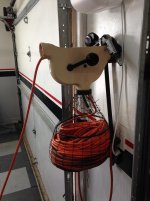
At the end of the day, you're going to want to use SOME sort of reel or frame to wrap the cord around. There are all manner of different types & styles, starting with the simple plastic frame cited by "djjsr" (which works OK for shorter cords, and stores fairly compactly). "You pays your money and you takes your choice."
Learn to properly coil cable. The wires have a natural twist to them. I started to type out how to do it, then decided to just find a video.
With that ultra-limp mic cable he's demonstrating with (or nearly any coax, for that matter, since most coax lacks a natural "twist"), almost any technique will work. But if you were to try that with, say, a 100-foot AWG 12 extension cord, you're going to have a mess on your hands. The problem is, you are effectively making a figure-8 which is folded back on itself. If you carefully un-coil it using two hands as shown in the video, BEFORE those alternating inner/outer loops have a chance to get tangled up with each other, fine. But if you let it sit in the bottom of a tool box or other storage container for a few months, then pick it up and attempt to unravel it from one end, the "pull from the middle" action which will occur on every other loop (due to the "figure-8" being doubled-over on itself) will make a rats nest in short order.
HOWEVER... The figure-8 pattern itself is worth remembering; and it works well when NOT folded back on itself. Aboard ships, it's referred to as "flaking your lines"; Google for examples.
I don't like that one at all. Too many tight-radius bends, which will take a "set" while in storage, and lead to still worse kinking and tangling in the future.