To avoid these ads, REGISTER NOW!

Straightening Welding Table Frame

tonyciambrone

Well-known member
Joined
Nov 4, 2015
Messages
1,152
Location
Northern Illinois
Hello wizards of GJ

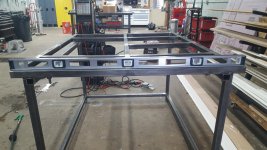
I am building a welding/fab table and it looks like I made a few mistakes during fit up and welding. The whole table is 1.5" sq tube, 12 gauge wall.

The long sides of the table are perfectly flat, but the middle of the short sides, and the tube in the middle runnning lengthwise got warped- bellied down a bit.

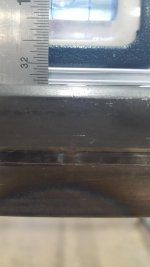
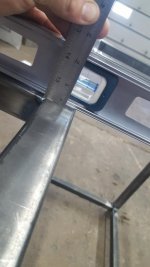
One edge is low 1/32nd in the middle, the opposite side almost 1/16 and the middle almost 3/32.

Right now all I have at my disposal is a Tig torch to heat with, and I tried a little flame straighten on both short sides, to minimal or no effect. Am I correct in thinking their are too many supports welded in the top for flame straightening to be an option? Or is my tig torch no substitute for oxy-acetylene?

Hopefully the pictures gives you the lay of the land
 

Attachments

  • 20200617_174017.jpg
    20200617_174017.jpg
    53 KB · Views: 260
  • 20200617_173959.jpg
    20200617_173959.jpg
    152.8 KB · Views: 327
  • 20200617_173952.jpg
    20200617_173952.jpg
    48 KB · Views: 244
  • 20200617_173935.jpg
    20200617_173935.jpg
    44.7 KB · Views: 203
To avoid these ads, REGISTER NOW!

MWMWMW

Well-known member
Joined
Sep 2, 2019
Messages
89
Location
WV
Gently massage it back into place with a hammer? Cut it out and weld on a new flat piece and try not to warp it?
 

larry_g

Well-known member
Joined
Apr 28, 2007
Messages
16,888
Location
oregon
In a past life I spent some time as a machine builder. To make flat table tops on a welded frame one way to do it was with shims. You don't need a perfect frame, just a perfect top and that can be had by shimming things. That said you also need to have a good reference and a carpenters level is not that.

If you don't want to shim between the top and frame at assembly then you can weld on some 1.5 x 1.5 x 1/4" pads at the appropriate mounting locations and then grind the pads till all the pad tops are co-planer. This goes along with top thickness, The thinner the top the closer the pads need to be.

That said, how are you planning to fix the top to the frame and how heavy is the top? Is the top heavy enough to not sag between the corner posts?

lg
no neat sig line
 

Firstram

Well-known member
Joined
May 16, 2017
Messages
1,391
I never weld the top and bottom of table framing members. If you only weld the verticals the welds pull sideways instead of up and down. I would shim the top.
 
OP
T

tonyciambrone

Well-known member
Joined
Nov 4, 2015
Messages
1,152
Location
Northern Illinois
In a past life I spent some time as a machine builder. To make flat table tops on a welded frame one way to do it was with shims. You don't need a perfect frame, just a perfect top and that can be had by shimming things. That said you also need to have a good reference and a carpenters level is not that.

What would you shim with, and what would you use as a reference instead?

I never weld the top and bottom of table framing members. If you only weld the verticals the welds pull sideways instead of up and down. I would shim the top.

Smart.. next time
 

joe49

Well-known member
Joined
Sep 25, 2009
Messages
1,883
Location
Tonica, Il
So your under 1/8'' out and some how that is and using a level is unacceptable?
When you use a level, straight edge, or square you check it. Draw a line with it and roll the straight edge or level over and check that the line matches. For a square draw a line with a perpendicular line at the middle, again roll the square over the perpendicular line to see if it matches. Both steel squares and straight edges can be trued up easily.
 

larry_g

Well-known member
Joined
Apr 28, 2007
Messages
16,888
Location
oregon
What would you shim with, and what would you use as a reference instead?


Smart.. next time

We used a shim kit similar to this, https://hvhindustrial.com/product/1...y6NkqFNQzU-kfTaeiISzO3tNVqZOiXIwaAqm_EALw_wcB

And precision straight edges like this, https://www.starrett.com/category/1...isplayMode=grid&itemsPerPage=12&sortBy=wp/asc


You can also use a precision level air an optical level to do the job. You also have to keep in mind what level pf precision you are trying to achieve. For many projects a +/- 1/16 inch is well with in tolerances needed for welding jobs.

If you want to check your straightedge do this. Set your level up where you are measuring with a ruler and instead measure with a feeler gauge. Now flip the level over and measure with the other side down. If the gap is the same then you can assume that your good to go.

lg
no neat sig line
 

rsanter

Well-known member
Joined
Dec 22, 2007
Messages
18,521
Location
visalia ca
You need to first ask why?

We're the pieces straight before welding? Or were they warped to begin with?

When you welded them did you weld faster on one side than the other? Or was there more gap one one side than the other?

If it is the welding that warped them I would start by using the TIG to reheat the welds on the side that got pulled more in order to relax that weld. When you get the filler material up to tempature it should 'stretch' or release some of its tension.

If itmis the material that was bent or bowed, I would get another piece of steel to go across the table and clamp to in order to pull that piece to where you want it. Then you can try using the TIG to heat several areas of the tube on the bottom to get it to relax or 'shrink '.
 
To avoid these ads, REGISTER NOW!
OP
T

tonyciambrone

Well-known member
Joined
Nov 4, 2015
Messages
1,152
Location
Northern Illinois
You need to first ask why?

We're the pieces straight before welding? Or were they warped to begin with?
Good question- I really did not check before I cut and welded
When you welded them did you weld faster on one side than the other? Or was there more gap one one side than the other?
Yes, I built the frame upside down clamped to a 1/2" plate table, I tacked together first and then welded the 'bottom' joints first. Honestly I thought if anything it would bow the opposite direction(up towards the top)

If it is the welding that warped them I would start by using the TIG to reheat the welds on the side that got pulled more in order to relax that weld. When you get the filler material up to tempature it should 'stretch' or release some of its tension.
"pulled more"-that being the bottom, which is bowed downwards?
If itmis the material that was bent or bowed, I would get another piece of steel to go across the table and clamp to in order to pull that piece to where you want it. Then you can try using the TIG to heat several areas of the tube on the bottom to get it to relax or 'shrink '.
So clamp across the warped side, heat bottom with torch?

Thanks everyone for the input
 

sberry

Banned
Joined
Jun 18, 2005
Messages
35,747
Location
Brethren, Michigan
Shim it with a little wire or welding rod and tack it on, you aint building the space shuttle and 99.998% of the time it wont matter. Its so rare that would matter would shim the project I was working on but cant recall anything I done in the last 30 years where that would mean a pinch of ****.
You will find out after a while that all this miter and fuss doesn't mean much when you need to weld a couple simple pieces together most of the time.
 
Last edited:

joe49

Well-known member
Joined
Sep 25, 2009
Messages
1,883
Location
Tonica, Il
Yep better order up a $267 shim kit and a $350 starrett straight edge for your table project, or maybe just get your caliper out and measure what you have laying around and use that or some 1/8'' welding rod hammered to the thickness you need. Naw spend the $617 and do it real right that's a great idea.:lol_hitti I do want to say I just new LARRYG was going to come up with that motor slotted shim kit and a precision straight edge.:wtf: Maybe he missed it's only a table not a platen.
 

rsanter

Well-known member
Joined
Dec 22, 2007
Messages
18,521
Location
visalia ca
So clamp across the warped side, heat bottom with torch?

Thanks everyone for the input

Both sides are warped, one warped up, the other down.
Place the clamp on the side you want the warped tube to move.
I say top and bottom because the pictures appear that the top tube is bowed "down"
You heat the bottom of the tube to "shrink" it. With the clamping pressure applied the heated area will shrink to thicken as the metal has to go,somewhere
 

matt_i

Well-known member
Joined
Mar 14, 2008
Messages
10,729
Location
SE Michigan
The "shims" can also be "fitting spacers" or machined plates made to a specific dimension. Make them on the belt sander or with files if there isn't a lot to take off.

This is a fantastic supplier of shims. I think they have a $25 minimum although its been a few years.

https://dougstampco.com/

Aside: Parts of the auto industry's body shop tooling are standardized on shims that look like a letter E except with 3 slots and are of 1/4, 1/2, 1, 2, and 5 mm thicknesses (roughly .010" steps). 15mm spacing, dowel pins and socket cap screws keep everything aligned as shim packs are changed. The reason is that stamped metal "moves" in dimension over days and weeks despite being stamped by the same dies. The vehicle body's fixturing has to be constantly adjusted in order to keep running on the same nominal dimensions.
 

larry_g

Well-known member
Joined
Apr 28, 2007
Messages
16,888
Location
oregon
In a past life I spent some time as a machine builder. To make flat table tops on a welded frame one way to do it was with shims. You don't need a perfect frame, just a perfect top and that can be had by shimming things. That said you also need to have a good reference and a carpenters level is not that.

If you don't want to shim between the top and frame at assembly then you can weld on some 1.5 x 1.5 x 1/4" pads at the appropriate mounting locations and then grind the pads till all the pad tops are co-planer. This goes along with top thickness, The thinner the top the closer the pads need to be.

That said, how are you planning to fix the top to the frame and how heavy is the top? Is the top heavy enough to not sag between the corner posts?

lg
no neat sig line

In reference to the weld on pads see this VID,
and around the 29 minute point he removes a slat to reveal the pad welded to the frame work. Only the pad tops are machined to level the top. In another part of the VID he is using the shims I referred to to level the table top.

lg
no neat sig line
 

dffay

Well-known member
Joined
Jul 9, 2015
Messages
434
How about a laterally placed 4x4 beam across the lower cross pieces and do a gentle press upwards with a bottle jack. It’s a cold method but you don’t need to go far.
 

yarrum

Active member
Joined
Dec 18, 2020
Messages
32
Location
Fort Worth, TX
Thirty five years ago, this 20 x 30 steel top had a 1/8" warp from a huge welded structure weld stress. Once removed, I built a fire under the plate and straightened it with a sledge. After it cooled I made the mistake of welding it to the red frame up-side down instead of hiding the sledge indentations, I then filled the indentations with my stick welder and the weld cooling stresses actually re-warped the plate. After licking my wounds, I simply counter stick welded the underside and the rest is history. Flat within 0.015".
 

Attachments

  • weld-table-2.jpg
    weld-table-2.jpg
    59.8 KB · Views: 43
To avoid these ads, REGISTER NOW!
Top Bottom