To avoid these ads, REGISTER NOW!

Strange behavior with some lights I wired up.

balane

Well-known member
Joined
May 4, 2011
Messages
2,996
Location
Pacific Northwest
EDIT: Video of issue posted on YouTube HERE

I really can't explain this. Yesterday at Lowe's I purchased a Fluke VoltAlert 1AC-A II voltage sensor. Looks like this;

1AC-II-a.jpg


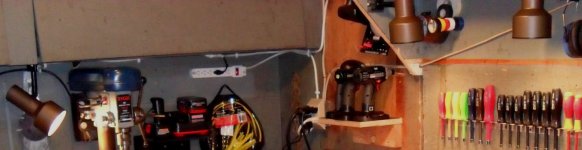
I'll try to explain this as best I can. I had some track lights I wasn't using so I took them apart and hard-wired three of them as spot lights over my tool chest and one on my drill press. All three of them are wired to a single three prong plug which plugs into a power strip mounted on the wall. Please see the photo below, in it you can identify the power strip and the three lights to get an idea as to how it's set up. The light housings in question are brown.

The lights are operating just fine and have been for some time. I found this anomaly just playing around with the new voltage sensor.

Now, the issue. When the power strip is turned off via the switch on it the voltage sensor picks up no current coming out of it on any outlet nor is any current indicated in the cord to the lights. When I flip the switch to on the sensor will register the current just fine in places you would expect it to. However, the metal lamp housings register AC current regardless if the switch is on or off. Only the metal housings register current, not the cable, not my wiring, nowhere but the metal housings and bulb sockets. If I unplug the cord from the power strip then the sensor will cease registering current on the metal housings.

I honestly have no idea what's going on and it confuses me. Even with the power strip switched to off is enough electricity getting by to cause the sensor to trip? If so, why doesn't it get picked up in the power strip outlets or the power cable to the lights?

I don't have another power strip that I can easily test it out with but do you think I should replace this power strip? I probably did a horrible job explaining this.

.
 

Attachments
  • lights.jpg
    lights.jpg
    121.2 KB · Views: 48
Last edited:
To avoid these ads, REGISTER NOW!

mrb

Well-known member
Joined
Dec 31, 2008
Messages
3,734
how are the connections made to the track light head? did you buy the bases for them or just hook some wires up? Are the metal heads grounded?
 
OP
B

balane

Well-known member
Joined
May 4, 2011
Messages
2,996
Location
Pacific Northwest
I connected the cables to the track lights with wire-nuts and electrical tape. No tracks are used, the lamps are hard-wired to the power cable. The ground wire on the lamps are connected to the ground on the plug. The plastic mounts/arms on the lamps are screwed into wood.

My big question is, with the power switch flipped to OFF why do the metal lamp housings show current but the power strip and cables do not?

Edit: Just in case anybody asks, I can feel no shock at all when touching the housings. I had no idea they would register any current at all until I used the sensor on them.
 
Last edited:

mypov

Well-known member
Joined
Aug 1, 2011
Messages
557
I would use a better voltage meeter and see how much of a reading you are talking about - those little testers can sometimes detect phantom power - the other thing is to double check the grounds on where you have tied in...But initially sounds like a grounding issue...just my two cents.
 
OP
B

balane

Well-known member
Joined
May 4, 2011
Messages
2,996
Location
Pacific Northwest
I would like to believe it's a phantom reading for sure but it's weird that it registers voltage on all three housings and nowhere else.

My neighbor was out and I just borrowed a power strip from him to test. I plugged it into another wall outlet, connected the power cord to the lights and made sure its power switch was set to off.

I got the exact same voltage indicator on the housings only and nowhere else. It's just so weird that it won't pick up any current right at an empty outlet on the strip yet the housings all still show electricity present.

So I think I can eliminate the power strip as being faulty at this point. I'll go through and recheck all the connections and wiring but I just don't know how even bad wiring could get these results. I'm really confused about this.

My wife thinks our house is haunted.

Edit: I'll also try to get a numerical reading of the voltage on the housings as soon as I can.
 
Last edited:

ddawg16

Well-known member
Joined
Jul 11, 2008
Messages
21,005
Location
S. California
I would be willing to bet the housings are not grounded.

Have you measured the voltage on the housings using a real meter?

Assuming you have them wired right.....take a ground wire and touch it to the housings.

My bet is that they are not grounded.....

I could go into a disertation on how the shape of them funnels the residual AC in the air and causes the Fluke to trigger....but then you would need to be wearing your tin hat.
 
OP
B

balane

Well-known member
Joined
May 4, 2011
Messages
2,996
Location
Pacific Northwest
I would be willing to bet the housings are not grounded.

Have you measured the voltage on the housings using a real meter?

Assuming you have them wired right.....take a ground wire and touch it to the housings.

My bet is that they are not grounded.....

OK, I'm going to rig up a ground wire to one of the housings now and repost my findings.

So electricity, on some small level, can make it through a power strip even with the switch off? (I've tried two strips now with the same results.) I didn't know this. I wonder why the Fluke isn't showing power directly on one of the strip outlets then.
 
OP
B

balane

Well-known member
Joined
May 4, 2011
Messages
2,996
Location
Pacific Northwest
It's just too strange, I'm going to take them down and get some regular lamps and not try to use these track lights in a way they weren't designed for. The sensor is now showing sporadic readings. It will flash voltage present for a few seconds and then nothing for a while (It was constant before.) I move the sensor away from the housing and then back to it and sometimes it will beep again, sometimes it won't. Trying to save a few bucks by repurposing them is doing nothing but making me crazy.

PS: I connected a ground wire to them and it seems to be doing the same crazy stuff. I just don't get it.
 

I void warranties

Well-known member
Joined
Mar 1, 2011
Messages
605
you can have an open neutral, feeding the ground wire. shorted neutral to ground.
incorrect wired duplex or gfic. use the lowest voltage setting on a digital meter.
power strip or surge protector? surge protector will let voltage through if it has been damaged. did you know you should swap out your surge protectors every 5-7 years or even sooner if its a cheepo.

So electricity, on some small level, can make it through a power strip even with the switch off? (I've tried two strips now with the same results.) I didn't know this. I wonder why the Fluke isn't showing power directly on one of the strip outlets then.
 
OP
B

balane

Well-known member
Joined
May 4, 2011
Messages
2,996
Location
Pacific Northwest
Neither power strip I'm trying has a surge protector on it, just basic on/off switches. I guess both of them could be malfunctioning. Looks like each one has been around the block a few times.

I did not know about changing the surge protectors on strips/outlets that have them however. I'll take a look at my other strips in the house and see if they have them. Thanks for the tip.
 

Boiler

Well-known member
Joined
Nov 20, 2009
Messages
1,967
Location
Indiana
Got an analog volt meter? I've heard people suggest using them when trying to decide if they are just measuring capacitance between two wires.
 

Norcal

Well-known member
Joined
Mar 16, 2008
Messages
13,769
Lose the volt stick, IMO they are a toy as they give too many iffy readings instead get a Wiggy, Knopp, or maybe even a Fluke voltage tester, a digital VOM will also read ghost voltages.
 
OP
B

balane

Well-known member
Joined
May 4, 2011
Messages
2,996
Location
Pacific Northwest
Lose the volt stick, IMO they are a toy as they give too many iffy readings instead get a Wiggy, Knopp, or maybe even a Fluke voltage tester, a digital VOM will also read ghost voltages.
OK, I'll take this back to Lowe's then. I realize, and am hoping, that the readings aren't true but they seem to happen with some consistency.
 
To avoid these ads, REGISTER NOW!

I void warranties

Well-known member
Joined
Mar 1, 2011
Messages
605
something is wired wrong. it doesn't have to be in that work area. see if you have another instance in the home. i would disagree with norcal, that's a sure consistent reading from that voltage tester.
 

Tscott

Well-known member
Joined
Oct 17, 2006
Messages
1,484
Location
Keystone Heights, FL.
I agree with the rest, the voltage sensor is not the tool to use for this job. You need a multi-meter to read potential from the case to the ground. This looks to me like ghost voltage as some other have suggested, basically nothing more than I high voltage low energy charge on the steel housing. I would say you are fine to use the lights as they are, just make sure a voltmeter does not show potential to ground with the strip off.

Tom
 
OP
B

balane

Well-known member
Joined
May 4, 2011
Messages
2,996
Location
Pacific Northwest
I'm working on getting a meter now. I have an automotive 12V multimeter here but it doesn't do AC.

I did another test by running a long extension cord from the lamp plug directly to a switched wall outlet on a completely different circuit. (No power strip used.) Exact same results. Voltage sensor triggered at the light housing with the wall switch either on or off.
 

foolishpride

Well-known member
Joined
Mar 21, 2009
Messages
343
Location
Southwestern Ohio
As many have said, it's just the nature of those pocket voltage detectors. You mentioned current a few times, but it's actually voltage that it senses.

I bet your pocket detector will light up when you hold it close to a laptop computer also. I know mine does. Those detectors are just used as a quick test to see if voltage is present, and if it's safe to work on. They shouldn't be used for troubleshooting anything.
 
OP
B

balane

Well-known member
Joined
May 4, 2011
Messages
2,996
Location
Pacific Northwest
I use the word current wrong all the time, I've been trying for years to break myself from saying it but it's no use, it just comes right out anyway.

As long as the sensor picks up voltage when it's not there and not the other way around I'll be OK with it. The thing with this situation is that the remarkable consistency and predictability in which it picks up a signal confuses me. Also on just three similar and specific fixtures. I've never seen anything like it and I still don't understand why it happens.
 

Steevo

Well-known member
Joined
Aug 18, 2009
Messages
8,738
Location
43.49600, -112.04300
Take your shoes off, pour some water on the floor and stand in it, then touch the housing and see if you detect any voltage

:)

Just Kidding!
Do not try this at home, without proper adult supervision.
 

Gary S

Well-known member
Joined
Dec 27, 2008
Messages
2,972
Location
Bismarck, ND
Lose the volt stick, IMO they are a toy as they give too many iffy readings instead get a Wiggy, Knopp, or maybe even a Fluke voltage tester, a digital VOM will also read ghost voltages.


Agreed. A voltage sensor isn't really measuring voltage. It is sensing whatever it might find in the vicinity.
Get a real voltmeter. Even a Harbor Freight $5 meter will be more reliable than the way you are doing it.
 
OP
B

balane

Well-known member
Joined
May 4, 2011
Messages
2,996
Location
Pacific Northwest
Agreed. A voltage sensor isn't really measuring voltage. It is sensing whatever it might find in the vicinity.
Get a real voltmeter. Even a Harbor Freight $5 meter will be more reliable than the way you are doing it.
As mentioned I'm working on getting one now.

So basically, thus far, nobody here knows why the voltage test sensor is giving predictable and consistent readings for a voltage field present at the light housings only with no power going to them, correct?

A cheap, faulty, broken, malfunctioning, etc. voltage sensor has no idea where it is to produce these kinds of results with any kind of repetition that is occurring here.
 

71flh

Banned
Joined
Jun 15, 2011
Messages
379
I'd guess somewhere along the line a neutral is switched instead of the hot.

People will no doubt skoff, but you can get a neon tester, touch one lead to your skin and the other to a hot and it will glow dimly.
 

Tscott

Well-known member
Joined
Oct 17, 2006
Messages
1,484
Location
Keystone Heights, FL.
As mentioned I'm working on getting one now.

So basically, thus far, nobody here knows why the voltage test sensor is giving predictable and consistent readings for a voltage field present at the light housings only with no power going to them, correct?

A cheap, faulty, broken, malfunctioning, etc. voltage sensor has no idea where it is to produce these kinds of results with any kind of repetition that is occurring here.

It is detecting a voltage, there is no doubt about it, but the question is how much voltage, and how much energy is contained within the charge. Everything is charged with voltage to some extent. What is the threshold of your voltage detector? When you get a proper meter my guess is that you will find almost 0 volts to ground probably somewhere in the mV range. nothing to worry about, just some stray charge. If you really want to freak yourself out, take your detector and walk around your house and see what it says is charged.

Tom
 

I void warranties

Well-known member
Joined
Mar 1, 2011
Messages
605
you can have an open neutral, feeding the ground wire. shorted neutral to ground.
incorrect wired duplex or gfci. use the lowest voltage setting on a digital meter. you need to check another part of the circuit and then work closer to the main panel or sub panel. just a hunch that the problem exist elsewhere in the circuit. i'm following your post, hope you find your problem.
 

Milton Shaw

Well-known member
Joined
Feb 11, 2011
Messages
4,845
I would check the ground on that outlet and the grounds on the entire house. If your ground is floating (not staying zero volts) you can get the symptoms you are describing. I have seen entire houses where the ground is not connected at all (not to ground rod and not to neutral bonded in main box). I have seen one where the electric stove powered all the grounds in the house through a light bulb in oven. It put a low current voltage on everything connected to ground, such as dryer, washer, and anything else with 3 prong plug. I have also seen this in apartment building where the whole building had a floating ground, and another one that had a 120volt neutral in every apartment (new construction wired wrong.). This burned out dishwashers, stove timers, lights, security system, etc. The helper (dufus) the electrician had marked the ends of the mains wrong (White taped one end and then the other end was marked on another wire).
 
To avoid these ads, REGISTER NOW!
Top Bottom