To avoid these ads, REGISTER NOW!

Strange issue with light socket in ceiling fan

Uncle Ben

Well-known member
Joined
Dec 16, 2010
Messages
319
Hey everyone, I've got a weird situation where a light bulb in a ceiling fan was suddenly 1/2 as bright as normal. There is no dimmer function on this ceiling fan, so I can't change the dim level. I put in a new bulb, but the bulb does not light at all. Fits in the socket that normal (standard household bulb), and same type of bulb that was already in there. I even bought a new pack of bulbs that was the exact same wattage (8W LED, 5000k). All 4 bulbs in the pack would not come on at all, not even dimly. Tried bulbs from another maker, but still same wattage...nothing. Put in bulbs from yet another pack (non Edison style, but same wattage, LED)...nothing.

If I put the original bulb back in, it lights up the moment I screw it in, but it is still only half as bright as it should be...but so far no other bulb that I put in there will come on even slightly.

Posting a video link here as well. Any ideas?
 
To avoid these ads, REGISTER NOW!

LXCam

ALLIANCE MEMBER
Joined
Apr 23, 2013
Messages
19,106
Location
AZ
Sounds like the center tab of the socket (power side) isn’t making contact with the bulb. From the amount of turns needed for the original bulb verses the other, I’d bet on that.

Turn off the power to the light and pry the center tab up/out a little. Also if it’s not clean shiny metal use a pencil eraser (or sandpaper) to clean it up.
 

Meursault74

Well-known member
Joined
Apr 1, 2019
Messages
21,932
Location
Southern California
Did you check the actual voltage at the light bulb pin?

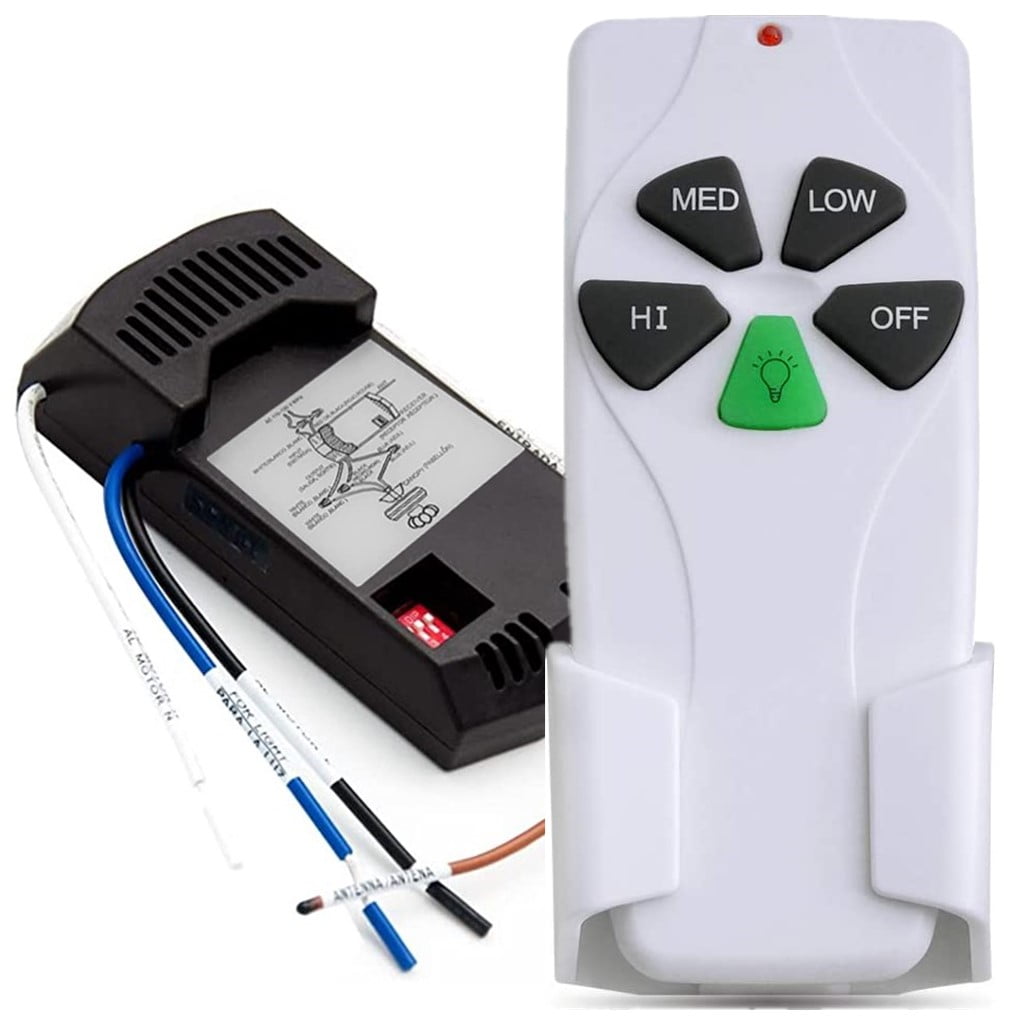
My nephew had an issue with the dimly lit bulbs in his ceiling fan that sometimes didn't go on. I found the voltage at the bulb pin low, but sometimes enough to light the bulb (LED and dimly). Turned out to be the wireless control module the would turn on the lights and adjust the fan speed. I removed it and wired it up with out it. I think I installed it when he was a child and couldn't reach the pull strings. No really need for it now and we didn't have another module on hand.

I don't see any pull strings on your fan, so I'm thinking it may have a module to control the lights and fan speed.

edit

the module was something like this


1764006780075.png
 
Last edited:
OP
U

Uncle Ben

Well-known member
Joined
Dec 16, 2010
Messages
319
I have not checked the voltage at the pin yet, but if I try bending the center tap down for a better connection and still have a problem, then I will check the voltage next. The fan has a remote, which is the only means of turning it on and off, but it does not have a dimmer function.
 

N_Jay

Well-known member
Joined
Nov 1, 2016
Messages
1,167
See if you hear a relay click when you turn the light on and off.

If not it is probably an electronic switch. It could fail in a higher than normal resistance or even cat as a diode causing weird symptoms.
try an incandescent bulb.
 

wyliesdiesels

Well-known member
Joined
Aug 14, 2012
Messages
19,998
Location
Modesto, CA
Did you check the actual voltage at the light bulb pin?

My nephew had an issue with the dimly lit bulbs in his ceiling fan that sometimes didn't go on. I found the voltage at the bulb pin low, but sometimes enough to light the bulb (LED and dimly). Turned out to be the wireless control module the would turn on the lights and adjust the fan speed. I removed it and wired it up with out it. I think I installed it when he was a child and couldn't reach the pull strings. No really need for it now and we didn't have another module on hand.

I don't see any pull strings on your fan, so I'm thinking it may have a module to control the lights and fan speed.

edit

the module was something like this


1764006780075.png

reading thru this thread i was gonna suggest this but you beat me to it... those wireless controllers can burn up and fail but not fully, causing weird issues with the fans and lights.
 
Last edited:

Wrench97

Well-known member
Joined
Jun 23, 2018
Messages
12,069
Location
Southeastern Pa
I'll add the 1 led bulb you have that lights dimly may be a dimmable type and the others are not, it's dim because of low voltage at the socket.
 
OP
U

Uncle Ben

Well-known member
Joined
Dec 16, 2010
Messages
319
Bent the center tab out, but that did not help. Checked the voltage at the socket and it is putting out only 25V, vs another exact same fixture in the room that is putting out 125V. Would that be an issue with the capacitor, or with the receiver itself?
 

Meursault74

Well-known member
Joined
Apr 1, 2019
Messages
21,932
Location
Southern California
Bent the center tab out, but that did not help. Checked the voltage at the socket and it is putting out only 25V, vs another exact same fixture in the room that is putting out 125V. Would that be an issue with the capacitor, or with the receiver itself?
at this point, just replace the remote control unit inside the fan. I've only replaced a couple of them, but they seem to be generic.

I'm sure the electricians on here will tell you the same. No one is going to open up one of those to fix it since they are readily available. They're relatively low cost as well.

Does your fan spin?
 

PelicanPines

ALLIANCE MEMBER
Joined
Apr 30, 2014
Messages
38,107
Location
New Jersey, USA, Earth, My own reality
Bent the center tab out, but that did not help. Checked the voltage at the socket and it is putting out only 25V, vs another exact same fixture in the room that is putting out 125V. Would that be an issue with the capacitor, or with the receiver itself?
Some ceiling fans have inline wattage limiting fuses. When they blow... The fan manufacturers expect you to replace the fan or at least the lighting.

Hunter fans are known for this.

I had one do this... Took me over an hour to track down the problem with a meter. I cut the inline fuse out... Spliced the ends and everything tested at full voltage.
 

Meursault74

Well-known member
Joined
Apr 1, 2019
Messages
21,932
Location
Southern California
Some ceiling fans have inline wattage limiting fuses. When they blow... The fan manufacturers expect you to replace the fan or at least the lighting.

Hunter fans are known for this.

I had one do this... Took me over an hour to track down the problem with a meter. I cut the inline fuse out... Spliced the ends and everything tested at full voltage.
Did you go to the silent Bob school of electricity? ;)


PelicanPines

ALLIANCE MEMBER
Joined
Apr 30, 2014
Messages
38,107
Location
New Jersey, USA, Earth, My own reality
Did you go to the silent Bob school of electricity? ;)

I am not kidding about the inline watt limiting fuse... Shocked more don't know about them.
 

dscheidt

Well-known member
Joined
Apr 26, 2017
Messages
2,888
I am not kidding about the inline watt limiting fuse... Shocked more don't know about them.
The power limiting fuse is to comply with some energy conservation regulations, but still allow the use of Edison screw base bulbs. The alternative is a fixed light, or some kind of bayonet base.
 
To avoid these ads, REGISTER NOW!

Milton Shaw

Well-known member
Joined
Feb 11, 2011
Messages
4,836
Take the lamp attachment off and see if there is a problem with the plug for the light attachment. I have seen them not lugged in, half plugged in and on floor displays that were later sold not plugged in at all. If not there take the fan wires and check the connection there under the cover assembly.
 
OP
U

Uncle Ben

Well-known member
Joined
Dec 16, 2010
Messages
319
at this point, just replace the remote control unit inside the fan. I've only replaced a couple of them, but they seem to be generic.

I'm sure the electricians on here will tell you the same. No one is going to open up one of those to fix it since they are readily available. They're relatively low cost as well.

Does your fan spin?
Yes, fan does spin just fine, including all speeds...just the bulb is less than half as bright as it should be, and that's only when keeping the original bulb in there. If I take the bulb from the other ceiling fan in the same room, which is bright and working normal, it is dull and not bright in the problem fixture as well.
 

Meursault74

Well-known member
Joined
Apr 1, 2019
Messages
21,932
Location
Southern California
Yes, fan does spin just fine, including all speeds...just the bulb is less than half as bright as it should be, and that's only when keeping the original bulb in there. If I take the bulb from the other ceiling fan in the same room, which is bright and working normal, it is dull and not bright in the problem fixture as well.
You said you measured 25V at the bulb socket pin, which is why it the bulb is dim.

The controllers I've seen have two output one for light and one for fan. It appears the fan part is still ok while the light portion isn't.

I couldn't tell you what's inside the module or how it's wired inside the box. I doubt it's practical to fix just that portion of the module.

Since this fan doesn't have manual pulls, I'm thinking the best way to a have a functional and bright on/off system is to replace the entire module inside the body of the fan. It's not as much work as replacing an entire fan, and certainly cheaper than replacement of the entire fan. It's a wire nut job and zip tie job.
 

Meursault74

Well-known member
Joined
Apr 1, 2019
Messages
21,932
Location
Southern California
Take the lamp attachment off and see if there is a problem with the plug for the light attachment. I have seen them not lugged in, half plugged in and on floor displays that were later sold not plugged in at all. If not there take the fan wires and check the connection there under the cover assembly.
Sure, could also be a loose connection. Viable to check that. If that's the case you can return the module or get practice putting the fan back together or leave everything hanging 'till you get the part you need (don't ask how I know):)
 

wyliesdiesels

Well-known member
Joined
Aug 14, 2012
Messages
19,998
Location
Modesto, CA
Yes, fan does spin just fine, including all speeds...just the bulb is less than half as bright as it should be, and that's only when keeping the original bulb in there. If I take the bulb from the other ceiling fan in the same room, which is bright and working normal, it is dull and not bright in the problem fixture as well.
i have seen those wireless control units fail on one output and not the other.... other times both outputs fail.... theyre cheap chinese junk and i tell customers its better to have pull chain fans than the wireless ****... some oblige
 

Meursault74

Well-known member
Joined
Apr 1, 2019
Messages
21,932
Location
Southern California
i have seen those wireless control units fail on one output and not the other.... other times both outputs fail.... theyre cheap chinese junk and i tell customers its better to have pull chain fans than the wireless ****... some oblige
I replaced one of those failed chain pull mechanisms once too on a fan. It simply broke. It was for the fan speed selector, though.

If the OP is up to drilling a hole in the side of the fan body, he could likely install one for the light switch. Even I wouldn't do that in this situation, but it would be possible if there's enough room inside for it.

1764115033930.png
 

CJ7VFR

Well-known member
Joined
Jan 13, 2015
Messages
2,939
Location
Central New Jersey
The power limiting fuse is to comply with some energy conservation regulations, but still allow the use of Edison screw base bulbs. The alternative is a fixed light, or some kind of bayonet base.
Yeah, those watt limiters were put into ceiling lights and ceiling fans back in 2005 or so. They are supposed to limit the total wattage of all the incandescent bulbs in a light fixture to about 180 watts or so total per light fixture. This was supposed to help keep the lights from getting too hot and causing a fire because people would put three or four 100 watt bulbs into ceiling fan lights when it says the max was 40 or 60 watt bulbs.

The problem that is happening now is that a lot of those watt limiters do not play nice with all LED bulbs because even with four 8 watt LED's for example, the watt limiters are not seeing enough of a load to work properly. So a lot of the LED bulbs will flicker, or be dim, or not work at all if the watt limiters are still installed in the light fixture.

I had this happen to me in a few ceiling fans with lights that I bought 15 years ago that I wanted to change the bulbs out to LED's. Every one of the ceiling fan lights would either not allow the LED's to come on at all or the LED's would be dim and flicker. If I replaced just one of the LED's with an old incandescent bulb of 40 or 60 watts the other LED's would then work properly. So it was the watt limiter not seeing enough load to work properly that was causing my issue.

I took the watt limiters out of all my ceiling fan lights and the LED's all worked fine after that.

Jim
 
Last edited:

wireman1987

Member
Joined
Nov 26, 2025
Messages
5
Sure sounds like the wattage limiter is failing or the remote module. Especially if you’re only reading 25v at the socket.
 
OP
U

Uncle Ben

Well-known member
Joined
Dec 16, 2010
Messages
319
I finally got around to opening up the fan again to do further testing, and it seems that the part that I thought was the wattage limiter is actually the capacitor for the fan. I opened up the next internal portion of the fan (you can see the two separate internal sections in one of the photos I attached), but there was no wattage limiter in there either. I also pulled the upper shroud off and pulled out the receiver, which has 120V coming into it, and it is putting out about 35V when the light is turned on. But as I look back at the photos, I think I may have tested the output voltage of the receiver incorrectly. I had a probe on the blue wire and the other probe on the yellow wire, but since yellow is the output to the fan and blue is the output to the light, I should have had a probe on the blue wire and the other probe on a separate neutral wire in order to test the output voltage for just the light. I won't be at home again until tonight, but perhaps you can let me know if I'm on the right track with what to test next and whether I should still be looking for a wattage limiter...or perhaps the wattage limiter is built into the receiver.

Obviously, I could just order a new receiver, but I like to know what is wrong before I throw parts at it.

Here are a few photos to show inside the fan and the receiver:

https://drive.google.com/file/d/1gDV0is1bfK1x5bcs4M5MpympsQMXDovW/view?usp=sharing

https://drive.google.com/file/d/19FZoUO5HDPTrHNqZLBtEWITOwAKytUGm/view?usp=sharing

https://drive.google.com/file/d/12y9klVpGhVSyaD_-UmjuChh73Sv289mI/view?usp=sharing

https://drive.google.com/file/d/1jurmuFB1Jnzs70KuYp7VclLZEdFU0oQ5/view?usp=sharing
 
OP
U

Uncle Ben

Well-known member
Joined
Dec 16, 2010
Messages
319
Ok, I'll do that.
Also, from what I'm reading, many modern ceiling fans/light fixtures are limited to only 12-24 volts being send to the bulb socket, so if I do test somewhere around this voltage going out from the blud (light) wire of the receiver, then that would be considered normal voltage, right? (The bulb socket is currently putting out 25V)
 

PelicanPines

ALLIANCE MEMBER
Joined
Apr 30, 2014
Messages
38,107
Location
New Jersey, USA, Earth, My own reality
Yeah, those watt limiters were put into ceiling lights and ceiling fans back in 2005 or so. They are supposed to limit the total wattage of all the incandescent bulbs in a light fixture to about 180 watts or so total per light fixture. This was supposed to help keep the lights from getting too hot and causing a fire because people would put three or four 100 watt bulbs into ceiling fan lights when it says the max was 40 or 60 watt bulbs.

The problem that is happening now is that a lot of those watt limiters do not play nice with all LED bulbs because even with four 8 watt LED's for example, the watt limiters are not seeing enough of a load to work properly. So a lot of the LED bulbs will flicker, or be dim, or not work at all if the watt limiters are still installed in the light fixture.

I had this happen to me in a few ceiling fans with lights that I bought 15 years ago that I wanted to change the bulbs out to LED's. Every one of the ceiling fan lights would either not allow the LED's to come on at all or the LED's would be dim and flicker. If I replaced just one of the LED's with an old incandescent bulb of 40 or 60 watts the other LED's would then work properly. So it was the watt limiter not seeing enough load to work properly that was causing my issue.

I took the watt limiters out of all my ceiling fan lights and the LED's all worked fine after that.

Jim
That's what I said with less words... Also the fuses pop with a bit of randomness that causes the lights to fail.
 

Meursault74

Well-known member
Joined
Apr 1, 2019
Messages
21,932
Location
Southern California
Ok, I'll do that.
Also, from what I'm reading, many modern ceiling fans/light fixtures are limited to only 12-24 volts being send to the bulb socket, so if I do test somewhere around this voltage going out from the blud (light) wire of the receiver, then that would be considered normal voltage, right? (The bulb socket is currently putting out 25V)
Source for this? I'm thinking this for for sealed units with LED, but I could be wrong.

your controller says combatable with incandescent and Compact Fluorescent. I haven't see any "normal household" type bulb run on 12-24 VAC.

Also say 300W for the light (I assume max). That would be a for 120V as a lower voltage would draw too much current.

Test what you need to , but I'd get another receiver unit. I don't know which brand is best, but "googling" the part number for yours didn't show favorable reviews.


I wouldn't buy it based on these reviews.
 

fitter30

Well-known member
Joined
Jun 23, 2019
Messages
2,968
Location
Peace Valley,mo
The older aftermarket remote controlled dimmers don't vary the voltage for dimming. They cycle power on/ off fast and variable speed. Even on full brite. Got two ceiling fans that will not light led or cfl bulbs. Purchased two led dimmers but haven't installed them yet.
 
To avoid these ads, REGISTER NOW!
Top Bottom