To avoid these ads, REGISTER NOW!

Strange light wiring problem.

cdestuck

Well-known member
Joined
Nov 13, 2013
Messages
1,462
Location
Altoona, Pa
I have a wiring problem and I need some help on. Behind my garage I build a covered area 40 foot long for some storage. In this area I put for jelly jar light fixtures for lighting.

The power first goes to the four fixtures and just passed the last picture I have my wall switch. Wiring is 14 gauge and I have 100 W bulbs in the fixtures.

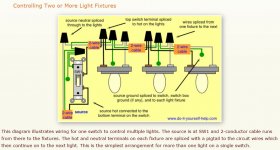
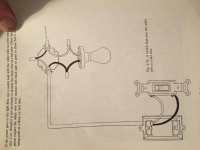
I wired each fixture just as this picture shows. But when I connected power and turned on the single pole switch at the far end of the four lights I only get a very dim light from each of the four bulbs. I have a good line feeding this circuit but still bulbs are very dim. (Regular bulbs, not cfl or led).

Could it be that you just can't wire 4 fixtures and then to switch at far end? I did notice that if I take one bulb out of fixture that the other 3 bulbs go out which I understand as it's opening the circuit. Any ideas guys??

Attached pic is just how I wired each fixture.
 

Attachments

  • IMG_9729.jpg
    IMG_9729.jpg
    139.1 KB · Views: 223
To avoid these ads, REGISTER NOW!

Mustang1167

Well-known member
Joined
Aug 29, 2011
Messages
949
Location
Pittsburgh, PA
I'm an amateur but why is the neutral and hot wires being crossed in the image? In the junction box I would keep hot with hot and neutral with neutral wires. If it worked this way that could be your problem. If I'm wrong someone tell me why so I can try to understand.

I can't figure out how to post images but google "multiple light junction box wiring" in the images there are a few well illustrated images.
 
Last edited:

Skyking1992

Well-known member
Joined
Sep 16, 2006
Messages
475
You've got the light fixtures wired in series, which is why the bulbs are dim. They should be wired in parallel. The switch can still be at the end.
 

PT Doc

Well-known member
Joined
Nov 12, 2010
Messages
3,197
Properly wired, lights in series is standard. The list that were there before were bright prior to your handiwork? Now after you add a switch and a light at the end, all lights are dim?
 

nehog

Well-known member
Joined
Jan 2, 2010
Messages
7,935
Location
Jaffrey, NH
Properly wired, lights in series is standard. The list that were there before were bright prior to your handiwork? Now after you add a switch and a light at the end, all lights are dim?

Series is never standard.

OP-lights have to parallel. Without adding at least one more conductor this won't work. Also I'd suggest posting to the Lighting and Electrical forum. Best answers are there.
 
OP
C

cdestuck

Well-known member
Joined
Nov 13, 2013
Messages
1,462
Location
Altoona, Pa
I'm an amateur but why is the neutral and hot wires being crossed in the image? In the junction box I would keep hot with hot and neutral with neutral wires. If it worked this way that could be your problem. If I'm wrong someone tell me why so I can try to understand.

I can't figure out how to post images but google "multiple light junction box wiring" in the images there are a few well illustrated images.

Well the wiring diagram I attached is correct if you are wiring just one fixture. But if you do the same wiring with more than one fixture (in my case I had 4 fiixtures) is wiring in series and wont work. What I need to do is from the 1st fixture through the last fixture is run 14-3 and not 14-2 wire. So I have to rip this stuff all apart and run the 14-3. ****
 

Handyfarmer

Well-known member
Joined
Dec 20, 2014
Messages
316
Location
in the high plains of Colorado

ryan20021982

Well-known member
Joined
Oct 27, 2015
Messages
797
Location
Northern IL
I'm an amateur but why is the neutral and hot wires being crossed in the image? In the junction box I would keep hot with hot and neutral with neutral wires. If it worked this way that could be your problem. If I'm wrong someone tell me why so I can try to understand.

I can't figure out how to post images but google "multiple light junction box wiring" in the images there are a few well illustrated images.

The pic shows neutral and hot connected because the power is already at the light and you are breaking the hot connection and putting a switch in the middle of it using standard wire so 1 will be white and 1 black but you are just using the wire to extend the hot to the switch and then back to the light.
 

rburke65

Well-known member
Joined
Nov 10, 2007
Messages
12,349
Location
Canfield, Ohio
Just because you see a "white" wire does not indicate it is a neutral. In this case the hite wire is continuing the hot feed to the switch. When you see a white and a black tied together in a fixture junction box, it usually means there is a switch in the circuit.
 

Al G

Well-known member
Joined
Jan 5, 2015
Messages
340
Location
Arizona
Others lights going out when you remove one bulb is the first indication of a problem. Can you move the switch to the beginning of the run instead of the end? That way you could keep the 14/2. But you need to rewire each socket correctly.
 
OP
C

cdestuck

Well-known member
Joined
Nov 13, 2013
Messages
1,462
Location
Altoona, Pa
As mentioned by several here and the posted diagrams, I need to pull my 14-2 between the fixtures and rewire with 14-3. I see the error of my ways, and electrical work. I've done tons of electrical work in the past but never this exact set up. I've learned today
 

MikeF2316

Well-known member
Joined
Dec 29, 2012
Messages
9,605
Location
Thornhill, ON
I'm not 100% sure, but I think code requires a neutral in the switch box now, because of all the electronic switches that do consume some power. So you'd need to run 3 conductor to the switch too.

You can do it this way with all 2 conductor if you connect all the additional lights to the first light. So the first light would have 3 cables in its box - power, switch, and other lights.
 

onewheat

Well-known member
Joined
Feb 19, 2012
Messages
1,286
Location
Knoxville, TN
This is the easiest way. Its not that complicated. No need to tear out the existing wire.

This is what I was thinking too. This setup does make me leery though, as there is a hot with each of the light fixtures even with the switch off - it isn't a problem, unless you are like me and tend to rely on wall switches to make fixtures "safe" to work on. :shocking:
 

6PTsocket

Well-known member
Joined
Mar 12, 2014
Messages
4,593
You've got the light fixtures wired in series, which is why the bulbs are dim. They should be wired in parallel. The switch can still be at the end.
Bingo!! That also explains why his string goes out when he removes a bulb.

Sent from my SM-G900V using Tapatalk
 

wyliesdiesels

Well-known member
Joined
Aug 14, 2012
Messages
19,983
Location
Modesto, CA
I have a wiring problem and I need some help on. Behind my garage I build a covered area 40 foot long for some storage. In this area I put for jelly jar light fixtures for lighting.

The power first goes to the four fixtures and just passed the last picture I have my wall switch. Wiring is 14 gauge and I have 100 W bulbs in the fixtures.

I wired each fixture just as this picture shows. But when I connected power and turned on the single pole switch at the far end of the four lights I only get a very dim light from each of the four bulbs. I have a good line feeding this circuit but still bulbs are very dim. (Regular bulbs, not cfl or led).

Could it be that you just can't wire 4 fixtures and then to switch at far end? I did notice that if I take one bulb out of fixture that the other 3 bulbs go out which I understand as it's opening the circuit. Any ideas guys??

Attached pic is just how I wired each fixture.

Theyre wired in series

I'm an amateur but why is the neutral and hot wires being crossed in the image? In the junction box I would keep hot with hot and neutral with neutral wires. If it worked this way that could be your problem. If I'm wrong someone tell me why so I can try to understand.

I can't figure out how to post images but google "multiple light junction box wiring" in the images there are a few well illustrated images.

Its called a switch loop.

Well the wiring diagram I attached is correct if you are wiring just one fixture. But if you do the same wiring with more than one fixture (in my case I had 4 fiixtures) is wiring in series and wont work. What I need to do is from the 1st fixture through the last fixture is run 14-3 and not 14-2 wire. So I have to rip this stuff all apart and run the 14-3. ****

correct

I'm not 100% sure, but I think code requires a neutral in the switch box now, because of all the electronic switches that do consume some power. So you'd need to run 3 conductor to the switch too.

You can do it this way with all 2 conductor if you connect all the additional lights to the first light. So the first light would have 3 cables in its box - power, switch, and other lights.

yes code now requires neutral in switch box
 

6PTsocket

Well-known member
Joined
Mar 12, 2014
Messages
4,593
If you want to run per into the lights first you will need 3 wires between each fixture. The black will carry the 120v unswitched all the way to the switch. Then the red will attach to all of the fixtures and will be the switched wire. The white will be neutral for all of the lights.

This is a good diagram.


http://s278.photobucket.com/user/ray2047/media/light-2.jpg.html
You have overly complicated it. You run 120 (hot and neutral) into a switch box. The hot goes through the switch and the switched hot and the neutral (in one piece of 2 wire romex) goes down the line from bulb to bulb. Aside from the ground, l have no idea where you came up with 3 wires. I wired this same circuit, operating a bunch of ceiling lights in my basement, and they work just fine.

Sent from my SM-G900V using Tapatalk
 

wyliesdiesels

Well-known member
Joined
Aug 14, 2012
Messages
19,983
Location
Modesto, CA
You have overly complicated it. You run 120 (hot and neutral) into a switch box. The hot goes through the switch and the switched hot and the neutral (in one piece of 2 wire romex) goes down the line from bulb to bulb. Aside from the ground, l have no idea where you came up with 3 wires. I wired this same circuit, operating a bunch of ceiling lights in my basement, and they work just fine.

Sent from my SM-G900V using Tapatalk

3cnd w/ grd is needed from the first fixture through the 4th and on to the switch because the power source enters the first fixture and the switch is at the other end of the string.

The OP used 2cnd w/ grd and had no way to get a switched hot back to the first fixture.

The circuit u wired mustve had the power source going to the switch first otherwise it wouldnt work.
 
To avoid these ads, REGISTER NOW!

6PTsocket

Well-known member
Joined
Mar 12, 2014
Messages
4,593
I took another look at that circuit of yours to see how they made an easy job so messy. They fed the unswitched hot into the last bulb fixture box and had to carry it through all the lamp boxes when it is not connected to any of them. Start at the switch and it is a lot simpler

Sent from my SM-G900V using Tapatalk
 

wyliesdiesels

Well-known member
Joined
Aug 14, 2012
Messages
19,983
Location
Modesto, CA
I took another look at that circuit of yours to see how they made an easy job so messy. They fed the unswitched hot into the last bulb fixture box and had to carry it through all the lamp boxes when it is not connected to any of them. Start at the switch and it is a lot simpler

Sent from my SM-G900V using Tapatalk

Yes thats why 3cnd w/grd was necessary(and u called out klassenl for saying this was necessary) which the OP already acknowledge.

Sometimes its not possible or is cost prohibitive to feed the switch first.
 

6PTsocket

Well-known member
Joined
Mar 12, 2014
Messages
4,593
Yes thats why 3cnd w/grd was necessary(and u called out klassenl for saying this was necessary) which the OP already acknowledge.

Sometimes its not possible or is cost prohibitive to feed the switch first.
The OP had worse problems than that. He wired his bulbs in series, like Christmas tree lights. I see your point if you have to introduce power at the last socket. I guess I missed that part. That's what they make 3 wire romex for. Now if he just had some 30 volt bulbs his series string would work. LOL.

Sent from my SM-G900V using Tapatalk
 

ard

Well-known member
Joined
Feb 16, 2015
Messages
4,391
Location
Sierra Foothills... California
As mentioned by several here and the posted diagrams, I need to pull my 14-2 between the fixtures and rewire with 14-3. I see the error of my ways, and electrical work. I've done tons of electrical work in the past but never this exact set up. I've learned today

Based on what YOU have posted so far, and the diagram I posted....it is not clear that you MUST pull 14-3.

My diagram has only 14-2 connecting each additional light....


(Altunafish? Went to school near there, some time ago...)
 

CJ7VFR

Well-known member
Joined
Jan 13, 2015
Messages
2,939
Location
Central New Jersey
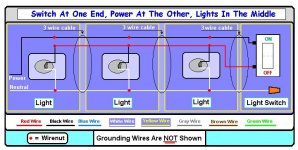
Here is a simple diagram of what you need to do. This shows the power coming into the lights first, then the switch is at the end of the run. You need to connect your lights in parallel as everyone has said. Doing it in series basically cuts the amount of power each light gets by the number of lights you are using. As someone said, it is similar to old style Christmas lights, where one bulb would go out, the entire string would go out.

With the new codes, you need to have a neutral wire in your switch box, thus the need to use 3 conductor wire (with ground), such as 14/3. This diagram shows you how to do it. The old way was similar to your first post, shown in your diagram, where the white wire in your 14/2 was used for the switched hot (black).

Normally in this case, you would either put black tape or use a black marker, to color the ends of the white wire black, to indicate that it is NOT a neutral wire, but is now part of the switched hot (black).

Jim
 

Attachments

  • New-3LightsWithSwitchAtTheEnd.jpg
    New-3LightsWithSwitchAtTheEnd.jpg
    68.5 KB · Views: 40
Last edited:

6PTsocket

Well-known member
Joined
Mar 12, 2014
Messages
4,593
Here is a simple diagram of what you need to do. This shows the power coming into the lights first, then the switch is at the end of the run. You need to connect your lights in parallel as everyone has said. Doing it in series basically cuts the amount of power each light gets by the number of lights you are using. As someone said, it is similar to old style Christmas lights, where one bulb would go out, the entire string would go out.

With the new codes, you need to have a neutral wire in your switch box, thus the need to use 3 conductor wire (with ground), such as 14/3. This diagram shows you how to do it. The old way was similar to your first post, shown in your diagram, where the white wire in your 14/2 was used for the switched hot (black).

Normally in this case, you would either put black tape or use a black marker, to color the ends of the white wire black, to indicate that it is NOT a neutral wire, but is now part of the switched hot (black).

Jim
That is a good clear drawing and shows it very well. I am not sure how you would do a switch with a black and white pair or exactly what the new regs say but I remember hearing something about banning the practice of color taping a wire to redesignate it. Any info? Carrying the neutral into every switch box is a good idea, IMHO.

Sent from my SM-G900V using Tapatalk
 

CJ7VFR

Well-known member
Joined
Jan 13, 2015
Messages
2,939
Location
Central New Jersey
If the OP can change his set up to have the power come into the switch first, and then go out to the lights, he would not have remove any of his 14/2 wire between each light fixture, and he could still use 14/2 from the switch to the first light.

He would just have to wire his lights in parallel, as shown in this diagram. But it would require him to re-route the power to the switch first.

This would also give him a neutral wire inside his switch box, so he would be up to code.

Jim
 

Attachments

  • lightwithswitch.JPG
    lightwithswitch.JPG
    93.3 KB · Views: 28
OP
C

cdestuck

Well-known member
Joined
Nov 13, 2013
Messages
1,462
Location
Altoona, Pa
Well want to do this rt so stopped at Lowes today and picked up a roll of 14-3. So I'll rip out my first work and replace it with the correct 14-3. Never did this beyond the light switch except for a single fixture. Ha. Sure wish I'd have dug deep into this before doing this wrong. Oh well
 

CJ7VFR

Well-known member
Joined
Jan 13, 2015
Messages
2,939
Location
Central New Jersey
Well want to do this rt so stopped at Lowes today and picked up a roll of 14-3. So I'll rip out my first work and replace it with the correct 14-3. Never did this beyond the light switch except for a single fixture. Ha. Sure wish I'd have dug deep into this before doing this wrong. Oh well

Before you rip out the wires, see if you can re-route the power so that it will come into the switchbox first. If it is easy enough to do.

If you follow the other diagram I posted, you would not have to rip out the wires you already have in place to each light. You would only have to re-wire the light fixtures in parallel instead of in series.

Then you can save the 14/3 you bought for another project, or you could return it for a refund and get yourself some cheaper 14/2 to run the power to the switch box first. Either way is good!

Jim
 
Last edited:

6PTsocket

Well-known member
Joined
Mar 12, 2014
Messages
4,593
If the OP can change his set up to have the power come into the switch first, and then go out to the lights, he would not have remove any of his 14/2 wire between each light fixture, and he could still use 14/2 from the switch to the first light.

He would just have to wire his lights in parallel, as shown in this diagram. But it would require him to re-route the power to the switch first.

This would also give him a neutral wire inside his switch box, so he would be up to code.

Jim
That is what I said earlier. Apparantly the situation is that power is going to be fed from the last bulb. That means 14/3. If the switch is far from the last bulb it is probably easier to run 14/3 down the line than have a long 14/2 go all the way to the switch and go back through the bulbs. It is really more of a logistic problem than an electrical one. What ever is easier.

Sent from my SM-G900V using Tapatalk
 

CJ7VFR

Well-known member
Joined
Jan 13, 2015
Messages
2,939
Location
Central New Jersey
...If the switch is far from the last bulb it is probably easier to run 14/3 down the line than have a long 14/2 go all the way to the switch and go back through the bulbs. It is really more of a logistic problem than an electrical one. What ever is easier.

Sent from my SM-G900V using Tapatalk

I have wanted to put 3 way switches in my basement for years now. The only light switch in my "shop" side of the basement is by the doorway into the shop where you come down the stairs. There never was a switch by the Bilco door that leads out of the basement into the yard.

I didn't want to rip out all the wiring and re-do it all in 14/3. Luckily for me, the power for the lights comes into the switch first, so all I had to do is run a 14/3 wire from the existing shop light switch, over to the wall near the Bilco door, and install a 3 way switch there.

Then I replaced the regular existing light switch for the shop lights with a 3 way switch, and hooked that up to the 14/3 wire feeding the new switch by the Bilco door. So now I can turn on/off the shop lights from either entrance.

In my case, it would have been cheaper/faster/easier if the lights had been wired up to 3 way switches from the get go. But because they were not, I did the easiest/fastest fix that did not require me to rip out all the existing wiring and replacing it with 14/3.

So for me it was a logistics thing.

Jim
 
Last edited:

Cmreschke

Well-known member
Joined
Feb 15, 2014
Messages
775
Location
North of Detroit
Just take a 14/2 from the fixture that has the power (furthest from switch) and run it directly to the switch box. All your whites are then neutrals, you have a neutral at your switch box, and all of your fixtures would be then parallel. You are just extending your power and feeding all fixtures from the switch instead of feeding the fixtures and running a loop back. I hope I explained it right. No need to rerun new wires. No need to buy 3 wire.
 

6PTsocket

Well-known member
Joined
Mar 12, 2014
Messages
4,593
[emoji106][emoji106][emoji106][emoji106]
If you lose 1 bulb,you'll lose the rest of them the way its wired.
Just one problem these are 120 volt bulbs . If they are the same wattage there will only be 30 volts on each bulb. He has already said his bulbs are very dim. Did you wonder why? This would only work with 4 bulbs if they were 30 volt bulbs. Not something you can get at HD or anywhere else. He wired them like old style Christmas lights, where all the bulbs are low voltage and together add up to 120 volts. In your house all the receptacles are in parallel . Every device is directly connectd to 120 volts, not through another device or three other devices. A little reading on ohms law and serial and parallel circuits is a good place to start. We all had to start somewhere. I hope my explanation helped you.

Sent from my SM-G900V using Tapatalk
 

MikeF2316

Well-known member
Joined
Dec 29, 2012
Messages
9,605
Location
Thornhill, ON
Well want to do this rt so stopped at Lowes today and picked up a roll of 14-3. So I'll rip out my first work and replace it with the correct 14-3. Never did this beyond the light switch except for a single fixture. Ha. Sure wish I'd have dug deep into this before doing this wrong. Oh well

You could get away with just running your new 14-3 from the first light, the one with the power in it, to the switch. You'd only need to remove the cable from the last box to the switch.
 

6PTsocket

Well-known member
Joined
Mar 12, 2014
Messages
4,593
I have wanted to put 3 way switches in my basement for years now. The only light switch in my "shop" side of the basement is by the doorway into the shop where you come down the stairs. There never was a switch by the Bilco door that leads out of the basement into the yard.

I didn't want to rip out all the wiring and re-do it all in 14/3. Luckily for me, the power for the lights comes into the switch first, so all I had to do is run a 14/3 wire from the existing shop light switch, over to the wall near the Bilco door, and install a 3 way switch there.

Then I replaced the regular existing light switch for the shop lights with a 3 way switch, and hooked that up to the 14/3 wire feeding the new switch by the Bilco door. So now I can turn on/off the shop lights from either entrance.

In my case, it would have been cheaper/faster/easier if the lights had been wired up to 3 way switches from the get go. But because they were not, I did the easiest/fastest fix that did not require me to rip out all the existing wiring and replacing it with 14/3.

So for me it was a logistics thing.

Jim
That's funny. Your house sounds almost like mine. There is a 3 way at the top of the basemet stairs and one at the back door, though my property is graded and my back door is at ground level. Great for moving in big stuff into my shop. I was lucky, it was wired that way originally. I did wire 3 ways for the two entrances to the kitchen.


Sent from my SM-G900V using Tapatalk
 

6PTsocket

Well-known member
Joined
Mar 12, 2014
Messages
4,593
Just take a 14/2 from the fixture that has the power (furthest from switch) and run it directly to the switch box. All your whites are then neutrals, you have a neutral at your switch box, and all of your fixtures would be then parallel. You are just extending your power and feeding all fixtures from the switch instead of feeding the fixtures and running a loop back. I hope I explained it right. No need to rerun new wires. No need to buy 3 wire.
Of course that would work but is awkward and wastes a lot of wire. You have wiring between the sockets and the switch and another external line running from the last socket to the switch for a total of two runs of romex containing a total of FOUR wires. It is much cleaner and a whole lot less wire to run one length of 14/3. It is a moot point. He has already bought the 14/3.

Sent from my SM-G900V using Tapatalk
 

Al G

Well-known member
Joined
Jan 5, 2015
Messages
340
Location
Arizona
Is the power coming into the last socket or the first? Some of the reponses above assume last and some assume first.
 

wyliesdiesels

Well-known member
Joined
Aug 14, 2012
Messages
19,983
Location
Modesto, CA
Just one problem these are 120 volt bulbs . If they are the same wattage there will only be 30 volts on each bulb. He has already said his bulbs are very dim. Did you wonder why? This would only work with 4 bulbs if they were 30 volt bulbs. Not something you can get at HD or anywhere else. He wired them like old style Christmas lights, where all the bulbs are low voltage and together add up to 120 volts. In your house all the receptacles are in parallel . Every device is directly connectd to 120 volts, not through another device or three other devices. A little reading on ohms law and serial and parallel circuits is a good place to start. We all had to start somewhere. I hope my explanation helped you.

Sent from my SM-G900V using Tapatalk

:lol: :lol: :lol: :lol:

I dont think u realize who youre trying to educate.

Zmax is a licensed electrician and knows way more about this subject than what youre trying to teach im.

And BTW, his statement was correct. If bulbs are wired in series and one goes out u loose the whole string of lights because the circuit is now open aka there is no continuity between bulbs. The same thing happens with christmas lights that are wired in series when a bulb goes out
 
Last edited:

Cmreschke

Well-known member
Joined
Feb 15, 2014
Messages
775
Location
North of Detroit
Of course that would work but is awkward and wastes a lot of wire. You have wiring between the sockets and the switch and another external line running from the last socket to the switch for a total of two runs of romex containing a total of FOUR wires. It is much cleaner and a whole lot less wire to run one length of 14/3. It is a moot point. He has already bought the 14/3.

Sent from my SM-G900V using Tapatalk
Awkward? How so?
Less wire? How is it less wire when your essentially tearing out what was installed and reinstalling another set of wires, waiting the original set of wires.
Neater cleaner? Debatable! Also not too late if what was purchased can be returned.
 
To avoid these ads, REGISTER NOW!
Top Bottom