To avoid these ads, REGISTER NOW!

Stripped/Rusted/Corroded Screws?

AFR

New member
Joined
Mar 31, 2018
Messages
4
You've all had 'em..

They come in many different shapes and sizes, and yield the same level of frustration. That one screw that just won't cooperate.

What do you do? There's several possible solutions, all with pros and cons - I suppose it would depend on the application itself.

Drilling or heating, for example, may be quick though also potentially damaging to the area around the screw. But maybe it isn't an expensive plane/car/project, etc. so there is a bit more room for options. However, there's also the amount of time spent removing such a screw.

I'd love to hear some ways you guys deal with the worst of the stripped/rusted/corroded screws!
 
To avoid these ads, REGISTER NOW!

TRWham

Well-known member
Joined
Aug 11, 2017
Messages
1,970
Location
East Cobb County, Georgia
We are rebuilding a '56 Oldsmobile 88, and I have found that a 1/4" impact driver (I have a Milwaukee M18) is amazing at loosening rusted Phillip's head screws without stripping them. Select the right size bit, apply enough pressure to keep the bit engaged in the screw and use quick bursts to break it loose and most will come out. That and Kroil. Lots and lots of Kroil.

For those that do strip, I usually grind off the head, remove whatever the screw was holding and attack with locking pliers.
 

plinker

Well-known member
Joined
Feb 28, 2007
Messages
4,286
Location
Northern Wi
I had a 8mm exhaust manifold bolt that would not drill out nicely, ended up getting it out, plan was to use a thread insert but ended up drill & tapping to 3/8-16 instead since the diameter was smaller then the insert and if re-threading eventually failed, the insert could still be used.

Time is the kicker, if you really dont want to replace whatever you're messing with due to replacement cost, obsolete or otherwise, you have all the time in the world. I had it a couple times where it was more cost vs time effective on customer related work where replacement was the way to go.

Screws can be tricky, most of the time I can get a P2R drywall bit to get it out, fits better anyway, 99% of the time. A hand impact driver can be your friend too.

For flush or above flush bolts, weld a nut to it and it normally comes out. Coarse threaded flange nuts work best I've found. Sometimes vise grips and heat or Kroil type oils work too.

If it's broke off below flush, a transfer punch that fits the hole the best drill the center out large as possible ans sometimes a extractor will work, but not always. I've also used a 1/8 burr to remove material to where you see threads & then pick the out the remainder in the threads with a pick or try and tap them out (not good on the tap I'm sure, but it can work).
blind holes are more of an issue, just have to watch your depth closely.

Rounded nuts and bolts can be gotten out with bolt out's or similar, the Matco non slip type sockets can work as well. I've had it where different size sockets can remove rounded stuff, just have to try fit them and see if they work. Sometimes if a 9/16 wrench rounds off a nut a 14mm may get it off and vice versa with other sizes.

Aluminum with other metal types along with corrosion can make life "interesting" at times.

A mini ductor type tool can be a big help too.
 
Last edited:

davethorik

Well-known member
Joined
Sep 14, 2013
Messages
4,992
Location
Norka, Ohio
You've all had 'em..

They come in many different shapes and sizes, and yield the same level of frustration. That one screw that just won't cooperate.

What do you do? There's several possible solutions, all with pros and cons - I suppose it would depend on the application itself.

Drilling or heating, for example, may be quick though also potentially damaging to the area around the screw. But maybe it isn't an expensive plane/car/project, etc. so there is a bit more room for options. However, there's also the amount of time spent removing such a screw.

I'd love to hear some ways you guys deal with the worst of the stripped/rusted/corroded screws!

Sounds like a hand impact might need to be on your shopping list (the kind you strike with a hammer).
 

engineer2

Well-known member
Joined
Dec 13, 2009
Messages
11,824
Location
Chicago burbs
If the phillips is stripped, sometimes you can peen the head a little bit to restore it. Hitting it can also help loosen it.
Cordless impact driver works well. I set my Makita to the lowest speed and have had a good success rate.
A hand impact screwdriver is worth a try too.
 

rustyzman

Well-known member
Joined
May 7, 2015
Messages
772
Location
Chicagoland
My go to for the worst of the stuck or rusted screws is an Air Hammer Screwdriver Attachment. Heat of course as needed, but the air hammer almost never fails me, even working as a auto/truck Tech in the rust belt. Like this one:
https://www.cpooutlets.com/wivco-de...MIoZTFxbWX2gIVCrnACh1Zmg4tEAQYAyABEgJ5J_D_BwE

Snap on Hand Impact as well, but the air hammer gets it done quick and efficient, even in tight spots and on light gauge metal.
 

Lelandwelds

Well-known member
Joined
Sep 6, 2017
Messages
2,443
Location
Central Texas
I used to just weld a nut to it. I had a rod that had a flux that protected the threads. Now I just swap out the "barely boogered" ones for new before they strip completely.
 

jonesg

Well-known member
Joined
Mar 15, 2010
Messages
1,698
Location
northern Maine/
My go to for the worst of the stuck or rusted screws is an Air Hammer Screwdriver Attachment. Heat of course as needed, but the air hammer almost never fails me, even working as a auto/truck Tech in the rust belt. Like this one:
https://www.cpooutlets.com/wivco-de...MIoZTFxbWX2gIVCrnACh1Zmg4tEAQYAyABEgJ5J_D_BwE

Snap on Hand Impact as well, but the air hammer gets it done quick and efficient, even in tight spots and on light gauge metal.

Just ordered one.! To get rusted Allen bolts out of my Volvo awd viscous coupler.
 

Attachments

  • 20170926_081341.jpg
    20170926_081341.jpg
    135.6 KB · Views: 50
Last edited:

steveo3002

Well-known member
Joined
Nov 9, 2010
Messages
737
Location
cambridge england
ive had good results with a small sharp chisel and hammer the head in a counterclock wise direction

bigger stuff gets a washer welded on and then a nut welded to that ..works like a charm
 

bob15

Well-known member
Joined
Dec 8, 2011
Messages
6,863
Location
Northeasten, CT
Weld a nut on top of the stripped fastener and unscrew. If the fastener is tall enough, a small pipe wrench can works wonders on turning fasteners.
 

pilotmotor

Well-known member
Joined
Mar 13, 2018
Messages
88
turbo sockets work very well on fasteners with even completely rounded heads. I use them on rusted exhaust bolts along with heat .
 

kythri

Well-known member
Joined
Jan 3, 2007
Messages
6,330
Location
Lebanon, OR
Has anybody else used these?

Normally I wouldn't think to use pliers (much less, by the nose) for such a problem, though these seem to be made for doing exactly that.

I've used the Engineer Screw Pliers to decent success - assuming you've got enough of a head to grab onto.

Vampliers are re-badged Engineer pliers, with the Vampliers clowns making claims that insinuate they invented the stuff, when all they did was license distribution from the Japanese inventors and manufacturers, and change the color of the grips.

You can skip the shyster middleman, and save a fair amount of coin, by purchasing the Engineer brand pliers on Amazon.
 
To avoid these ads, REGISTER NOW!

6PTsocket

Well-known member
Joined
Mar 12, 2014
Messages
4,593
My worst rust case was not a fastener but a front rotor that would not come off. I tried Kroil and PB baster around the studs and around the back of the rotor hub. I applied heat, I beat on it with a big hammer. Still stuck.....for 2 days. Finally I took a cutoff wheele, estimated how far back the front face of the flange was and cut all the way around the hub. I hammered a chisel in there and with a pry bar and more pb blaster, I got the front of the hub off the studs. All the rust was between the edge of the axle flange and the inside of the hub. With it exposed I was able to apply more rust buster and hammer it loose. PHEW!! What a pia that was.

Sent from my SM-G900V using Tapatalk
 

pilotmotor

Well-known member
Joined
Mar 13, 2018
Messages
88
My worst rust case was not a fastener but a front rotor that would not come off. I tried Kroil and PB baster around the studs and around the back of the rotor hub. I applied heat, I beat on it with a big hammer. Still stuck.....for 2 days. Finally I took a cutoff wheele, estimated how far back the front face of the flange was and cut all the way around the hub. I hammered a chisel in there and with a pry bar and more pb blaster, I got the front of the hub off the studs. All the rust was between the edge of the axle flange and the inside of the hub. With it exposed I was able to apply more rust buster and hammer it loose. PHEW!! What a pia that was.

Sent from my SM-G900V using Tapatalk

Ive had this situation many times and devised this plan.I bought a milwaukee portable band saw and cut the rotor between the vents all the way down to the hub in two spots opposite each other then slide hammer the halfs off , takes 15 min tops.The band saw cuts the cast iron like butter.Cars that have the hub very close to the inside of the hat have this problem like the older expeditions and elantras
 

6PTsocket

Well-known member
Joined
Mar 12, 2014
Messages
4,593
Ive had this situation many times and devised this plan.I bought a milwaukee portable band saw and cut the rotor between the vents all the way down to the hub in two spots opposite each other then slide hammer the halfs off , takes 15 min tops.The band saw cuts the cast iron like butter.Cars that have the hub very close to the inside of the hat have this problem like the older expeditions and elantras
I am grateful for any new techniques and suggestions but I am not following exactly what you did. The rotor is a "hat" with 5 holes through the crown and a double thicknes "brim" braced by the ribs. The 1/2 axle flange is all the way up inside the crown with the studs sticking through the holes. The rust was between the flange and the top of the inside of the crown. That is pretty far from the rotor or "hat brim" How does cutting through the ribs between the rotors break the rust. It seems it would just leave the inside rotor half floating free. I'm sure I'm missing something in your explanation. Thanks for any advice.

Sent from my SM-G900V using Tapatalk
 

pilotmotor

Well-known member
Joined
Mar 13, 2018
Messages
88
By cutting the rotor from the outer edge all the way down to the wheel hub (flange with studs ) you reduce the force needed to remove it considerably . You cut into the hat section also (the area around the flange) then you can use what ever method you were using before it was cut and it will peel away from the flange instead of having to pull straight off. Basically all that is left to the rotor is a small section that gets sandwiched between the wheel and flange and that cracks very easily. I just aim for the area between the ribs so it cuts faster. Your case may have been different but all the rust i see builds up on the inside edge of the hat forming a raised ring locking the rotor to the flange.Sorry if its not clear , i could post a pic of one i cut off a civic last week if you like.
 
Last edited:

wafrederick

Well-known member
Joined
Jul 3, 2010
Messages
6,051
Location
Holton,Mi
Has anybody else used these?

Normally I wouldn't think to use pliers (much less, by the nose) for such a problem, though these seem to be made for doing exactly that.

I have and they work.I know one code you put in to get 15% off on their website with free shipping: koon15.This is if you buy them from Vampire tools
 

6PTsocket

Well-known member
Joined
Mar 12, 2014
Messages
4,593
By cutting the rotor from the outer edge all the way down to the wheel hub (flange with studs ) you reduce the force needed to remove it considerably . You cut into the hat section also (the area around the flange) then you can use what ever method you were using before it was cut and it will peel away from the flange instead of having to pull straight off. Basically all that is left to the rotor is a small section that gets sandwiched between the wheel and flange and that cracks very easily. I just aim for the area between the ribs so it cuts faster. Your case may have been different but all the rust i see builds up on the inside edge of the hat forming a raised ring locking the rotor to the flange.Sorry if its not clear , i could post a pic of one i cut off a civic last week if you like.
That would be really helpful. Thanks.

Sent from my SM-G900V using Tapatalk
 

6PTsocket

Well-known member
Joined
Mar 12, 2014
Messages
4,593
By cutting the rotor from the outer edge all the way down to the wheel hub (flange with studs ) you reduce the force needed to remove it considerably . You cut into the hat section also (the area around the flange) then you can use what ever method you were using before it was cut and it will peel away from the flange instead of having to pull straight off. Basically all that is left to the rotor is a small section that gets sandwiched between the wheel and flange and that cracks very easily. I just aim for the area between the ribs so it cuts faster. Your case may have been different but all the rust i see builds up on the inside edge of the hat forming a raised ring locking the rotor to the flange.Sorry if its not clear , i could post a pic of one i cut off a civic last week if you like.
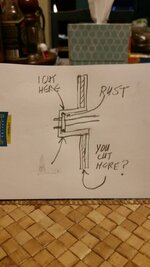
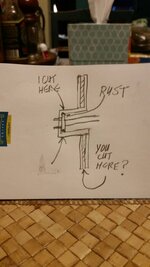
This where I cut, right in front of the rust that was holding the rotor. The disk part seems far from the problem area. I was told that if you hit the hub hard enough it will shatter. Never tried that. Probably would need a bigger sledge. Not sure the bearings would survive.3197fbba247d8f90328e40e9d6f8304d.jpg

Sent from my SM-G900V using Tapatalk
 

Attachments

  • 3197fbba247d8f90328e40e9d6f8304d.jpg
    3197fbba247d8f90328e40e9d6f8304d.jpg
    69.2 KB · Views: 0

finn

Well-known member
Joined
Mar 27, 2005
Messages
16,359
Location
The UP, God's country
Kroil or PB blaster applied daily for a couple of weeks, then an unworn screwdriver with a square shank and an open end wrench got the flat head screws out of the windshield frame on my 36 Ford. Never would have believed it.

Lately, I’ve been using the Bosch impact driver, but I think it’s time to pick up a hand held impact, as you probably have more feel / control of the force applied.
 

pilotmotor

Well-known member
Joined
Mar 13, 2018
Messages
88
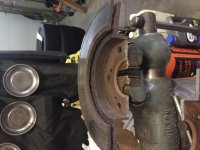
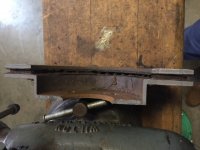
Hope this helpsIMG_0015.JPG

IMG_0016.JPG

IMG_0017.JPG

i never needed to but you can aim for the lug nut hole with the saw and the face will be even weaker there , cracking easier.
The first pis shows the rust lip that was holding it from sliding off
 
Last edited:

6PTsocket

Well-known member
Joined
Mar 12, 2014
Messages
4,593
Hope this helpsIMG_0015.JPG

IMG_0016.JPG

IMG_0017.JPG

i never needed to but you can aim for the lug nut hole with the saw and the face will be even weaker there , cracking easier.
The first pis shows the rust lip that was holding it from sliding off
Thanks for the pictures. It's true, a picture IS worth a thousand words. I just work on my own stuff and hope I never get that hung up again but I will definitely remember your advice. My rotor was so rusty in the ribs that after beating on it for a while, the inner plate broke loose before I got the rest off. Fun of living in the rust belt.

Sent from my SM-G900V using Tapatalk
 

davethorik

Well-known member
Joined
Sep 14, 2013
Messages
4,992
Location
Norka, Ohio
I've used the Engineer Screw Pliers to decent success - assuming you've got enough of a head to grab onto.

Vampliers are re-badged Engineer pliers, with the Vampliers clowns making claims that insinuate they invented the stuff, when all they did was license distribution from the Japanese inventors and manufacturers, and change the color of the grips.

You can skip the shyster middleman, and save a fair amount of coin, by purchasing the Engineer brand pliers on Amazon.

Or just buy an old pair of gas & burner pliers at a flea market or yard sale from any number of US mfrs...vampliers and engineer trying to claim they invented, but they did not. They just put grooves in the end of lineman style pliers...been in gas & burner pliers over a century.
 

Ilikeike

ALLIANCE MEMBER
Joined
Jan 8, 2015
Messages
2,452
Location
Northern Ca.
After reading the OP's 1st post, I wondered how many posts he would make before a click bait link to some product. only 2 !
But I'm cynical and grumpy:lol:
 

JB052

Active member
Joined
Nov 12, 2009
Messages
35
I was taught to always give a slight turn in the opposite direction, before trying to undo a fastening.
 

ItsNemo

Well-known member
Joined
Mar 5, 2016
Messages
4,806
Location
Canada
This where I cut, right in front of the rust that was holding the rotor. The disk part seems far from the problem area. I was told that if you hit the hub hard enough it will shatter. Never tried that. Probably would need a bigger sledge. Not sure the bearings would survive

Sent from my SM-G900V using Tapatalk

I've watched a buddy of mine break a car rotor into several pieces with just a mini-sledge and some well placed swings. Then again, the guy is a heavy truck mechanic and also breaks "unbreakable" sledge hammers getting drums off trucks lol
 

6PTsocket

Well-known member
Joined
Mar 12, 2014
Messages
4,593
I've watched a buddy of mine break a car rotor into several pieces with just a mini-sledge and some well placed swings. Then again, the guy is a heavy truck mechanic and also breaks "unbreakable" sledge hammers getting drums off trucks lol
So you are the second one to say it can be done that way but I am definitely not as strong as your friend and would probably do more damage to myself. LOL!! After 2 days of ×%#&ing with that rotor, I might have generated enough force out of shear frustration if I had known that might work.

Sent from my SM-G900V using Tapatalk
 

jonesg

Well-known member
Joined
Mar 15, 2010
Messages
1,698
Location
northern Maine/
This where I cut, right in front of the rust that was holding the rotor. The disk part seems far from the problem area. I was told that if you hit the hub hard enough it will shatter. Never tried that. Probably would need a bigger sledge. Not sure the bearings would survive.3197fbba247d8f90328e40e9d6f8304d.jpg

Sent from my SM-G900V using Tapatalk

That looks like the more elegant solution, I would just cut a slot big enough to drive a chisel between the opposing surfaces.

I wonder if a jolt from a mig would loosen it.
 

ItsNemo

Well-known member
Joined
Mar 5, 2016
Messages
4,806
Location
Canada
So you are the second one to say it can be done that way but I am definitely not as strong as your friend and would probably do more damage to myself. LOL!! After 2 days of ×%#&ing with that rotor, I might have generated enough force out of shear frustration if I had known that might work.

Sent from my SM-G900V using Tapatalk
I wouldn't have believed it unless I had seen it for myself...it's nuts.
 
To avoid these ads, REGISTER NOW!
Top Bottom