To avoid these ads, REGISTER NOW!

Strongest welded joint

What is the strongest?

  • A

    Votes: 2 5.9%
  • B

    Votes: 0 0.0%
  • C

    Votes: 27 79.4%
  • D: All the same

    Votes: 4 11.8%
  • E: None of the above

    Votes: 1 2.9%

  • Total voters
    34

scooby074

Well-known member
Joined
Oct 26, 2008
Messages
5,229
Location
Nova Scotia
Which is the strongest welded joint? A, B or C? Weight will be applied to the far right end, other end will be attached to a frame. Think fork lift fork as an example.

Edit: Material is 1/8 wall rectangle tubing.

edit 2 : 800lbs max wt. 4' max horiz distance from joint
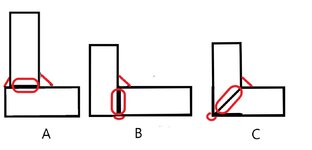
joint.jpg
 
Last edited:
To avoid these ads, REGISTER NOW!

PugetDude

ALLIANCE MEMBER
Joined
Mar 13, 2013
Messages
22,267
Location
Superstition Mountains, AZ
Is this solid stock or tubing? Size? Thickness?
Without knowing the exact parameters, I'd go with C with the diagonal joint beveled and welded to full penetration of material thickness.
I'd also weave a nice wide hot pass over the diagonal joint when you get it filled flush.
The fillet weld on the inside corner should be at least as big as the parent material is thick. The weld on the outside corner of the joint is mostly in compression. just bevel and weld as you normally would.
Free advice on an internet forum.
As always, YMMV.
 

Jswain

Well-known member
Joined
Apr 26, 2013
Messages
2,450
Location
Calgary, AB
Is this solid stock or tubing? Size? Thickness?
Without knowing the exact parameters, I'd go with C with the diagonal joint beveled and welded to full penetration of material thickness.
I'd also weave a nice wide hot pass over the diagonal joint when you get it filled flush.
The fillet weld on the inside corner should be at least as big as the parent material is thick. The weld on the outside corner of the joint is mostly in compression. just bevel and weld as you normally would.
Free advice on an internet forum.
As always, YMMV.
X2, as long as the fitup is good and your welder is powerful enough.
 
OP
S

scooby074

Well-known member
Joined
Oct 26, 2008
Messages
5,229
Location
Nova Scotia
Is this solid stock or tubing? Size? Thickness?
Without knowing the exact parameters, I'd go with C with the diagonal joint beveled and welded to full penetration of material thickness.
I'd also weave a nice wide hot pass over the diagonal joint when you get it filled flush.
The fillet weld on the inside corner should be at least as big as the parent material is thick. The weld on the outside corner of the joint is mostly in compression. just bevel and weld as you normally would.
Free advice on an internet forum.
As always, YMMV.
1/8 wall rect. tubing. Ill update the OP
 

GaryM909

Well-known member
Joined
Apr 11, 2016
Messages
1,515
Location
Calgary, Alberta, Canada
C is probably a little stronger but If I had my choice of welding it I would prefer B. I would put some weld on the inside corner and then back gouge-fill and then add the fillet weld the same thickness as the parent metal. C would be a pain to gouge and weld and then having to build up and grind to reform the outside corner.

Tubing is another story. The 1/8 sq. tube will probably tear before the weld fails.
 

bdbecker

ALLIANCE MEMBER
Joined
Nov 18, 2015
Messages
5,543
Location
Iowa
If joint strength is a concern, adding gussets would also be a good way to beef things up.
 

WoodsTruck

Well-known member
Joined
Jan 12, 2013
Messages
1,019
Overkill: Use C, but with a twist.
Cut 2 L shaped pieces to go on the inside, drill a hole on each leg so you can puddle weld to the L backer. Now you can put the heat to the diagonal weld since you have a backer to burn in to.
 

Attachments

  • joint2.JPG
    joint2.JPG
    44.2 KB · Views: 28

readhead

Well-known member
Joined
Dec 8, 2012
Messages
6,175
Location
Durango, Co.
None of them matters if we don’t know what force is being applied.
Is it a ten foot arm holding a feather or a two foot arm holding a two hundred pound anvil?
We need more information.
 

Bad Eye Bill

Well-known member
Joined
Nov 15, 2017
Messages
5,028
Location
New Brunswick Canada
I went with C just because it looks stronger.

I have no idea if it actually is though.

I can weld stuff together that doesn't break, mostly, but am far from an expert on fabrication.
 
To avoid these ads, REGISTER NOW!

danielbuck

Well-known member
Joined
Apr 15, 2014
Messages
917
A gusset is cheap insurance. But I imagine any of those joints would hold just fine if it's welded good. You might have problems with the tube bending before the welds let go, would be an interesting test :)
 
OP
S

scooby074

Well-known member
Joined
Oct 26, 2008
Messages
5,229
Location
Nova Scotia
None of them matters if we don’t know what force is being applied.
Is it a ten foot arm holding a feather or a two foot arm holding a two hundred pound anvil?
We need more information.
800lbs max wt. 4' max horiz distance from joint
 

Jacko264

Well-known member
Joined
Mar 27, 2016
Messages
927
Location
Kingston upon Hull uk
C is the strongest as there is no open ends In the box but if you use B and weld a plate on the end of the vertical box and gusset it will be as good.
thats only my opinion
G
 

Old Man Roger

Well-known member
Joined
Apr 6, 2017
Messages
17,397
Location
Palm Coast Florida
A gusset is cheap insurance. But I imagine any of those joints would hold just fine if it's welded good. You might have problems with the tube bending before the welds let go, would be an interesting test :)
I was thinking the same thing, the tubing will be the limiting factor. That being said, C looks to have the most welded surface.
 

welder4956

Well-known member
Joined
Apr 8, 2010
Messages
3,059
Location
Birmingham, AL USA
The tubing is the load limiting factor in these sketches, not the weld. Assuming the cut ends are beveled for complete joint penetration, any of these would have essentially the same load carrying ability. My preference would be B since two sides have radii that would result in a flare bevel groove weld with more potential for complete joint penetration. The splice could be made stronger with reinforcement plates across the weld on two sides, but the tubing would still be the weakest link.
 

Monza Harry

Well-known member
Joined
Dec 29, 2018
Messages
1,433
Location
Windsor ON
A gusset is cheap insurance. But I imagine any of those joints would hold just fine if it's welded good. You might have problems with the tube bending before the welds let go, would be an interesting test :)
Well my internet armchair quarter backing thinks that that tube as pointed out will be the weak point as others have said! That weld joint [C] could be strengthened by the two plates as Daniel proposed, then I would add a plate at a 45° angle inside touching the inside corner then plug weld generously along both the top and bottom tangent points. Then add a outside corner cap plate (inside or outside both with pro's and con's). With an opening and inside plates (inner and outer) you have sn excellent opportunity for great penetration at the apexes. I would do the outer course with an exterior cap with full wrap weld. Weld the inner 3 gussets together before insertion to make final welding the easiest. Harry [pic for general concept as words alone may have been lacking! LOL!]
 

Attachments

  • 20240205_211857.jpg
    20240205_211857.jpg
    519.1 KB · Views: 19

nadogail

Well-known member
Joined
Jan 23, 2009
Messages
31,904
Location
Coronado, CA
I would say it depends on the filler metal and degree of penetration. 11018 is the strongest filler I am aware of, but you will not find it a "Big Box" store; the best they will have is 7018.
 

Jswain

Well-known member
Joined
Apr 26, 2013
Messages
2,450
Location
Calgary, AB
Make them any stronger and it'll be a more expensive fix when you stick them in the ground at full speed so I wouldn't overkill too much lol.

I had a boss that used to frequently snap forks clean off a Volvo 120 loader. You could tell it was him because nothing was ever said about it and a new set would show up lol. He was wild in that thing
 
OP
S

scooby074

Well-known member
Joined
Oct 26, 2008
Messages
5,229
Location
Nova Scotia
Make them any stronger and it'll be a more expensive fix when you stick them in the ground at full speed so I wouldn't overkill too much lol.

I had a boss that used to frequently snap forks clean off a Volvo 120 loader. You could tell it was him because nothing was ever said about it and a new set would show up lol. He was wild in that thing
Haha. Yeah this one is totally on me. Always keep your tips up lol. And I used to work in a warehouse driving forklift ! I should know better.
 
OP
S

scooby074

Well-known member
Joined
Oct 26, 2008
Messages
5,229
Location
Nova Scotia
Bear in mind guys, this is a light tractor (Kubota). Every pound on the fork construction is a pound it cant lift. It maxes out at only 800lb of lift at the best of times. Thats why the light duty tubular construction.

The joint question was more about curiosity for this and other jobs. I always figured the mitred (C) would be strongest because the force is being applied across the entire surface of the cut. A &B put the force on the face of one of the pieces. I figure this for Tubular construction for sure. Not so sure about solid material? Probably the same, where the weld would tear from the face at failure?
 

danielbuck

Well-known member
Joined
Apr 15, 2014
Messages
917
1/8" wall square tubing is affordable, I say build the best one you think will work, and see how it goes, for science :D what size rectangle tubing are you thinking about using? 1x2?)
 
To avoid these ads, REGISTER NOW!
Top Bottom