To avoid these ads, REGISTER NOW!

Structural Stuff

the pitch

Active member
Joined
Mar 8, 2026
Messages
29
Location
Southwestern Ontario, Canada
Hey guys,

Looking to turn garage into more useable space (possibly a theatre room/workout room). However my main goal with this post is to get some help making this garage structure more sound. I would like to raiser the rafter ties, I am going to add more collar ties but I've got a couple of questions I was hoping to get help with...

My idea is to add new beefier rafter ties in the lower third, however I question the "rafter tie", Is it typical to have it notched out (to tie into the top plate) and then continue on through to the facer board of the soffit? Can I cut the rafter tie flush with the wall? (after I install the bigger ones of course) Is the notch enough of a tie for the soffit? (looks to be 2 or 3 toe nails)

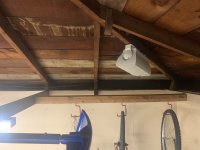
Secondly, the roofline is a hip on both ends and gable in the middle and has a secondary hip where the breezeway joins (see pics). I am wondering how much load in placed on the down post where the hip meets the gable has? Does this do much? Load transfer? There is a 2x6 that is sandwiched in between the down posts that runs down the middle of all the rafter ties (doesn't seem to be nailed, besides the ends where the down posts meet) Does this do much? Load transfer?.

Thanks ahead of time.Garage1.jpgGarage meets breezeway.jpgGarage corner of hip.jpgRoofline.jpg
 

Attachments

  • Garage1.jpg
    Garage1.jpg
    500.6 KB · Views: 24
To avoid these ads, REGISTER NOW!

zendriver

Well-known member
Joined
Dec 10, 2014
Messages
29,814
Location
Indiana
I might be tempted to attach them to the rafters, to keep them from spreading more.

Looks like the roof might might already been sagging having what looks like more than one fix.
 

billconner

Well-known member
Joined
Jul 20, 2021
Messages
6,956
Location
Thousand Islands NYS
If you raise the rafter ties, you have to debate the rafters. It's not hard to calculate with Diana, sizes, spacing, species, and snow load.

As far as supporting the soffit, does the rafter extend to save? That should support soffit so flush cutting existing rafter tie should not be a problem.

Hope I understood the conditions.
 
OP
T

the pitch

Active member
Joined
Mar 8, 2026
Messages
29
Location
Southwestern Ontario, Canada
What issue are you trying to fix?
My idea is to raise the rafter height to gain some headroom, but i'd like to make sure structure is at a detriment. My main conundrum is the point where the hip roof meets the gable roof, is the wood that is down to the rafter tie structural? It looks as though it may be but it doesn't make sense in my brain how it is (if it is)
 
OP
T

the pitch

Active member
Joined
Mar 8, 2026
Messages
29
Location
Southwestern Ontario, Canada
I might be tempted to attach them to the rafters, to keep them from spreading more.

Looks like the roof might might already been sagging having what looks like more than one fix.
As far as I can tell there may be minimal sag at some point. We just bought the house, I'm finding out a lot of things were cobbled around here, so I wouldn't be surprised if something was done incorrectly. When you say "I might be tempted to attach them to the rafters" what do you mean by them? I should have mentioned the garage size in the initial post but it's only 12' across and 23' long.
 
OP
T

the pitch

Active member
Joined
Mar 8, 2026
Messages
29
Location
Southwestern Ontario, Canada
If you raise the rafter ties, you have to debate the rafters. It's not hard to calculate with Diana, sizes, spacing, species, and snow load.

As far as supporting the soffit, does the rafter extend to save? That should support soffit so flush cutting existing rafter tie should not be a problem.

Hope I understood the conditions.
What is the debate with the rafters? If I raise the ties how will this affect the rafter? Is stress placed on the 2x4 rafter as the tie is raised? Sorry I'm new around here...who is Diana?
 
OP
T

the pitch

Active member
Joined
Mar 8, 2026
Messages
29
Location
Southwestern Ontario, Canada
As far as I can tell there may be minimal sag at some point. We just bought the house, I'm finding out a lot of things were cobbled around here, so I wouldn't be surprised if something was done incorrectly. When you say "I might be tempted to attach them to the rafters" what do you mean by them? I should have mentioned the garage size in the initial post but it's only 12' across and 23' long.
Might I ask which photo you thought there was sag? Just out of curiousity
 
OP
T

the pitch

Active member
Joined
Mar 8, 2026
Messages
29
Location
Southwestern Ontario, Canada
My idea is to raise the rafter height to gain some headroom, but i'd like to make sure structure is at a detriment. My main conundrum is the point where the hip roof meets the gable roof, is the wood that is down to the rafter tie structural? It looks as though it may be but it doesn't make sense in my brain how it is (if it is)
isn't derp
 

sayn3ver

Active member
Joined
Jan 16, 2022
Messages
44
My idea is to raise the rafter height to gain some headroom, but i'd like to make sure structure is at a detriment. My main conundrum is the point where the hip roof meets the gable roof, is the wood that is down to the rafter tie structural? It looks as though it may be but it doesn't make sense in my brain how it is (if it is)

You want to raise the rafter height or the ceiling joist/rafter ties?

The rafter ties (the flat horizontal members) in a normal hand cut gable are allowed to be up to 1/3 of the overall height of the roof by the IRC/IBC code. These ties are also supposed to be lapped at the rafters and nailed according to code. Your rafter ties from the photo look like they are inline with the rafters and not next to the rafters providing almost no thrust resistance (the typical tie finds itself in tension as the lower parts of the opposing rafters naturally want to splay outwards with the weight and force of gravity. Think of a big weight placed on the ridge with a big arrow facing down. With the rafter tie lapped next to the bottom of the rafter, the nails that are driven in are then holding the rafter tension in sheer which is the nail's strength.

If what you say you want to do is raise the rafter height, I don't know of a code compliant solution. The rafters are typically required to sit on the top plate of the wall. You could realistically maybe jack up all the rafters and ties on a side and slide in another 2x member gaining another 1.5" but I don't know how sound a triple top plate is. I would imagine nailing that new plate down by the IRC schedule wouldn't structurally change much. But your entire roof is now 1.5" higher but that will literally impact all aspects. your siding would be 1.5" short. The hip to gable intersection will be 1.5" taller and all those jack rafters will need to be lengthen the roof sheathing extended 1.5". new valleys and reroofing, etc. All for 1.5" At that point might as well just rip the garage down and frame taller walls and start over.

EDIT: Looking closer at the photo, it looks like your hip roof ridge is already the same elevation as the gable roof. Raising the rafters or going higher is going to create a mess of much more complicated roof framing.
 

firebirdparts

Well-known member
Joined
Jun 8, 2016
Messages
10,594
Location
Kingsport, TN
The low pitch makes for a weak design, but the hip roof makes for a strong design. There is theoretically zero load on a vertical post under the hip intersection. They just put that up for construction.

If you remove all the rafter ties, the area that will sag is the ridge pole and only the walls that can move if the ridge pole moves, That is, just the middle of the long wall, FWIW. If you had enough stiffness at the ridge pole, you technically wouldn't need any Rafter ties at all in theory.

In reality, getting solid connections with wood is pretty difficult. Rafter ties work because it's flat on flat and you can attach that. So reality differs from theory in that area. In a hip building, you can send all the push forces to the 4 corners, but you have to be able to attach that in a suitably strong way, and that's not that easy.
 
OP
T

the pitch

Active member
Joined
Mar 8, 2026
Messages
29
Location
Southwestern Ontario, Canada
You want to raise the rafter height or the ceiling joist/rafter ties?

The rafter ties (the flat horizontal members) in a normal hand cut gable are allowed to be up to 1/3 of the overall height of the roof by the IRC/IBC code. These ties are also supposed to be lapped at the rafters and nailed according to code. Your rafter ties from the photo look like they are inline with the rafters and not next to the rafters providing almost no thrust resistance (the typical tie finds itself in tension as the lower parts of the opposing rafters naturally want to splay outwards with the weight and force of gravity. Think of a big weight placed on the ridge with a big arrow facing down. With the rafter tie lapped next to the bottom of the rafter, the nails that are driven in are then holding the rafter tension in sheer which is the nail's strength.

If what you say you want to do is raise the rafter height, I don't know of a code compliant solution. The rafters are typically required to sit on the top plate of the wall. You could realistically maybe jack up all the rafters and ties on a side and slide in another 2x member gaining another 1.5" but I don't know how sound a triple top plate is. I would imagine nailing that new plate down by the IRC schedule wouldn't structurally change much. But your entire roof is now 1.5" higher but that will literally impact all aspects. your siding would be 1.5" short. The hip to gable intersection will be 1.5" taller and all those jack rafters will need to be lengthen the roof sheathing extended 1.5". new valleys and reroofing, etc. All for 1.5" At that point might as well just rip the garage down and frame taller walls and start over.

EDIT: Looking closer at the photo, it looks like your hip roof ridge is already the same elevation as the gable roof. Raising the rafters or going higher is going to create a mess of much more complicated roof framing.
Just raising the rafter ties and re-supporting the hip roof (if need be) is what I am looking to do. The rafter ties are indeed inline with the rafters and are notched and nailed directly to the top plate and then continue on through the soffit to the fascia board. Are the first and last rafter ties supporting the hip through the vertical supports? Are those vertical supports structural? What is the purpose of the board sandwiched in-between the vertical supports and the rafter tie doing?(the one that runs perpendicularly across the top of the rafter ties)
Thanks
 
OP
T

the pitch

Active member
Joined
Mar 8, 2026
Messages
29
Location
Southwestern Ontario, Canada
Just raising the rafter ties and re-supporting the hip roof (if need be) is what I am looking to do. The rafter ties are indeed inline with the rafters and are notched and nailed directly to the top plate and then continue on through the soffit to the fascia board. Are the first and last rafter ties supporting the hip through the vertical supports? Are those vertical supports structural? What is the purpose of the board sandwiched in-between the vertical supports and the rafter tie doing?(the one that runs perpendicularly across the top of the rafter ties)
Thanks
Further clarification - I have no plans for storage above the rafter ties nor do I plan to drywall the bottom of them.
 
OP
T

the pitch

Active member
Joined
Mar 8, 2026
Messages
29
Location
Southwestern Ontario, Canada
The low pitch makes for a weak design, but the hip roof makes for a strong design. There is theoretically zero load on a vertical post under the hip intersection. They just put that up for construction.

If you remove all the rafter ties, the area that will sag is the ridge pole and only the walls that can move if the ridge pole moves, That is, just the middle of the long wall, FWIW. If you had enough stiffness at the ridge pole, you technically wouldn't need any Rafter ties at all in theory.

In reality, getting solid connections with wood is pretty difficult. Rafter ties work because it's flat on flat and you can attach that. So reality differs from theory in that area. In a hip building, you can send all the push forces to the 4 corners, but you have to be able to attach that in a suitably strong way, and that's not that easy.
It's somewhere between a 4/12 and 5/12 pitch (the photo makes it look a little flatter). How would you add stiffness at the ridge board?
How would you send the push forces to the four corners? Are you saying the vertical post under the hip could be removed? Thank you
 

zendriver

Well-known member
Joined
Dec 10, 2014
Messages
29,814
Location
Indiana
As far as I can tell there may be minimal sag at some point. We just bought the house, I'm finding out a lot of things were cobbled around here, so I wouldn't be surprised if something was done incorrectly. When you say "I might be tempted to attach them to the rafters" what do you mean by them? I should have mentioned the garage size in the initial post but it's only 12' across and 23' long.

What I meant was, I couldn’t decide for sure. Unless I’m standing inside the garage looking at it. images Don’t always give me the full picture.

If you want to raise the ceiling, you probably don’t have a lot of choice, but to attach to the rafters
 

billconner

Well-known member
Joined
Jul 20, 2021
Messages
6,956
Location
Thousand Islands NYS
What is the debate with the rafters? If I raise the ties how will this affect the rafter? Is stress placed on the 2x4 rafter as the tie is raised? Sorry I'm new around here...who is Diana?
Diana was a typo/spell check - dimensions. Sorry.

Yes, the rafter tie attached is a load on the rafter, reducing the snow load. Without checking, I believe code says if you raise the ties to third point, rafter capacity is approx 2/3 of what it is with tie at bottom. So maybe one solution is to sister rafters.

Like others, I suspect the vertical hangers can be removed. They may have been used for construction or to support a storage load on the rafter tie.

Based on 12 x 23, shouldn't be hard. Loads are really small. Firebird's suggestion of a ridge beam instead of a ridge board is interesting. 11 feet? Interesting.

Just math ultimately.

Are you planning insulation and/or a ceiling? Could impact structure.
 
OP
T

the pitch

Active member
Joined
Mar 8, 2026
Messages
29
Location
Southwestern Ontario, Canada
Diana was a typo/spell check - dimensions. Sorry.

Yes, the rafter tie attached is a load on the rafter, reducing the snow load. Without checking, I believe code says if you raise the ties to third point, rafter capacity is approx 2/3 of what it is with tie at bottom. So maybe one solution is to sister rafters.

Like others, I suspect the vertical hangers can be removed. They may have been used for construction or to support a storage load on the rafter tie.

Based on 12 x 23, shouldn't be hard. Loads are really small. Firebird's suggestion of a ridge beam instead of a ridge board is interesting. 11 feet? Interesting.

Just math ultimately.

Are you planning insulation and/or a ceiling? Could impact structure.

Diana was a typo/spell check - dimensions. Sorry.

Yes, the rafter tie attached is a load on the rafter, reducing the snow load. Without checking, I believe code says if you raise the ties to third point, rafter capacity is approx 2/3 of what it is with tie at bottom. So maybe one solution is to sister rafters.

Like others, I suspect the vertical hangers can be removed. They may have been used for construction or to support a storage load on the rafter tie.

Based on 12 x 23, shouldn't be hard. Loads are really small. Firebird's suggestion of a ridge beam instead of a ridge board is interesting. 11 feet? Interesting.

Just math ultimately.

Are you planning insulation and/or a ceiling? Could impact structure.
I'm good with math lol (master electrician) however I don't have a building code book.

I don't think sistering the gable rafters would be too difficult (just have to find out if it's needed) There are only 4 sets of gable rafters (24"OC). Then a hip roof on both ends (one end has the breezeway hip also joined)

My idea is to spray foam the rafter spaces (had plans to add 2x2s to get depth for ceiling) and walls and then board directly to rafters. I would need to have some compensation for that dead load...i'm assuming that would be on a building code table as well?
 

billconner

Well-known member
Joined
Jul 20, 2021
Messages
6,956
Location
Thousand Islands NYS
I find it easy to calculate all this based on span tables in the code. There is free view only access, and your state may also have it, and library would have it usually.

Here's the thing. Probably your "old" garage as is would not meet the minimums for new today, which is what would normally apply for your changes. So, are you going to follow codes, like as if you got a building permit?

I don't think what you want to do is difficult, but it is a little more than just bailing in raised rafter ties and cutting old ones.

Where in the world are you, for snow load. I'm in 60 psf land, which is a significant design constraints.
 
OP
T

the pitch

Active member
Joined
Mar 8, 2026
Messages
29
Location
Southwestern Ontario, Canada
I find it easy to calculate all this based on span tables in the code. There is free view only access, and your state may also have it, and library would have it usually.

Here's the thing. Probably your "old" garage as is would not meet the minimums for new today, which is what would normally apply for your changes. So, are you going to follow codes, like as if you got a building permit?

I don't think what you want to do is difficult, but it is a little more than just bailing in raised rafter ties and cutting old ones.

Where in the world are you, for snow load. I'm in 60 psf land, which is a significant design constraints.
I would like to gain the headroom certainly, but my main concern is safety and longevity.

The house is 75 years old and has held up this long and I also realize we can't afford to build the Taj Mahal here.

As far as code goes, I would like to follow it (or at least as close as reasonably practicable). I am in Southwestern Ontario, Canada - according to building standards docs I've found my snow load is 27psf or 1.3kPa (two numbers I've found on various sites).

After looking through the span tables it seems as though my ceiling joists can span 8'1" (2x4 - 24"OC), my roof joists (2x4 - 24"OC) can span 5'1" with a snow load of 40psf or 2.0kPa and my roof rafters (2x4 - 24"OC) are allowed to span 6'5" under the same conditions. From wall to wall is 12'.

Now what to do with that information...How to know if it's a roof joist? (again no drywall attached to this)

I would like to raise the rafter tie as much as possible (maybe 10-12" which is within the bottom third), I was think a 2x6 - 24"OC face nailed to the existing 2x4 rafter would do the trick, allowing me to then to cut out the existing 2x4 rafter tie. If need be I could raise height by only 3 ½" and still be able to face nail the 2x6 to the rafter and toe nailing to the top plate.
 
To avoid these ads, REGISTER NOW!

billconner

Well-known member
Joined
Jul 20, 2021
Messages
6,956
Location
Thousand Islands NYS
@the pitch Sorry - read this early today and got waylaid by work. I'll try to study and reply.

I don't know if southwestern Ontario is Ft Frances, Windsor, or other but on US side snow load is a lot more than 27psf. US codes require a minimum of 30, and where I live on border near Kingston, it's 60.

6' span, 24" on center, I can work with that.

Not sure what you are calling a roof rafter versus roof joist. I assume ceiling joists are rafter ties, but it is confusing that they are rafter ties until you attach a ceiling and then become ceiling joist.
 
OP
T

the pitch

Active member
Joined
Mar 8, 2026
Messages
29
Location
Southwestern Ontario, Canada
@the pitch Sorry - read this early today and got waylaid by work. I'll try to study and reply.

I don't know if southwestern Ontario is Ft Frances, Windsor, or other but on US side snow load is a lot more than 27psf. US codes require a minimum of 30, and where I live on border near Kingston, it's 60.

6' span, 24" on center, I can work with that.

Not sure what you are calling a roof rafter versus roof joist. I assume ceiling joists are rafter ties, but it is confusing that they are rafter ties until you attach a ceiling and then become ceiling joist.
I am in St. Thomas, ON (half way between Toronto and Windsor)...Kingston falls into one of the snow belt regions, we get a lot less prolonged accumulation and much less lake effect snow than even just 30 miles north of us (although this year was pretty darn wintery).

As far as my confusion with the terminology - it only really became confusing when I read the Ontario Building Code span tables and it gave span listings for roof rafters, roof joists, and ceiling joists. Is a roof joist and a rafter tie the same thing? Why are roof joists (if it is a rafter tie) spans less than that of ceiling joists? I guess maybe because a roof joist (rafter tie) can also be a ceiling joist, but a ceiling joist is not necessarily a roof joist.
I digress...

I appreciate your help and look forward to reading your response, Thanks in advance.
 

TRWham

Well-known member
Joined
Aug 11, 2017
Messages
1,958
Location
East Cobb County, Georgia
As small as that roof is, I would first recommend simply replacing it with a new gable roof with a ridge beam and vault the ceiling. Even if you keep the door, posting down to a beam across that opening would work and maybe another beam at the rear depending on what other structure might be available to bear it. It may seem extreme, but I think it may be simpler and quicker in the end and the rafter and collar ties go away as an issue. The biggest problem would be matching the shingles to avoid doing the entire roof.
 
OP
T

the pitch

Active member
Joined
Mar 8, 2026
Messages
29
Location
Southwestern Ontario, Canada
As small as that roof is, I would first recommend simply replacing it with a new gable roof with a ridge beam and vault the ceiling. Even if you keep the door, posting down to a beam across that opening would work and maybe another beam at the rear depending on what other structure might be available to bear it. It may seem extreme, but I think it may be simpler and quicker in the end and the rafter and collar ties go away as an issue. The biggest problem would be matching the shingles to avoid doing the entire roof.
Thank you for your response, but this is absolutely out of the question for me. Best case scenario I raise the rafter ties and add more structural support. Worst case, I leave it as is. Thanks again.
 

NUTTSGT

Super Moderator
Staff member
Joined
Sep 14, 2009
Messages
50,895
Location
Northern Central Ohio
I might be wrong here but I believe you might be in Canada. That can change what you are required to do by code


I would suggest, for future reference, to add a general location to your profile..it helps with questions like these.
 
OP
T

the pitch

Active member
Joined
Mar 8, 2026
Messages
29
Location
Southwestern Ontario, Canada
@the pitch Sorry - read this early today and got waylaid by work. I'll try to study and reply.

I don't know if southwestern Ontario is Ft Frances, Windsor, or other but on US side snow load is a lot more than 27psf. US codes require a minimum of 30, and where I live on border near Kingston, it's 60.

6' span, 24" on center, I can work with that.

Not sure what you are calling a roof rafter versus roof joist. I assume ceiling joists are rafter ties, but it is confusing that they are rafter ties until you attach a ceiling and then become ceiling joist.
Hey Bill, just reaching out to see if you ended up coming up with anything?
 

billconner

Well-known member
Joined
Jul 20, 2021
Messages
6,956
Location
Thousand Islands NYS
Hey Bill, just reaching out to see if you ended up coming up with anything?
I was at a conference 5 days last week - got home late Monday because a a day weather delay, and am about to head out in a few minutes until next Monday. So no, I apologize. Intended to look this up but haven't had a minute. I may have hotel time to look at this. It's on my list.
 
OP
T

the pitch

Active member
Joined
Mar 8, 2026
Messages
29
Location
Southwestern Ontario, Canada
I was at a conference 5 days last week - got home late Monday because a a day weather delay, and am about to head out in a few minutes until next Monday. So no, I apologize. Intended to look this up but haven't had a minute. I may have hotel time to look at this. It's on my list.
No worries at all, I really appreciate it!
 

billconner

Well-known member
Joined
Jul 20, 2021
Messages
6,956
Location
Thousand Islands NYS
OK. Using 2024 IRC, I figured for 30 and 50 PSF ground snow load. I assumed SPF no. 2 for species and grade, 24" o.c., L/180 which means not plaster or drywall ceiling. I did use a dead load of 20 PSF to allow for ceiling and insulation. Probably small difference if you wanted to go to L/240 for drywall.

For 30 PSF the 2x4 just makes it at 5'-11". If you raise rafter ties to 1/3 point on rafters, they only span 4'-0". Simplest fix for me is to sister each 2x4, this framing is effectively on 12" centers, and that spans 8'-5" or 5'-7" raised a 1/3. Raise it just a 1/4 and it's good to 6'-3".

I'll give you the 30 psf. I was surprised but map in IRC shows 30 from north of Detroit to Erie PA and I think you're in that area.

A 2x4 rafter-tie/ceiling joist is good for 9'-5", which with them raised you are within.

My sketch - no AutoCAD on my laptop in hotel - attached.PXL_20260320_172503048.jpg
 
OP
T

the pitch

Active member
Joined
Mar 8, 2026
Messages
29
Location
Southwestern Ontario, Canada
Thanks for that, It's much appreciated.

Couple questions/comments.

Are you suggesting sistering every 2x4 in the current roofline or just the gable portion?

Assuming the rules were different in the past, my current roofline would not pass a modern inspection. Having said that, the current 2x4 rafter ties span 12' are undersized, would adding a 2x6 face nailed into the rafter and toe nailed into the top plate be an improvement? This would essentially be 3.5" higher than it currently sits (as mentioned before the 2x4 rafter ties are notched and sit flush with top plate)

Would using a trusscore product (or something different) be better for direct connection to the rafter? The initial idea was to dress the rafter ties to look like timbers and drywall directly to the rafter for finishing.

Thanks again for all your help.
 

billconner

Well-known member
Joined
Jul 20, 2021
Messages
6,956
Location
Thousand Islands NYS
Just gable, including the ones that meet at hip apex. I'd probably do the ones in line with ridge board but not sure I can justify that. So all but jack rafters.

I agree the 2x4 collar ties are undersized but if you raise them, they won't be. On the other hand replacing them with 2x6s gives you more meat for the connections. I think rafter tie connections are always a weak point. In my recently built garage I used timberloks in both ties and rafters and feel better than nails.

Not sure what trusscore means to you. Here it's a plastic interior wall panel. So apologies but can't picture it.

I could get onboard with double ext rafter ties butting into the double rafters. that could give you "beam" look. Maybe I don't understand.
 
OP
T

the pitch

Active member
Joined
Mar 8, 2026
Messages
29
Location
Southwestern Ontario, Canada
Ya trusscore is the same here...just wondered if that might minimize deflection if mounting directly to the rafter? or would drywall still be ok to hang directly to rafter?

I could sister in some 2x6 instead of 2x4s (giving me more room for insulation)...would you sister with nails or also with timberloks?

Ok just so I'm clear...If I double up the gable rafters (including the hip apex, and possibly the ones in line with the ridge board) I could raise the rafter tie (within the bottom third) without any concern? And we've established the wood going down from where the hip meets the gable to the rafter tie can be removed as well.

Any concerns with the collar ties?

With the sistered rafter - how would you go about tying in to the top plate? a wedge with toe nails? (like the existing ones) or is there a better method?

As far as the 'beam' look - I was just considering dressing up the rafter tie with 1bys to make it look like a beam. I suppose I could source out some timbers that could work both structurally while still having a finished look...
 

billconner

Well-known member
Joined
Jul 20, 2021
Messages
6,956
Location
Thousand Islands NYS
Collar ties to my learning are to resist uplift. Good for garages in hurricane areas.

I'd nail sistered rafters and toe nail to ridge board. Not really necessary since trying to create 2x4s on 12" centers. That was basis for sistering.

And I would timberlok rafters up through top plates.

Insulation and venting are different questions.

I've seen trusscore but have not used it. I don't.tjinknit matters structurally if you use either.
 
OP
T

the pitch

Active member
Joined
Mar 8, 2026
Messages
29
Location
Southwestern Ontario, Canada
Collar ties to my learning are to resist uplift. Good for garages in hurricane areas.

I'd nail sistered rafters and toe nail to ridge board. Not really necessary since trying to create 2x4s on 12" centers. That was basis for sistering.

And I would timberlok rafters up through top plates.

Insulation and venting are different questions.

I've seen trusscore but have not used it. I don't.tjinknit matters structurally if you use either.
When you say "trying to create 2x4s on 12" centers" do you mean that the sistered rafters, while on 24" centers, simulate a 2x4 on 12"?

I will be spray foaming the entire envelope, the roof will be hot sprayed.

If drywall weight isn't a problem for deflection then drywall it is
 

billconner

Well-known member
Joined
Jul 20, 2021
Messages
6,956
Location
Thousand Islands NYS
Yes, I'm saying two 2x4s sistered 24" o.c. has same strength as single 2x4s 12" o.c. This was debated on a building code forums - mostly building officials - and they were slit between it was just as strong vs. it's not called out in the code book. Your deck has to be able to span between rafters but easy.

Let me go back and check drywall. I see my sketch used L/180 and I need to look at L/240 for drywall. It works fine for the flat part on ceiling joist, I can't say for sure on the 2' of sloped section. I honestly don't think it will make a difference in such short spans.

I may have guessed you were leaning to t&g.

ps on an airplane (since 6:00 am west coast) so not today.
 
OP
T

the pitch

Active member
Joined
Mar 8, 2026
Messages
29
Location
Southwestern Ontario, Canada
Yes, I'm saying two 2x4s sistered 24" o.c. has same strength as single 2x4s 12" o.c. This was debated on a building code forums - mostly building officials - and they were slit between it was just as strong vs. it's not called out in the code book. Your deck has to be able to span between rafters but easy.

Let me go back and check drywall. I see my sketch used L/180 and I need to look at L/240 for drywall. It works fine for the flat part on ceiling joist, I can't say for sure on the 2' of sloped section. I honestly don't think it will make a difference in such short spans.

I may have guessed you were leaning to t&g.

ps on an airplane (since 6:00 am west coast) so not today.
Ok great thank you, I do like the idea of t&g...

Oh...How would you connect at the top plate? You said timber locks through the bottom but the same as existing? which is a triangular cut piece of lumber. Or is there another better way to do this?

Any downsides to sistering in 2x6s instead?
 

billconner

Well-known member
Joined
Jul 20, 2021
Messages
6,956
Location
Thousand Islands NYS
I like screws. Easy and nearly not visible and tests say stronger than plates.

No downside of 2x6 I can see except the detail at top plate. Your get a little "shelf" of soffit. Lots of ways of addressing it. I'd probably let bottom edge extend to wall, a kind of reverse birds mouth.

I did a room with T&G and it was an expensive pre finished product. I later did my porch, and found it much cheaper.and came up with a rack to allow me to coat it easily and quickly.
 

Attachments

  • F_SDWC_InstPho_Pho_Inst_SDWC-TrussScrew-HighVibrance-Orange_C0.jpg
    F_SDWC_InstPho_Pho_Inst_SDWC-TrussScrew-HighVibrance-Orange_C0.jpg
    96.5 KB · Views: 16
OP
T

the pitch

Active member
Joined
Mar 8, 2026
Messages
29
Location
Southwestern Ontario, Canada
I like screws. Easy and nearly not visible and tests say stronger than plates.

No downside of 2x6 I can see except the detail at top plate. Your get a little "shelf" of soffit. Lots of ways of addressing it. I'd probably let bottom edge extend to wall, a kind of reverse birds mouth.

I did a room with T&G and it was an expensive pre finished product. I later did my porch, and found it much cheaper.and came up with a rack to allow me to coat it easily and quickly.
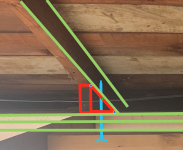
So how long is that screw in the photo? does it go right through the double top plate and up into the rafter? (see blue 'screw' in photo) Can I do just the screw and not the plate? (like in your photo) or does it have to be both?

If I am raising the rafter tie up into the bottom third, then the method in your attached photo won't work...can I use a wood wedge (red triangle) in that space like what is already there? (see photo attached) and then face nail the rafter tie into the doubled up rafter?

Not sure I understand this "No downside of 2x6 I can see except the detail at top plate. Your get a little "shelf" of soffit. Lots of ways of addressing it. I'd probably let bottom edge extend to wall, a kind of reverse birds mouth." - any way you can draw this?

Also, I'm assuming the sistered 2x4 only needs to run as far as just beyond the top plate...is that correct?
 

Attachments

  • Drawing.png
    Drawing.png
    1.6 MB · Views: 18
Last edited:

billconner

Well-known member
Joined
Jul 20, 2021
Messages
6,956
Location
Thousand Islands NYS
Your existing rafters may not be what I consider "normal" - I can't quite tell from photos - but sketch shows what I was thinking by "shelf" under 2x6 birds mouth.

A 4" screw if perpendicular to rafter starting at seam between double top plates, or a 6" screw if straight up through double top plate. I used 8" but rough sawn so double top plate was a full 4" thick.

And 2x4 12" OC for 30 psf snow load, 20 psf dead load (excessive), and L/240 will easily support drywall at 8'-3" span, and your only at 6'-0". I double checked ceiling joist/rafter tie for same criteria and spans 9'-5" - well over your 8' span with it raised. Now if these ceiling joists are 24" o.c., a single 2x4 only goes 7'-2" - close but may sag. Put a 2x4 hanger in center or go to 2x6.
 

Attachments

  • PXL_20260324_183801177_copy_1228x1632.jpg
    PXL_20260324_183801177_copy_1228x1632.jpg
    419.2 KB · Views: 15
To avoid these ads, REGISTER NOW!
Top Bottom