To avoid these ads, REGISTER NOW!

Sub-panel and future proofing?

duneslider

Well-known member
Joined
Jan 20, 2013
Messages
2,267
Location
Riverton, Utah
I'm planning to put a sub-panel in a utility room next to my garage but as I have been planning out the future I am wondering what is the proper way to do this based on some possibilities in the future.

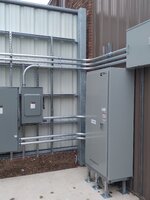
Main power comes to the house on the south of house into the meter that has the 200amp disconnect/breaker then travels halfway through house to the 200amp panel in basement. I want to run a line from the house main panel to the utility roof near the garage on the North end of the house.

Future plans would include a potential shop with a possible ADU above the shop which would be located on the North side of house near the subpanel.
If I add solar in the future it would also be located towards the north end of the house nearest the potential subpanel.
If I add car charging, additional welder, rv hook ups these would also be near the subpanel (currently already have a 40amp/220v plug in the garage coming from the house panel).
If I add a battery wall this would also make the most sense to be on the north end of the house near the potential subpanel.

Initially, I had planned on the 90amp feed that is so often talked about on here to feed the subpanel but given all these future possibilities does that make sense, or should I be looking to run something larger to the subpanel given the future potential? It would be very difficult to change any of this wiring back to the house panel in the future once the basement is complete.
 
To avoid these ads, REGISTER NOW!

Stuart in MN

Well-known member
Joined
Sep 8, 2005
Messages
23,157
Location
Minneapolis
Adding solar or a battery wall would require a connection directly back to the main disconnect, along with some sort of transfer switch equipment, so they wouldn't be run to the sub panel.
 

starquestMM

Well-known member
Joined
Jan 7, 2013
Messages
1,077
Location
JC, Missouri
adding solar to anything but the main panel comes with some extra requirements that might be doable or not. Utility here wants an external disconnect within X feet of the meter. They "can" approve variances, but i haven't gotten that far yet. Also there will be some limitations in the main panel itself that need evaluating.
 

dcg9381

Well-known member
Joined
Jun 20, 2018
Messages
11,883
Location
Austin, TX
You can absolutely add "grid tie" solar to a sub-panel. I've got 6kW feeding the shop sub-panel. You need to make sure that the panel is rated for solar + feed amps though.

Around here, you need a "photovoltaic disconnect" (DC disconnect for the panels) and a "panel disconnect" for the AC feed, both must be accessible outside the building and labelled.

Many newer PV systems have "rapid shutdown" when they lose grid sync. NEC allows this in place of physical disconnects, but in some areas the POC will require physical disconnects anyway.


OP, if you're doing solar, you'll want to provide a path (conduit perhaps) from the existing panel to where the inverter might sit and another conduit path from the inverter to the panel general area. 3/4" should do it for arrays under 10kW.
 
Last edited:
OP
D

duneslider

Well-known member
Joined
Jan 20, 2013
Messages
2,267
Location
Riverton, Utah
It sounds like maybe I shouldn't worry about the solar going to the sub. I can fairly easily get the solar line straight through the attic to the main disconnect without much trouble.
 

u2slow

Well-known member
Joined
Nov 20, 2011
Messages
3,610
Location
BC
If you surface mount a panel and put a conduit or 2 through a space you will finish, it's easier to add stuff later.
 

dcg9381

Well-known member
Joined
Jun 20, 2018
Messages
11,883
Location
Austin, TX
It sounds like maybe I shouldn't worry about the solar going to the sub. I can fairly easily get the solar line straight through the attic to the main disconnect without much trouble.
Again, solar can go on a sub panel no problem. I don't know of any "additional" requirements that this would trigger.
It may be adventageous to do it now as again, you'll need an exterior disconnect (two) unless you're allowed a rapid shut down system.
 
OP
D

duneslider

Well-known member
Joined
Jan 20, 2013
Messages
2,267
Location
Riverton, Utah
Again, solar can go on a sub panel no problem. I don't know of any "additional" requirements that this would trigger.
It may be adventageous to do it now as again, you'll need an exterior disconnect (two) unless you're allowed a rapid shut down system.
An exterior disconnect wouldn't be an issue for either location and frankly would be easier and less "unsightly" than if it were on the north side by the main house disconnect.

If 3/4" conduit would be enough for solar, I also don't have an issue making a few runs with 3/4 or 1" just in case. I plan to run some conduit for coax for a different hobby anyway.
 
To avoid these ads, REGISTER NOW!
OP
D

duneslider

Well-known member
Joined
Jan 20, 2013
Messages
2,267
Location
Riverton, Utah
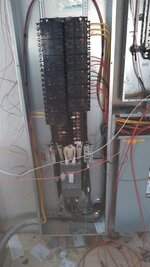
I'm finally moving forward on the 90amp subpanel but as I am looking at planning and ordering I realized that my existing panel has zero opening at the top of the panel for the 2-2-2-4. I could go all the way down the wall and up the bottom but that adds almost 6 feet of SER and seems silly, but maybe that is the best way.

I currently have a 40amp breaker near the top of the panel that I planned to remove to put in the 90amp breaker, the location for the cable going to the 40amp is not big enough for the SER. I could maybe do some rearranging of the romex entering the top to free up a space large enough for the SER, so that is an option. I did have the thought that if I could come in the side of the panel I could have basically a straight shot at the breaker. I haven't done that before and am not sure what the proper way would be, if there is one, to go through a stud and into the panel? If that is an option, what is the proper way to do that? Or should I just rearrange the romex at the top to make room at the top?

The rest of the job is straight forward and pretty standard. There are still a dozen open slots in the existing panel but there isn't a lot of space left to have wire enter the panel.
 

dave*99

Well-known member
Joined
May 5, 2009
Messages
4,276
Location
Coastal NJ
I'm finally moving forward on the 90amp subpanel but as I am looking at planning and ordering I realized that my existing panel has zero opening at the top of the panel for the 2-2-2-4. I could go all the way down the wall and up the bottom but that adds almost 6 feet of SER and seems silly, but maybe that is the best way.

I currently have a 40amp breaker near the top of the panel that I planned to remove to put in the 90amp breaker, the location for the cable going to the 40amp is not big enough for the SER. I could maybe do some rearranging of the romex entering the top to free up a space large enough for the SER, so that is an option. I did have the thought that if I could come in the side of the panel I could have basically a straight shot at the breaker. I haven't done that before and am not sure what the proper way would be, if there is one, to go through a stud and into the panel? If that is an option, what is the proper way to do that? Or should I just rearrange the romex at the top to make room at the top?

The rest of the job is straight forward and pretty standard. There are still a dozen open slots in the existing panel but there isn't a lot of space left to have wire enter the panel.
Hole punch?
 
OP
D

duneslider

Well-known member
Joined
Jan 20, 2013
Messages
2,267
Location
Riverton, Utah
I'd rather come in the top and make the hole bigger
Its not about making the hole bigger, that is easy. It's the fact that there isn't room currently to make a bigger hole unless multiple circuits of romex are moved to make room for a bigger hole. If that is the best way to go I can do that though.
 

Bert_

Well-known member
Joined
Dec 24, 2016
Messages
9,775
Location
NW Iowa
Its not about making the hole bigger, that is easy. It's the fact that there isn't room currently to make a bigger hole unless multiple circuits of romex are moved to make room for a bigger hole. If that is the best way to go I can do that though.
Ok. I would not want to come in the side. If you have room to move a couple romex to another hole I'd do that.

If the top of the panel is packed then I would make the wire longer and come in the bottom
 

ipgenie

Well-known member
Joined
Jan 29, 2020
Messages
562
Location
Idaho
In Utah, you might have Rocky Mountain Power as your utility. We have them in Idaho and were required to run the inverted solar power all the way to the main panel. Even with rapid shutdown, a lockable mechanical disconnect is required within a few feet of the main panel.

My main is on the shop where the panels are located so it was easy for me. My neighbor put panels on their barn and had to run the solar power around the barn, across almost their whole property to the opposite side of the house so it could be connected directly to the main panel (with adjoining disconnect).

Maybe you have different requirements than we do, but it would pay to find out while it's still easier to run the conduit. The requirements can vary wildly from one jurisdiction to another.

Edit to add, make sure the math adds up before you jump in on grid tie solar. Hiring out the project would be tough to ever break even with the current grid tie agreements. Also, if you are looking to add battery backup, you will need a transfer switch or interlock at the main panel and additional wiring/conduit to feed it from the battery/inverter. A backup generator is almost always the cheaper way to go vs solar/batteries and this is coming from someone who has all of the above. DIY and a smaller system can sometimes make it work out to reasonabley break even.
 
Last edited:

mm08822

Well-known member
Joined
Jan 13, 2012
Messages
6,037
Location
NJ
Its not about making the hole bigger, that is easy. It's the fact that there isn't room currently to make a bigger hole unless multiple circuits of romex are moved to make room for a bigger hole. If that is the best way to go I can do that though.
Not that I like to, but certain rx connectors can handle up to 3 flat (2wire) cables depending on conductor gauge. I personally wouldn't do more than 2 cables per connector. Maybe this info helps for top entry.
 
OP
D

duneslider

Well-known member
Joined
Jan 20, 2013
Messages
2,267
Location
Riverton, Utah
In Utah, you might have Rocky Mountain Power as your utility. We have them in Idaho and were required to run the inverted solar power all the way to the main panel. Even with rapid shutdown, a lockable mechanical disconnect is required within a few feet of the main panel.

My main is on the shop where the panels are located so it was easy for me. My neighbor put panels on their barn and had to run the solar power around the barn, across almost their whole property to the opposite side of the house so it could be connected directly to the main panel (with adjoining disconnect).

Maybe you have different requirements than we do, but it would pay to find out while it's still easier to run the conduit. The requirements can vary wildly from one jurisdiction to another.

Edit to add, make sure the math adds up before you jump in on grid tie solar. Hiring out the project would be tough to ever break even with the current grid tie agreements. Also, if you are looking to add battery backup, you will need a transfer switch or interlock at the main panel and additional wiring/conduit to feed it from the battery/inverter. A backup generator is almost always the cheaper way to go vs solar/batteries and this is coming from someone who has all of the above. DIY and a smaller system can sometimes make it work out to reasonabley break even.
You are correct, we do have RMP and they do require the grid tie-in at the main on the side of the house. So, not really planning to do it anytime soon and if I do the easiest route to do that would be the attic, which is mostly a straight shot and not hard to do.
 
OP
D

duneslider

Well-known member
Joined
Jan 20, 2013
Messages
2,267
Location
Riverton, Utah
Not that I like to, but certain rx connectors can handle up to 3 flat (2wire) cables depending on conductor gauge. I personally wouldn't do more than 2 cables per connector. Maybe this info helps for top entry.
Most are in the rx connectors that are only rated for 2. There are some in clamps that are approved for 3, those are the ones that are in the knockouts that have room to put the SER in. So, I would have to do some rearranging of what is going where to free up access to one of the areas that has room to put the larger cable through and looking at things there are a few circuits that go over to the utility room (2 GFCI and furnace) that I could just pull from this panel and put in the new subpanel that would free up some space on top for what I need.

I was more just curious if there was an easier way than doing all that moving around. None of it is hard to do, especially right now while the basement is unfinished.
 
To avoid these ads, REGISTER NOW!
Top Bottom