To avoid these ads, REGISTER NOW!

Sub panel in new exterior shop

mcspeed

Well-known member
Joined
Jul 13, 2017
Messages
82
I’m in the elect planning stage of my shop build project.

16 x 28 wood frame building
When finished walls will have sheet rock, ceiling will be open to rafters to expose clerestory windows.

3-3-3-5 copper cable coming from 200 amp panel in house

Plan is to run 100 amp breaker in house panel to 12 space sub panel fed from bottom in shop.

Have studied FAQ section wyliediesel posted….thank you!

3-240v circuits 1@ for HVAC (30), compressor (30) welder (50).

3-120 v 20a circuits for misc lighting, outlets, garage opener
1- 120v 20a spare circuit

My main questions are:
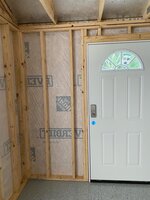
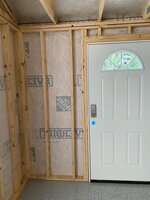
1) The sub panel will be located Left of man door in pic and there is insufficient space for wires to run above door in wall. Can I run wires up to rafters and across without conduit/chase?
Keeping in mind rafters will remain open and walls sheet rocked. I of course want it to be safe, code compliant and look neat and tidy.

2) Confirm wire entering panel requires conduit?

3) Any access requirements for cable entering sub panel?

Any other thoughts and ideas are welcome and thanks in advance!
47ad2eb0eebb20caefcb25841e786a03.jpg


Sent from my iPhone using Tapatalk
 

Attachments

  • 47ad2eb0eebb20caefcb25841e786a03.jpg
    47ad2eb0eebb20caefcb25841e786a03.jpg
    94.4 KB · Views: 0
To avoid these ads, REGISTER NOW!

wyliesdiesels

Well-known member
Joined
Aug 14, 2012
Messages
20,002
Location
Modesto, CA
I would use aluminum over copper to save a bit of money (u didnt specify the length)

#1 al if you really need 100a or #2 al MHF if you can get by with 90a (you probably could, your load is not very high)
 

pattenp

Well-known member
Joined
Jun 4, 2008
Messages
10,175
Location
Virginia - USA
What is the cable type you are thinking of using and how will it be run/installed between house and shop? 3-3-3-5, I'm smelling SER which is not allowed underground even in conduit.
 

Norcal

Well-known member
Joined
Mar 16, 2008
Messages
13,754
With a little prior planning a conduit could have been stubbed up in the stud bay to feed the panel.
 
OP
M

mcspeed

Well-known member
Joined
Jul 13, 2017
Messages
82
May not have made it clear, cable is already in. Just need to pull it up through floor.


Sent from my iPhone using Tapatalk
 
OP
M

mcspeed

Well-known member
Joined
Jul 13, 2017
Messages
82
3-3-3-5 is USE and indoor is romex of the appropriate size for the circuits.

My understanding is that I don’t need conduit for USE if protected by drywall but wanted to verify.

What is not clear is any requirements on the rest of the wires being exposed in rafters. Most of which will be #12.


Sent from my iPhone using Tapatalk
 

pattenp

Well-known member
Joined
Jun 4, 2008
Messages
10,175
Location
Virginia - USA
Something is not making sense. Does the cable have a jacket? If it's just USE then it's not approved for entering the structure. Will you post a pic of the cable?
 

pattenp

Well-known member
Joined
Jun 4, 2008
Messages
10,175
Location
Virginia - USA
NM wiring can run exposed along the rafters as long as it's not exposed to damage. I assume no attic flooring from which the NM can be stepped on.
 
OP
M

mcspeed

Well-known member
Joined
Jul 13, 2017
Messages
82
Thanks pattenp….. Hammering rain here so not able to get a pic. Yes it has a jacket. Will go inside wall 4-5’ to panel.


Sent from my iPhone using Tapatalk
 

pattenp

Well-known member
Joined
Jun 4, 2008
Messages
10,175
Location
Virginia - USA
It's sounding more like the cable is SE, but it's odd that you say it is USE. Could you have the letters mixed up and it's SEU? Which isn't the correct cable to use either.
 

mike93lx

ALLIANCE MEMBER
Joined
Dec 9, 2013
Messages
37,494
Location
Richmond, VA
Thanks pattenp….. Hammering rain here so not able to get a pic. Yes it has a jacket. Will go inside wall 4-5’ to panel.


Sent from my iPhone using Tapatalk

4",4' or 400' doesn't matter. If it isn't rated for in-structure use, it can't be there. Same with underground. Hopefully you didn't pull the wrong wire.
 

dcg9381

Well-known member
Joined
Jun 20, 2018
Messages
11,748
Location
Austin, TX
IF you run romex in those walls, make sure you're installing plates over the pass-through. Real easy to hit a wire in drywall. As others have mentioned, you do not need internal conduit unless your wire type requires it.

I would do at least one 1" conduit run from your panel for "future use" with a pull-string.

Any AV or internet?

As Wylie mentioned, might do the main run in aluminum... Just in case you haven't seen the prices of copper. 90A is the "sweet spot" for aluminum wire pull (within rational distances).

A building this size won't need 30A for HVAC. A 2-ton ductless system will pull under 12A continuous (at least mine does). It's different if you're using electric heat though...
 

John in OH

Well-known member
Joined
Jun 2, 2007
Messages
2,444
Location
SE Ohio & Eastern Virginia
You don't mention if the sub-panel has a main breaker or not.

IIRC, (and it's been a LONG time since I studied the code) I thought a main disconnect was required in sub-panels in separate buildings???

Maybe some others here on GJ can clarify my foggy memory.
 

joe6344

Member
Joined
Apr 3, 2020
Messages
9
Location
texas
Get a bigger panel. It's not much more expensive now and you are already out of spaces.

Sent from my SM-G975U using Tapatalk
 
To avoid these ads, REGISTER NOW!

dcg9381

Well-known member
Joined
Jun 20, 2018
Messages
11,748
Location
Austin, TX
I think a disconnect is required also (not going into all the exceptions). Easy enough if you're feeding a breaker in that panel.
 

wyliesdiesels

Well-known member
Joined
Aug 14, 2012
Messages
20,002
Location
Modesto, CA
You don't mention if the sub-panel has a main breaker or not.

IIRC, (and it's been a LONG time since I studied the code) I thought a main disconnect was required in sub-panels in separate buildings???

Maybe some others here on GJ can clarify my foggy memory.

only if there is more than 6 branch breaker handles
 

dcg9381

Well-known member
Joined
Jun 20, 2018
Messages
11,748
Location
Austin, TX
Disconnects are required for all detached building panels as is a grounding electrode system.

I think we're saying the same thing. But for clarification, isn't a feed breaker (properly labeled and installed, ie - screwed in) a valid disconnect?
 

Terry D

Well-known member
Joined
Mar 25, 2015
Messages
2,202
Location
St. Louis, MO.
We really need a picture of the cable you installed. Is it direct bury or is it in conduit underground from the house. What do you mean when you say you have to pull it up through the floor.

I would install a larger sub panel with a main breaker for the disconnect, you are already using 10 spaces out of your 12 space panel. And if you back feed a breaker for your main, you will use all 12
 
Last edited:

alfredeneuman

Well-known member
Joined
Mar 3, 2011
Messages
4,580
Location
Fullerton, CA
My comment about breakers is limited to the new panel in the detached building. There must be another disconnect in the new building.
A breaker ahead of the feeder is insufficient.
 

dcg9381

Well-known member
Joined
Jun 20, 2018
Messages
11,748
Location
Austin, TX
A main breaker is a form of disconnect, whether it's backfed and screwed down or factory installed.

Doesn't it have to be labelled? One of my panels has a feed breaker which is screwed in.. I assume that's so you cant easily get it free and mistake it for something that isn't backfed (think it isn't live).
 

dcg9381

Well-known member
Joined
Jun 20, 2018
Messages
11,748
Location
Austin, TX
Main breaker - which would also serve as a disconnecting means for the shop

In many panels, the "main breaker" is obvious as it's centered and out of the way of the other breakers. In load centers (assuming this is the right word) that have a fed-breaker, I thought that breaker had to be labelled and mounted in a manner that makes it not easy to remove? Otherwise there is no other way to recognize this as a feeding breaker.
 

Terry D

Well-known member
Joined
Mar 25, 2015
Messages
2,202
Location
St. Louis, MO.
In many panels, the "main breaker" is obvious as it's centered and out of the way of the other breakers. In load centers (assuming this is the right word) that have a fed-breaker, I thought that breaker had to be labelled and mounted in a manner that makes it not easy to remove? Otherwise there is no other way to recognize this as a feeding breaker.
Yes. When back feeding a breaker for the the main, it must have a hold down device and be labled as MAIN. The reason being that when working on the panel with the cover off, if that back fed breaker came off the buss, it would have energized parts. The 100 amp eaton BR panels used to come from the factory with a 2 pole 100 amp breaker back feed with a hold down screw. Dont know if they still do
I never cared for BR panels

Sent from my SM-G960U using The Garage Journal mobile app
 
Last edited:

Norcal

Well-known member
Joined
Mar 16, 2008
Messages
13,754
Yes. When back feeding a breaker for the the main, it must have a hold down device and be labled as MAIN. The reason being that when working on the panel with the cover off, if that back fed breaker came off the buss, it would have energized parts. The 100 amp eaton BR panels used to come from the factory with a 2 pole 100 amp breaker back feed with a hold down screw. Dont know if they still do
I never cared for BR panels

Sent from my SM-G960U using The Garage Journal mobile app

A plug in breaker requires a hold down but most here are not going to use panelboards with bolt on breakers. I agree about BR panels or as I call them “Zinsco II”.
 
To avoid these ads, REGISTER NOW!
Top Bottom