To avoid these ads, REGISTER NOW!

Subpanel feeder wire (Clarify attic and underground use) (Updated: 12-23-21)

Knight511

Well-known member
Joined
Dec 28, 2020
Messages
91
Location
TX
Finally time to plan the run from my garage to the workshop, so I have a clarification question about supply power from the garage to the subpanel in the shop.

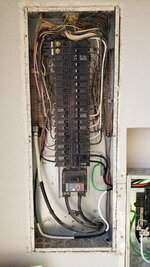
1. House breaker panel is almost full. I am going to add a subpanel in the garage, directly next to the main panel to supply electricity to "outside the house" items (the pool and workshop for now) to prevent a FULL panel and to avoid the cost of replacing the panel (NEC 2020 here... AFI/GFI breakers would make replacing the box incredibly expensive).

2. The wire run from the garage to the workshop is about 75-90 feet total. The wire will run up the wall in PVC conduit in the garage into the attic, across the attic to the rear wall of the house, then down the exterior brick wall (PVC conduit) into the ground, across 30 feet of yard, and then up into the shop.

3. As much as I want 100 amp service (feed the ego more than the tools), I have ordered the need 90 amp breaker to supply the shop.

I am open to running conduit or direct burial wire across the yard (there is no difference in labor since I have to trench either). My mind is tired from reading info about supply wires. What is the correct type of wire that can be used in the garage, through the attic of my house, and under ground to the shop? I would like to avoid splicing different types together just to save headaches.

Thank you guys for all the help you have knowingly or unknowingly given me as I get my shop set up.
 
To avoid these ads, REGISTER NOW!

mike93lx

ALLIANCE MEMBER
Joined
Dec 9, 2013
Messages
37,631
Location
Richmond, VA
run conduit the whole way with three #2 aluminum xhhw's and one #4 aluminum xhhw. easy and cheap. good the whole way, indoors, underground.

only other options that I can think of that work the whole way are MHF (aluminum) and copper THWN/XHHW.

THe aluminum MHF will cost the same as the aluminum xhhw, so that's a wash. the copper will probably cost 4x as much and won't gain you anything except slightly smaller conductors
 

pattenp

Well-known member
Joined
Jun 4, 2008
Messages
10,175
Location
Virginia - USA
Another way is to use SER cable from the house planel to a junction box just before going underground and switch to the XHHW-2 or MHF for the run the shop. The MHF can go the whole way with conduit just where above ground and inside the structure. To me the SER/XHHW-2 or MHF is the easiest.
 

wyliesdiesels

Well-known member
Joined
Aug 14, 2012
Messages
20,030
Location
Modesto, CA
not too many choices here and theyve all been listed. MHF, individual XHHW al or THWN copper, or SER transitioned to one of the previous mentioned options...
 
OP
K

Knight511

Well-known member
Joined
Dec 28, 2020
Messages
91
Location
TX
Thank you. I thought the W coded wires were the choice since MHF is just bound XHHW, but I didn't want to mess something up when ordering. There will be no junction box due to the size of the conductors. Running straight MHF or XHHW will work great. :)
 

Bert_

Well-known member
Joined
Dec 24, 2016
Messages
9,749
Location
NW Iowa
If conduit the whole way run xhhw. If you are only running conduit in the building and direct burying the rest the run MHF

Xhhw is not direct bury
 
OP
K

Knight511

Well-known member
Joined
Dec 28, 2020
Messages
91
Location
TX
Back up (I didn't want to make a new thread) - Two questions:

I will be running 1awg aluminum XHHW-2 for the conductors for this install. The price between running for 100amp vs 90amp is small ($36), so run the bigger "just in case" although I know I probably won't need it. Conduit will be oversized to 2" for ease of pull (again, small price increase over the 1.5").

1. Is there a realistic way for me (a DIYer) to thread 2" RMC? Price is a wash between renting a trencher to dig down the 18" for PVC conduit or use RMC at the 6" depth and dig by hand. PVC is super simple for a DIYer since it is just glued, but the RMC at the ground may be better protected from lawn equipment. The distance between the house and the shop is 27', so I can't imagine long elbows making up 7' of distance, so I would need to make 1 cut and 1 threading.

2. Do I need to run the conduit all the way through the attic (just under 60 feet of attic length)? Can the conduit be put up through the eave (outside the house) into the attic using a 90 and then terminated for the attic run? I know I would need to use a bushing for metal conduit to protect the wire.

Thank you guys again.
 

mike93lx

ALLIANCE MEMBER
Joined
Dec 9, 2013
Messages
37,631
Location
Richmond, VA
Xhhw requires conduit the whole way. If you don't want to run conduit indoors, you need to transition to a jacketed wire, like SER.

I would trench and run pvc, personally. Threading 2" without a machine or experience sounds like a bunch of frustration to me.

Above grade, use sched 80 for protection. If you damage that with lawn equipment, you're trying too hard.
 

Bert_

Well-known member
Joined
Dec 24, 2016
Messages
9,749
Location
NW Iowa
2" rmc is close to $100 a stick. Not sure how that pencils out?

How far do you need to trench?
 
OP
K

Knight511

Well-known member
Joined
Dec 28, 2020
Messages
91
Location
TX
Mike's response kills the question about RMC. I wa sonly calculating the distance outside. PVC it is now. I have read the sch40 in the hot attic (North Texas) is a problem. I think I may need to look at SER to avoid using the PVC in the attic?
 
OP
K

Knight511

Well-known member
Joined
Dec 28, 2020
Messages
91
Location
TX
What size junction box would I need to transition SER to XHHW? 1awg is big and the splices are big... I thought I was finished learning for this project. Time for more reading.
 
To avoid these ads, REGISTER NOW!

yatg

Well-known member
Joined
Aug 16, 2019
Messages
2,826
Location
Southern Oregon
Pretty sure Home Depot can cut/thread custom lengths. Every HD plumbing department I've been in has a pipe thread machine.

NEC 314.28 covers junction box sizing.
For 4ga and larger,
(1) Straight Pulls. In straight pulls, the length of the box or conduit body shall not be less than eight times the metric designator (trade size) of the largest raceway.

If you're entering from the top and exiting from the bottom, a 2" conduit needs a 16x16 box.

Polaris type connectors to join the wires. Not cheap but easy.
 
OP
K

Knight511

Well-known member
Joined
Dec 28, 2020
Messages
91
Location
TX
I didn't understand why there would need to be a transition when post 3 was made. Now I understand. I think, given the price of a junction box and Polaris connectors, it would just be easier to run the sch40 the whole length through the attic and use an uncut length of XHHW.

Now I am even rethinking the 100amp. If I were to run all of my lights, my table saw, 2 maxed out 120v outlets, and the dust collector all at the same time I think I will end up getting (which won't happen because I don't have enough hands for all that), I am only running 67amps per the spec docs. If I were to get my "dream" dust collector, the same set up would run 76.2amps.

Run a 100amp (already have the breaker) from my main panel to the subpanel in the garage (that feeds the "outside" needs in the OP). Then run a 75amp to the shop. Smaller cable (2awg probably to have overhead) and smaller conduit.

Once again, thank you for the help. The amount of patience many of you have with folks like me is amazing. I look forward to getting flamed (actually critiqued) once I get this project wrapped up and post the pics. :)
 

mike93lx

ALLIANCE MEMBER
Joined
Dec 9, 2013
Messages
37,631
Location
Richmond, VA
Are you adding the 120v circuits in that load calc? That only counts as 20a total, if they are on each leg.

Since all that would never happen (how often is a single 20a circuit fully loaded anyway? And when you also have the saw running), 60a would get it done

Running bigger than #2 would likely never benefit you. I bet #4 comfortably gets it done.

You can also go much smaller than 2" conduit. I'd run 1.5" for a set of #2 wires
 
Last edited:
OP
K

Knight511

Well-known member
Joined
Dec 28, 2020
Messages
91
Location
TX
Are you adding the 120v circuits? That only counts as 20a total, if they are on each leg.

Since all that would never happen (how often is a single 20a circuit fully loaded anyway? And when you also have the saw running), 60a would get it done

Running bigger than #2 would likely never benefit you. I bet #4 comfortably gets it done.

You can also go much smaller than 2" conduit. I'd run 1.5" for a set of #2 wires

I didn't know the 20amps would only count as one if on different legs (leg is pole, right?). Would they count separate if each breaker was on a the same pole (just for bonus learning)?

I think #4 and 60amps would be enough, but I would also be stuck with that decision. The cost difference is only $84 between #2 and #4. The labor is all on me, and there is NO WAY I want to go through this again in the future (LoL). $84 is cheap as chips for future use. You are right with the conduit, I will step down to 1.5" now which also saves some $... and even the step down from the 100amp breaker to the 70amp (I don't see a 75 which is perfectly fine) even saves about $20. :)
 
OP
K

Knight511

Well-known member
Joined
Dec 28, 2020
Messages
91
Location
TX
EDITED (Found my own answer faster than I thought I could): When reading ampacity charts, I have just used the 60 degree column because I don't know when to down rate the wire, but the cerro wire chart shows #4 is good for 75amps at 90 degrees. Do I have to derate the XHHW-2 if it is run in conduit from subpanel all the way to the workshop? Would #4 be rated at 75a or 65a is what I am asking with this situation?

Nevermind... I think I found my own answer in NEC Tables 310.15(B)(2)(a) and 310.15(B)(3)(a). Due to the temps in my attic, I have to derate the wire safely by 0.76 given summer temps. I would need wire rated at 90amps to run the 70a breaker with the derating bringing me back up to #2.


mike93lx

ALLIANCE MEMBER
Joined
Dec 9, 2013
Messages
37,631
Location
Richmond, VA
I didn't know the 20amps would only count as one if on different legs (leg is pole, right?). Would they count separate if each breaker was on a the same pole (just for bonus learning)?

I think #4 and 60amps would be enough, but I would also be stuck with that decision. The cost difference is only $84 between #2 and #4. The labor is all on me, and there is NO WAY I want to go through this again in the future (LoL). $84 is cheap as chips for future use. You are right with the conduit, I will step down to 1.5" now which also saves some $... and even the step down from the 100amp breaker to the 70amp (I don't see a 75 which is perfectly fine) even saves about $20. :)
It's all about the load at 240v. If you have a single 20a 120v load, it counts as 20a as one of the hots is loaded at 20a. If you add 20a but out it on the other hot, it is still 20a since each hot is only carrying 20a.

So.if you are going to do two circuits of 120v outlets, have them one different buss bars in the panel (next to each other).

I'd run #2 as well, and would probably breaker at 60a as that Is a readily available size and is a lot cheaper than a 90a breaker
 
OP
K

Knight511

Well-known member
Joined
Dec 28, 2020
Messages
91
Location
TX
I feel decently intelligent from my original design based on that info. :) On the main work wall, where all of the saw and such would be plugged in, there are actually 4 20a circuits. There are 2 levels of boxes (one at 48" and one at 24"), each level has 2 20a circuits that are run out-of-phase (breakers side by side) because that made the most sense to me when I was thinking about the sine wave of the current and would make more sense if I plugged in 2 high amp devices into the same box (plugs are color coded for each circuit, black and white outlets). If I plugged 2 devices in, I wanted them to pull out of phase. I couldn't explain why that made sense to me back then. :)

(Reading that ramble again.... I hope that makes sense to more than just me. LoL)

And holy cow! The 60amp breaker is super cheap (half the price of the 70amp). Sounds like a plan. Thanks mike!
 

wyliesdiesels

Well-known member
Joined
Aug 14, 2012
Messages
20,030
Location
Modesto, CA
EDITED (Found my own answer faster than I thought I could): When reading ampacity charts, I have just used the 60 degree column because I don't know when to down rate the wire, but the cerro wire chart shows #4 is good for 75amps at 90 degrees. Do I have to derate the XHHW-2 if it is run in conduit from subpanel all the way to the workshop? Would #4 be rated at 75a or 65a is what I am asking with this situation?

Nevermind... I think I found my own answer in NEC Tables 310.15(B)(2)(a) and 310.15(B)(3)(a). Due to the temps in my attic, I have to derate the wire safely by 0.76 given summer temps. I would need wire rated at 90amps to run the 70a breaker with the derating bringing me back up to #2.

The 90° column is ONLY for derating. if you arent derating then you need to size by the 75° column

If the attic temps get high, then yes you should derate the wire ampacity, starting with the ampacity in the 90° column.

#4 al is good for 65a if not derating....
 
OP
K

Knight511

Well-known member
Joined
Dec 28, 2020
Messages
91
Location
TX
I am pretty sure I have found my answer, and my mind makes sense of the situation (but my life's electrical experience has been DC and automotive), but I have another question.

Main panel feeds a subpanel (literally inches away in the next stud bay and connected through the stud using a 3/4 RMC ******) which will feed my shop sub panel.

The 2 subpanels have the bonding screws removed because they are subpanels.

My main panel has the neutral bar bonded to the chassis (so bonded to ground) of the main panel.

The main panel is professionally installed (meaning it is stuffed full of wires that are neatly separated) which looks like a nightmare to my amateur eyes. I am running #3 copper from the main panel to the first sub since the run is so short and it fits nicely through the ******.

1. Can I install a new ground bar in the main panel and run both the ground and neutral from the first subpanel to that bar? (This would make the install INFINITELY easier with shorter runs of wire)

It seems that I will need a couple of feet of #8 to ground the first sub panel, so there is not a second question.

:) I know this has dragged out for a long time, but I am really happy completing the project myself.
 
Last edited:

Bert_

Well-known member
Joined
Dec 24, 2016
Messages
9,749
Location
NW Iowa
#3 thhn is going to be extremely tight in a 3/4 ******, if conduit fill even allows it. You can do 60% fill for that ****** but I'm not sure I would want to. I would bump that up to a minimum of 1".

Neutral for the sub panel needs to go to neutral in the main panel. Ground can be connected to the can if you want.
 
OP
K

Knight511

Well-known member
Joined
Dec 28, 2020
Messages
91
Location
TX
I did not want to hear that the ****** was too small.... I did not want to go back and change it... that would make me an *** for asking for advice and not listening. Now that I have wired the first subpanel, I am, once again, thankful for the advice and happy that I listened.

I swapped the 3/4 ****** out this morning and then ran the wire. I also cleaned up (moved/tucked) some of the wires in the main that were causing problems with the cover properly closing. Used 3-#3 copper plus the #6 copper ground. :)

The panels don't line up (and that makes me a little sad) because the framers of the house used an sheer brace through the bay at the height I needed. I had to decide to lower the panel or have it stick out 3/4" away from the drywall. I chose to drop it.

20211224_104226.jpg 20211224_104211.jpg
 
To avoid these ads, REGISTER NOW!
Top Bottom