To avoid these ads, REGISTER NOW!

Subpanel from house, or new power drop

andyvh1959

Well-known member
Joined
Feb 15, 2020
Messages
2,598
Location
Green Bay WI
My brother is finally prepping to build his shop behind his ranch house in an Appleton WI neighborhood. The slab has been on the property for near 20 years and he'll be building this late winter/early spring. I was at his house yesterday to review his options to get power to the shop. We discussed running 220v 100a service from his house in buried conduit about 50' from the back of the house. To get conduit in the ground into the basement of his house means drilling though the basement wall. His main 100a panel is full, no expansion slots for a duplex breaker to feed out to a subpanel in the shop. So he'd need to have a subpanel wired from the current main feeding his breaker panel, to route power out to the shop. He also planned to have a subpanel in his shop.

In his neighborhood the overhead power lines are on his property back lotline, probably 12' laterally behind where the shop will be. So would it make more sense to have the power company provide a new power drop off that line direct down to a new meter post behind his shop? In Wisconsin a meter is required, which he has no issue with a separate billing for his shop. Aside from paying a montly meter fee and separate billing, I think he may be money ahead to have a new power drop to his shop instead of: 50' of buried conduit, drilling the basement wall for the conduit, getting a new subpanel installed in his basement (by an electrician, he won't do it), about 75' of three runs of #1 copper in the conduit to a new subpanel in the shop.

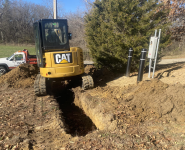
Right now he can locate the power into the shop wherever it makes the most sense. Also, right now in Wisconsin the ground is frozen so its not easy to create a trench for a buried conduit from the house to his shop, other than renting equipment to do it or wait until late spring to be able to hand dig the trench.
 
To avoid these ads, REGISTER NOW!

SouthernIllinois

Well-known member
Joined
Jan 14, 2024
Messages
1,679
FWIW, I am in Illinois and have Ameren for electricity service.

I was willing to pay for a monthly fee for a separate meter for my shop for ease of running power.

When they did a site visit, the told me I was only allowed one meter on the property since it wasn't a farm or a business. I have no clue how they made that determination - I am on 15 acres, out in the country.

I ended up having to tie into the line as it came off the pole, put in a new meter and disconnect and run a line off the new meter to the shop and tie into the existing buried line to the house and remove the meter off the house.

Maybe I should have just borrowed a couple head of my neighbors cows and been a "farm" and gotten the second meter like I wanted.

Screenshot 2024-12-06 at 5.29.37 PM.png
 

jblnut

ALLIANCE MEMBER
Joined
Jan 17, 2015
Messages
7,101
Location
In the Middle of MN
My brother is finally prepping to build his shop behind his ranch house in an Appleton WI neighborhood. The slab has been on the property for near 20 years and he'll be building this late winter/early spring. I was at his house yesterday to review his options to get power to the shop. We discussed running 220v 100a service from his house in buried conduit about 50' from the back of the house. To get conduit in the ground into the basement of his house means drilling though the basement wall. His main 100a panel is full, no expansion slots for a duplex breaker to feed out to a subpanel in the shop. So he'd need to have a subpanel wired from the current main feeding his breaker panel, to route power out to the shop. He also planned to have a subpanel in his shop.

In his neighborhood the overhead power lines are on his property back lotline, probably 12' laterally behind where the shop will be. So would it make more sense to have the power company provide a new power drop off that line direct down to a new meter post behind his shop? In Wisconsin a meter is required, which he has no issue with a separate billing for his shop. Aside from paying a montly meter fee and separate billing, I think he may be money ahead to have a new power drop to his shop instead of: 50' of buried conduit, drilling the basement wall for the conduit, getting a new subpanel installed in his basement (by an electrician, he won't do it), about 75' of three runs of #1 copper in the conduit to a new subpanel in the shop.

Right now he can locate the power into the shop wherever it makes the most sense. Also, right now in Wisconsin the ground is frozen so its not easy to create a trench for a buried conduit from the house to his shop, other than renting equipment to do it or wait until late spring to be able to hand dig the trench.
I vote separate meter on the shop but trenching in and having one meter keeps some things easier. I have two services on my property and it’s a pain for no particular single reason. The house has a service and the farm stuff has a service. I had to get creative to be able run a single generator to power the property as well as data lines between the two needed to be fiber and a few other goofy things.

Unless it’s been waaaaaaay colder there with less snow cover I doubt you’re frozen down too far. I turned up mud today while cutting wood along a fence line that had 6-8” of snow. I’m about an hour north of you longitudinally in central Mn.
 

sparky 1971

Well-known member
Joined
Oct 9, 2018
Messages
7,987
Location
Central Iowa
Without seeing it and only going by the description, I agree. I'd look into a 200 amp meter main on the shop with a 100 amp feeder to a sub panel in both the shop and the house. The shop can be done first while leaving the house service alone then in the future, an underground feeder can be run to the house when convenient. If it's coordinated right, the existing service entrance conduit can be cut off and recycled into an entrance for the feeder. Blank the meter socket off then, when it's time for a new roof, take everything down and patch the hole. The only thing that should need to be done to the existing house panel would be to isolate the neutrals by removing the bonding screw or strap and moving the ground wires to a ground bar.
 
OP
A

andyvh1959

Well-known member
Joined
Feb 15, 2020
Messages
2,598
Location
Green Bay WI
Thanks for the replies. Though, if he were to have the main drop into his shop with the meter there and then run a service line to the house he still would have to run in ground conduit to the house main panel. I thought the drop to the shop (even with a separate meter and billing) would avoid the issues of buried conduit and taping into the current main panel. Difference is the new buried line to the house avoids the added sub-panel in the house.

I get the point, new meter, new drop, one billing. I'll tell him he could do the new drop/new meter/double billings for now and then eventually run an in ground service entrance to the house some time in the future. That could require careful placement fo the main panel in the shop for a future service cable from the shop to the house. He could locate the meter on the shop at the southeast corner which would allow for a future buried conduit line direct to the house.

His house was built in the late 60s, with 100 amp service to the main panel. Given that age it likely has shared neutrals/grounds like my house had (built in 73). So he could later have it updated to split the neutrals and grounds as an electrical upgrade.
 
Last edited:

sparky 1971

Well-known member
Joined
Oct 9, 2018
Messages
7,987
Location
Central Iowa
I get the point, new meter, new drop, one billing. In fact, he could do the new drop/new meter/double billings for now and then eventually run an in ground service entrance to the house some time in the future. That could require careful placement fo the main panel in the shop for a future service cable from the shop to the house. He could locate the meter on the shop at the southeast corner which would allow for a future buried conduit line direct to the house.
A meter main would take care of that. It's two compartments, the top half is the meter, the bottom half is the main panel. Go from the back of the meter main in to the shop for that sub panel. Then, go out the bottom of the meter main underground to the house. All of the 200 amp meter mains that I've installed have feed through lugs and eight breaker spaces. That would allow 200 amps to the shop or house and 100 amps to the other (mine is 200 to the house and 100 to the shop) or he could run 100 to each which is what I would probably do so I could use the existing penetration into the house and 200 isn't necessary in the shop.
 

BurtEggley

Well-known member
Joined
Oct 8, 2024
Messages
885
here the service fees per utility meter are 1/3 to 1/2 of the cost of the utility bill. Much of that goes to the state in hidden fees and taxes the utility company pays on the user's behalf. If that same way of accounting happens there then what? My vote would be since you are in the planning stages, you can wait until spring to dig. Like others have suggested, I'd look into making the shop a 200 amp panel and then taking 100 amps to the house. Use Conduit large enough so that you could pull 200 amps to the house if needed for a later upgrade. Where is the garage / parking? Is there a chance an EV charger might be needed some future day?
 

HoosierMark

Well-known member
Joined
Jan 31, 2013
Messages
1,444
Location
Southeast IN
I know this is slightly different but when I built my house 10 years ago they brought enough power underground to satisfy my needs. They put 200 amp in for the house and set it up for additional 200amp service for the future barn all on one meter. I would suggest you hook up a new service to the barn with provisions to supply 200 amp to the house in the future to eliminate cost of two services. This also sets you up for a future back up generator or EV charger when desired.
I have electric service to a cabin and all that is on is a refrigerator. The service fee for the connection alone is about $60 plus a few bucks for the usage. We thought we could avoid all charges by disconnecting the fridge but nope it is automatic for the convenience. i am glad I only have one meter for house and barn.
 

wyliesdiesels

Well-known member
Joined
Aug 14, 2012
Messages
20,051
Location
Modesto, CA
1) Check the monthly cost of a second service.
2) Get an estimate for having the trench dug.
3) Do the math.

The trench cost won’t go up every year like the POCO charges do.
bingo

OP is thinking of the high initial costs to trench and run a feeder but that is a fixed cost. The monthly meter fees and rates will continue to go up.
 
To avoid these ads, REGISTER NOW!

wyliesdiesels

Well-known member
Joined
Aug 14, 2012
Messages
20,051
Location
Modesto, CA
My brother is finally prepping to build his shop behind his ranch house in an Appleton WI neighborhood. The slab has been on the property for near 20 years and he'll be building this late winter/early spring. I was at his house yesterday to review his options to get power to the shop. We discussed running 220v 100a service from his house in buried conduit about 50' from the back of the house. To get conduit in the ground into the basement of his house means drilling though the basement wall.

I would avoid drilling through the basement wall if at all possible to prevent leaks. Is there another route he can take to get into the basement?

His main 100a panel is full, no expansion slots for a duplex breaker to feed out to a subpanel in the shop. So he'd need to have a subpanel wired from the current main feeding his breaker panel, to route power out to the shop. He also planned to have a subpanel in his shop.

It may be possible to combine a few underutilized circuits to make room for a double pole breaker for the shop

Can you post pics of both panels with covers on and off?

In his neighborhood the overhead power lines are on his property back lotline, probably 12' laterally behind where the shop will be. So would it make more sense to have the power company provide a new power drop off that line direct down to a new meter post behind his shop? In Wisconsin a meter is required, which he has no issue with a separate billing for his shop. Aside from paying a monthly meter fee and separate billing, I think he may be money ahead to have a new power drop to his shop instead of: 50' of buried conduit, drilling the basement wall for the conduit, getting a new subpanel installed in his basement (by an electrician, he won't do it), about 75' of three runs of #1 copper in the conduit to a new subpanel in the shop.

not necessarily money ahead. youre making an apples to oranges comparison here. The cost to run the feeder is a fixed price. The cost for a new service and associated fees is not fixed and will continue to rise every year or 2. in the long run, the second service will be more expensive, especially if the 2nd meter is billed at higher commercial rates.

for the feeder, its cheaper to run aluminum and you will need 4 wires not 3.

Right now he can locate the power into the shop wherever it makes the most sense. Also, right now in Wisconsin the ground is frozen so its not easy to create a trench for a buried conduit from the house to his shop, other than renting equipment to do it or wait until late spring to be able to hand dig the trench.

Does it have to be done now?
 
OP
A

andyvh1959

Well-known member
Joined
Feb 15, 2020
Messages
2,598
Location
Green Bay WI
The new power does not have to be done right now. He could build the shop like I did, and run a heavy extension cord into the shop once it is framed up. Then after the shop is completed and the electrical is done except for the incoming service he'll be well into springtime here in Wisconsin.

I asked him about the main panel and he just said it is maxed out for breaker positions. But it may still be possible to combine a few current circuits onto other breakers and open a duplex breaker slot for the 100 amp feed out to the shop sub-panel. I like the idea of the in ground conduit coming up at the back of the house to a conduit box at the sill joist. Would be much easier than punching through the basement wall. So at this point I'll tell him to contact WI Energies to consult on options for his shop and house.
 

83VillageRepair

Well-known member
Joined
Aug 17, 2007
Messages
768
Location
Merkel, Texas
As others have said I would convert the house to a subpanel either by putting an outdoor main on the house or by making the shop the main panel. The trend in electric utilities is to raise the the fixed meter charge with the eventual cost being $100 or more per service/meter. Invest the fixed cost now and avoid the the reoccuring cost later.
 

BillK

Well-known member
Joined
Aug 24, 2006
Messages
9,349
Location
Beautiful Southern Maryland
I am leaning the other direction. If the house panel is full then now would be a good time to upgrade it to 200 A and then feed the shop from it. I bet in the long run it will be less expensive then a separate feed and meter to the shop. If the panel is full he will probably want to upgrade it in the future anyway. If you are going to feed the house from the shop you will need to dig the trench no matter what.

But what he really needs to do is contact the power company and run the different options past them.
 

markietas

Well-known member
Joined
Jun 27, 2012
Messages
93
Location
Salisbury, NC
OP I think you are overestimating the cost / difficulty of trenching between the buildings.

This is something you and your brother can easily do yourself in a single day with a cheap trencher rental.

50' is nothing, I've done 350 in a day by myself. The wire / conduit cost will be completely insignificant compared to all of your other costs/ options.

Regardless of wheather you feed the house from the shop, or vice versa, I wanted to try and take that small part out of your concern.

Personally I am on the side of install a new 200A (or larger if the house could potentially use more than 100A in the future) service to the shop and feed the house as a sub panel.

But as has also already been said, y'all need to call the electric company and ask them about the various possibilities they will cooperate with and the rough costs.
 

Innovate1

Well-known member
Joined
Jul 28, 2014
Messages
4,289
Location
Illinois near St. Louis, Missouri
I would look at upgrading the house to 200A - that's pretty standard these days. And my utility gave me the option of a 320A meter base with an extra set of output lugs for a detached building so that's what I did. You should ask if that's an option. I am guessing that might be a meter with main breakers since many places want outside switches now but mine are inside (done 20 years ago).

Use aluminum conductors. Or copper if you have excess money you need to spend! When you dig the trench throw an extra 1" conduit in the trench for fiber optic cable or low voltage for network and such.

If you can't take the shop feed from the meter base then put in a big panel with room for the shop breaker.

Lots of options. You just need to find out which are allowed and get some pricing. Upgrading the house will cost more but better in the long run IMHO.
 

Improved700

Well-known member
Joined
Jul 16, 2008
Messages
131
Location
NE Wisconsin
Hey Andy.
Neenah here.....

What's your brother going to do for heat in the shop?
LP, Nat Gas, Elec?

If you trench from house to shop, you could to a common trench, with Nat Gas and Electric?

I trenched from my house to the shop. 135 feet, and had to go through asphalt driveway as well. Was not the worst thing.
Of course it was in the summertime.

I looked into 2 meter bases. In the end, it was cheaper to go with trenching.
WE Energy here.

Good luck with the project.
kev
 

reader2580

Well-known member
Joined
Dec 31, 2014
Messages
14,564
Location
Minneapolis, MN
Trenching can be easy if the ground is relatively flat, and no landscaping features to deal with. The first trench from my old detached garage to my house took a couple of days to do. The flat part was easy to do with a trencher. However, I had to hand dig about 30 feet of trench due to a retaining wall and landscaping. I had to dig by hand close to five feet deep in the landscaping. That took at least a full day.

A 135 foot trench I dug from my house to my solar ground mounts took about four hours. The hardest part was digging a tunnel under a sidewalk.
 
OP
A

andyvh1959

Well-known member
Joined
Feb 15, 2020
Messages
2,598
Location
Green Bay WI
When I hand dug the trench for the conduit to my shop it was easy in the sandy Green Bay soil, easy to exceed 18" deep, actually got to 24". I too had to go under a 24" wide sidewalk along the back side of the house. Not too bad after I punched a hole through the sidewalk against the brick wall, and used a small auger to get down to the trench level. So I agree digging the trench is not a big issue.

I agree too that getting 200amp to the house may be his best option and then a buried conduit line out to the shop. Separate meter on the shop and the house could be more hassles in the future. Like many have said here, the 1st step is to review all the options with the power company. All these replies bring a lot more rationale to the questions for the power company.
 

75gmck25

Well-known member
Joined
Jul 21, 2014
Messages
1,328
Location
Alexandria, VA
A few points to consider.
- You can rent a trencher and get down to the 18" depth very quickly. Trenching 50-60 feet goes quickly, especially if the trencher is self propelled. The hardest part of the trenching may be getting it in and out of your pickup.
- Drilling through a basement wall to run 2" conduit is a relatively simple, easy job. You can rent the drill and SDS bit from HD or other places, and it will easily drill through concrete and brick walls. You may also need the same sized bit to drill through the rim joist or siding.
- Drill through the basement wall at a level above ground so you don't have to worry about water infiltration. Conduit can be buried up to near the wall, then run up outside to where you drill through. A long sweep and an LB will work fine.
- Use 2" conduit so you have enough space for whatever wire you want to use. Run a 2nd conduit of about 1.5" size that you can use for Cat 6, cable, alarm wiring, etc. Requirements expand over time.
- If the house is already maxed out with breakers and is set up for only 100 amps, its probably time to upgrade the panel anyway. Whether you want a main panel at the house or at the shop will depend on the physical geography and the power company's willingness to run the upgraded service.
 
To avoid these ads, REGISTER NOW!
Top Bottom