To avoid these ads, REGISTER NOW!

Subpanel Installation

Gigfy

Well-known member
Joined
Jan 30, 2011
Messages
82
Hi, I have two questions regarding subpanel installation. If you could answer either question, I would be appreciative.

I have experience in various aspects of wiring, but the I've never come across the following issues. Here's some background:

This is for my own house. The main panel is located on a basement wall. The meter is located on the outside of the wall. I need to put in a 100 amp subpanel to add circuit capacity. I plan to put the subpanel right next to the main. There will be plenty of free space around the sub panel. I plan to use some 2 AWG copper 75C wire for the subpanel feed from the main.

One question I have is, is it absolutely necessary to use a backer board (3/4" plywood) for the subpanel, or can I simply tap con the sub panel to the concrete wall, just as the main panel was done when it was installed. Quite frankly, I don't see the reason why a backer board would be required, since fastening the subpanel with tapcons in concrete would be more secure than fastening the subpanel with woodscrews into a backer board. I also can't see how conductivity issues would come into play. A concrete wall may be considered a conductive material, but I plan to connect the subpanel to the main with EMT anyway.

Can anyone enlighten me on why a backer board would be required?

My other question is, what is the correct way to dress a feeder wire inside a subpanel or a main? I stumbled across this Website that supposedly shows pictures how to correctly dress a feeder cable, but I've never seen this before.

http://www.renovation-headquarters.com/electrical-sub-panel-2.htm

Are you really supposed to wrap the cable around the inside of the panel, as the drawing shows? I've never seen this done before, and it seems strange.

Thanks.
 
To avoid these ads, REGISTER NOW!

Charles (in GA)

Well-known member
Joined
Jan 11, 2006
Messages
12,489
Location
50 mi south of Atlanta
It would depend entirely on the layout of the subpanel, where the conduit entered the panel, what the radius of the bend was and if it was acceptable for the wire size you are installing.

I certainly would not do it unless there were some pressing need to do so, and I know of no requirement to do this.

Charles
 

Garage Junkie

Well-known member
Joined
Jan 2, 2010
Messages
173
Location
Cleveland, OH
I would think there would be no problem screwing right into the concrete for the sake of mounting the panel, but keep in mind that you need to staple any incoming wires nearby as well, and for that, you will want a nailer strip.

As far as dressing the wires- that looks like overkill. For mine, I just tried to not bend any of the #3 Cu to the point of kinking the wire. You can find specific bending radius specs for wires- but again, a little common sense goes a long way. With that said though, I ended up taking my common 3/4 of the way around the panel to make a nice, easy connection into the lug.

Thread on my panel project (very similar to yours) is here:

http://www.garagejournal.com/forum/showthread.php?t=88064

Good luck with your project!
 
OP
G

Gigfy

Well-known member
Joined
Jan 30, 2011
Messages
82
Thanks to both of you for the responses.

I didn't want to use a backer board unless it was some code violation. If I ever sell the house, having a backer behind one electrical panel, but not the other (main) panel, would probably cause a home inspector to flag the thing. I'd rather not go through the hassle of also having to retro fit the main panel with a backer board as well.

Garage Junkie,

Thanks for that link. Neat work. Indeed my project is very similar to yours. I too am hooking up a welding plug in my garage (out of the subpanel). I'll also have a 30 amp 220 service for the dryer coming out of the subpanel.

I noticed you looped the cable around in the main panel, instead of taking a direct root. I suppose that was to give some extra cable in case you want to move the main later on, or is the extra cable to allow for settling/movement?

I really need to get a welding circuit hooked up soon. I just got my welder back from my brother who had it for years. The temporary service I've hooked up for the welder, would probably choke most people on this forum (two leads made out of extension cords, with no case ground).
 

Garage Junkie

Well-known member
Joined
Jan 2, 2010
Messages
173
Location
Cleveland, OH
I noticed you looped the cable around in the main panel, instead of taking a direct root. I suppose that was to give some extra cable in case you want to move the main later on, or is the extra cable to allow for settling/movement?

It did that for a couple reasons-
With #3 you need to use a lug on the common bus as it will only accept up to #4 in the normal holes.
The lug will not fit on the bus bar where it is next to a breaker, so that meant putting it high up on the bus bar away from the breakers and close to the main connections. So that meant the common had to come in from the top, so I had to either come up the right side or the left. If I had come up the right side it would have been a tight bend coming out of the 6" conduit. Even with the plastic proctector rings on the ends of the threads, I still would rather avoid a sharp bend resting against the conduit ends. Yeah, I still did that with the hot leads, but mostly because of lack of options.
 
OP
G

Gigfy

Well-known member
Joined
Jan 30, 2011
Messages
82
Garage Junky,

I was actually referring to the lead cables feeding the main, not the subpanel feeders.

However, that reminds me of a question I've had in the back of my mind. I was wondering if a 2 ga. cable will fit OK in a 100 amp Cutler Hammer breaker?
 
OP
G

Gigfy

Well-known member
Joined
Jan 30, 2011
Messages
82
BTW, I forgot to mention all the branch circuits out of my main panel come out the top right next to the ceiling joists, so they don't fasten to the wall.

I plan to put the top of the subpanel at the same height so I don't think I'll need a nailing strip for wires
 

Aceman

Well-known member
Joined
Jan 28, 2007
Messages
2,513
Location
Eastern Oregon
Garage Junky,

I was actually referring to the lead cables feeding the main, not the subpanel feeders.

However, that reminds me of a question I've had in the back of my mind. I was wondering if a 2 ga. cable will fit OK in a 100 amp Cutler Hammer breaker?

It should be fine.
 
OP
G

Gigfy

Well-known member
Joined
Jan 30, 2011
Messages
82
Thanks Aceman,

I went to Home DoDo today and got the box and wire.

I wanted to get a 2-3G cable but they only had single stranded 2 ga. cable. Since all the load conductors will be black, I need to mark the neutral with some of that white tape. Does anyone know where to get that? They did have green 4 ga. for the ground, so I'm OK on that one.
 

oleguy

Well-known member
Joined
Nov 22, 2009
Messages
273
get white tape where you get wire.#4 is over kill for ground.all you need is #8 green.
 
OP
G

Gigfy

Well-known member
Joined
Jan 30, 2011
Messages
82
When I got there, since I couldn't buy the 2-3G cable, I couldn't quite remember how big the ground had to be. I thought it was supposed to be either 6 ga. or 4 ga. Guess I got it wrong and wasted a little money.
 
OP
G

Gigfy

Well-known member
Joined
Jan 30, 2011
Messages
82
I'm ready to hang the subpanel and wanted to ask if the layout looked OK.

I'll come out of the side (toward the bottom) of the main with a 1 1/2" PVC sweep 90. An LB would be used to make the 90 for the subpanel. Someone on this forum mentioned some inspectors frown on using an LB to terminate in a subpanel, though I can't imagine why. But I wanted to ask before I put it on the wall. Here's a pic.
 

Attachments

  • 125 subpanel.JPG
    125 subpanel.JPG
    95.5 KB · Views: 99

royalton10

Well-known member
Joined
Oct 19, 2007
Messages
247
Location
Lancaster, Ohio
I would suggest you have an LB that has a cover on the same plane as the subpanel cover. (Cover to rotate 90 degrees to the left) Hopefully they have an LB with that kind of configuration. In present configuration LB cover may be hard to remove.
 
To avoid these ads, REGISTER NOW!

mrb

Well-known member
Joined
Dec 31, 2008
Messages
3,734
why are you using that sweep and lb instead of just coming straight out of your main panel and into the new one?
 

walrus

Well-known member
Joined
Nov 12, 2008
Messages
11,676
Location
Maine
why are you using that sweep and lb instead of just coming straight out of your main panel and into the new one?

To keep the feeders away from the breakers??, ***** when they are in the way every time you want to get to the ground bar or neutral bar
 
OP
G

Gigfy

Well-known member
Joined
Jan 30, 2011
Messages
82
"why are you using that sweep and lb instead of just coming straight out of your main panel and into the new one?"

Fair question. I want the top of subpanel to match the height of the top of the main panel (but the subpanel is shorter than the main).

Probably sounds silly to some folks, but I like that kind of finished look. That's also part of the reason I went with a Cutler Hammer subpanel. The main panel is CH and I wanted the colors to match.

I do have another question on the hookup of this subpanel. I'm not sure anyone can help me or not.

The main panel is an old Cutler Hammer (CH style) panel. It has one neutral/ground bus bar, old style. The old style CH neutral/ground bus bars had bigger openings (and bigger set screws). In years past, I installed 4 main CH panels and I remember those type of set screws. The old style openings accept a #4 wire. I need to attach a #2 wire, so it won't go into the lugs. Therefore, I need a lug kit that will accept a #2 wire. I looked on the old panel, and the part # is CH 95U for the lug kit.

I Googled that part # and can't find anything. I called Eaton, and they gave me part numbers for a neutral lug kit: NL20; NL30; NL300. They said any of those lug kits would work for me. But those lug kits fit the new CH bus bars with smaller holes (and set screws). The lugs on these kits fasten down using a screw that goes in the set screw hole of the bus bar. The older bus bars not only have bigger openings, but also bigger set screws. The set screws on the old style are .306" dia. The set screws on the new type bus bars are .243 dia.

The new kits won't work. Frustrating!

Anyone happen to know where to get an old style neutral lug kit?
 
OP
G

Gigfy

Well-known member
Joined
Jan 30, 2011
Messages
82
Walrus makes a good point too, and I agree with it. However, I would mention CH panels are fully reversible, so that would only be an issue if the panel was fastened right side up. (that is, with the main lugs at the top).
 

Aceman

Well-known member
Joined
Jan 28, 2007
Messages
2,513
Location
Eastern Oregon
"why are you using that sweep and lb instead of just coming straight out of your main panel and into the new one?"

Fair question. I want the top of subpanel to match the height of the top of the main panel (but the subpanel is shorter than the main).

Probably sounds silly to some folks, but I like that kind of finished look. That's also part of the reason I went with a Cutler Hammer subpanel. The main panel is CH and I wanted the colors to match

I do this for a living and do the same thing, I like the tops to be the same height. With that said, I've never had to use an LB with a 90 degree sweep to make that happen. I'm not gonna lie, your setup is going to look like ****. Why aren't you using a straight pipe ****** between the panels? You can punch your own hole in the panels if there isn't a factory knockout available at the right height.

To keep the feeders away from the breakers??, ***** when they are in the way every time you want to get to the ground bar or neutral bar

If he does it right the feeders don't have to run down the sides of the panel in the way of the neutral/ground bars.
 
Last edited:
OP
G

Gigfy

Well-known member
Joined
Jan 30, 2011
Messages
82
"I'm not gonna lie, your setup is going to look like ****."

I held the panel up against the wall, and I don't see anyway I can use a straight run, even if I cut my own holes.

I have to hang the subpanel to the left of the main panel, because of a gas line (on the right side of the main panel). Because the subpanel is shorter than the main, if I ran a straight run, I'd hit the branch breaker area of the main panel, or I'd hit near the top of the main panel, which has the neutral/ground bus and a ton of wires. Unfortunately, the best location for coming out of the main is the lower left knockout.

However, I did reflect on your comment, and I think it would look better if I came straight out of the main from the lower left knockout and then made one 90 degree bend straight up into the bottom of the subpanel. That way there would only be one 90 degree bend instead of two. I'd use an LL fitting for the 90.

Thanks.
 

Norcal

Well-known member
Joined
Mar 16, 2008
Messages
13,753
Flip the panel 180 degrees, line lugs on the bottom.....
 
OP
G

Gigfy

Well-known member
Joined
Jan 30, 2011
Messages
82
Thanks Norcal,

I did plan to flip the box of the subpanel since I now plan on coming up through the bottom, but you're right, I didn't mention that in my last post.

I'm still stalled trying to find a large neutral lug to fit the bus in the main panel. If I can't find one, I'm thinking about installing another bus bar (new style) in the main panel. To that end, I wonder if someone could answer a few questions?

The current neutral/ground bus in the main has a large lug at the top (for the main neutral) and a large lug at the bottom, which holds the ground.

I could add another (secondary) neutral/ground bus on the other side. I could take the ground wire out of the lug in the primary bus and use that lug to bond the two busses together (I hope this is making sense).

However, I've no idea what size wire is needed to bond the two busses together. It's a 200 amp box. Also, should the wire connecting the two busses be marked with a certain color tape: white, green?

If I went this route, I wouldn't be able to dedicate one bus as a neutral, and the other as a ground, the way newer boxes do, because it would require a lot of splicing to rearrange the wires in the box.
 

fefarms

Well-known member
Joined
Jan 25, 2007
Messages
186
If it is a service entrance panel you don't need to split ground and neutral into separate bus bars, as these must be bonded together anyway.

The bond wires for a panel protected by a 200 amp main breaker need to be #6 awg or larger. Such bond wires need to be bare or green.
 

Charles (in GA)

Well-known member
Joined
Jan 11, 2006
Messages
12,489
Location
50 mi south of Atlanta
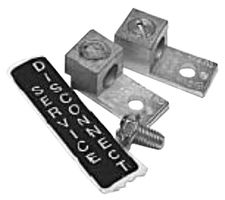
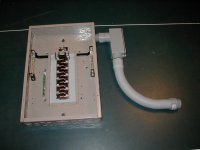
Spend some time looking at the accessories for ALL brands of panels, at Home Depot and Lowes. While it might not be perfectly Kosher (code says all components and accessories used in a panelboard must be approved for that panelboard) if you can find a larger lug with two ears properly spaced that fits in the holes in the ground bar, or a lug with a larger hole, go for it.

4652073.jpg


siemead00003_193_tn_010.jpg


Charles
 
OP
G

Gigfy

Well-known member
Joined
Jan 30, 2011
Messages
82
Fefarms,

You misunderstand. The reason I would be moving the ground over to the secondary bus is because it would free up the large lug on the primary bus. I could then use the large lug on the primary bus to bond the two busses together. Once I have the secondary bus hooked up I can get all the large lugs I need to hook it up to the subpanel neutral bus and the subpanel ground bus.

Thanks for the info about the color of wire needed to bond the two busses. I must say I'm a little surprised that it only needs a #6 wire. The main leads coming in the panel are 4/0 AL. and the neutral is 2/0.

Charles thanks again for responding. I actually tried what you suggest, but maybe I'll dig around a little more. I saw some Square D lugs like the lower picture at the big box. But the lug spacing for Square D is a little different, and I'm reluctant to rely on one of the large lugs that doesn't have a perfect fit.

Square D also has a another style

http://www.amazon.com/dp/B00002NB3P/?tag=atomicindus08-20

very similar to Cutler Hammer

http://www.electriciansupplies.com/product.cfm/p/44045/Cutler-Hammer-NL20.htm

I actually bought the Square D Homeline kit above and that's how I figured out it doesn't fit the old style main panel. It does fit the new style subpanel though.

Crazy that one lug can hold up the whole show.
 

Norcal

Well-known member
Joined
Mar 16, 2008
Messages
13,753
Spend some time looking at the accessories for ALL brands of panels, at Home Depot and Lowes. While it might not be perfectly Kosher (code says all components and accessories used in a panelboard must be approved for that panelboard) if you can find a larger lug with two ears properly spaced that fits in the holes in the ground bar, or a lug with a larger hole, go for it.

4652073.jpg


siemead00003_193_tn_010.jpg


Charles


The 2nd one is a ITE/Seimens CS-1 & it is listed for grounding conductors ONLY.
 
To avoid these ads, REGISTER NOW!
Top Bottom