To avoid these ads, REGISTER NOW!

Subpanel/Panel bushing question.

acer66

Well-known member
Joined
Dec 4, 2010
Messages
4,418
Location
Western North Carolina
Hi there,

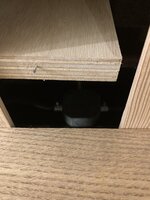
I am adding a circuit to this sub panel which was afaik inspected and I saw theses bushings.

I only have seen them in metal studs.

The wires going through them are laying on a suspended ceiling without being fastend anywhere close to the panel.

Is that kosher?

Thank you.
 

Attachments

  • IMG_2452.jpeg
    IMG_2452.jpeg
    642.1 KB · Views: 131
  • IMG_2451.jpeg
    IMG_2451.jpeg
    642.1 KB · Views: 127
To avoid these ads, REGISTER NOW!

nadogail

Well-known member
Joined
Jan 23, 2009
Messages
32,226
Location
Coronado, CA
The conductors need to be protected from physical damage, they do not seem to be rubbing on any sharp edges. Some sort of bushing or grommet would do that, even a short length of split tubing.
Maybe the fact that there is an air space between the cables and the panel satisfied the requirement.
 

mike93lx

ALLIANCE MEMBER
Joined
Dec 9, 2013
Messages
38,398
Location
Richmond, VA
The conductors need to be protected from physical damage, they do not seem to be rubbing on any sharp edges. Some sort of bushing or grommet would do that, even a short length of split tubing.
Maybe the fact that there is an air space between the cables and the panel satisfied the requirement.
Air gap isn't enough.

That romex with what looks like a disconnected male adapter is concerning too.
 

sparky 1971

Well-known member
Joined
Oct 9, 2018
Messages
8,113
Location
Central Iowa
A anti-short bushing does not secure the cable(s) where they enter the enclosure, **** work to use the bushings in that application.
I've used them several times to make a home inspector happy. Someone fishes romex right through a knockout and calls it good, later the house gets sold, home inspector convinces buyers they will definitely die if they buy the house in that condition. I, being the hero that I am, come to the rescue and save a bunch of lives and it only cost $125.00
 
OP
A

acer66

Well-known member
Joined
Dec 4, 2010
Messages
4,418
Location
Western North Carolina
A anti-short bushing does not secure the cable(s) where they enter the enclosure, **** work to use the bushings in that application.
Thank you for confirming that.

I asked the owner again and it was inspected.

I fixed the disconnected male adapter mike was referring to.

Found a 12 and 14g ground wire under one screw.

Several loose screws on neutrals and ground.

A MWBC on a tandem with no handle.

I wonder how they got away with no AFCI‘s.

I gutted and rewired my house completely a few years before this panel was done.
And everything in the house except for 240V had to be on AFCI breakers and we are in the same county.
 
Last edited:

wyliesdiesels

Well-known member
Joined
Aug 14, 2012
Messages
20,201
Location
Modesto, CA
Thank you for confirming that.

I asked the owner again and it was inspected.

I fixed the disconnected male adapter mike was referring to.

Found a 12 and 14g ground wire under one screw.

Several loose screws on neutrals and ground.

A MWBC on a tandem with no handle.
Are you sure its a tandem breaker? Cause if it is that creates a potential to overload the neutral.
 

sparky 1971

Well-known member
Joined
Oct 9, 2018
Messages
8,113
Location
Central Iowa
Wow, now that I can see that on my desktop, what a mess. I can say that I have seen worse though.
Thank you for confirming that.

I asked the owner again and it was inspected.
Depending on the location, inspections may not mean much
I fixed the disconnected male adapter mike was referring to.

Found a 12 and 14g ground wire under one screw.

Several loose screws on neutrals and ground.

A MWBC on a tandem with no handle.
Are you sure it's a MWBC? If so, get that taken care of because the neutral is carrying the combined current of both circuits. It may be that the red of one circuit is on the tandem and the black is on either the breaker above or below the tandem. And, it may predate the handle tie rule. I don't remember exactly what edition of the NEC introduced it to us, but it's been fairly recent.
I wonder how they got away with no AFCI‘

I gutted and rewired my house completely a few years before this panel was done.
And everything in the house except for 240V had to be on AFCI breakers and we are in the same county.
It might have been AFCI "protected" at the time of the inspection. Someone might have come along after the fact and thrown the arc fault breakers in the trash where where they belong. I wouldn't ever do such a dastardly thing, but someone else that cares nothing about the safety of others might.

Also, this probably isn't the case, but the inspector may have not even pulled the cover off the panle. I had an inspector call me up and threaten to fail me for not leaving the panel cover off for a final inspection for and addition once. He claimed that his municipality had a rule that stated they couldn't take the panel cover off, it had to be done by the electrician. I had the homeowner meet him so I wasn't even there. He told me that he would let it go this time and trust that I had everything correct, but next time I had better either leave it off or be there for the R&R. That was the last time I pulled a permit in that area.
 
Last edited:
OP
A

acer66

Well-known member
Joined
Dec 4, 2010
Messages
4,418
Location
Western North Carolina
Wow, now that I can see that on my desktop, what a mess. I can say that I have seen worse though.

Depending on the location, inspections may not mean much

Are you sure it's a MWBC? If so, get that taken care of because the neutral is carrying the combined current of both circuits. It may be that the red of one circuit is on the tandem and the black is on either the breaker above or below the tandem. And, it may predate the handle tie rule. I don't remember exactly what edition of the NEC introduced it to us, but it's been fairly recent.

It might have been AFCI "protected" at the time of the inspection. Someone might have come along after the fact and thrown the arc fault breakers in the trash where where they belong. I wouldn't ever do such a dastardly thing, but someone else that cares nothing about the safety of others might.

Also, this probably isn't the case, but the inspector may have not even pulled the cover off the panle. I had an inspector call me up and threaten to fail me for not leaving the panel cover off for a final inspection for and addition once. He claimed that his municipality had a rule that stated they couldn't take the panel cover off, it had to be done by the electrician. I had the homeowner meet him so I wasn't even there. He told me that he would let it go this time, but next time I had better either leave it off or be there for the R&R. That was the last time I pulled a permit in that area.
The tandem breaker in question feeds a 14/3 but I am not sure where it goes since the breaker labeling is all over the place.
 

sparky 1971

Well-known member
Joined
Oct 9, 2018
Messages
8,113
Location
Central Iowa
The tandem breaker in question feeds a 14/3 but I am not sure where it goes since the breaker labeling is all over the place.
If it's a 14/3 it needs to get off of the tandem and on to two regular breakers on opposite legs. The use of a handle tie or two pole breaker is entirely up to you.
 

sparky 1971

Well-known member
Joined
Oct 9, 2018
Messages
8,113
Location
Central Iowa
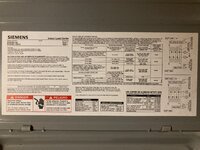
The whole panel was filled with tandem breakers except for two quads.

IMG_2454.jpegIMG_2395.jpeg
Good grief! What is the part number for the panel? I have my doubts as to whether it is listed for all of those tandems. It is pretty easy to get a Siemens tandem to fit in places it's not meant to be though. At least I've heard that before.:rolleyes:
 
To avoid these ads, REGISTER NOW!

sparky 1971

Well-known member
Joined
Oct 9, 2018
Messages
8,113
Location
Central Iowa
The 12/24 means it's a 12 space panel capable of supporting 24 circuits. It's listed for use with all of those tandems. Stupid, but still code compliant. Someone saved about $10 by buying that panel, but then spent an extra $100 in breakers.
 
OP
A

acer66

Well-known member
Joined
Dec 4, 2010
Messages
4,418
Location
Western North Carolina
The 12/24 means it's a 12 space panel capable of supporting 24 circuits. It's listed for use with all of those tandems. Stupid, but still code compliant. Someone saved about $10 by buying that panel, but then spent an extra $100 in breakers.
Cool and maybe the prior owner installed the panel original because his style of work throughout the house is summed up by the state of this panel perfectly.
 
OP
A

acer66

Well-known member
Joined
Dec 4, 2010
Messages
4,418
Location
Western North Carolina
My condolences
Thank you. 😝

The guys work would make for a good conversation piece.
I talked to him a few times when the current owner bought the house a few years back and he was really nice but his craftsmanship was lets say interesting.

From simple things like putting non dimmable led’s on dimmers over a habit to bury boxes, installing motion sensor lights where the feeding wire just ends somewhere in the attic insulation and so on.

The electrical highlight was his elaborate incandescent landscape lighting which was also a selling point for the current owner with half a dozen big transformers all over the place catching fire almost burning the house down a few weeks in after the sale.

That carries over to cabinetry, plumbing and whatever else he could get his hands on.
 
Last edited:

mm08822

Well-known member
Joined
Jan 13, 2012
Messages
6,230
Location
NJ
I've used them several times to make a home inspector happy. Someone fishes romex right through a knockout and calls it good, later the house gets sold, home inspector convinces buyers they will definitely die if they buy the house in that condition. I, being the hero that I am, come to the rescue and save a bunch of lives and it only cost $125.00
After the Home Inspector report was read, you became a SUPER-HERO to fix those items.
 

mm08822

Well-known member
Joined
Jan 13, 2012
Messages
6,230
Location
NJ
It's usually a quick find to figure out the HO did the work. So many times the methods used are harder than doing the correct way with the proper hardware. 🤦‍♂️
 
OP
A

acer66

Well-known member
Joined
Dec 4, 2010
Messages
4,418
Location
Western North Carolina
I thought about starting a new thread but maybe not.
If it should let me know.
Thank you.

This is still on the same job and I am still trying to clean electrical things up while I go around working on stuff.

IMG_2551.jpegIMG_2554.jpeg
The first pic is a buried box roughly 10” up from the ceiling.
2nd pic is looking at the box from underneath the ceiling.

Is there a way to make it code compliant with an access panel?

It is also a bit of tricky location in general.
IMG_2555.jpeg
The red dot is where the box roughly is and the first pics were taken from the right side of the glass block wall which is the shower stall.


Thank you.
 

sparky 1971

Well-known member
Joined
Oct 9, 2018
Messages
8,113
Location
Central Iowa
A junction box has to be accessible.

NEC definition of accessible is: capable of being removed or exposed without damaging the building structure or finish or not permanently closed in by the structure of finish of the building.

Others might tell you that it has to be readily accessible, junction boxes do not have to be. Equipment such as breakers, disconnects, and GFCI's do have to be though.

Readily accessible:
Capable of being reached quickly for operation, renewal, or inspections without requiring those to whom ready access is requisite to take actions such as to use tools (other than keys), to climb over or under, to remove obstacles, or to resort to portable ladders and so forth.

As long as you can get to the box without having to destroy anything, you are ok. Having to take out a few screws is fine.
 

Norcal

Well-known member
Joined
Mar 16, 2008
Messages
13,788
Thank you guys that helps me a lot.

1692966281228.png
3 12/2‘s in the box and the ground was about 1/16” max away from the neutral screw.
When using a cut in box like the one shown above remove the ears off the device & it will seat better, as will the plate.
 
OP
A

acer66

Well-known member
Joined
Dec 4, 2010
Messages
4,418
Location
Western North Carolina
When using a cut in box like the one shown above remove the ears off the device & it will seat better, as will the plate.
That is a great tip, thank you.


The more I work on the remodel the more tricky it gets with the the space in the subpanel.

Discovered a run where a plastic box was attached with a single drywall screw, 12g and 14g on the same circuit feeding random hallway lights and receptacles all hooked up to a 20A bathroom circuit.

Another bathroom also feeds half of the adjacent office.

Looks like I opened up a big ole can of worms. 😝
 
To avoid these ads, REGISTER NOW!
Top Bottom