
#crnxr
New member
Hey all. Long-time lurker and first post. Wanted to start by saying thank you to all the knowledgeable and helpful people here who are willing to lend advice to amateurs like myself.
Our home is a SFR with 200A service in WA state. I'd like to run 90A to a sub-panel in shed which is 200' from the main panel. For now I'll be running a few outlets for power tools, outdoor lights, and maybe a wall heater. I know 90A is overkill now, but I plan to utilize the full capacity at a future date when a larger shop is built.
Here's the plan...would appreciate feedback on anything I overlooked
90A breaker in main panel
1/0-1/0-1/0-#4 AL USE-2/RHH/RHW-2 (MHF) in 2" Schedule 80 conduit (18" deep) to shed
At shed...24 space QO panel with 100A breaker
(2) 5/8 dia. x 8' grounding rods spaced 6' apart with #8 bare copper
Neutral and ground not bonded at sub-panel
Questions...
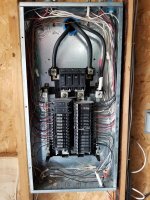
1) I'd like to run the circuit through the back of the main panel using an LB fitting (See pic). Any issues with drilling the current knockout (Lower center on back of panel) larger to accommodate 2" pvc male adapter/lock ring and bushing?
2) Down the road I'd like to move this panel into a new detached shop, which will require about 40' more wire. Can I make a couple of extra trenches and lay more wire than I need now so that it can be extended later? With up to 240' I figured the voltage drop at just under 4%.
3) For outdoor lighting I planned to run some 12/2 UF-B from the shed about 40' to a quad outlet box. Can I run this in the same trench as the branch circuit?
Thanks very much in advance.
Kyle
Our home is a SFR with 200A service in WA state. I'd like to run 90A to a sub-panel in shed which is 200' from the main panel. For now I'll be running a few outlets for power tools, outdoor lights, and maybe a wall heater. I know 90A is overkill now, but I plan to utilize the full capacity at a future date when a larger shop is built.
Here's the plan...would appreciate feedback on anything I overlooked
90A breaker in main panel
1/0-1/0-1/0-#4 AL USE-2/RHH/RHW-2 (MHF) in 2" Schedule 80 conduit (18" deep) to shed
At shed...24 space QO panel with 100A breaker
(2) 5/8 dia. x 8' grounding rods spaced 6' apart with #8 bare copper
Neutral and ground not bonded at sub-panel
Questions...
1) I'd like to run the circuit through the back of the main panel using an LB fitting (See pic). Any issues with drilling the current knockout (Lower center on back of panel) larger to accommodate 2" pvc male adapter/lock ring and bushing?
2) Down the road I'd like to move this panel into a new detached shop, which will require about 40' more wire. Can I make a couple of extra trenches and lay more wire than I need now so that it can be extended later? With up to 240' I figured the voltage drop at just under 4%.
3) For outdoor lighting I planned to run some 12/2 UF-B from the shed about 40' to a quad outlet box. Can I run this in the same trench as the branch circuit?
Thanks very much in advance.
Kyle
Attachments

Last edited: