To avoid these ads, REGISTER NOW!

Suggestions for Boiler set-up?

mnwebb

Well-known member
Joined
Mar 6, 2017
Messages
98
Location
St.Paul, MN
I am trying to figure out my most compact, and attractive way, to route my in-floor heat system. Any suggestions would be greatly appreciated!

I will have 2 zones, one in the lower cement floor and one under the 2nd story rafters. I have never done this and it probably shows.

I was told that the pumps have a longer life if the flow of water is upwards (any truth to that?). So one design is with pumps flowing down and one with pumps flowing up.

I will have wallboard, and some kind of board that the whole system attaches to.

Thanks all!
-MNWebb

https://ibb.co/SscRnRt
https://ibb.co/tHX7Vsn

https://www.garagejournal.com/forum/hamb/attach/jpg.gif

https://www.garagejournal.com/forum/hamb/attach/jpg.gif
 

Attachments
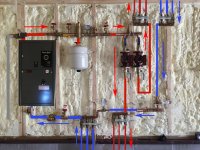
  • Heatafter1.jpg
    Heatafter1.jpg
    159.7 KB · Views: 84
  • Heatafter2.jpg
    Heatafter2.jpg
    159.8 KB · Views: 61
Last edited:
To avoid these ads, REGISTER NOW!

finn

Well-known member
Joined
Mar 27, 2005
Messages
16,203
Location
The UP, God's country
Pex in concrete runs at ~110 degrees water temperature.

Staple up pex, which sounds like your plan for the second story, needs higher temperature water, ~140 degrees, to effectively transfer heat.

That’s my experience, anyway, so you will need some sort of mixing valve for the concrete floor.
 

squeezer

Member
Joined
Mar 19, 2007
Messages
7
Google “ Primary Secondary closely spaced T” and start reading...

It’s counterintuitive at first but makes for a well performing system.

The recommendation is to pump away from the boiler.

Don’t be afraid to plumb in 3D. Flat layouts are easier to draw but rarely give the most compact near boiler layout...
 
OP
M

mnwebb

Well-known member
Joined
Mar 6, 2017
Messages
98
Location
St.Paul, MN
squeezer...make sure the main "T's" are with 6" of each other is the idea, correct?

Aren't any pumps one the discharge side of the boiler pumping away?

Thanks!
 

johnnyradiant

Well-known member
Joined
Mar 27, 2017
Messages
833
Location
Vancouver, BC
Easy read book "Primary-Secondary Pumping Made Easy!" - Dan Holohan. It's a simple read that lays out a good foundation on this stuff. Dan has/had a site called www.heatinghelp.com. There's some other books on there. Pumping Away is another one of his that makes a good companion. And he has/had some other authors listed as well.

The hardest part about layout is there are so many choices of fittings, run lengths, directions, etc. It's really like chess where you need to think out all the steps and lay them out and chances are once you get going you'll encounter other options that could have been done. Don't hesitate to expand the compactness out a bit for service. There is nothing more frustrating going into service a nice neat and tidy layout that gave zero consideration to any of the components or the boiler that will at some point need some form of service.
 

johnnyradiant

Well-known member
Joined
Mar 27, 2017
Messages
833
Location
Vancouver, BC
Oh and finn's point about the 2 different loop temps required is critical to how well your system will work without compromises (not warm enough upstairs or too hot a slab downstairs, which is uncomfortable to stand on for any length of time). Upstairs loop first (hottest zone/loop first) Downstairs loop second with a mixing valve.
 
OP
M

mnwebb

Well-known member
Joined
Mar 6, 2017
Messages
98
Location
St.Paul, MN
Ah thx johnnyradiant...good to know about the temp differences. What does the mixing valve do?

Squeezer.....my system in 300' in the slab and maybe 200 above...does the Primary make sense inn a smaller system? I read..."Important note: For relatively small radiant systems, those using less than 3,000 linear feet of 7/8″ XL PEX, Primary/Secondary plumbing isn’t necessary. Unless, as stated above, a specific boiler manufacturer requires Primary/Secondary plumbing to protect the unit’s internal heat exchanger."
 
Last edited:
To avoid these ads, REGISTER NOW!

johnnyradiant

Well-known member
Joined
Mar 27, 2017
Messages
833
Location
Vancouver, BC
Ah thx johnnyradiant...good to know about the temp differences. What does the mixing valve do?

Squeezer.....my system in 300' in the slab and maybe 200 above...does the Primary make sense inn a smaller system? I read..."Important note: For relatively small radiant systems, those using less than 3,000 linear feet of 7/8″ XL PEX, Primary/Secondary plumbing isn’t necessary. Unless, as stated above, a specific boiler manufacturer requires Primary/Secondary plumbing to protect the unit’s internal heat exchanger."

finn said it first I just underscored. The temp you need/want in a slab is lower than what you need/want for pipe stapled up under your second floor. Your boiler will need to produce the hottest required temp for upstairs. The mixing valve for slab will take the boiler feed and mix in some of the return from the loop to lower the temp going into your slab.

I assumed that most boiler man.s preferred Primary/Secondary based on the common local ones here. That said I walked into a system that had just been installed with some head scratching install choices with a couple 775k boilers where the manual clearly stated in a couple places P/S. The local reps even had a rep from their NY plant come out and go through the iffy stuf and the problem stuff. In the end they were ok with the common/equal length header the creative company used and honored their boiler warranty above and beyond the printed version, so P/S isn't the end all be all but it would have made that install a whole lot better, and a lot of other installs too.
 

yeldogt

Well-known member
Joined
Jan 2, 2012
Messages
18,184
Why are you using 7/8 pex ?... how big is the building? ... what is the heat load of the whole building for sizing the boiler? heat load for each area ? BTU per SF? Loop length for response time?

Unless you have spray foam the heat from a typical stable up is not going to work .... even with foam it is often does not work. Needs high temp and constant operation.

Also, using 7/8 - the contact area is less than 1/2. Underfloor requires some type of plates depending on per square foot output needed and response time desired.

Near piping depends on boiler. primary/ secondary or LLH depends on other factors.


You need to do some reading
 
OP
M

mnwebb

Well-known member
Joined
Mar 6, 2017
Messages
98
Location
St.Paul, MN
yeldogt - It's not a 7/8" pex...where did you get that idea?

The building is 550sf on the bottom (in cement) and 400 sf on the 2nd floor. Entire building spray foamed.

Are you saying that staple up is always inefficient and not worth the cost? I have only heard that it is slightly less effective as above floor.

thx
 

yeldogt

Well-known member
Joined
Jan 2, 2012
Messages
18,184
I misread the "Note" above as being what you used -- lists 7/8

The contact area between the tubing and floor is very small with simple staple up -- That type of staple up requires much hotter water and constant circulation. Extremely slow response. Think about what you are trying to do ... PEX in a slab allows for full contact (it's still slow). You just have a tube running through a bay. Even with 8" spacing the output is low.


Do some research. You will see how the use of various plates allow for both great transfer from the tube and distribution to the subfloor. I'm using extruded plates and 3/8 PEX on my current project where I have to use under subfloor system.

With only 400sf of area -- I would get whatever plate will provide an output using around the same water temp as the slab. The system will be simple.

You need to get the load in each area -- see what BTU per foot you need. See what the various systems put out. Understand how that output is rated -- typically continuous. The way you are doing it now you are going to need two very different water temps for each type of radiant. If you need X amount of heat per foot from the floor ... and you can't get it ... it will not work.
 
Last edited:

finn

Well-known member
Joined
Mar 27, 2005
Messages
16,203
Location
The UP, God's country
yeldogt - It's not a 7/8" pex...where did you get that idea?

The building is 550sf on the bottom (in cement) and 400 sf on the 2nd floor. Entire building spray foamed.

Are you saying that staple up is always inefficient and not worth the cost? I have only heard that it is slightly less effective as above floor.

thx

Inefficient isn’t really the correct term, as inefficient implies a loss of thermal energy, which isn’t the case.

As Yelp stated, the issue is the difficulty in transferring the heat from the fluid, through the tubing wall, and into the floor substrate.

In my house, I used the inexpensive stamped steel plates from Menards that’s have a circular groove that encompasses the pex tubing, and fastened to the underside of the subfloor. The entire floor joist Bay is then insulated with bats, leaving an air channel.

There are aluminum stampings and extrusions available that have slightly better heat transfer coefficients than the thin steel stamping I used.

In my case, heat transfer is sufficient to keep the house warm running ~140 degree water out temperature, except for the living room which has a vaulted 16’ ceiling and glass doors and large windows on two walls. On cold days (below 10-15 degrees), I have to bump the boiler to 150 degrees to maintain comfort in that room.

It’s all about heat transfer: from the tube to the floor and from the room to the atmosphere.

Note that, in any case, the water temperature has to be considerably above the ~110 degrees that I run in my shop, which has pex embedded in the concrete floor.
 

haugy

Well-known member
Joined
Dec 1, 2009
Messages
783
Location
Nashville, TN
Jeezus. I thought I had a good handle on radiant in-floor heating but this damn thread has made my eyes crossed. Looks like I have more planning to work out.
 
To avoid these ads, REGISTER NOW!
Top Bottom