To avoid these ads, REGISTER NOW!

Suggestions for welding table legs.

tearlessj

Well-known member
Joined
Mar 25, 2010
Messages
49
I got a really good deal on a 3'x5' 1" plate of steel the other day. I'm really excited to finally build a nice welding table. I was thinking of using 2x2 3/16 square tubing for the legs. The local metal supply quoted me $3.60/ft for the tubing. Then I remember I have 60ft of round 1.5" .120 DOM laying around in the backyard. Would it be possible to use the round tubing for my table legs or is that a terrible idea? Is it even possible?

Thank you
 
To avoid these ads, REGISTER NOW!

kkroger

Well-known member
Joined
Apr 21, 2013
Messages
1,143
611 pounds for the plate... do you plan on framing in the legs? or just sticking them on there? Do you plan to move the table? Wheels? the round tube would hold it and if framed in at the bottom and at the top should be structurally OK... but just stuck on would probably fold like a Chinese fan...
 

kkroger

Well-known member
Joined
Apr 21, 2013
Messages
1,143
That said, 11 Ga square tube would be less expensive and also structurally sound. You really want to frame in the top and probably a shelf underneath too.
 

tarbellb

Well-known member
Joined
Apr 17, 2011
Messages
5,733
Location
Oregon
Considering roll cages are made from DOM tubing of similar size you will be fine.... if done correctly.

Triangulation is key. I would buy some flat bar stock (maybe 1/4" x 4"), use that as your top frame to BOLT into the table. Then weld your vertical legs to the flat bar and do some cross bracing with the DOM. Finish it up with some nice full lock casters (using that flat again) and you got yourself a killer welding table.
 
OP
T

tearlessj

Well-known member
Joined
Mar 25, 2010
Messages
49
Considering roll cages are made from DOM tubing of similar size you will be fine.... if done correctly.

Triangulation is key. I would buy some flat bar stock (maybe 1/4" x 4"), use that as your top frame to BOLT into the table. Then weld your vertical legs to the flat bar and do some cross bracing with the DOM. Finish it up with some nice full lock casters (using that flat again) and you got yourself a killer welding table.
This sounds like a good plan. Is there a reason why I shouldn't weld the bar stock to the table?
Don’t weld the legs directly to the top. It will warp


Sent from my iPhone using Tapatalk Pro
Unfortunately it already had legs welded to it at one point. I'm not too worried though, I don't really need the table to be perfectly flat.
 

Cheepbeer

Well-known member
Joined
Jun 4, 2017
Messages
158
Location
NW Ohio
I had a piece of 2x2x1 laying around doin nothin. I welded some 2"x1/4 angle on it and wrapped the bottom with rebar. Works just fine.
 

rsanter

Well-known member
Joined
Dec 22, 2007
Messages
18,489
Location
visalia ca
If I was you I would use the tubing you have.
You could do three tubes together in the corner for legs.
Then you can also use the tubes for cross connection pieces between the legs to make the frame of the table.
You can even incorporate a shelf using more of the tubing you have.
Then to mount the top I would weld tabs to the frame and then drill and tap the bottom of the plate to bolt the base to the top.
To make sure you keep the top plate flat after bolting you can use shims as needed between the tabs and the top

Do you plan to move it ever? You can incorporate a lifting system with wheels in the frame if you do. For me I have my welding table on some large HD casters and that has worked great for me
 

tarbellb

Well-known member
Joined
Apr 17, 2011
Messages
5,733
Location
Oregon
This sounds like a good plan. Is there a reason why I shouldn't weld the bar stock to the table?

Unfortunately it already had legs welded to it at one point. I'm not too worried though, I don't really need the table to be perfectly flat.

Sounds like it might be a moot point now, but welding to the top could potentially warp it. But may already not be flat?

Another advantage to doing hardware vs weld is the ability to break it down if needed, let you move into a smaller place, sell it, etc...
 

matt_i

Well-known member
Joined
Mar 14, 2008
Messages
10,722
Location
SE Michigan
Steel seems to have really shot up in price, I was shocked at a quote I got for our plant last week which normally has a pretty good (enviable) discount. I realize some geopolitical forces are at work which we can't get into here.

The steel table I made had the legs bolted to a ladder frame which is intended to be bolted to the top....someday...:) I did that with the idea I could disassemble and then move it with just an engine hoist.
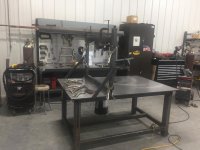
One I got from scrap is fully welded, but its forklift-only.

Legs...yeah, right. I used 4x4x1/4" box tube for my build and the other uses 2-1/2" sq x 1/4 I believe. Its good to plan what goes underneath before you start striking any arcs.
 

dr_clyde

Well-known member
Joined
Jan 7, 2009
Messages
6,425
Location
Holland, MI
I see no reason you can't use the round tube. With the steel market the way it is right now, using what you have makes more sense to me than buying new.

I would make some bolt plates and use threaded holes to attach it to the top. It will be better in the long run should you ever need to take the top off for some reason.

Just make a good frame with the appropriate amount of braces and triangulation and you should be just fine. Make a truss shape, and it will be very strong.
 

1wook

Active member
Joined
Feb 22, 2014
Messages
42
Location
Central MN
Congrats on the bench top material score!

Your not really going to warp 1" thick plate by welding .25" or smaller material to it... If you're going to weld the 1/4" flat bar to the table then there isn't much point in using it.

What do you have to lift / flip the plate with? That may drive more of your design than some of the other factors.

Your tubing will work but you'll have to be intentional about how you gusset/triangulate a support structure for the legs especially if you put it on castors. IMO bolting the little legs and their bracing to the top seems like allot of holes to drill instead of welding it.

Considering roll cages are made from DOM tubing of similar size you will be fine.... if done correctly.

Triangulation is key. I would buy some flat bar stock (maybe 1/4" x 4"), use that as your top frame to BOLT into the table. Then weld your vertical legs to the flat bar and do some cross bracing with the DOM. Finish it up with some nice full lock casters (using that flat again) and you got yourself a killer welding table.

This sounds like a good plan. Is there a reason why I shouldn't weld the bar stock to the table?
QUOTE]
 
To avoid these ads, REGISTER NOW!

dr_clyde

Well-known member
Joined
Jan 7, 2009
Messages
6,425
Location
Holland, MI
Congrats on the bench top material score!

Your not really going to warp 1" thick plate by welding .25" or smaller material to it... If you're going to weld the 1/4" flat bar to the table then there isn't much point in using it.

What do you have to lift / flip the plate with? That may drive more of your design than some of the other factors.

Your tubing will work but you'll have to be intentional about how you gusset/triangulate a support structure for the legs especially if you put it on castors. IMO bolting the little legs and their bracing to the top seems like allot of holes to drill instead of welding it.


This sounds like a good plan. Is there a reason why I shouldn't weld the bar stock to the table?
QUOTE]

You can and will warp thick metals by welding to them, regardless of the thickness of the piece being welded to it. I'm this case it doesn't matter much, but sometimes it can.
 

joe49

Well-known member
Joined
Sep 25, 2009
Messages
1,883
Location
Tonica, Il
Any time you weld anything you create stress in the weldment. This is many times not any problem. When it is a problem you can stress relieve the welds by peening. Also preheat and restraining the weldment can be used. Back bending can be used to compensate for the shrinkage at the weld is another technique. But waiting till it cools and then peening is the simplest treatment. ...and it's not one way or another you can use multiple methods at the same weld.
 

Lelandwelds

Well-known member
Joined
Sep 6, 2017
Messages
2,443
Location
Central Texas
I have used drill stem before. Just use a good sized apron. Short straight tubing will withstand an impressive amount of weight especially as a vertical column.
 

Lelandwelds

Well-known member
Joined
Sep 6, 2017
Messages
2,443
Location
Central Texas
Any time you weld anything you create stress in the weldment. This is many times not any problem. When it is a problem you can stress relieve the welds by peening. Also preheat and restraining the weldment can be used. Back bending can be used to compensate for the shrinkage at the weld is another technique. But waiting till it cools and then peening is the simplest treatment. ...and it's not one way or another you can use multiple methods at the same weld.

Thick plate doesn't move much. Preheat isn't needed on mild steel. It would take some dramatic peening to have much effect. I guess he could park a bulldozer on it to restrain movement.

Would you worry about the table having the same dimensions at 100°F and 19°F? Just weld it. If legs are a bit light, try to use a forklift to move tables instead of just pushing.
 

joe49

Well-known member
Joined
Sep 25, 2009
Messages
1,883
Location
Tonica, Il
If you would search some you will find out that most of what you have said is incorrect. I do agree as I stated in my previous post with small welds on thick plate, "This is many times not any problem." If you like I can recommend a few fabrication books so you won't need a dozer.
 

Firstram

Well-known member
Joined
May 16, 2017
Messages
1,390
A 3x5x1" plate weighs 620 lbs, that's only 155 lbs per corner, the tubing you have will be fine. Build the table frame using the plate like a table, only on the ground. Be sure to leave at least a 3" overhang on all 4 sides and only weld a 3/4" bead (1 per leg) when you attach the legs to the plate. Use a few friends, a come along or a tow truck to flip the table over. Once the table is on it's feet jack it up and install the casters. That top will warp after years of welding, when it does you can cut those 4 tacks and flip it over.
 

tarbellb

Well-known member
Joined
Apr 17, 2011
Messages
5,733
Location
Oregon
Congrats on the bench top material score!

Your not really going to warp 1" thick plate by welding .25" or smaller material to it... If you're going to weld the 1/4" flat bar to the table then there isn't much point in using it.

4-6 holes tapped through the flat bar doesnt seem like much? Perhaps your misread my intention. Flat bar is the flange between the DOM tube base and table, w/ 1" you only need to tag in maybe 4-6 bolts. All the bracing underneath would be welded into the flat bar.

Granted there are a 1000 ways to skin this cat....
 

4 FN 27

ALLIANCE MEMBER
Joined
Oct 19, 2015
Messages
4,635
Location
Minnesnowta
I agree with the Doc...you will not warp a 1 inch plate anymore than it is warped right now.

The ultimate table:

If I was in your shoes I would make the investment into 1/4 wall x 3 x 4 Tubes for the Base (square frame that attaches to the Top) and the Legs/Cross Members.

Make a Rectangular Frame approx. 4 inches smaller than the Top on all sides. This will allow you a nice clamping edge all the way around. Weld that Frame to the bottom of the Table Top choosing the best side up.

Send it out and have it Blanchard Ground to Flat. Taking as little material as possible to maintain maximum thickness.

Then weld the Legs on with very heavy duty Levelers. Place the Cross Members off the floor high enough to sweep under. Set one cross Member back a little so you can pull a stool up and sit and weld and not have the Cross Member in the way of your feet or TIG Pedal.

I built a table like this back in 1997. Still in service today and works awesome. I do plan on making a new one soon based on the some of the designs I have seen right here on GJ.
 

Attachments

  • IMG_6342.jpg
    IMG_6342.jpg
    120.3 KB · Views: 52
  • IMG_6257.jpg
    IMG_6257.jpg
    145.6 KB · Views: 43
  • IMG_6012.jpg
    IMG_6012.jpg
    150.5 KB · Views: 44

BD1

Well-known member
Joined
Mar 18, 2007
Messages
4,602
Location
north side
And you will still have a warped table.

My 1" thick top 4'X4' has not warped in the 20 years I've had. It's a work table too and had hundreds of pounds set on it, beaten, and welded. It's not gonna warp from welding on it that's for sure. Build correctly and it will last a lifetime and remain the way you built it.
 

eyeball

Well-known member
Joined
Jul 14, 2011
Messages
407
...That top will warp after years of welding, when it does you can cut those 4 tacks and flip it over.


And you will still have a warped table.


Sent from my iPad using Tapatalk


And you will still have a warped table.


My 1" thick top 4'X4' has not warped in the 20 years I've had. It's a work table too and had hundreds of pounds set on it, beaten, and welded. It's not gonna warp from welding on it that's for sure. Build correctly and it will last a lifetime and remain the way you built it.


My point was that a tabletop does not warp on only one side.
 
Last edited:
To avoid these ads, REGISTER NOW!
Top Bottom