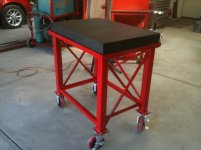
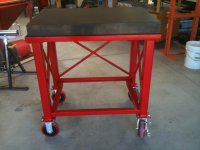
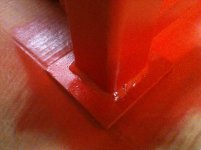
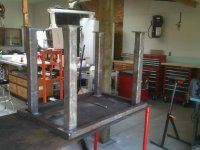
The stone lies flat on the angle iron. I looked at Starrett's website and some others and the best practice is to support the plate by three points, 20% of the length in from the edges. Here's a good summary:
"Another common cause for calibration variation is a plate that is improperly supported. A surface plate should be supported at three points, ideally located 20% of the length in from the ends of the plate. (Erik Note: These should be the same three points the plate was supported by when it was made in the factory). Two supports should be located 20% of the width in from the long sides, and the remaining support should be centered. Only three points can rest solidly on anything but a precision surface. Attempting to support the plate at more than three points will cause the plate to receive its support from various combinations of three points, which will not be the same three points on which it was supported during production. This will introduce errors as the plate deflects to conform to the new support arrangement. If the plate is properly supported, precise leveling is only necessary if your application calls for it. Leveling is not necessary to maintain the accuracy of a properly supported plate."
For my purposes, I decided the above was overkill. I'm a hobby shop and don't need to ensure 0.00001" accuracy on my plate, the workbench is probably flat enough for my actual needs. However, if you want to do it right, I believe the three point method above is the best practice.




 thinking to myself Ive always just used the floor.
 +- 1/8" is plenty fine for any woodworking I do!