To avoid these ads, REGISTER NOW!

Switching legs on 240

ALinCarolina

Well-known member
Joined
Dec 29, 2014
Messages
757
Location
NC Piedmont
I installed a walk-in cooler here on our farm. It is a split system with the compressor outside of the building. I have installed HVAC and have a 608 certification but since I haven't dealt that much with refrigeration I had a pro with 30 years experience come hook it up and charge it. He does work for the grocery chains, etc.

Well as soon as we fired it up it blew the start capacitor. He had an extra on his truck so we replaced it and it blew too. We assumed it was the relay so I called the company and they sent a new relay and a couple of capacitors under warranty. When they came he came back out and we tried it again with the new components. Within less than 10 seconds we had another cloud of smoke and a blown capacitor. We traced all the wiring per the wiring diagram and all was correct. The 240 lines that were installed by a licensed electrician looked correct: L1 and L2.

The tech then tried something he said he had seen done in the past that had worked. He just swapped the L1 and L2 to the other way and everything worked fine. It is still working fine now several days later. We both said this makes no sense but glad it worked after going through 3 caps. Today I checked the voltage at the disconnect: one leg to ground was 126.6 and the other was 122.2. Don't know if that means anything.
There is a wealth of knowledge on here so does anybody have an explanation?
 
To avoid these ads, REGISTER NOW!

BillK

Well-known member
Joined
Aug 24, 2006
Messages
9,314
Location
Beautiful Southern Maryland
Today I checked the voltage at the disconnect: one leg to ground was 126.6 and the other was 122.2. Don't know if that means anything.
There is a wealth of knowledge on here so does anybody have an explanation?
I would think that both legs should be the same. Is the main service 3 phase by some chance ? I am pretty sure with three phase 1 leg is slightly different than the other 2 ? Ill have to check mine at the shop in the morning.
 

Chuckster in NJ

Well-known member
Joined
Jan 26, 2010
Messages
2,287
Location
Hunterdon County NJ
1) You are checking incoming voltage to ground and it should have no impact on the 240 volt motor.
2) Does NOT make any sense swapping L1 and L2 to keep the cap from cooking…. However see my #4 reply
3) Did you check the motor windings to ground?
4) Do you have a three phase "orange leg" service? "IF" you do the high leg may be hooked up to a winding that is leaking voltage to ground therefore blowing out the cap due to higher voltage of orange leg…….. Megger that motor and see how it checks out.
5) Also check currents on each leg (with motor running) to makes sure they are the same.
 

Ole Slewfoot

Well-known member
Joined
Feb 22, 2016
Messages
5,098
Location
Freedom, CA
If it's got a 110 section, test that with a dvom, including to chassis ground....
My buddy recently got a $$,$$$ water filtration system wired such that the frame was a 110 hot.
It worked, but pretty dangerous in something that makes puddles.
 

wyliesdiesels

Well-known member
Joined
Aug 14, 2012
Messages
19,994
Location
Modesto, CA
1) You are checking incoming voltage to ground and it should have no impact on the 240 volt motor.
2) Does NOT make any sense swapping L1 and L2 to keep the cap from cooking…. However see my #4 reply
3) Did you check the motor windings to ground?
4) Do you have a three phase "orange leg" service? "IF" you do the high leg may be hooked up to a winding that is leaking voltage to ground therefore blowing out the cap due to higher voltage of orange leg…….. Megger that motor and see how it checks out.
5) Also check currents on each leg (with motor running) to makes sure they are the same.
3 phase motors do not need a capacitor to start. the capacitor is for single phase motors and starts the motor by creating a phase shift....

also capacitors for motors are usually rated for much higher voltage than the motor... ive seen 400vac and up...
 

Chuckster in NJ

Well-known member
Joined
Jan 26, 2010
Messages
2,287
Location
Hunterdon County NJ
3 phase motors do not need a capacitor to start. the capacitor is for single phase motors and starts the motor by creating a phase shift....

also capacitors for motors are usually rated for much higher voltage than the motor... ive seen 400vac and up...
I know that! RE-READ my post and I was inquiring about the SERVICE.
 

American Locomotive

Well-known member
Joined
Jan 8, 2017
Messages
10,945
Location
Rhode Island
My best guess is that something was wired incorrectly, and was corrected (accidentally?) when swapping L1 and L2.

As mentioned, it's not possible for it to make a difference, especially since your measured voltages with respect to ground are correct.
 
OP
A

ALinCarolina

Well-known member
Joined
Dec 29, 2014
Messages
757
Location
NC Piedmont
Just got back on here. Thanks for the responses. It is single phase. I can get a photo of the relay and surrounding equipment after work today. I ran into my electrician at Lowes yesterday and we agreed it shouldn't make any difference but if not maybe blind luck.
 

nadogail

Well-known member
Joined
Jan 23, 2009
Messages
31,933
Location
Coronado, CA
Some of the buildings I have worked in were Delta and others were not. That is why I wrote “some systems”.
 

sparky 1971

Well-known member
Joined
Oct 9, 2018
Messages
7,967
Location
Central Iowa
How does this happen?
Between both the other phases measure 240V the the (stinger, wild leg, 208V B phase).
I'd be willing to guess that it was the 120 side of a 120/240 dryer or range. I know that doesn't qualify as a straight 240 circuit, but most people call 120/240 circuits 220.
 

wyliesdiesels

Well-known member
Joined
Aug 14, 2012
Messages
19,994
Location
Modesto, CA
How does this happen?
Between both the other phases measure 240V the the (stinger, wild leg, 208V B phase).
How does it happen? Someone puts a single phase breaker on the stinger phase. Then installs a 120v receptacle except the voltage potential is 208v and they dont check before plugging the equipment in
 
To avoid these ads, REGISTER NOW!

sparky 1971

Well-known member
Joined
Oct 9, 2018
Messages
7,967
Location
Central Iowa
How many dryers and ranges (typically residential loads) do you suppose are used with 3 phase 4 wire delta services?
I know of one range I installed a receptacle for in a break room. I made damned sure to put the breaker on C and A phase. The same place had a laundry room but I don't know if the dryer was electric or gas. Maybe it's the only small industrial plant that has the combination of a delta service, an electric range, and maybe an electric dryer. Then again, maybe not.
 

kaffine

Well-known member
Joined
Dec 13, 2009
Messages
3,610
Location
Henderson, NV
How many dryers and ranges (typically residential loads) do you suppose are used with 3 phase 4 wire delta services?

Isn't one of the reasons 3 phase 4 wire delta is used is to supply 240V to single phase loads vs 208V? I would guess a fair amount of equipment running from that would have 120V loads inside.
 

wyliesdiesels

Well-known member
Joined
Aug 14, 2012
Messages
19,994
Location
Modesto, CA
Isn't one of the reasons 3 phase 4 wire delta is used is to supply 240V to single phase loads vs 208V? I would guess a fair amount of equipment running from that would have 120V loads inside.
yes it was design for small amounts of 3 phase load and lots of single phase load....
 

sparky 1971

Well-known member
Joined
Oct 9, 2018
Messages
7,967
Location
Central Iowa
I got a call this afternoon from a mechanical contractor because of a weird voltage. He told me they changed out a roof top unit on a church and had 120 to ground on two phases and 218 on the middle and wanted me to run out and see WTF was wrong. I told him that was perfectly normal and explained what it was, and to leave the high leg in the middle, if rotation was wrong, swap A and C phase. I didn't go out, but since it's a church, I can all but guarantee there are at least a couple of electric ranges in there and probably a clothes dryer.
 

Wiz02

Well-known member
Joined
Jul 13, 2007
Messages
2,399
Location
Southeastern PA
seen quite a few believe it or not....
Place where I used to work, prior to moving to a new facility, had a survey asking about amenities at the new digs. Since the company had lots of pot luck lunch parties, an oven and cooktop were top requests. In order to get them for the break room, we would have needed a restaurant permit and that was a non starter, so we had a huge kitchen with a couple of sinks and lots of cabinets and counter tops but just microwaves.
 

Ole Slewfoot

Well-known member
Joined
Feb 22, 2016
Messages
5,098
Location
Freedom, CA
Our reefer trucks have a 3ph aux motor.
As far as I can tell rotation isn't standardized at terminals, sometimes you plug in, it makes a terrible noise, and you have to rewire the receptacle.

What's up with that?
 
OP
A

ALinCarolina

Well-known member
Joined
Dec 29, 2014
Messages
757
Location
NC Piedmont
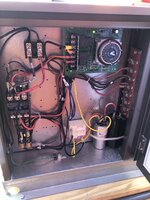
I used a clamp meter on the L1 and L2 wires while the unit was running and got 7.2 and 7.4 amps. Does this say anything? Here are the photos of the outside unit.
 

Attachments

  • F0DE8888-5ABC-4F13-88FD-62D42A7F1E52.jpeg
    F0DE8888-5ABC-4F13-88FD-62D42A7F1E52.jpeg
    611.8 KB · Views: 19
  • D94FDA7B-41BB-48A0-876C-1636FB91B299.jpeg
    D94FDA7B-41BB-48A0-876C-1636FB91B299.jpeg
    695.9 KB · Views: 19
To avoid these ads, REGISTER NOW!
Top Bottom