Alright so from what im reading everywhere everyone is saying 220/230/240v are all basically the same and you can switch them all out. So my question is i have 30amp 220v plug in my garage so if what everyone is saying is true i should be able to just switch the female plug from a 220 style to the 330v style right?

You are using an out of date browser. It may not display this or other websites correctly.
You should upgrade or use an alternative browser.
You should upgrade or use an alternative browser.
switching plug from 220 to 230v
- Thread starter boostedjd
- Start date
Aceman
Well-known member
330v style right?
There is no 330 volt style.
1969
Well-known member
330v, interesting.
Magneto
Well-known member
Not sure I can decipher this one. But I'll take a stab at it. You're probably asking about the various female NEMA outlet configurations and their companion plugs, 3 slot vs. 4 slot, used on 240 lines. Those plugs are generally wired for specifics purposes and amperages i.e., dryers, ovens, welders, RVs, etc etc..... and most importantly all require correct wire gauges to handle load.
Last edited:
frank_c
Well-known member
330, 331. Whatever it takes.
beat me to it...
ishiboo
Well-known member
Alright so from what im reading everywhere everyone is saying 220/230/240v are all basically the same and you can switch them all out. So my question is i have 30amp 220v plug in my garage so if what everyone is saying is true i should be able to just switch the female plug from a 220 style to the 330v style right?
220, 230 and 240v are all the same... so the plugs are the same. You want to switch from one 240v plug to a different one, apparently.
Zeke
Well-known member
The question makes no sense. Troll?
Electric_Light
Well-known member
- Joined
- Jan 3, 2015
- Messages
- 74
198v and 252v
soj
Well-known member
The question makes no sense. Troll?
His first post... Hopefully he will clear this up... and introduce himself.
jp
jmlcolorado
Well-known member
I had a similar problem when I moved into my house. The house was wired for 120, but everything I own is 110. I ended up having to hire an electrician to re-wire the whole house to comply. Electrician was a little hesitant at first, but once he got the 50% down check, he went to town. I was really impressed with his work. He said we couldn't be in the house while he did the work since there would be no power while he made the swap. Understandable.
He did so good that you can't even tell he did anything. Luckily he was able to reuse all the outlets and switches, and he somehow patched all the drywall and had it painted so well, you would never know anything ever happend. He even drew back on all the drawings in crayon my kids so kindly left on the wall too!!!!
While we were out of town while he did the work, he kept me appraised to his progress. He did say that he needed to remove some of my things as they would no longer work with the new voltage in the home, and apparently they were illegal to have in the house. Something about a code or something.
No biggy though, just my TV, blu ray player and 2 year old surround sound system. I had a huge chunk of money in those, but better be safe and not break any codes, so I let him take those. I've been known to be a little on the cautious side.
I'd reccomend talking to an electrician about your problem. Usually the ones in the Home Depot parking lot looking for work are the best since they aren't a big company with a lot of overhead, so their prices are usually cheaper.
My electrician had so little overhead, that his van had his logo painted on the side. He said he did that himself just to keep costs down in his company so he could pass the savings on to his customer. Don't go the big companies, they will bend you over the table.

He did so good that you can't even tell he did anything. Luckily he was able to reuse all the outlets and switches, and he somehow patched all the drywall and had it painted so well, you would never know anything ever happend. He even drew back on all the drawings in crayon my kids so kindly left on the wall too!!!!
While we were out of town while he did the work, he kept me appraised to his progress. He did say that he needed to remove some of my things as they would no longer work with the new voltage in the home, and apparently they were illegal to have in the house. Something about a code or something.
No biggy though, just my TV, blu ray player and 2 year old surround sound system. I had a huge chunk of money in those, but better be safe and not break any codes, so I let him take those. I've been known to be a little on the cautious side.
I'd reccomend talking to an electrician about your problem. Usually the ones in the Home Depot parking lot looking for work are the best since they aren't a big company with a lot of overhead, so their prices are usually cheaper.
My electrician had so little overhead, that his van had his logo painted on the side. He said he did that himself just to keep costs down in his company so he could pass the savings on to his customer. Don't go the big companies, they will bend you over the table.
230v, my bad. In my garage i have 30 amps, 220 volt outlet. it is the style with 2 slanted prongs at the bottom and the L shaped prong at the top. I am looking to buy the lincoln electric weldpack 180. The plug for the weldpack 180 has the sidewasy D shape at the bottom and then the two parrallel lines on top with one smaller than the other. If you google image it it shows it on the box. It also says its 230v. So since everyone is saying 220/230/240v are the same, can i just switch out the female end in my garage to fit the plug that the welder is supposed to take?
Last edited:
jmlcolorado
Well-known member
You'll be fine switching required plug ends. Just make sure your plug is rated for proper amperage the welder required. In other words, don't use a 30 amp plug on a 50 amp welder. This is noted in the welder manual. It's not the output of the welder, but what the welder requires for current.
That small of a welder should be fine with a 30 amp circuit, but that should also be noted in the manual.
That small of a welder should be fine with a 30 amp circuit, but that should also be noted in the manual.
Elginz
Well-known member
What you have to look at is the amperage. The plugs are kind of designed to match amperage and wire size, and purpose. Look at the amperage rating on the receptacle you want to use, it would have to be rated at 30 amperes or less. If less the over load protection (breaker) would need to be matched to the receptacle.
I had a similar problem when I moved into my house. The house was wired for 120, but everything I own is 110. I ended up having to hire an electrician to re-wire the whole house to comply. Electrician was a little hesitant at first, but once he got the 50% down check, he went to town. I was really impressed with his work. He said we couldn't be in the house while he did the work since there would be no power while he made the swap. Understandable.
He did so good that you can't even tell he did anything. Luckily he was able to reuse all the outlets and switches, and he somehow patched all the drywall and had it painted so well, you would never know anything ever happend. He even drew back on all the drawings in crayon my kids so kindly left on the wall too!!!!
While we were out of town while he did the work, he kept me appraised to his progress. He did say that he needed to remove some of my things as they would no longer work with the new voltage in the home, and apparently they were illegal to have in the house. Something about a code or something.
No biggy though, just my TV, blu ray player and 2 year old surround sound system. I had a huge chunk of money in those, but better be safe and not break any codes, so I let him take those. I've been known to be a little on the cautious side.
I'd reccomend talking to an electrician about your problem. Usually the ones in the Home Depot parking lot looking for work are the best since they aren't a big company with a lot of overhead, so their prices are usually cheaper.
My electrician had so little overhead, that his van had his logo painted on the side. He said he did that himself just to keep costs down in his company so he could pass the savings on to his customer. Don't go the big companies, they will bend you over the table.
FN Classic!!

OP, sounds like you may have a 30amp 120 volt dryer plug, but it could be 220. Go look in your panel and see what breaker is for it. If it is a two pole breaker not a single pole like what your lights and general receptacles are on then you might be half way there. Once you locate that breaker, it should say the amperage on it, look for either 30 or 50. Once you identify that it will help. Now if it does happen to be a 30amp, you can still install a 50amp standard welding receptacle, just remember the welder will not work to full capacity.
Now with that in mind, and just because someone here is gonna ***** about installing a 50amp receptacle on a 30amp circuit. You cannot do the opposite. Installing a 30amp device on a 50amp circuit can be really bad....but I digress.
Here is a link for a NEMA chart for you to compare what you have now and what you need for your welder. If you need any additional help choosing the receptacle you need, just ask.
And good luck!
http://www.bing.com/images/search?q...A72732276B46C34E6144A780C9717&selectedIndex=5
Strouty
Well-known member
I have made all of my outlets the 50 amp style like you are talking about on the lincoln. I do have a few adapters that I have made so if I have a piece of equipment that comes in with a weird plug, I do not need to rewire it to test it.
wyliesdiesels
Well-known member
The OP has a 10-30r. He needs a 6-20r(20a circuit). Its not so easy to just swap recepticles because the 3 prong 'dryer' recepticle DOESNT have an EGC/ground- only 2 hots and a neutral. The welder needs 2 hots and an EGC- no neutral.
Heres the caveat- if this circuit feeds off of the main service panel, then the neutral wire is connected to the same bar(neutral bus bar) where EGCs terminate(main service panel only), and so it is simply a recepticle change.
However, if the circuit feeds off of a sub panel, and the subpanel is 4 wire fed, then the neutral wire needs to be moved over to the EGC bar!
Heres a good reference of NEMA outlets and plugs:
http://www.stayonline.com/reference-nema-straight-blade.aspx
If the circuit is fed off a 4-wire subpanel, its not that easy as just switching the recepticle. See above...
Fixed it for ya- 120v/240v...
Welder circuits ARE the exception. A lot of times u will have 50a outlet and wire on a breaker thats close to twice that. Again, only in wleder circuits.
Code actually doesnt allow the opposite either. U cant install a 50a recepticle on a 30a circuit..
Heres the caveat- if this circuit feeds off of the main service panel, then the neutral wire is connected to the same bar(neutral bus bar) where EGCs terminate(main service panel only), and so it is simply a recepticle change.
However, if the circuit feeds off of a sub panel, and the subpanel is 4 wire fed, then the neutral wire needs to be moved over to the EGC bar!
Heres a good reference of NEMA outlets and plugs:
http://www.stayonline.com/reference-nema-straight-blade.aspx
You'll be fine switching required plug ends. Just make sure your plug is rated for proper amperage the welder required. In other words, don't use a 30 amp plug on a 50 amp welder. This is noted in the welder manual. It's not the output of the welder, but what the welder requires for current.
That small of a welder should be fine with a 30 amp circuit, but that should also be noted in the manual.
If the circuit is fed off a 4-wire subpanel, its not that easy as just switching the recepticle. See above...
FN Classic!!
OP, sounds like you may have a 30amp 120v/240v volt dryer plug, but it could be 220. Go look in your panel and see what breaker is for it. If it is a two pole breaker not a single pole like what your lights and general receptacles are on then you might be half way there. Once you locate that breaker, it should say the amperage on it, look for either 30 or 50. Once you identify that it will help. Now if it does happen to be a 30amp, you can still install a 50amp standard welding receptacle, just remember the welder will not work to full capacity.
Now with that in mind, and just because someone here is gonna ***** about installing a 50amp receptacle on a 30amp circuit. You cannot do the opposite. Installing a 30amp device on a 50amp circuit can be really bad....but I digress.
Here is a link for a NEMA chart for you to compare what you have now and what you need for your welder. If you need any additional help choosing the receptacle you need, just ask.
And good luck!
http://www.bing.com/images/search?q...A72732276B46C34E6144A780C9717&selectedIndex=5
Fixed it for ya- 120v/240v...
Welder circuits ARE the exception. A lot of times u will have 50a outlet and wire on a breaker thats close to twice that. Again, only in wleder circuits.
Code actually doesnt allow the opposite either. U cant install a 50a recepticle on a 30a circuit..
Last edited:
sberry
Banned
He doesn't need a 20R,,, he needs a 6-50-R which is what comes on the welder. Use this recept and don't fool with the welder cord.
The OP has a 10-30r. He needs a 6-20r(20a circuit). Its not so easy to just swap recepticles because the 3 prong 'dryer' recepticle DOESNT have an EGC/ground- only 2 hots and a neutral. The welder needs 2 hots and an EGC- no neutral.
Heres the caveat- if this circuit feeds off of the main service panel, then the neutral wire is connected to the same bar(neutral bus bar) where EGCs terminate(main service panel only), and so it is simply a recepticle change.
However, if the circuit feeds off of a sub panel, and the subpanel is 4 wire fed, then the neutral wire needs to be moved over to the EGC bar!
Heres a good reference of NEMA outlets and plugs:
http://www.stayonline.com/reference-nema-straight-blade.aspx
If the circuit is fed off a 4-wire subpanel, its not that easy as just switching the recepticle. See above...
Fixed it for ya- 120v/240v...
Code actually doesnt allow the opposite either. U cant install a 50a recepticle on a 30a circuit..
No argument there. But there's a huge difference between under protecting the device verses the opposite where you could theoretically damage the conductor. Fact is if the circuit is protected at 30amps and the welder draws 40, the breaker will open long before the conductor starts to overheat and melts the insulation.
Like I said, I knew that statement would go over like a dart in church.
Zeke
Well-known member
I apologize for the troll remark. Welcome to our new member.
330, 331. Whatever it takes.
CD - you win the Internet for today! Cracked me up!
wyliesdiesels
Well-known member
He doesn't need a 20R,,, he needs a 6-50-R which is what comes on the welder. Use this recept and don't fool with the welder cord.
The qebsite says it uses a 20a input. I couldnt find reference to what plug it has...
No argument there. But there's a huge difference between under protecting the device verses the opposite where you could theoretically damage the conductor. Fact is if the circuit is protected at 30amps and the welder draws 40, the breaker will open long before the conductor starts to overheat and melts the insulation.
Like I said, I knew that statement would go over like a dart in church.
Thats the way the code is written. Cant put a higher rated outlet on a lower rated circuit.
And BTW, u cant ALWAYS relie on the breaker to trip because if its a Zinsco, FPE, etc, it may very well NOT trip and then youve got melted wire!
The welder says it need 230v and 20amps. If I'm reading my breaker correctly the one I currently have is a 30 amp breaker.
Thats why i suggested a 6-20r but u may need a bigger outlet. However, welders do have special sizing requirements so it gets a little confusing. Its based on duty cycle.... I will look and see what this welder ACTUALLY needs...
Also, is this existing circuit fed off of a subpanel or a main service panel??
wyliesdiesels
Well-known member
Ok so manual says 20a input, 40a breaker...still trying to find what plug it has....
http://www.lincolnelectric.com/assets/servicenavigator-public/lincoln3/imt10135.pdf
http://www.lincolnelectric.com/assets/servicenavigator-public/lincoln3/imt10135.pdf
Last edited:
Strouty
Well-known member
It is almost always a 50 amp style plug, I don't think I have ever seen a welder with a different one unless it was changed by the owner. My 300 amp miller has a 50 on it, my plasma cutter has the same, as well as my 211 miller.
Welders (the machine not the people) are weird, the way that they rate them and how they are wired is strange as well. I do not think they follow code, but I do not understand why.
Welders (the machine not the people) are weird, the way that they rate them and how they are wired is strange as well. I do not think they follow code, but I do not understand why.
Strouty
Well-known member
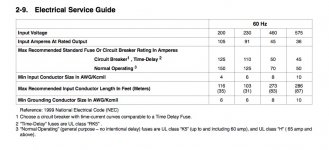
I remember when I was setting up my 300 amp welder, the information miller gave me was no where near code. When talking to the electrical supply company about it they said welders are always weird and to just follow the manufacturers chart. I also discussed it with an electrician and he agreed. I have never had any issues and I used 6 gauge wire with a 100 amp breaker 90 feet of wire. Here is the chart from miller:
Attachments
wyliesdiesels
Well-known member
I remember when I was setting up my 300 amp welder, the information miller gave me was no where near code. When talking to the electrical supply company about it they said welders are always weird and to just follow the manufacturers chart. I also discussed it with an electrician and he agreed. I have never had any issues and I used 6 gauge wire with a 100 amp breaker 90 feet of wire. Here is the chart from miller:
Actually if u go through the code section that deals with welders, u will see that its based on duty cycle. Code allows a higher rated breaker with a lower rated wire and outlet FOR WELDER CIRCUITS BUT the outlet MUST be labeled 'for welder use only'!
Last edited:
zmaxmotorsports
Well-known member
I had a similar problem when I moved into my house. The house was wired for 120, but everything I own is 110. I ended up having to hire an electrician to re-wire the whole house to comply. Electrician was a little hesitant at first, but once he got the 50% down check, he went to town. I was really impressed with his work. He said we couldn't be in the house while he did the work since there would be no power while he made the swap. Understandable.
He did so good that you can't even tell he did anything. Luckily he was able to reuse all the outlets and switches, and he somehow patched all the drywall and had it painted so well, you would never know anything ever happend. He even drew back on all the drawings in crayon my kids so kindly left on the wall too!!!!
While we were out of town while he did the work, he kept me appraised to his progress. He did say that he needed to remove some of my things as they would no longer work with the new voltage in the home, and apparently they were illegal to have in the house. Something about a code or something.
No biggy though, just my TV, blu ray player and 2 year old surround sound system. I had a huge chunk of money in those, but better be safe and not break any codes, so I let him take those. I've been known to be a little on the cautious side.
I'd reccomend talking to an electrician about your problem. Usually the ones in the Home Depot parking lot looking for work are the best since they aren't a big company with a lot of overhead, so their prices are usually cheaper.
My electrician had so little overhead, that his van had his logo painted on the side. He said he did that himself just to keep costs down in his company so he could pass the savings on to his customer. Don't go the big companies, they will bend you over the table.

Last edited:
zmaxmotorsports
Well-known member
The question makes no sense. Troll?
Theres our little ray of sunstroke!
Actually if u go through the code section that deals with welders, u will see that its based on duty cycle. Code allows a higher rated breaker with a lower rated wire BUT the outlet MUST be labeled 'for welder use only'!
K sparky, where in article 630 does it state that?. The labeling part that is.
wyliesdiesels
Well-known member
K sparky, where in article 630 does it state that?. The labeling part that is.
I dont remember where it is, and my book is locked up at work. I will look monday.
Strouty
Well-known member
I dont remember where it is, and my book is locked up at work. I will look monday.
A likely story, next you are going to tell us that the Patriots use under inflated footballs.
wyliesdiesels
Well-known member
A likely story, next you are going to tell us that the Patriots use under inflated footballs.
Sorry dont watch football...if u dont believe me i will take a pic of my book on my desk...
A likely story, next you are going to tell us that the Patriots use under inflated footballs.
Buhahahahaha
Strouty
Well-known member
Sorry dont watch football...if u dont believe me i will take a pic of my book on my desk...
It was a joke, but I may or may not believe you, I will need to ponder that for a while.
sberry
Banned
Look at the instructions for the welders, especially this 200 compact mig class.Code actually doesnt allow the opposite either. U cant install a 50a recepticle on a 30a circuit..