To avoid these ads, REGISTER NOW!

Table saw advice,

Ol'WhiteCap

Well-known member
Joined
Jan 26, 2016
Messages
134
Location
Henderson, CO
I know,I know. Keep my fingers away from the blade.
In the past. I've had a radial arm saw that I didn't enjoy at all. When ripping long boards. The "kick back" was terrible. So when a table saw came up on Craigslist I bought it. This is something new to me.
I'm asking for advice on ripping 2x4s and plywood, etc. there has to be a lot of tips that will make my sawdust making more enjoyable.
 
To avoid these ads, REGISTER NOW!
OP
O

Ol'WhiteCap

Well-known member
Joined
Jan 26, 2016
Messages
134
Location
Henderson, CO
There are extensions on the sides and a rip fence. It is an old craftsman. I purchased a 52? Tooth carbide blade and a 24? Tooth carbide blade set at Lowes.
 

SteveCh

Well-known member
Joined
Dec 21, 2012
Messages
1,051
longer boards and plywood are much, much easier to control and rip if you either: have a helper to hold the board(s) up as they come off the far side of the table, or invest in a couple of roller stands, or just build a small table the height of the table saw table to catch the wood as it progresses past the blade. The later can be done with scrap wood and does not need to be very large. I'm too cheap to buy the rollers and made a little table I can move around and takes up little room in the shop.

If you get a piece of ply a little off-kilter, the blade can kick the sheet back into you. You will be amazed at how powerfully the blade can do this if you've never experienced it. My previous pickup had a dent in a door from a piece of ply flying across the room and hitting it. Controlling the ply sheet is doable, even by yourself, but you must be really cautious. I've been doing it for forty years, had a couple kickbacks in that time, without other trouble.

Use pushers sticks when ripping smaller wood to a narrow piece, like less than an inch. Make your own from scrap wood or buy the plastic commercially sold ones. I keep them hanging off the saw on a hook so they are always available. I've seen [in person] two guys lose fingers on table saws, both were ripping narrow pieces. Well, each guy lost a digit on one finger, but that is still a bad day.

Wear glasses or eye protection, the blade can kick out splinters even from ply. Anecdote [again], buddy of mine had a two-inch splinter of hardwood shoot into his thigh. He got it out ok, with some pliers, but it was a drag.

Try not to stand directly behind the blade when cutting. It isn't always comfortable to stand off to the side, and I admit I don't always follow my own advice. But kickbacks can send a board at a fairly high rate of speed right into your abdomen. It hurts!!! [Recall my truck door....]
 
Last edited:

ssdave

Banned
Joined
Apr 11, 2015
Messages
2,913
Location
Eastern Oregon
Kickbacks on a tablesaw can generally be prevented by having some kind of one way anti-kickback device. Here's what I use:

http://www.woodcraft.com/Product/146836/Table-Saw-Safety-Roller-Yellow.aspx?gclid=CMjqyeWlis4CFYqPfgodW-QD0Q

I prefer this to a serrated metal strip that is attached to the blade guard/splitter, because it doesn't damage the surface of the board like the serrated metal anti-kickback pawl does. The rubber rollers also hold the board against the fence, and make for a smoother cut.
 

Attachments

  • antikickback.jpg
    antikickback.jpg
    18.5 KB · Views: 37

Garththomas

Member
Joined
May 21, 2016
Messages
7
Its good to have an out feed support, if you have a helper they can hold the end up but not pull. push sticks are a must for anything that gets your hands within 4" or less from the blade. Kickbacks are dangerous and if your saw has a guard with a splitter and kickback teeth thats a start but blade height is important and there is a line between a smooth cut and a kickback proof cut, with the blade set high kickbacks are less likely but you may leave more tooth marks on the wood. With the blade set so it protrudes above the work by 1/2" or less it can make a smoother cut but will take more power to push and cut and then the tendency to ride up and kick back is more possible.
For ripping 2x4s the courser blade is better, that 52 tooth blade is more for plywood or particle board or cross cutting. A splitter or shriving blade is good for keeping the work straight and helps keep it against the fence and the first and minimum piece of safety equipment on any table saw I would look for.
 

7th Kahuna

Well-known member
Joined
Aug 4, 2012
Messages
1,704
Location
Los Angeles, CA
Lots of good advise here. Another tip, make sure you have gone over, cleaned, lubricated, and properly set up your saw. Most importantly, make sure the blade and the fence are absolutely parallel. Of course since absolute rules are generally meant to be broken, one tip that was shared with me is to adjust the saw so the leading edge of the blade is ever so slightly closer to the fence than the trailing edge. This reduces the chance that stock gets pinched between the blade and fence as you are finishing a cut. Along that same line, make sure you have a nice push block or push stick. Combined with a zero-clearance insert, it makes cutting narrow material much safer.
 

7th Kahuna

Well-known member
Joined
Aug 4, 2012
Messages
1,704
Location
Los Angeles, CA
What ever you do, ripping material on a table saw is going to be several orders of magnitude nicer than on the RAS. I haven't ripped on a RAS since I was a kid helping my dad. Never again. Conversely, cross cuts on a table saw are not so bad. If you have a lot to do or are cutting especially small pieces, consider building a simple cross cut sled. There are lots of examples online.
 
OP
O

Ol'WhiteCap

Well-known member
Joined
Jan 26, 2016
Messages
134
Location
Henderson, CO
Thanks, this is Information that I'm looking for and planning to follow. Thanks.

The blade height info is good to know. And pusher sticks will be the first tool. I like the idea of the yellow wheels to prevent kickbacks. As kickbacks are a major concern, from my radial arm saw days.

Keep the hints coming
 

Empty Pockets

Well-known member
Joined
Sep 21, 2015
Messages
4,942
Location
Rural New York
Back in the day, I ran a formica shop. While there were times that a RAS was the best tool for the job, but the 3 table saws we had got the lion's share of the work.

If space allows, build an outfeed table nearly as long as the longest piece of material you expect to be cutting. A sizable table to the side to act as an extension to the saw's table will help, as well.

Keeping the top edge of the saw blade just above to top edge of the material will give a better cut and kick up less saw dust into your face.

Safety glasses and a push stick are a must.

Make sure you have a sharp blade. Don't get cheap and try to use a blade with damaged carbide, as they can fly at tremendous speed.

DON'T trust the built in measurements for the rip fence. Set the fence then measure the distance to the blade with a tape rule. Measure to both the front edge and rear edge of the blade.

Have fun, and please post pictures of finished projects
 

woody 73

Well-known member
Joined
Apr 14, 2009
Messages
11,540
Location
The Great State Up North
The more alcohol and drugs you can take the better you will be!:evil:
Best too use the saw when you are sick as a dog and the bigger the headache the better!:evil:
The bigger the fight with your loved ones all the more better!:evil:
Push sticks are for the birds!:eek:
Wearing safety equipment is also for the birds!:eek:
The more **** on your floor the better!:eek:
No need too unplug the saw before changing the blade!:evil:

I must be forgetting something:dunno: some things my old shop teacher used too preach too us.

http://www.woodcraft.com/articles/317/two-dozen-table-saw-safety-tips.aspx

Safety first!:rocker:
 

Plombob

Well-known member
Joined
Oct 19, 2008
Messages
4,116
Location
Tennessee
DON'T trust the built in measurements for the rip fence. Set the fence then measure the distance to the blade with a tape rule. Measure to both the front edge and rear edge of the blade.

I learned that one the hard way. My boss used to toss the fence into a bin with scrap wood. Eventually, it got slightly kinked at the back end. I got hit in the stomach with a large piece of plywood that kicked back because I didn't measure at both ends. I almost passed out from the punch.
 

Hornman

Well-known member
Joined
May 9, 2013
Messages
517
Location
Southwest DFW
I haven't seen anyone state that for ripping you should use a ripping blade. Yeah, I know that a combo blade will cut wood in the rip direction, but a real rip blade will work noticably better. The Diablo rip blades at HD are pretty decent and reasonably inexpensive.

Make sure your rip fence is straight. If it is not, the blade will bind and either burn the wood or kickback. You can fasten a board as an auxiliary fence and shim it so it stays straight. You will have to measure the distance from the front and the rear to the blade to make sure you are cutting parallel to the blade. I found it useful to measure to the crosscut sled grooves front and back.
 
To avoid these ads, REGISTER NOW!

LeeG

Well-known member
Joined
Nov 29, 2012
Messages
1,525
Location
Phoenix, AZ
Get a Grripper. Seriously. The only thing better than having one of these is to have two. Push sticks work well, but these things bring safety to a different level. They allow you to support both sides of the cut while keeping your hands clear of the blade.

820434_002.jpg


Also, don't use dull or damage blades. A quality table saw blade can be resharpened many times (get it professionally done - not a DIY task).

Build a sled for crosscutting. I followed the example in William Ng's excellent video for building and calibrating my sled and it is much more accurate for cross cutting than even expensive miter gauges.

Do consider getting an upgraded miter gauge. The stock ones are barely adequate. I personally use the Incra HD1000, but there are many good aftermarket products for sale.

Lastly, if your saw doesn't have a built in riving knife, look at the MJSplitter by MicroJig. If you have a zero tolerance insert (and you should), these install directly in line with the blade and help prevent the work piece from pinching back together behind the cut and causing kickback.
845404.jpg
 

FullRaceMerc

Well-known member
Joined
Jan 9, 2015
Messages
3,836
Location
SoCal (SGV)
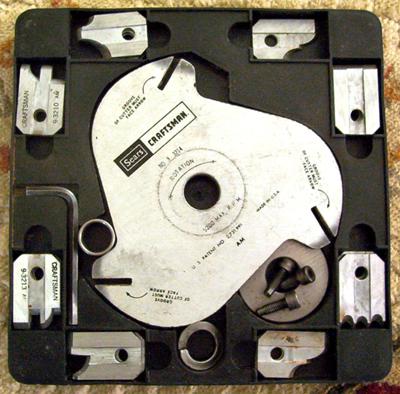
Don't use one of these. I have heard the "friend of a friend got killed by one" stories. Although they have never been confirmed, looking at one you can see how it could go terribly wrong. That reminds me, I need to get the one I've never used out of the garage before someone finds it & tries it out.

craftsman-93214-shaper-or-moulding-head-21260728.jpg
 

Handyfarmer

Well-known member
Joined
Dec 20, 2014
Messages
316
Location
in the high plains of Colorado
I made a couple of narrow tables about 6 foot long they were about 12" wide, same height or about 1/8 to 1/4 lower, than the saw height, for ply wood set one on the side and one behind the saw, for long boards one in front and one behind,
I have since replaced them with roller tables, the roller tables require more precision set up, as if there not in the same plane as the saw they will pull the lumber off to the side,

If one can build and extension table/wing on the right side and extend the rails for the fences, so the fence can be 49" from the blade, on the right, makes cutting ply wood much easier,

Use push sticks and blocks, regardless, keep your hands and fingers 3 inches from the blade,
 

KenC

Well-known member
Joined
Dec 20, 2009
Messages
2,577
Repeating others info, 'cause it's really important: Get a couple of good blades, rip and combo, or crosscut and keep them sharp.

Align the blade with the table, and the rip fence with the blade.

If possible, invest in a good aftermarket fence. I use a Biesemeyer with 52" rails. With these you CAN trust the measurement, I haven't used my tape measure to set the rip in years. And the fence stays in alignment when moved or even removed and replaced.
use an outfeed table, helps a lot when ripping long stuff.
 

cgrutt

Well-known member
Joined
Mar 4, 2016
Messages
8,169
Agree with above you can definitely trust measurement with good fence. Just need to recalibrate scale if you change blades (make test cut, measure, loosen two screws and set scale to measured cut). I happen to have a spare Biesemeyer fence with rail if anybody is looking for one. My Powermatic came with its own fence so ended up with a spare.
 

guy48065

Well-known member
Joined
Aug 12, 2012
Messages
637
Location
Calibration Lab
Get a better blade and read the page in the manual on how to properly rip on a RAS. When set up correctly they are worth keeping & using. I fully intended to get rid of mine when I got a nice sliding compound miter saw but there are some things NO other tool can do as quickly (eg. half-lap joints on long stock, like face frames).

I'm not saying you made a mistake getting the TS--they're the most useful power tool in a woodshop--but that you should keep the RAS. Mine does crosscuts so clean they gleam.
 

TomB19

Well-known member
Joined
Jan 1, 2015
Messages
547
Location
Regina, SK, Canada
Use the 24T blade for ripping and build or buy a featherboard.

Personally, I like the Magswitch featherboard. It is infinitely convenient and works great.

Adjust the blade so the carbide blade tips protrude about 3/16" above the stock you're cutting. Don't crank the blade right up.

Keep the blade clean. Either buy a blade cleaning kit or pick up a large plastic plate from a dollar store and some simple green. I spray the blade and let it sit on the plate for about 10m. Then, I use a toothbrush to wipe off the pitch and resin. It will feel like a new blade after being cleaned. You'll get cleaner cuts with less resistance and less load on the saw.

I assume that saw doesn't have a splitter. That's going to make it difficult to cut long stock. Long wood always has stress of somekind in it. It's going to bind, no matter what you do. A splitter will help, as will extra power. Even with my 5hp cabinet saw, there are times when I really have to push the wood and can feel the saw working harder. Those are times that would completely stall a 1.5hp saw.
 

mkbug

Active member
Joined
Apr 21, 2007
Messages
42
Location
Vacaville, CA
too often saws are missing their blade guards because guys think they "get in the way". Mine was missing when I bought my saw...and after cutting the tip of my thumb on the blade I got a blade guard from http://thesharkguard.com/default.html. It works great. Rarely do I have to remove it to make a special cut.

As for cutting sheets of plywood on a tablesaw...I cut mine down with a circular saw then bring the smaller piece to the tablesaw for an accurate cut. Much easier to handle.
 

Furious Filipino

Well-known member
Joined
May 25, 2016
Messages
85
Location
San Francisco East Bay
I know that a lot of people rip large sheets on the table saw, but my own personal rule of thumb is to break it down as much as possible with a circular saw and straight edge, or better yet, a track saw/home-built circular saw guide, and use the table saw for precision work.

Think about your workflow so you avoid having to cut large sheets: What you have you built or are planning to build that needs an 8' by **' dimension? Even custom work needs to be built to be broken down and delivered.
 

7th Kahuna

Well-known member
Joined
Aug 4, 2012
Messages
1,704
Location
Los Angeles, CA
Get a Grripper. Seriously. The only thing better than having one of these is to have two. Push sticks work well, but these things bring safety to a different level. They allow you to support both sides of the cut while keeping your hands clear of the blade.

820434_002.jpg

Lowes had those on clearance a month ago. Looked like a good idea, but the clearance price was exactly 3 cents less than the regular. (How is that a clearance?) Last time I checked, it was unchanged. I wonder how much they actually get used by the folks who buy them. People being people, it looks like the set up could take too long for a one off cut, at least a cut like the one in the photo.

Don't use one of these. I have heard the "friend of a friend got killed by one" stories. Although they have never been confirmed, looking at one you can see how it could go terribly wrong. That reminds me, I need to get the one I've never used out of the garage before someone finds it & tries it out.

craftsman-93214-shaper-or-moulding-head-21260728.jpg

You and I are of the same mind with those. I have an old Delta set I acquired with my saw. I would have to be really desperate to use them. But like you, I've no direct knowledge of anyone getting hurt. Seems like if they were so dangerous there would have been a recall. We aren't taking about a product that hasn't been sold in 40 years. Still, as stated, I'd have to be really desperate. I did know a guy that took a 'shaper head' in the thigh. Cut a nerve or two. I was a kid, so no specific details, but I have to wonder if he had a similar head mounted in the shaper. I believe part of my Delta set is compatible with the Delta Heavy Duty Shaper. There are also the heads that clamp a pair of knives. I think about that every time I look at a shaper.
 

My Old Tools

Well-known member
Joined
Jun 4, 2014
Messages
5,424
Location
Hamrick Lake, TX
The best thing you can do for any saw is to upgrade the fence if it hasn't been done. Get a Biesemeyer or clone. A solid parallel fence eliminates the need for most of the **** contraptions shown above.
 

Kevin54

MEMBER EMERITUS
Joined
Jan 12, 2005
Messages
29,341
Location
Urbana, Ohio
Get a couple of these....One for the front and one for the back of the saw, or use them both for the outfeed side. They are invaluable when no one is around to help you with a 4x8 sheet of plywood :thumbup:

30354101.jpg
 
To avoid these ads, REGISTER NOW!
Top Bottom