To avoid these ads, REGISTER NOW!

Talk to me about betonite

Chaz

Well-known member
Joined
Apr 3, 2006
Messages
806
Location
Missoula, MT
I'm installing a pretty large pond on the property (29,000 gallons, 2,000 square feet). I figured on using a epdm pond liner, but they're expensive and can tear. I've never used betonite, but some old timers around here seem to think it would work for me. I've got lotsa questions..

Does it seep leak, or is it really watertight upon completion?

How is it worked into the pond area?

Is it permanent, or does it have to be re-done every several years?

Would I be smart to put a layer under a pond liner?

Does it dry REALLY hard?

Thanks for any help you can provide.
 
To avoid these ads, REGISTER NOW!

theoldwizard1

Well-known member
Joined
Feb 22, 2011
Messages
43,588
Location
SE MI
Bentonites most common usage is a "drilling mud" to prevent blow or collapses of the shaft as it is drilled.

However, from Wikipedia :

Groundwater barrier

The property of swelling on contact with water makes sodium bentonite useful as a sealant, since it provides a self-sealing, low permeability barrier. It is used to line the base of landfills to prevent migration of leachate, for quarantining metal pollutants of groundwater, and for the sealing of subsurface disposal systems for spent nuclear fuel. Similar uses include making slurry walls, waterproofing of below-grade walls, and forming other impermeable barriers, e.g., to seal off the annulus of a water well, to plug old wells.
Bentonite can also be "sandwiched" between synthetic materials to create geo-synthetic clay liners (GCL) for the aforementioned purposes. This technique allows for more convenient transport and installation, and it greatly reduces the volume of bentonite required.
It is also used to form a barrier around newly planted trees to constrain root growth so as to prevent damage to nearby pipes, footpaths and other infrastructure. Farmers use bentonite to seal retention ponds.

Note that there are several types of bentonite.
 

Rhyno

Well-known member
Joined
May 21, 2013
Messages
327
Location
Salt on the left, Mormons on the right, Yup, "This
I'm installing a pretty large pond on the property (29,000 gallons, 2,000 square feet). I figured on using a epdm pond liner, but they're expensive and can tear. I've never used betonite, but some old timers around here seem to think it would work for me. I've got lotsa questions........

That's a good sized pond.....Is it going to be stagnant? or are you going to have a supply and drain?

.......Does it seep leak, or is it really watertight upon completion?.....?

That really depends on the soil that supports the "added Clay", or.... I mean Bentonite. But really, how do you compare that to evaporation rates?

Bentonite is a Clay. It is Mined. I'd guess that there are a few places in MT, where it is produced. Wyoming, too. After being "dug up" it is ran through a series of machines to refine/filter. Eventually, it is a finished product, which can be a Fine Powder.

.......I've never used betonite, but some old timers around here seem to think it would work for me.........How is it worked into the pond area?

Is it permanent, or does it have to be re-done every several years?

A dump truck and a shovel.....

You'd have to reapply, if it is washed away, absorbed into your base soil (and some absorption or combining of soils will happen), or hauled away. But realistically, .......

.....

Would I be smart to put a layer under a pond liner?.....

If you did that, the Clay would make a "soft" surface, that wouldn't puncture your "Liner."

It would be a good move for the Dept. of Redundancy Department.....


.....Does it dry REALLY hard?.....

Once it is dry, it is hard enough to need an Excavator to dig it up......but you want to use it as a pond liner..... it's gonna stay wet.


Get yourself a dump truck load.....have fun and feel good that you are using something that is "natural."

There are a S-Load of lakes, that are lined with Clay....:D
 

Stuart in MN

Well-known member
Joined
Sep 8, 2005
Messages
23,411
Location
Minneapolis
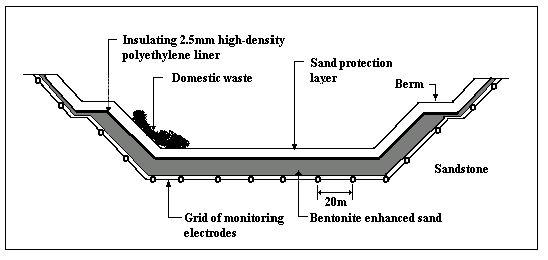
As mentioned, bentonite is commonly used underneath landfills, along with a heavy PVC liner. Basically the same construction as a pond.

leaklnf3.gif
 

Clik

Well-known member
Joined
Jan 1, 2011
Messages
430
Location
Highest Mountain in Western, MD
I lived between the Chesapeake Bay and the Patuxent River for many years. Lots of marinas in the area. They had to pay to dispose of fiberglass boats that no one wanted. The county impound lots had lots of boats that were abandoned on the streets that went for disposal. Cut the tops off and they make great small ponds, cattle troughs, etc. For ponds you can paint the inside a dark color and put some rocks around the edges. No one will ever know it was an old boat unless you want to keep the shape for a nautical theme.
 

theoldwizard1

Well-known member
Joined
Feb 22, 2011
Messages
43,588
Location
SE MI
As mentioned, bentonite is commonly used underneath landfills, along with a heavy PVC liner. Basically the same construction as a pond.

leaklnf3.gif

Notice that is says "bentonite enhanced sand". I wonder what the ratio of bentonite to sand is and how thick you need to lay it down ?

I also wonder if you could just lay down a couple of inches of bentonite and rototill it into the existing soil. For a 2000 sq ft pond you are probably talking about 20 - 40 cu yds ! :shocking:


Here is some more info on sodium bentonite.

mixed.jpg

How Much Sodium Bentonite to Seal a Pond ?

In the bottom of a 5-gallon plastic pail, drill 20 to 25 eighth inch holes. Gather enough soil from the area to be sealed to fill about 3 inches of the pail. You can either select the most porous soil, (sand) or a mixture of soil taken from several areas of concern in order to present an “average” soil.

In this soil, mix one to two pounds of sodium bentonite and tamp down in the bottom of the pail. Into this pour a gallon or two of water and see if the sodium bentonite provides the necessary seal. If not, repeat the process and increase the amount of sodium bentonite by half a pound until the water is contained within the pail.

The bottom of the pail represents about one square foot. When you know how many pounds of sodium bentonite it takes to seal the pail, then we know how many pounds per square foot to distribute and roto-till into the pond, dam or other earthen structure.

Sodium Bentonite Application Method

Drain the area to be treated and remove all rocks and plant growth.
Use 1 part granular or powdered sodium bentonite mixed with 5 parts soil to fill large holes and crevices.

Plow the area to be treated to a depth of 4 to 6 inches and allow soil to dry.
Apply sodium bentonite to the area using the ratio determined by the bucket method or the application rate chart.

When the entire area has been covered, mix the sodium bentonite with the top 3 to 4 inches of soil, using a disc, spike tooth harrow or hand rake, and then roll or tamp to compact it.

Sandy soil works best for mixing with sodium bentonite because it compacts better. If clay soil is used it must be fine and without lumps.
 
Last edited:

HoosierMark

Well-known member
Joined
Jan 31, 2013
Messages
1,452
Location
Southeast IN
In my area, bentonite is not cheap. I had, may still have a leaky pond. Due to a pipeline constucted close to it, I think they are responsible for it. So they bring a guy in, he wants to truck in bentonite and then use a disc to work it into the soil. Sounds like it could work but the cost on a 2 acre pond was astronomical. Why not just put a sand layer down like they do on above ground pools and then line it with something like rubber roofing material. Just an idea on the roofing material. I always thought they just used heavy plastic and covered it with clay in SE Indiana when they were trying to stop a leak. A 40 x 50 pond is not really that big, are you sure you will have a leakage problem at all?
 

Kevin54

MEMBER EMERITUS
Joined
Jan 12, 2005
Messages
29,341
Location
Urbana, Ohio
I had a pond and it leaked. Before we moved in, the owners tried to have it fixed with Bentonite to no avail. Then came the cattails, and a buddy gave me a water iris with what had a couple pieces of bamboo in it. It was a pain in the ***.

Get with your county extension agent. They will be able to tell you whether you land can sustain a pond or not. Some places you can dig a hole, and next thing you know, you will have a beautiful pond. Other places, not so much.

I remember now, where you had your ground staked out for one. Fo with a pond liner and be done with it. I can find you a few sites if you like. A properly lined pond will not leak. But you need something more than plastic. You need an actual pond liner. It will be a heavy membrane. And it's not something one person can handle. Depending on the side of the pond, it may take 6-12 guys to even move it out flat. It will be shipped by semi, and you'll need a skidsteer, or a tractor with fork to move it.

Clear out any vegetation, rake it all out so there are no rocks or any sticks. Line with sand, and be a little generous with the sand, then place the liner. If you want gamefish, bluegills will show up automatically. If you want Koi, you have to purchase them. You will want moving water. Either get a bunch of stones and make a water falls, or you will need a floating fountain. As long as the water is circulation, you won't have a mosquito problem. Plus the fish will take care of them.

Another thing to do is drive around and stop and talk to people that have ponds in your area. Most will be more than happy to talk about them and give you tips and pointers as to what or what not to do, and possibly who to get in contact with as far as creating a pond in your area. If you have a lot of people in your area that have ponds, chances are you won't have to go to a lot of trouble to have one yourself.

If per chance you can have a natural pond, and your soil will sustain a pond, if you don't have a liner, I would say stay away from Koi and goldfish. The reason being is that they are mudsuckers and will undermine the banks.
 

MoparTrucks

Well-known member
Joined
Aug 21, 2009
Messages
3,218
Location
Ozarks of Missouri
I have two ponds on my farm, one a little over 1/4 acre that holds water year round with no issues and is about 8 foot deep in the middle and one that is almost as big that is full 2/3rds of the year but eventually leaks down to dry during the summer. I had a contractor look at it and the bentonite was just too expensive and there was still no guarantee it would work for my application so we are just letting it silt up and running live stock on it hoping to seal it up.

I think Kevin has good advice, seek out your cooperative extension agent and ask for help. In many areas they will actually come out to your place and test your soil for you and give you advice and recommendations. Ponds are great and we really enjoy ours as its full of wildlife and is a private oasis surrounded by trees but in most areas they are not maintenance free and you really need to factor in a means to aerate it. We are looking for a windmill for ours...another couple thousand.
 

8man

Well-known member
Joined
Oct 16, 2013
Messages
630
Location
Bryan, Texas
In some of the sandy soils here in Texas we've used Bentonite with good success to seal ponds. I don't know the components of your soils, but as said above, get with your ag agent and get a soils test to help determine the answers to your questions.
 
To avoid these ads, REGISTER NOW!

denis4x4

Well-known member
Joined
Jul 23, 2006
Messages
514
Location
Durango CO
My pond was lined about 20 years ago. My neighbor went the betonite route and after several attempts to get it to hold water, he went the liner route. The extra cost in materials and labor cost him dearly. Like several other posts, get with your local extension agent for info.
 
OP
C

Chaz

Well-known member
Joined
Apr 3, 2006
Messages
806
Location
Missoula, MT
Thanks guys, It sounds like a bit of a crapshoot as to whether it'll work or not. I'll stick with the pond liner idea..
 

jgreen-fsi

Well-known member
Joined
Aug 25, 2013
Messages
225
Location
West Texas
I used bentonite on farm tanks before. Out here our soil is very sandy. We spread it by hand and went down in the bottom with a small 8N tractor and disced it in. Then we drove all over compacting the soil in the bottom. Did it work? Kinda. Its hard to integrate on steep sides.

Another thing I've done is once a new tank is dug, I'll feed cattle down there for a few months and let them stomp it down. This method has been successful for me.
 

Kevin54

MEMBER EMERITUS
Joined
Jan 12, 2005
Messages
29,341
Location
Urbana, Ohio
" If you want gamefish, bluegills will show up automatically."

How does this happen?

When you have body of water, eggs will stick on to the legs of Ducks, Herons, Geese, Turtles, that were stuck there by them visiting other bodies of water. One Bluegill can lay over 50,000 eggs. With that being told, when we had our pond, the Bluegills were interesting to watch. One area of our pond was what the previous owner describes as a beach area. It wasn't sand, but it was an area of very small stone/gravel. Just about the size of BB's. At mating time, the Bluegills would start swimming around a certain area, and using their tails, mouth, nose, would dish out a bowl shaped area and would lay eggs. At mating time, the Bluegill is VERY territorial. And other Bluegill that came close to that area, **** was on. They constantly stayed at the spot, to keep other Bluegills away.

Bluegills are good eating. And although some may see fish as their pets, you really need to keep the Bluegill population down. We had a 3/4 acre pond, and I had it drained down completely on a number of occasions. When we bought the house, the perimeter of the pond had what I call "junkyard gravel". Basically it was stones that ranged in size from golf ball size to tennis ball size. Weeds were constantly growing and it was a ***** to keep the weeds out. So we drained the pond and removed all of the stone around the perimeter, then built a walkway across the pond using all of the stone, and other clay we had around. The pond was empty for close to a month. Within a months time, we had a bazillion of small Bluegills. Withing a year, we still had a bazillion, except they were much larger. We did have some great Bluegill cookouts.

All of our fish were grain fed. We have a Fish Farm just a couple of miles from our house, so we always bought 50 lb. bags of Floating fish food, which was pellets of food that would float for close to 30 minutes. Also, a couple of guys that I worked with that fished to kill time at various ponds, would release their catch into our pond. So we had Crappies, Channel Cat's, Blue Cats, Yellow Belly Cats, then of course the dreaded Bluegills. We also had White Amur's (Grass Carp) The Amurs are a sterile breed and basically shot blanks :lol:

The Bluegills for the most part weighed around (1) pound each with a 10" girth. The Blue Cats, which were here when we bought the house.....They weighed in at 30-40 pounds each. The other Cat's weighed in at a couple of pounds each. Crappies would weigh in close to a pound. The White Amurs....50+ pounds each :scared: I won't even get into the Koi and Goldfish.

All of the regular fish were edible. The White Amurs......Once the pond was down far enough, we waded in, caught them, then transferred them to a farm pond of a friend to keep his weeds under control some. We also had Bull Frogs. A LOT of bull frogs. So many that in the summer, we had to keep the windows of the house shut, just to be able to sleep. They were that noisy. But man, nothing better than some fried up Frog Legs.:bowdown: The Bull Frogs we had were huge. Take your first three fingers, put them together, and that is about how large the Frog legs were. More meat than bone by far. Almost close to the amount of meat that you would get out of a Chicken Wing.

All in all though, I don't miss the pond. People showing up all of the time to fish. I'd ask how they came to fish in our pond? :wtf: You give ONE person permission, then all of a sudden you have a friend of a friend of a friend fishing, that just so happened to hear that we didn't care who fished in it.

Yea.....I don't miss it at all. We will eventually put another pond in. Just large enough to have a few Koi fish, and a waterfalls, so we can sit out, have a small campfire, and listen to the water coming over the waterfall. Maybe 10' x 10' or so
 

geologist

Well-known member
Joined
Dec 14, 2011
Messages
5,326
How about snakes? I'm looking at about 30 more acres, and there's a piece I'd like to put a 3 or 4 acre "micro-lake" (deep water pond) at the western end of the property. I'd like to have a nice waterin' hole without drawing too many snakes. The micro-lake is in yellow, showing the depth in 4 foot increments.

attachment.php
 

Attachments

  • microlake.jpg
    microlake.jpg
    20.2 KB · Views: 248
Last edited:

southalabama

Well-known member
Joined
Jan 10, 2011
Messages
5,547
Location
Brewton AL
Around here "drilling mud" or bentonite is only used after it has been determined a pond leaks and other alternatives aren't working. Clay and rubber membrane liners are soldo options.

Most koi type ponds use a rubber liner.
 

Micscience

Well-known member
Joined
Aug 22, 2012
Messages
140
This thread was a good read. I first learned about bentonite clay from metal casting. It is used in green sand to form molds about 8%-10% of bentonite is mixed with sand and some water and you have yourself some green sand.

You could mess around with the clay yourself on a smaller scale. Once bentonite is compressed it holds pretty good so a good compression increases your odds but we are talking about a pond here so that is a whole other level of pressure that I have never dealt with. I know if heat is added to bentonite clay it tends to bind stronger as well. Anyways that is my two cents good luck.
 

Ohio Auto

Well-known member
Joined
Dec 25, 2010
Messages
1,494
Location
Ohio
I put a half acre pond on my property when I built my house about 8 years ago. My new neighbor is a well driller so we talked extensively about bentonite.

First..have you done any soil tests to determine if you're going to have a leak problem? I wouldn't just automatically assume you need a liner.

Secondly, bentonite over that large of a space is not going to last forever. That's why you usually see it listed with other components to create a seal....like between a pipe and soil, or between a liner and soil.

The cost would be very high...might as well go with a sure fix like a liner.

However, I wouldn't overlook bringing in clay and forming a barrier on the bottom of your pond once it's dug. Clay is usually inexpensive around here and if you have a good excavator he lay you down a foot of clay on the bottom with no problem.
 
To avoid these ads, REGISTER NOW!
Top Bottom