To avoid these ads, REGISTER NOW!

Tankless heater help

To avoid these ads, REGISTER NOW!

koditten

Well-known member
Joined
Apr 10, 2008
Messages
5,528
Location
Midland, Michigan
Are you using this to heat water for domestic use or for a floor heat system? If you are using for domestic water, do you have well water or city water? If for floor heat does it tell you what water pressure you need? Most of these water heaters have a minimum operating pressure and most floor heating systems operate at less than 15psi. If you don't have enough pressure it wont turn on.

We need some more info on your intended use.
 
OP
D

Dave28

Well-known member
Joined
Nov 2, 2011
Messages
64
Location
Baden, PA
Koditten,

I am using this solely for heat. I do have a well that puts out around 50 - 60psi. I planned on using a Grundfos UPS26-99FC 3-Speed Circulator Pump w/ IFC, 1/6HP and installing a pressure reducing valve between the pump and manifold.

Bob from American Heat Direct told me AHS units can be set digitally and have the right flow switch for hyfronic floor heating. Figure 100 sq ft to 1 kilowatt.

Here are the specs on the heater I am looking at.

Dimensions
16" X 13.5" X 3.25"

Shipping Weight
20 Pounds

Body / Heat Exchanger
Stainless Steel

Elements
3 Brass Flange / Copper / Stainless Steel

Pipe Fittings
Stainless Steel 3/4" NPT

Activation Flow Rate
0.25 Gallons per Minute

Operating Pressure
Min 25 PSI, Max 150 PSI

Required Wire Gauge from Main to Subpanel
4 ga

Required Wire from Subpanel to Tankless
8 ga (Consult and Electrician)

Cover
Brushed Stainless Steel

Volts
240

United States
ETL #834 Approved #499 UL Compliant

Canada
CSA Approved

Stand-by Heat Loss
0%

Max power
66 Amps

Required Breaker
70 Amp Sercice Panel

Subpanel
Two 35 Amp Breakers/2pole
 

Toymeister

Well-known member
Joined
Nov 30, 2011
Messages
595
Location
North Florida
I have a tankless, NG model, a Rinaai. I installed in the attic where the original tanked model was.

Please understand the realities of a tankless heater. Rarely will you save enough to offset the cost of them. Consumer reports published an article on this. Summary: there is no free lunch it cost X to heat water, the only saving is in the maintaining of the water. That is cheap the tankless is not.

Second the cold sandwich. Tankless heaters take a moment to heat the water. So, your wife takes a nice hot shower. You follow 10 minutes later. You immediately get hot water from the pipes, then cold water for a few seconds, then hot again. Sounds like no big deal but very irritating

Third, maintenance. Think of your coffee maker it slows down you clean it with vinegar. Same thing here. Once a year you use the isolating valves to pump vinegar thru it for an hour.
Fourth these work on rise so it will do fine in the summer when the input temp is 50 degrees but less so in the winter in PA when the input temp is lower

I use a tankless, I save 40% of my water heating cost and I do not have cold sandwiches.

I replaced the bad hot water heater and eliminated a second heater which heated only master BR and powder room water. I save pennies on the one I replaced but nearly all on the other.

I placed a 5 gallon tanked heater AFTER the tankless so there is a small bit of hot water on hand and whatever brief blast of cold sandwich is mixed in the tank. The five gallon runs very little after all of the income water is heated before it gets it.

I plan on improving my system further by placing a 50 gallon tank (with bypass valves for winter shut off) BEFORE the tankless. Since it is in an attic, in Alabama I will save quite a bit there too.

Is it worth it for you, maybe? You will save space and DIY is a huge savings. Reality is you can save nearly as much with a water heater blanket and a timer. Unless you have special requirements, think hard on why you want to do this.
 
Last edited:

koditten

Well-known member
Joined
Apr 10, 2008
Messages
5,528
Location
Midland, Michigan
Toymeister; He is planning on using it for heating his floor, many of your points will not apply in this application. As for using it for domestic water heat, I couldn't agree more. I would never use one of these units with well water.

I'll be the first to admit that the only real benifit to any on demand unit is the savings of space. All other aspects will mostly equal out when it comes to doing the math.

Dave28; using these heaters for heating the floor water works well, even though you have well water, it will not be a big issue with scale build up. You are heating the same water over and over. Just make sure you check the ph of the water every year. keeping the water above 7 will combat any metal corrosion in your system.

With that being said, I am a dedicated conventional boiler proponant. I like gas fired, convention boilers for garage floor heating. I have experience building my 2 different systems and I like their simlicity. I'm not saying if those electric heaters will or won't work. If your area has cheap electricity or you don't have access to gas, this is the way to go.

I had help from the pro's and my systems turned out wonderful. Don't be afraid to ask, they want to help you.

KO
 

koditten

Well-known member
Joined
Apr 10, 2008
Messages
5,528
Location
Midland, Michigan
I just went back and read the specs again. I see that it requires .25 gallon/min to turn the unit on. You are going to have to use a primary and secondary loop system. In most cases that means 2 pumps. Not a big deal, pumps are cheap.
 

darkk

Well-known member
Joined
Dec 24, 2009
Messages
3,361
Location
Willimantic, Ct.
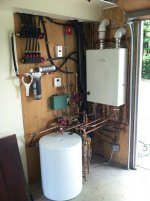
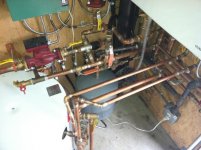
My son in law owns a heating and plumbing business and he installed this in his garage (40x42) with hydronic in floor heat. It also heats an apartment (20x26) above the garage. The only thing I know about it is it works pretty good...
 

Attachments

  • th1.jpg
    th1.jpg
    67.2 KB · Views: 158
  • th2.jpg
    th2.jpg
    60.6 KB · Views: 125
  • th3.jpg
    th3.jpg
    65.7 KB · Views: 122
  • th4.jpg
    th4.jpg
    61.3 KB · Views: 110

Toymeister

Well-known member
Joined
Nov 30, 2011
Messages
595
Location
North Florida
Toymeister; He is planning on using it for heating his floor, many of your points will not apply in this application. As for using it for domestic water heat, I couldn't agree more. I would never use one of these units with well water.

KO

Sorry it was a cross post, his post hit before mine. Its the wonderfull internet speed that I have here...
 
OP
D

Dave28

Well-known member
Joined
Nov 2, 2011
Messages
64
Location
Baden, PA
First let me say I love the Garage Journal forum. Everyone is so friendly and willing to help out and I have learned a lot since joining.

Here is why I am looking for a new heat source. I made the mistake of going cheap and buying a used 80 gallon electric water heater off Craigs List. It was only $200 and sounded like a good deal at the time. It is a Whirlpool Energy Smart unit that has a control board on it that regulates the heat. The used appliance store I bought it from said they had just replaced the control board and the unit worked fine and they guaranteed it for 30 days.

I waited about a week for the concrete to cure before turning on the heat. Water temp started to rise and everything looked fine. I went upstairs for a while and thought I would check it in a few hours and see how it was heating. Come back down and find the light flashing on the control board saying I had a bad element, no big deal they are not to expensive. I check the new elements against the old ones and the both read the same meaning there is nothing wrong with the old ones.

I did some research online on the Whirlpool water heater and find so many complaints on the water heaters it would make your head spin including some catching fire. Many of the complaints centered around the control board. BTW the Whirlpool water heater is made by US Water Heater.

Now I figure maybe the board is bad so I order a new board ($75 plus S/H). Put the new board in and it is still flashing bad elements. The most the unit will heat the water is around 85 - 90 degrees. I bought it 3 months prior to hooking it up so so much for them taking it back.

My plan for next winter is to hopefully come up with enough cash to get a coal boiler to heat the house and garage but for right now I need to do something for heat in the garage. While the water heater is making a little heat I am worried it will fail altogether and I'll be stuck with no heat and frozen lines.

My only option right now is electric as there is no natural gas on our road.

I created a rough drawing of a layout for the new tankless system. I would greatly appreciate and and all feedback on it. My drawing can be found here http://www.cruisin-nites.com/garage/Heating-layout.jpg

Heating-layout.jpg


Thanks,
Dave
 

Fastback

Well-known member
Joined
Oct 5, 2010
Messages
518
Location
Indy
FWIW My electric heater was under $200 (Shipped) from Ebay and I have had it for 4 years, it has heated my garage for two years. IT is a USA made elcheapo unit, but it works perfectly. I know electric is more than gas, but the gas unit I wanted was about $5000 and I can buy a bunch of coal fired electricity right now for that much money, do the math (Next step is solar). Since it only runs for about 4 months a year my annual costs are still under/around $500 to heat my shop (Thats darn near the entire bill and I have a huge air compressor that runs everyday, its a working shop right now).

I keep my shop at 63º unless I plan to paint, then I bump it up. 63º can make me sweat if I am blocking or sanding.

Also, why would you even need a "Supply from well"?

IMG00214-20110118-1236-1.jpg
 
OP
D

Dave28

Well-known member
Joined
Nov 2, 2011
Messages
64
Location
Baden, PA
Fastback,

Thanks for the reply and information. I emailed Bob from www.titantanklessheater.com asking about what Titan unit would work for my system. He sent back the following reply "Go to www.americanheatdirect.com for info on the AHS units. These can be set digitally and have the right flow switch for hyfronic floor heating. figure 100 sq ft to 1 kilowatt
Bob"

Hydronic heating is all new to me and that is why I am asking for advice. I messed up on my first heating source ($300 lost) and don't want to mess up again.

As far as the supply from the well goes don't I need a supply line in case the system needs additional water?
 

Fastback

Well-known member
Joined
Oct 5, 2010
Messages
518
Location
Indy
I dont know, if you are just heating a closed system radiant floor, then no you will not.

We really need more info, like how thick is the slab, whats the Square footage and how well are you insulated etc..? Did you use expansion around the slab to prevent heat from climbing the walls, did you insulate under the slab, where on the planet are you...?

Share more info and I am sure you will get it sorted out, I did not know much but I read everything I could find and and asked a lot on this forum and ended up with a system that has about $400 on the wall and couldn't be happier. I find that many systems are over complicated considering what they are actually doing.


As far as the "Set and forget" temp on that boiler, my closed system has that primitive dial on the front, but I can still maintain consistent temps on the output side and my elements look to be basic retail units, so if they die I can just swap out. But, that new unit looks pretty cool and I could see it being better than what I have.
 
Last edited:

chjeeper

Member
Joined
Sep 14, 2011
Messages
12
Location
North Ga
Dave,
I may not be interpreting your setup right, but my main concern with using an electric tankless for any reason would be operating cost. Standard electric tank water heater elements pull 4.5 kWh when operating. The Tankless Electrics can pull up to 16 kWh according to data sheet online. A tankless puts out a whole lot more btu in order to heat up the water instantly whereas a tank heater is just warming up the water and therefore requires less amps. So look at it this way, how many hours are you estimating this tankless system will run and find out what standard operating draw is. 16 kWh will be full load amp draw but the tankless may or may not be operating at that level all the time, I'd guess 12 kWh while it's running. Look at your electric bill and figure out what you're paying per kWh. To run a tankless in the southeast on a .11 cent per kWh average, 12 x .11 = $1.32/hr to operate, whereas .50/hr for a tank water heater. Not to mention if you're running any other type of electric heating in your house combined with this electric tankless at the same time and you're running the shop and house on the same transformer, your transformer may not like it.
 
OP
D

Dave28

Well-known member
Joined
Nov 2, 2011
Messages
64
Location
Baden, PA
I am located 20 miles north of Pittsburgh, PA. Garage is 1100 sq.ft. concrete block with the front side being below grade and rear being on grade. No insulation at this time but I will insulate over the next month or so. Slab is 4-5" thick and insulated from the walls. I have 2" rigid plus vapor barrier under the slab.

I have 5 loops in the slab ranging from 220 - 250 ft. I have a 6 port manifold and I plan to use the 6th port for a hanging unit heat for another room next to my garage. The unit heater will come as soon as I get get the slab working correctly.
 

Fastback

Well-known member
Joined
Oct 5, 2010
Messages
518
Location
Indy
Dave, it sounds like the floor is done up right, enough loops and proper insulation, so thats great. The hard parts done. I think your heater choice may be a sound one, I understand that you need 1kw per 100 SF, and with the heat loss of a garage door you may be right in there, if not a bit large.. I would still shop around and check other brands, costs etc..

Your garage is a bit larger than mine, I am only 720 SF so you may need a larger heater than I used, but my dial is set between low and middle heat output, so It could keep up but may not live as long.

I ended up setting mine up with a "Low and slow" approach, 110º out of that little heater is kinda loafing, and my pump usually runs on low, if my loops were any longer I would just run the pump on medium.
I toyed with sending in 140º into the floor at the beginning, but the heater drew a lot of juice and while it may have ran half as long it worked twice as hard and I figured it would be more likely to die running at 100% duty cycle, that and it made the lights flicker (Even with a dedicated 60 amp run).

But, remember that a BTU is a BTU, it does not matter if you use a tank or a tankless to achieve the fluid temps. Many will argue that a tank is great, but I am not storing hot water, I am storing HEAT, and it is stored only in the slab! If I go to a solar collector on the roof I will need to add a tank style heater and a second pump since my hot water from that system will be more finite, I will need to mix.

With that many loops you will need to understand what "Feet of head" is for pump selection (If you have not already purchased a pump), google that for yourself and understand it, understanding is ownership, opinions on the web are just that.

I know that many hear live or die by a heat loss calculation, I dont blame them but reality sets in once a building is built and you cannot achieve a better heat loss ratio, so insulate the hell out of your building and use good doors.
I would at least use 6" studs, if not 6" + another row of 4" on top, or bang up some good foam board on the block, then build an insulated stud wall over that. At least with the block wall your studs will not be touching the block tight (Right?) so you will not get convection of the cold through the wall.

Just remember that heat does not rise, hot air rises and you re not heating air, so double check to make sure you are not sending heat up a post or beam that can **** BTU out of the floor. I would even go so far as to set the bottom plate for the interior walls on some sorta expansion or insulation board, and prevent the wall board from sitting tight on the floor. Some guys get hung up on heat loss calcs but never consider convection, and that skews the numbers somewhat.


Make sure you have a decent basic understanding of layouts on a simple system, where the pump is in relation to the air vent does matter, and the amount of 90º elbows does not help when you are trying to bleed the air from the system. Making a fill/drain system to purge the air out is the only way to go IMHO, you can see it in my pic.

Feel free to PM me if you want more info about my little system.
 

copterdoctor

Well-known member
Joined
Jan 21, 2010
Messages
2,504
Location
Wasilla Alaska
can someone tell me why it's not good to use if on a well? we have a tankless, and a well, and have had zero issues. and can you also explain the cleaning process?
Our house is only 2 years old, so I'm not worried about it going **** up quite yet, but any preventative maintenance I can do would only help.
I should also mention, we use this for hot water only. no infloor heat...
thanks
Copter
 

koditten

Well-known member
Joined
Apr 10, 2008
Messages
5,528
Location
Midland, Michigan
Most well water has lots of minerals, usually described as hardness. If you have a water softener upstream of the heater you will hold off the scaling of the heater. Eventually the heater will scale up, like the inside of a much used tea pot. Your owners manual will have mantanance procedures to remove the scale. Most use a weak acid to disolve the build up. Kind of a pain to do, and you have to do it regularly.

City water is usually not as "hard", so it is easier on the on=demand water heater internals. You can see, just by looking at the unit, that there will not be alot of room in the internals for this scale to grow.

Here in Michigan, we have plenty of hardness in the well water. I fell for the smaller, cheaper, more efficient electric water heaters propaganda. Chalk up one failed, on demand water heater. I know of several other people on well water systems that scaled up their electric on demand water heaters.

I know things improve as technology improves, but conventional water heaters are cheap and last longer and are more forgiving if one lapses on draining the tank regularly. Space saving is the only real advantage of these units in my humble expirience.

To supply hot water to a floor system, I'm a conventional boiler man. Thats what conventional boilers are designed to do and they do it very well.

I know these electric water heaters work well for floor heat. My only conscern is if they will be working as they should in 15 years. I know my boiler will still be functioning. I don't know if an on demand water heater will be functioning. Call me a chicken if you want.

KO
 

Fastback

Well-known member
Joined
Oct 5, 2010
Messages
518
Location
Indy
I know things improve as technology improves, but conventional water heaters are cheap and last longer and are more forgiving if one lapses on draining the tank regularly. Space saving is the only real advantage of these units in my humble expirience.

To supply hot water to a floor system, I'm a conventional boiler man. Thats what conventional boilers are designed to do and they do it very well.

I know these electric water heaters work well for floor heat. My only conscern is if they will be working as they should in 15 years. I know my boiler will still be functioning. I don't know if an on demand water heater will be functioning. Call me a chicken if you want.

KO

I run rv antifreeze instead of water to avoid scale buildup on my floor heater, but I have had domestic tank heaters die due to rust and scale in only a year, and that's on city water. I would not run water in any heat system, it's caustic and fish poo in it.
 
To avoid these ads, REGISTER NOW!

Toymeister

Well-known member
Joined
Nov 30, 2011
Messages
595
Location
North Florida
What all designs and drawings that have been presented so far omit an isolation valve:

http://www.amazon.com/dp/B000TTF9QC/?tag=atomicindus08-20

This is the same as you would use for a hot water heating system and it is for the same purpose: to pump the 'weak acid solution" i. e. vinegar, thru the heater. This will help with the well water. You would have to use it with any system unless you are using distilled water.
 
Last edited:
OP
D

Dave28

Well-known member
Joined
Nov 2, 2011
Messages
64
Location
Baden, PA
My well water is very soft. I had a company call me years ago want to sell me a water system to put on my well. I told him my water was fine but he insisted on doing a test on my water and said there is no charge for the demonstration. I told him fine, come on out.

He took a sample of my water and tested it against a sample of his. As he looked at the results he looked puzzled. He said I must have mixed the two samples up and wanted to do another test. I looked at him and smiled. I said fine help yourself. He did another test while he was explaining how his system worked. I watch carefully and again he looked puzzled. I just smiled and ask if he needed another sample of my water. He said yes if you don't mind as I must have messed up.

After the third test he said as much as I'd like to see you my system I can't because your water is better then what I ran through my system.

So hard water is not an issue here.
 
OP
D

Dave28

Well-known member
Joined
Nov 2, 2011
Messages
64
Location
Baden, PA
Fastback,

You have giving me a lot of information to go over and it is greatly appreciated. I did use LoopCad to do my design and it did a nice layout of the tubing but I don't think the numbers it came up with are correct in the area of head.

I downloaded another program called RadiantWorks to put my information in to and see what it came up with but I haven't received the unlock key yet.

Do you think the Grundfos 26-99FC pump is to big for my system? Can to big of a pump be bad?

Most well water has lots of minerals, usually described as hardness. If you have a water softener upstream of the heater you will hold off the scaling of the heater. Eventually the heater will scale up, like the inside of a much used tea pot. Your owners manual will have mantanance procedures to remove the scale. Most use a weak acid to disolve the build up. Kind of a pain to do, and you have to do it regularly.

City water is usually not as "hard", so it is easier on the on=demand water heater internals. You can see, just by looking at the unit, that there will not be alot of room in the internals for this scale to grow.

Here in Michigan, we have plenty of hardness in the well water. I fell for the smaller, cheaper, more efficient electric water heaters propaganda. Chalk up one failed, on demand water heater. I know of several other people on well water systems that scaled up their electric on demand water heaters.

I know things improve as technology improves, but conventional water heaters are cheap and last longer and are more forgiving if one lapses on draining the tank regularly. Space saving is the only real advantage of these units in my humble expirience.

To supply hot water to a floor system, I'm a conventional boiler man. Thats what conventional boilers are designed to do and they do it very well.

I know these electric water heaters work well for floor heat. My only conscern is if they will be working as they should in 15 years. I know my boiler will still be functioning. I don't know if an on demand water heater will be functioning. Call me a chicken if you want.

KO
 

Fastback

Well-known member
Joined
Oct 5, 2010
Messages
518
Location
Indy
If the pump is to fast your coolant will not stay in the floor long enough for proper heat transfer, to slow and your return temps are low and the last bit of slab does not get enough heat.
I like the taco pump listed in the pic I posted, it is cheap, well built and has three speeds within IFC "integrated flow control" basically a one way check valve. Check to see how it would work for you, my runs are around 275' IIRC and it runs on low typically.
 
Last edited:

Fastback

Well-known member
Joined
Oct 5, 2010
Messages
518
Location
Indy
I would like to know why well water is being discussed? Propolyne glycol is the best choice, I can see no need to connect it to the well?
 

stevefasano

Well-known member
Joined
May 24, 2009
Messages
135
As for as the tankless brand..I use an Olympia AH18..I liked the specs better than other brands..it has three heating elements that others has only two..I have #10 wire in hand so I didn't have to buy wire and the unit it mounted 35' from the panel..I use it for kitchen,bathroom n washing machine..When using shower or tub the it starts at all three elements then after about 30 seconds then next two elements one minute and after that one element at 20 something amps till the water it off..That's winter water temp in..summer time it uses one element . Very efficiently unit..The unit was on sale so I bough two for $400 if something goes bad I have a spare in hand..Never have no problem yet..
http://www.olympiatankless.com/product/Olympia AH18
 
OP
D

Dave28

Well-known member
Joined
Nov 2, 2011
Messages
64
Location
Baden, PA
Steve,

That unit sounds very interesting. The only thing that has me wondering is why was the original price $698.00 and now on sale for $229.99. I just did some checking on their site and that is the same guy who sells The American Heat and also Titan Tankless
BobSha Enterprises Inc
4012 E. Shore Road
Miramar, Florida 33023
 
Last edited:

z28toz06

Well-known member
Joined
Nov 30, 2005
Messages
1,012
Location
Connecticut
koditten;2016299[B said:
]Most well water has lots of minerals, usually described as hardness. If you have a water softener upstream of the heater you will hold off the scaling of the heater. Eventually the heater will scale up, like the inside of a much used tea pot.[/B] Your owners manual will have mantanance procedures to remove the scale. Most use a weak acid to disolve the build up. Kind of a pain to do, and you have to do it regularly.

City water is usually not as "hard", so it is easier on the on=demand water heater internals. You can see, just by looking at the unit, that there will not be alot of room in the internals for this scale to grow.

Here in Michigan, we have plenty of hardness in the well water. I fell for the smaller, cheaper, more efficient electric water heaters propaganda. Chalk up one failed, on demand water heater. I know of several other people on well water systems that scaled up their electric on demand water heaters.

I know things improve as technology improves, but conventional water heaters are cheap and last longer and are more forgiving if one lapses on draining the tank regularly. Space saving is the only real advantage of these units in my humble expirience.

To supply hot water to a floor system, I'm a conventional boiler man. Thats what conventional boilers are designed to do and they do it very well.

I know these electric water heaters work well for floor heat. My only conscern is if they will be working as they should in 15 years. I know my boiler will still be functioning. I don't know if an on demand water heater will be functioning. Call me a chicken if you want.

KO

A lot of what occurs here also depends on the temperature the water is being heated to. I believe most of these minerals won't precipitate, or come out of solution unless heating the water above 155 degrees farenheit.


If you can stay below that it will minimize mineral issues. one good thing about closed systems is u can use distilled or reverse osmosis water to fill the system and eliminate that issue.
 

stevefasano

Well-known member
Joined
May 24, 2009
Messages
135
Dave..Yeh,,the low price is scary thinking the unit is bad or cheaply built but I sat on that and ask around and knowing two people that have those Olympia AH18 and like them without problems..three more have the bigger Olympia sizes and the same...So that's why I brought two AH 18s..just in case..Mine is two years now and I got those at $400 n free shipping for two 18s and yes Bob in Fla.. Brand new units too ..
So the $228 now is still a deal..In fact I found him selling though eBay ,,that was where I bought though..At that time he was also selling AH 16 at dirt cheap price and also stated those 16s will be dropped being no more making that model..
 

Fastback

Well-known member
Joined
Oct 5, 2010
Messages
518
Location
Indy
To be fair to to the cheap price on these heaters, well, there is nothing inside em. Mine is a tiny circuit board and two tubes with normal water heater elements screws in the top. I would feel let down if I spent a bunch of money on a boiler and took it apart and found what I did.

Serious question but why does the topic of well water keep coming up?
 
OP
D

Dave28

Well-known member
Joined
Nov 2, 2011
Messages
64
Location
Baden, PA
Steve,

Do you know who manufactures the Oylimpia heater? I could find dealers but not who makes this unit. I like the price and it appears to have about the same specs as the American Heat unit that cost over twice the price. The only real difference I see is one is a stainless cabinet and the other is powder coated. The dealer I found sells both and said they are moving the Oylimpias out to make room for the newer version. I found their information here http://www.olympiatankless.com/

As for as the tankless brand..I use an Olympia AH18..I liked the specs better than other brands..it has three heating elements that others has only two..I have #10 wire in hand so I didn't have to buy wire and the unit it mounted 35' from the panel..I use it for kitchen,bathroom n washing machine..When using shower or tub the it starts at all three elements then after about 30 seconds then next two elements one minute and after that one element at 20 something amps till the water it off..That's winter water temp in..summer time it uses one element . Very efficiently unit..The unit was on sale so I bough two for $400 if something goes bad I have a spare in hand..Never have no problem yet..
http://www.olympiatankless.com/product/Olympia AH18
 

stevefasano

Well-known member
Joined
May 24, 2009
Messages
135
Manufactured by..

Niagara Industries, Inc.
2540 N.W. 38 Ct.
Miami Fl, 33142
(305) 876-9010

Fax (305) 876-9030
 

Provincial

Well-known member
Joined
Sep 21, 2011
Messages
6,863
Location
Near Salem, OR
Serious question but why does the topic of well water keep coming up?

Well water can have minerals or chemicals in it that damage the insides of water heaters. Well water users have to take this into consideration when sourcing water system components. Most municipal water is treated to avoid this, hence the discussion.
 

Fastback

Well-known member
Joined
Oct 5, 2010
Messages
518
Location
Indy
Well water can have minerals or chemicals in it that damage the insides of water heaters. Well water users have to take this into consideration when sourcing water system components. Most municipal water is treated to avoid this, hence the discussion.

No, my question is WHO USES WELL WATER IN A RADIANT SYSTEM?
 
OP
D

Dave28

Well-known member
Joined
Nov 2, 2011
Messages
64
Location
Baden, PA
Steve, I just called Niagra and the don't manufacture the Olympia heater nor do they know who does. They only make Titan heaters.
 

stevefasano

Well-known member
Joined
May 24, 2009
Messages
135
The only number left on my address list when I got the units is Bob,877-229-1191 ..let me know what you find...
 
OP
D

Dave28

Well-known member
Joined
Nov 2, 2011
Messages
64
Location
Baden, PA
I like the price. I called Bob the end of last week but haven't received a call back. I'm just concerned if I need parts where can I get them.
 

stevefasano

Well-known member
Joined
May 24, 2009
Messages
135
I like the price. I called Bob the end of last week but haven't received a call back. I'm just concerned if I need parts where can I get them.
That was why got two..maybe 5-10 or more years later if I need a part..the other one is still boxed and ready..At the price for two is still cheaper than other brands..When I get in town next week I'll open the box and see if any manufactured info in the unit or paper work...now in thinking Who makes the mystery tankless heater...but then again at that price n
good quality,,if someone built it in their basement..It still worth it..:lol_hitti
 
Last edited:

theoldwizard1

Well-known member
Joined
Feb 22, 2011
Messages
43,126
Location
SE MI
I would like to know why well water is being discussed? Propolyne glycol is the best choice, I can see no need to connect it to the well?

I know next to nothing about radiant floor heating but I have to agree with the above post.

However, if you use propylene glycol as the working fluid don't you need some kind of reservoir/fill tank that holds an extra gallon or 2 ?

Also, how do you automatically shut down the system if it springs a leak ?
 
To avoid these ads, REGISTER NOW!
Top Bottom