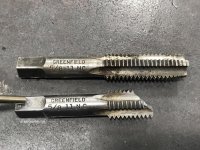
I have some 1” plate (Grade 50) that I’m trying to tap with a 5/8”-11NC tap. I’m doing them by hand, using a quality Greenfield tap, with tapping fluid. Going in a little bit, reversing to break up cuttings, forward, repeat. Snapped the tap off about half way in. What’s the trick to tapping thick steel without breaking the taps. I used the 17/32” drill bit called for this size tap. And obviously use quality taps (which didn’t seem to help).

You are using an out of date browser. It may not display this or other websites correctly.
You should upgrade or use an alternative browser.
You should upgrade or use an alternative browser.
Tapping 1” thick steel
- Thread starter schurtjl
- Start date
dutchgray
Well-known member
For a start I would clearance out some of the thickness unless you really need 1" of threads, I would take 3/8" out so your only trying to thread 5/8" depth. You could go for a slightly larger drill size if you still want to tap full depth, probably get a metric one a bit over the actual size.
You will need to start absolutely square to the drilled hole also, I would make a guide bush for this.
I would also use WD40 as a tapping fluid, plenty of it, it works very well.
You will need to start absolutely square to the drilled hole also, I would make a guide bush for this.
I would also use WD40 as a tapping fluid, plenty of it, it works very well.
dr_clyde
Well-known member
What kind of tap are you using? 4 flute hand taps **** for chip clearing and generally aren’t good for much.
I would recommend a spiral point tap. Union Butterfield makes my go-to taps.
I also don’t recommend WD-40 for tapping. It’s meant as a mild lubricant, not a tapping fluid. Use something like tap magic, rapid tap or a purpose designed tapping fluid. If you’re tapping steel, Ridgid pipe threading oil works great because it has lots of sulfur in it, which behaves well under extreme pressure.
I would recommend a spiral point tap. Union Butterfield makes my go-to taps.
I also don’t recommend WD-40 for tapping. It’s meant as a mild lubricant, not a tapping fluid. Use something like tap magic, rapid tap or a purpose designed tapping fluid. If you’re tapping steel, Ridgid pipe threading oil works great because it has lots of sulfur in it, which behaves well under extreme pressure.
ddawg16
Well-known member
Do you have the right size hole?
matt_i
Well-known member
I recommend a magnet drill press, or even rig up a setup to use your actual drill press. The DP can then also do the tapping (chuck the tap directly).
The one single thing that makes tapping all holes easier is to have the tap aligned the same as the pilot hole and those machines above have the fixturing to enforce that.
This is setting up to tap 1" thick for 1/2-13. Very easy with the magnet drill press. May be able to rent it as they are expensive for a job here or there.

THis is setting up to tap 1" thick for 3/4-10. Also the magnet DP makes it a snap. No need to even own the right tap wrench. Use the spiral point taps recommended above. I use Tap Magic.

Short video of actual tapping.

The one single thing that makes tapping all holes easier is to have the tap aligned the same as the pilot hole and those machines above have the fixturing to enforce that.
This is setting up to tap 1" thick for 1/2-13. Very easy with the magnet drill press. May be able to rent it as they are expensive for a job here or there.
THis is setting up to tap 1" thick for 3/4-10. Also the magnet DP makes it a snap. No need to even own the right tap wrench. Use the spiral point taps recommended above. I use Tap Magic.
Short video of actual tapping.
Last edited:
Do you have the right size hole?
Yes, 17/32” is the correct size hole for 5/8”-11 NC
blazemaster83
Well-known member
Looked like you were using an old tap. Try picking up a new hss tap and I bet it'll go right through. Only other reason would be if the plate is something other than mild steel
Those are all good suggestions but it could be you’re just not perfectly aligned. If you have a 5/8 nut and some flat stock and a welder I’d suggest drilling a 5/8 hole, weld a nut to the flat stock and using it as a guide.
I think I have some pics on this phone of the same set up and if so I’ll be back.
I think I have some pics on this phone of the same set up and if so I’ll be back.
Looked like you were using an old tap. Try picking up a new hss tap and I bet it'll go right through. Only other reason would be if the plate is something other than mild steel
It’s G50 steel, not A36.
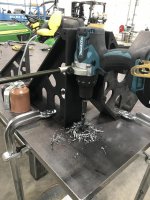
Someone mentioned above a mag drill. I was/am considering a Hougen HMD905 2-speed. Only issue is no reverse for tapping, have to step up to a HMD2MT to get the 2 speed and reverse. Which is about an additional $500. For drilling true holes, I’m just using a couple Fireball squares set up to run my holes nice and straight. Works well, though I’d prefer the mag drill setup.
Attachments
Jagmandave
Well-known member
I have hand tapped a 1" thread in 1 1/2" steel - and tho I don't know what G50 is I was going into bog standard plate steel. Brand new tap and cutting fluid was all it took - I did 6 of them this way.....
dr_clyde
Well-known member
Mag drills are really handy tools, I have two that get regular use.
Once you get used to using annular cutters to drill big holes you'll always want to use them.
Tapping with them isn't a big deal, but holding the tap can be tricky. My hougen doesn't have a drill chuck, so we use the Milwaukee for that. You can just hand remove the tap if the drill doesn't have reverse.
G50 should tap just fine with the right setup. New, sharp HSS spiral point tap and some tapping fluid should cut fine.
I will say that it is critical to be lined up dead square on thick tapping jobs. If your tap is crooked, you're gonna have a bad time.
Once you get used to using annular cutters to drill big holes you'll always want to use them.
Tapping with them isn't a big deal, but holding the tap can be tricky. My hougen doesn't have a drill chuck, so we use the Milwaukee for that. You can just hand remove the tap if the drill doesn't have reverse.
G50 should tap just fine with the right setup. New, sharp HSS spiral point tap and some tapping fluid should cut fine.
I will say that it is critical to be lined up dead square on thick tapping jobs. If your tap is crooked, you're gonna have a bad time.
Yes, 17/32” is the correct size hole for 5/8”-11 NC
https://www.guhring.com/Support/Technical/Tap-Drill-Sizes
According to the tap chart above a 17/32 will give you a 80% thread depth. That is tight. If you look down the chart you will see that 35/64 will give you a 66% thread depth. Much easier to tap and well within strength limits. As said above relieve the hold a bit. Use a clearance drill and relieve the top of the hole ~ 1/4 to 3/8" deep and you will have a built in tap guide to get you started.
On edit, looking at the specs you have on that plate and seeing that it is flame cut, are you getting into a heat affected zone where the material could have hardened? Hit the edge with a file and see if it has hardened.
good luck
lg
no neat sig line
Last edited:
sberry
Banned
I was going to suggest 35/64 also for hand tap. I have done this, hand drill, hand tap.
hunter1151
Well-known member
Spiral point gun tap is what you need, they are very strong and have a nice long lead.
danielbuck
Well-known member
- Joined
- Apr 15, 2014
- Messages
- 943
are you tapping all the way through? From the photo, it looks like you have 4 threads that are tapered. For that thick of steel, I would get a longer taper. McMaster sells them with up to 7 to 10 threads of taper. I have a feeling this would make it easier.
If you're tapping bottomed holes, I would go as far as you can with the longest taper you have, then run a shorter taper, and then finish with a bottoming tap. I know that is expensive and time consuming to use 3 different taps per hole, but when hand tapping thick metal, I try to give myself every advantage I can get.
On a slightly related note, last week enlarged some 3/8"NPT and 1/2"NPT water-jacket fittings on some aluminum engine heads (I like my plugs and fittings to have as many threads of engagement as I can get, and the factory tap was only giving me about 3 threads). The heads were already torqued down to the motor, and I didn't want to re-do all of that.
To keep the shavings from falling down into the water jackets, I loaded the tap up with thick engine assembly grease (almost a paste, thicker than normal grease). It amazed me how easy the tap went through when it was loaded up with grease, compared to just putting a little tapping fluid on the threads when I was enlarging the holes on the intake manifold (which wasn't installed yet, so I wasn't concerned with the chips falling in).
I wonder if something like this might help you out? Maybe there's not enough lubricant in there, or it's dripping down through the hole? Maybe there's a thicker grease-like tapping lubricant?
If you're tapping bottomed holes, I would go as far as you can with the longest taper you have, then run a shorter taper, and then finish with a bottoming tap. I know that is expensive and time consuming to use 3 different taps per hole, but when hand tapping thick metal, I try to give myself every advantage I can get.
On a slightly related note, last week enlarged some 3/8"NPT and 1/2"NPT water-jacket fittings on some aluminum engine heads (I like my plugs and fittings to have as many threads of engagement as I can get, and the factory tap was only giving me about 3 threads). The heads were already torqued down to the motor, and I didn't want to re-do all of that.
To keep the shavings from falling down into the water jackets, I loaded the tap up with thick engine assembly grease (almost a paste, thicker than normal grease). It amazed me how easy the tap went through when it was loaded up with grease, compared to just putting a little tapping fluid on the threads when I was enlarging the holes on the intake manifold (which wasn't installed yet, so I wasn't concerned with the chips falling in).
I wonder if something like this might help you out? Maybe there's not enough lubricant in there, or it's dripping down through the hole? Maybe there's a thicker grease-like tapping lubricant?
Last edited:
sqznby
Well-known member
https://www.guhring.com/Support/Technical/Tap-Drill-Sizes
According to the tap chart above a 17/32 will give you a 80% thread depth. That is tight. If you look down the chart you will see that 35/64 will give you a 66% thread depth. Much easier to tap and well within strength limits. As said above relieve the hold a bit. Use a clearance drill and relieve the top of the hole ~ 1/4 to 3/8" deep and you will have a built in tap guide to get you started.
On edit, looking at the specs you have on that plate and seeing that it is flame cut, are you getting into a heat affected zone where the material could have hardened? Hit the edge with a file and see if it has hardened.
good luck
lg
no neat sig line
Great advise for drilling/tapping

Good thinking about heat affected zone as well
I agree with db, looks like a plug tap. I normally just start holes with a plug tap most of the time but for bigger diameter & coarse threads I'll try to use a taper tap when I can. Makes it a lot easier to tap. If not a through hole then follow with a plug or bottom tap if needed.
The holes go completely through the plate. I’m thinking the first tap had a stress fracture somewhere, as it broke way too easy. It was an old Greenfield set I purchased used. The second tap I tried worked better and tapped all 8 holes with no issue.
Last edited:
matt_i
Well-known member
I'm not sure if it was mentioned but the spiral point "gun" taps are stronger than 4 fluters.
Since they rely on a machine or fixture for alignment, they have only 2 or 3 flutes, allowing significantly more material in the cross-section.
Work extremely well in battery drills for small holes if your aim is good and the thickness is ~1/4" or less.
Since they rely on a machine or fixture for alignment, they have only 2 or 3 flutes, allowing significantly more material in the cross-section.
Work extremely well in battery drills for small holes if your aim is good and the thickness is ~1/4" or less.
Kevin54
MEMBER EMERITUS
Throw away the 4 flute taps. They cause more problems than ever. For 5/8, get a 3 flute tap instead. More chip clearance. Depending on the use of the plate, you could always open up your hole by a few more thousandth to make it easier..... .005-.010 larger.
PugetDude
ALLIANCE MEMBER
are you tapping all the way through? From the photo, it looks like you have 4 threads that are tapered. For that thick of steel, I would get a longer taper. McMaster sells them with up to 7 to 10 threads of taper. I have a feeling this would make it easier.
If you're tapping bottomed holes, I would go as far as you can with the longest taper you have, then run a shorter taper, and then finish with a bottoming tap. I know that is expensive and time consuming to use 3 different taps per hole, but when hand tapping thick metal, I try to give myself every advantage I can get.
On a slightly related note, last week enlarged some 3/8"NPT and 1/2"NPT water-jacket fittings on some aluminum engine heads (I like my plugs and fittings to have as many threads of engagement as I can get, and the factory tap was only giving me about 3 threads). The heads were already torqued down to the motor, and I didn't want to re-do all of that.
To keep the shavings from falling down into the water jackets, I loaded the tap up with thick engine assembly grease (almost a paste, thicker than normal grease). It amazed me how easy the tap went through when it was loaded up with grease, compared to just putting a little tapping fluid on the threads when I was enlarging the holes on the intake manifold (which wasn't installed yet, so I wasn't concerned with the chips falling in).
I wonder if something like this might help you out? Maybe there's not enough lubricant in there, or it's dripping down through the hole? Maybe there's a thicker grease-like tapping lubricant?
I've had good success with Chain Saw Bar Oil for tapping steel. It's engineered to cling, not run. Seems to hang in there better than a light-bodied fluid.
joe49
Well-known member
Used motor oil is good for tapping and drilling.
matt_i
Well-known member
Throw away the 4 flute taps. They cause more problems than ever. For 5/8, get a 3 flute tap instead. More chip clearance. Depending on the use of the plate, you could always open up your hole by a few more thousandth to make it easier..... .005-.010 larger.
Agree with your idea but finding that +.005" to +.010" drill bit is tricky in that size. With 1/64" steps past 17/32" = .531" (nominal for 75%) those are .016" steps. Unless you are stocked with many metric sizes and the closest I see is 14.0mm which is .551 = .020" larger. So it would have to be a file or reamer or try to force the drill bit to cut larger by jamming something in one of the flutes. Can of course get a custom metric size which seem available in 0.1mm increments = .004" and every reamer under the sun is available as a custom grind.
Kevin54
MEMBER EMERITUS
Agree with your idea but finding that +.005" to +.010" drill bit is tricky in that size. With 1/64" steps past 17/32" = .531" (nominal for 75%) those are .016" steps. Unless you are stocked with many metric sizes and the closest I see is 14.0mm which is .551 = .020" larger. So it would have to be a file or reamer or try to force the drill bit to cut larger by jamming something in one of the flutes. Can of course get a custom metric size which seem available in 0.1mm increments = .004" and every reamer under the sun is available as a custom grind.
I'll have to look, but I may have an adjustable reamer that I could send you and you can keep it. I'll check things tomorrow. But get rid of the 4 flute taps. They are nothing but trouble. From small to large, I have had to remove hundreds of them over the years from parts.
PhantomEB
Well-known member
I have heard I should use 5/8 tapped holes on my fixture table....why?
Kensico
Active member
Rapid Tap cutting fluid
https://www.amazon.com/dp/B00065V026/?tag=atomicindus08-20
https://www.amazon.com/dp/B00065V026/?tag=atomicindus08-20
dr_clyde
Well-known member
I have heard I should use 5/8 tapped holes on my fixture table....why?
Not tapped, just 5/8.
That’s the size of Strong Hand drop in tooling.
Farrier
Well-known member
You will never tap holes in 1" plate by hand successfully. Farm it out to a shop with the right tools.
You will never tap holes in 1" plate by hand successfully. Farm it out to a shop with the right tools.
You did see the OP finished all the holes?
"The second tap I tried worked better and tapped all 8 holes with no issue."
Kevin
Zrexxer
Well-known member
You will never tap holes in 1" plate by hand successfully. Farm it out to a shop with the right tools.
Well, I guess he DID.
The second tap I tried worked better and tapped all 8 holes with no issue.
You can tell from the style of lettering and manufacturer's identification that that tap is fairly old. I have some Greenfield taps from that era as well, if I am tapping new threads I will sharpen them with a stone before use. The nice thing about the spiral point "gun" taps is that the bevel on the point pushes all of the chips forward, so you don't need to back up every little bit to break the chips. The spiral point tap can be advanced forward continuously until the hole is tapped then run out in reverse. This makes it more friendly in general, and especially for mag drills without an easy way to reverse.
Sent from my Pixel 2 using Tapatalk
Sent from my Pixel 2 using Tapatalk