
You are using an out of date browser. It may not display this or other websites correctly.
You should upgrade or use an alternative browser.
You should upgrade or use an alternative browser.
Taps?
- Thread starter no704
- Start date
LopezBart
Well-known member
Smaller taps often omit the center drilled hole, but use a pointed end on the square shank instead. Many tap T handles have center drilled holes for guides.

alwaysFlOoReD
Well-known member
OK, I need pics of a "follower" and/or "guide", please. Trying to picture how that works.
Edit; googled it. The follower is used on a lathe. The guide can be used while hand tapping.
Edit; googled it. The follower is used on a lathe. The guide can be used while hand tapping.
Smaller taps often omit the center drilled hole, but use a pointed end on the square shank instead. Many tap T handles have center drilled holes for guides.
Yes, and that is a great way to tap something while maintaining perpendicularity with a mill. Chuck up a center finder in the mill and apply pressure to the tap handle while turning.
alfadan
Well-known member
I think for the smaller taps, it's easier to make the 60 degree cone on the end for grinding fixtures in manufacturing, rather than drill/grind a 60 degree taper hole.
I think there are reversible tap followers for the external taper.
I think there are reversible tap followers for the external taper.
LopezBart
Well-known member
https://fowlerprecision.com/products/fowler-micro-tap-guide has reversible convex/concave pins for this purpose.
What I do is drill the parent hole using my mill. Then I swap the chuck for an arbor holding this thing:OK, I need pics of a "follower" and/or "guide", please. Trying to picture how that works.
Edit; googled it. The follower is used on a lathe. The guide can be used while hand tapping.
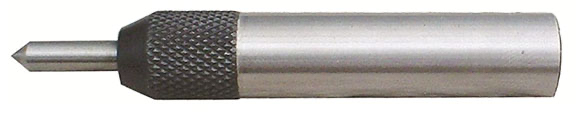
This point pilots on the recess in the back of the T tap handle.
If you are using this style of tap handle,
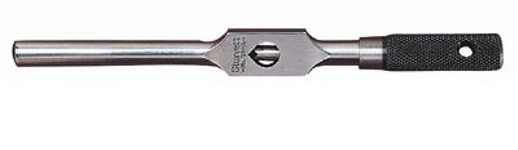
then you need the recess in the tap.
The key is figuring out how much working room you have between your workpiece and your quill/spindle and selecting the right set up that doesn't require moving the table.
I always found the little cone fits well in the small hole left when my drill press chuck is all the way closed. It let's me apply some pressure to get the tap started while turning with the other hand.
Nowadays most things ARE power tapped or tapped in the lathe but I still use that technique for the occasional random hole.
Nowadays most things ARE power tapped or tapped in the lathe but I still use that technique for the occasional random hole.
RoninB4
Well-known member
-For small taps without the center in the end you could simply make a tap alignment block. Take a small block of metal and drill a hole (in a drill press or mill) that's just slightly larger (.005 or so) than the tap. Use this to align the tap perpendicular to the hole. Power tapping the smaller sizes (1/4 or under) is asking for trouble unless you really know what a sharp tap is supposed to feel like or you have a tapping head with the clutch adjusted correctly. This is especially true when tapping trouble prone materials like SS (that may be work-hardened). Of the thousands of holes I've tapped I still break a tap now and then. For all taps under 5/16 I tap by hand unless it's aluminum or brass. JMO.
Why wouldn’t you just put small taps without the recess in a T handle which does have the recess.-For small taps without the center in the end you could simply make a tap alignment block. Take a small block of metal and drill a hole (in a drill press or mill) that's just slightly larger (.005 or so) than the tap. Use this to align the tap perpendicular to the hole. Power tapping the smaller sizes (1/4 or under) is asking for trouble unless you really know what a sharp tap is supposed to feel like or you have a tapping head with the clutch adjusted correctly. This is especially true when tapping trouble prone materials like SS (that may be work-hardened). Of the thousands of holes I've tapped I still break a tap now and then. For all taps under 5/16 I tap by hand unless it's aluminum or brass. JMO.
Maybe I’m missing something in this thread. If you are power tapping, you don’t need the recess. I use the recess only for hand tapping and the one in the tap is only used for the straight tap handle. I only use straight handles when the taps are larger in size or I don’t have the space the T handle takes up.
Fundamentally, one should never need a recess is a small tap, which is likely why tap makers don’t add the feature.
@RoninB4, straighten us out. What am I missing? When you talked about making a block, what is turning the tap? Why not just use a T handle?
RoninB4
Well-known member
-I'm not the last word on much of anything, all I do is offer my experience, a few reference books, and my opinion. Not everybody has the T-handle type, I don't care that much for them and use mine only when reach is an issue. I much prefer the straight type tap handles as they give me better direct feedback from the tap as to how it's doing. When a tap is somewhat dull or the material is just tough (work hardening) I can "feel" whether the tap is actually cutting or just pushing material. When that happens there's a good chance of it breaking and making a simple task a larger PITA. Even when the tap is cutting ok the flutes can get clogged up with chips, new chips will have nowhere to go and the tap starts to bind up. That's where feedback is important to me. I know, by feel, how a tap is doing and whether I need to back it out of the hole or not. I've had several instances where I needed 3 brand new taps to create ONE threaded hole. Even with power tapping I'll often just get the tap started to ensure it's aligned with the hole axis and then finish it by hand. I'll power tap when I feel confident about the outcome but even aluminum, as soft as it is, can create a situation that breaks a tap. I really hate digging a broken tap out of a hole just because I got in a hurry and failed to consider the conditions. That's sorta like the "too fast for conditions" traffic infraction. Taps over 7/16" are usually a fairly safe bet for power tapping.Why wouldn’t you just put small taps without the recess in a T handle which does have the recess.
No "chamfer" on the end of smaller taps is likely because it would be more difficult to do with the smaller sizes although I may be wrong about that. I never really considered the "why" because I felt it it didn't need one anyway. JMO. Hope this helps someone.
Ditchdigger
Well-known member
Here is a typical follower with a point for taps with the divot on the end
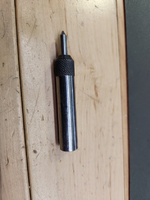
and if you take the socket set out the end you will see that it has it's own centered divot on the other side so it can be flipped around and used with smaller taps with points.
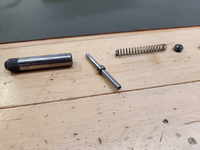
And taps without either? Usually made for CNC operations where they would be superfluous. My favorite Widia taps omit them on smaller than M6 spiral flute variety
and if you take the socket set out the end you will see that it has it's own centered divot on the other side so it can be flipped around and used with smaller taps with points.
And taps without either? Usually made for CNC operations where they would be superfluous. My favorite Widia taps omit them on smaller than M6 spiral flute variety
Just recently drilled and tapped some 4-40 holes in steel by hand... I was inordinately careful...
Did not want to hear the "SNAP"
Used one of the smaller tap sockets and cut the threads by gripping the body with my fingers...
Did not want to hear the "SNAP"
Used one of the smaller tap sockets and cut the threads by gripping the body with my fingers...
Last edited:
RoninB4
Well-known member
-No courage eh?Just recently drilled and tapped some 4-40 holes in steel by hand... I was inordinately careful...
Did not want to hear the "SNAP"
-Me neither.
I had occasion to do this very thing yesterday, so I snapped some photos.I always found the little cone fits well in the small hole left when my drill press chuck is all the way closed. It let's me apply some pressure to get the tap started while turning with the other hand.
Nowadays most things ARE power tapped or tapped in the lathe but I still use that technique for the occasional random hole.

