Just had my slab poured today and it looked great after the finisher power troweled it. Beautiful smooth finish with no blemishes. I did exactly as he said to do and watered it at 7pm this evening. When the slab dried off again I was left with horrible white staining all over the surface!!! I am assuming this is efflorescence but is that normal? I was planning on sealing the concrete but now it looks horrible and I’m thinking I may have to epoxy it. Has anyone else experienced this? And is it something that will eventually go away leaving that smooth uniform appearance again?


You are using an out of date browser. It may not display this or other websites correctly.
You should upgrade or use an alternative browser.
You should upgrade or use an alternative browser.
Terrible white staining (efflorescence?) on new slab
- Thread starter Mike_72
- Start date
I don't think it's efflorescence on freshly poured concrete. Might be some Portland rising to the top. Give it a month to fully cure then see what you got.
Do I continue to spray it with water several times a day?
ConCretin
Well-known member
Concrete will whiten when exposed to water but generally not after it is fully set. It sounds like your concrete was set so I'm at a bit of a loss. Pictures might help. Depending on the cause the whiteness may very well go away with time. I wouldn't panic just yet.
Another issue to consider is your curing method. Applying water once and letting the slab dry out is not proper curing. You want to protect the concrete from drying out for as long as practical - ideally 28 days. Your concrete needs it's mix water to continuing gaining strength.
You can keep it wet by spraying or ponding, cover it to retain the moisture or spray on a curing compound.
Another issue to consider is your curing method. Applying water once and letting the slab dry out is not proper curing. You want to protect the concrete from drying out for as long as practical - ideally 28 days. Your concrete needs it's mix water to continuing gaining strength.
You can keep it wet by spraying or ponding, cover it to retain the moisture or spray on a curing compound.
Last edited:
Concrete will whiten when exposed to water but generally not after it is fully set. It sounds like your concrete was set so I'm at a bit of a loss. Pictures might help. Depending on the cause the whiteness may very well go away with time. I wouldn't panic just yet.
Another issue to consider is your curing method. Applying water once and letting the slab dry out is not proper curing. You want to protect the concrete from drying out for as long as practical - ideally 28 days. Your concrete needs it's mix water to continuing gaining strength.
You can keep it wet by spraying or ponding, cover it to retain the moisture or spray on a curing compound.
My intentions were to regularly water to keep it moist but as I started seeing this white powder appearing I began to question if what I was doing was correct. I will ask the concrete guy his opinion today as he will be coming to remove the forms. Hopefully I haven’t done any irreversible damage...
ConCretin
Well-known member
My intentions were to regularly water to keep it moist but as I started seeing this white powder appearing I began to question if what I was doing was correct. I will ask the concrete guy his opinion today as he will be coming to remove the forms. Hopefully I haven’t done any irreversible damage....
This isn't on you. Applying water to cure concrete is a loooong established method. If the floor was power troweled, the concrete was set and curing water will not hurt the concrete one bit.
You mentioned a white powder rather than a stain. This does suggest efflorescence.
I don't want to cast blame without all the information but if your finisher placed the concrete too wet or applied a lot of water to the surface to achieve that pretty finish, it's possible that it brought up dissolved solids (i.e. efflorescence) that only became visible when you applied curing water and let it dry.
The good news is that this type of efflorescence can be removed relatively easily. The bad news is high slump and water added to the surface may cause other issues such as dusting. You definitely don't want to apply a sealer over the efflorescence. I'd take some pictures, show your concrete guy the problem and restart your water cure.
I might consider holding off on payment until you are assured you got a quality job.
Let us know what your concrete guy says.
Last edited:
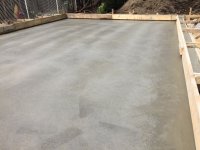

Concrete is 4600psi 14mm 3”. 7” thick in center and 14” thickened edge. I watched the finisher fairly closely and only once did I see him using a small Gatorade bottle to add a tiny bit of water as he was power troweling (just a few drops every once in a while). Was 50 degrees during the pour and never made it above 60 the rest of the day.
pb57
Well-known member
Looks like normal concrete curing to me. no problem there. Paul
Falcon67
Well-known member
7/24 -
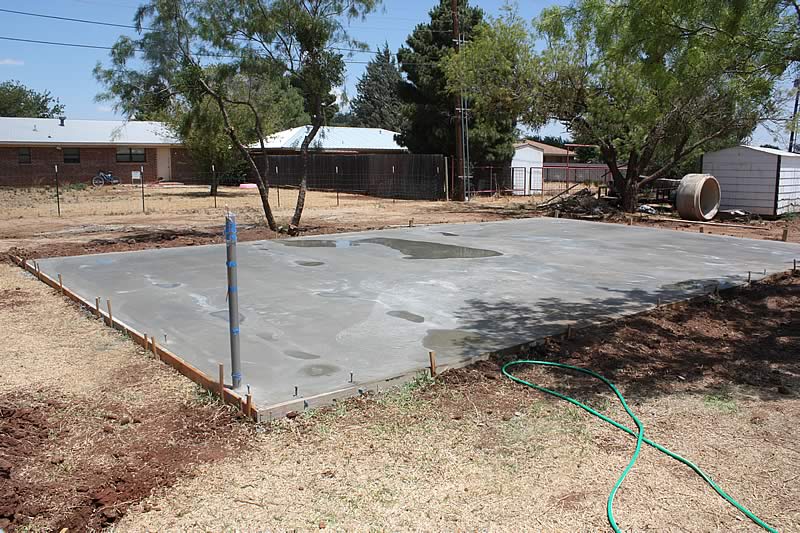
Kept it wet that weekend then let it go. Slab temp when dry was around 130F.
8/8
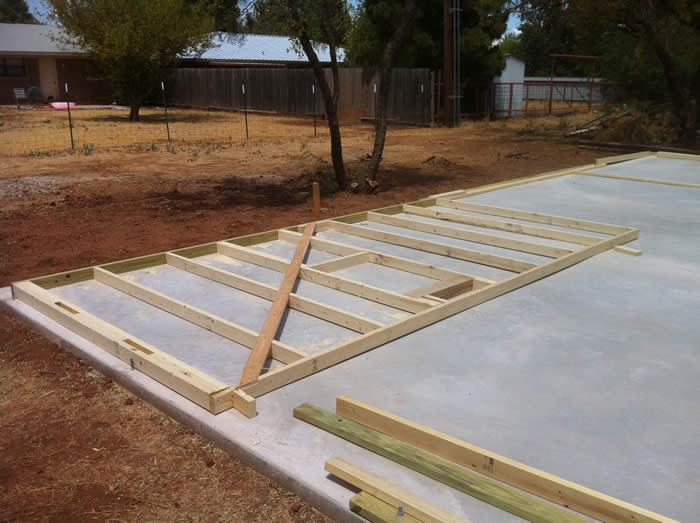
Kept it wet that weekend then let it go. Slab temp when dry was around 130F.
8/8
What are the consequences of me having let the surface dry out? Have I lost the opportunity to wet cure the surface to maximum strength now? I will be heading home from work in a couple of hours and will wet it down and cover with a sheet of poly.
Mike, in your night time pic of the slab, the white rings around the low spots are from lime in the water you put on it. I have a stamped patio that looks the same way after i wash it down with the hose. They do not show up after a rain storm, just when i use the hose. Terry
ConCretin
Well-known member
Now that I've seen the pics, I don't really think you have a problem. Normal bleed water brought some dissolved solids to the surface. Your wet cure concentrated them around the low spots as it dried. It all looks pretty normal to me. Glad you were there to verify there wasn't a bunch or water splashed on the surface during finishing.
Your curing plan is good. Letting the slab dry out for a few hours isn't the end of the world especially given the cools temps you have. keeping it wet going forward should provide for a good cure.
Your curing plan is good. Letting the slab dry out for a few hours isn't the end of the world especially given the cools temps you have. keeping it wet going forward should provide for a good cure.
I’ve “earth bagged” the openings for the garage door and man door. Have about an inch of water pooled in the slab which should last a fair bit of time even with the minor leakage. Is it normal that when I run my hand over the wet slab it leaves a slippery feeling film on my hand?

Falcon67
Well-known member
What are the consequences of me having let the surface dry out? Have I lost the opportunity to wet cure the surface to maximum strength now? I will be heading home from work in a couple of hours and will wet it down and cover with a sheet of poly.
No, the water just helps. Nobody does that to house slabs here - they pour the 'crete in the early morning and the forms are off by afternoon. Walls may be going up in the next day or two. Nobody wets anything. I poured mine in 2011 and that was one of those summers where it was 100F+ by 11AM. I put a sprinkler on it for a day or so then let it go. They poured on Saturday morning and I went to work Monday and let it do whatever. It's 2019, no issues. The "issues" I have with my slab relate to the 2nd truck being hella late and someone stepping on a form, giving one corner a bit of slope.
Thanks so much everyone for your input. This is my first big undertaking in construction and the costs are certainly not insignificant so I’d like everything to be done right. It’s really great to have a resource like this with so many knowledgeable people.
I notice that there are many little white/beige particles appearing in the water which is pooled on the slab. Should I be concerned or is this just some of the minerals coming out of the concrete, same as what leaves the white residue behind when the surface dries?

I notice that there are many little white/beige particles appearing in the water which is pooled on the slab. Should I be concerned or is this just some of the minerals coming out of the concrete, same as what leaves the white residue behind when the surface dries?
Lucid Moments
Well-known member
I used to work for a Bank doing construction "inspections" (checking what was done so the builders could get their draw) and have been around thousands of construction sites here in the US Southeast. I have literally never seen someone try to keep water on a slab after it was poured.
I don't doubt that it can be beneficial, but I do doubt that it is necessary. I guess it depends a lot on what is going to go on top of the slab, and what is under the slab as well.
I don't doubt that it can be beneficial, but I do doubt that it is necessary. I guess it depends a lot on what is going to go on top of the slab, and what is under the slab as well.
I used to work for a Bank doing construction "inspections" (checking what was done so the builders could get their draw) and have been around thousands of construction sites here in the US Southeast. I have literally never seen someone try to keep water on a slab after it was poured.
I don't doubt that it can be beneficial, but I do doubt that it is necessary. I guess it depends a lot on what is going to go on top of the slab, and what is under the slab as well.
Well, one thing is for sure... There have been several instances in my life where I have ended up making stuff worse after my attempts at making it better. Really hope this isn’t one of those instances!!
ConCretin
Well-known member
I used to work for a Bank doing construction "inspections" (checking what was done so the builders could get their draw) and have been around thousands of construction sites here in the US Southeast. I have literally never seen someone try to keep water on a slab after it was poured.
I don't doubt that it can be beneficial, but I do doubt that it is necessary. I guess it depends a lot on what is going to go on top of the slab, and what is under the slab as well.
Well, one thing is for sure... There have been several instances in my life where I have ended up making stuff worse after my attempts at making it better. Really hope this isn’t one of those instances!!
Sooo, tract home builders are now the authority on quality concrete construction. Good grief! How many posts have we seen on here about cracked, dusty and delaminating floors? If you are looking for an example of how to do things right, I'd suggest you keep looking.
Mike_72, curing a concrete slab is a simple and inexpensive way to maximize the value of your investment. Keep on doing what you are doing and ignore the noise. There is no downside to curing and you are significantly improving the strength and durability of your slab.
SALIV8
Well-known member
Mike 72,
Listen to that guy ^ concrete is his business.
Listen to that guy ^ concrete is his business.
el monte slim
Well-known member
I'll admit to knowing diddly squat about concrete, but I once witnessed a neighbor do something that just didn't look right to me. For context, it should be noted this guy did every outdoor task like he was attempting to set a land speed record. It was almost comical to witness him push-mowing his yard, raking leaves, building a deck, or landscaping, etc. My wife and I would often refer to him to him as "Speedy G," or "Mister go-go mouse."
When it came time for him to erect a new stick-built two-car garage, the concrete mixing truck showed up at 6:00am and a small crew did the pour. By 1:00pm he was removing the forms, and began erecting the structure with a few other guys. By 9:00pm the walls were in place, the roof trusses were up, and every bit of the exterior had been sheathed in OSB. Keep in mind this guy wasn't a professional contractor. He was a dispatcher for a trucking company.
I wanted to be impressed by this accomplishment, but I was only thinking that the concrete hadn't cured, and now it's got all that weight of the structure sitting on it. Given the time frame I just described, was I correct in thinking that?
When it came time for him to erect a new stick-built two-car garage, the concrete mixing truck showed up at 6:00am and a small crew did the pour. By 1:00pm he was removing the forms, and began erecting the structure with a few other guys. By 9:00pm the walls were in place, the roof trusses were up, and every bit of the exterior had been sheathed in OSB. Keep in mind this guy wasn't a professional contractor. He was a dispatcher for a trucking company.
I wanted to be impressed by this accomplishment, but I was only thinking that the concrete hadn't cured, and now it's got all that weight of the structure sitting on it. Given the time frame I just described, was I correct in thinking that?
ConCretin
Well-known member
Sooo, tract home builders are now the authority on quality concrete construction. Good grief! How many posts have we seen on here about cracked, dusty and delaminating floors? If you are looking for an example of how to do things right, I'd suggest you keep looking.
I'm quoting my own post because upon re-reading it today, it seems unnecessarily snarky. My apologies to Lucid Moments.
There is too much poor workmanship in my industry and I see the results on the GJ and in real life far too often. Many problems with a concrete slab don't appear until well after the bill has been paid. It's the process that is important not how the slab looks the next day.
One of the great things about the GJ is people sharing the right way to do things so we can all get better at what we do. We don't always agree and that's half the fun but there's no need to be uncivil.
Last edited:
rayra
Well-known member

Here is the slab after the finishers left, before any water was added
lol. That's called 'drying concrete'.
Get back to us in a month. Keep wetting it, will make it stronger. DON'T SEAL IT for a few months at least.
Lucid Moments
Well-known member
I'm quoting my own post because upon re-reading it today, it seems unnecessarily snarky. My apologies to Lucid Moments.
There is too much poor workmanship in my industry and I see the results on the GJ and in real life far too often. Many problems with a concrete slab don't appear until well after the bill has been paid. It's the process that is important not how the slab looks the next day.
One of the great things about the GJ is people sharing the right way to do things so we can all get better at what we do. We don't always agree and that's half the fun but there's no need to be uncivil.
Don't sweat it, I'm prone to be a little snarky too on occasion.
I am not, and do not pretend to be, a concrete expert. I can only share my experience.
ConCretin
Well-known member
Curing slabs is far more prevalent on commercial/industrial projects, which are constructed per detailed specifications. These specs typically require curing measures to be maintained for 7 days, which should get the concrete to 70 percent of design strength. Obviously the longer the better. Concrete theoretically reaches its full design strength in 28 days so that is ideal.
We’ve done many thousands of square feet of flatwork per year over the last 30 plus years and the vast majority of it has been properly cured. Will your slab crumble the first time you step on it if you don’t properly cure it? Obviously not. But after you spend all that time and money, it’s kind of foolish not to maximize it's durability and performance by making sure your concrete reaches its design strength. Just because most people lack the knowledge or motivation doesn’t mean you should.
Btw. There are several ways to cure a concrete slab other ponding or spraying with water. You can spray on a curing compound or cover the slab with poly or a curing membrane. Anything to keep it from drying out before it reaches strength.
We’ve done many thousands of square feet of flatwork per year over the last 30 plus years and the vast majority of it has been properly cured. Will your slab crumble the first time you step on it if you don’t properly cure it? Obviously not. But after you spend all that time and money, it’s kind of foolish not to maximize it's durability and performance by making sure your concrete reaches its design strength. Just because most people lack the knowledge or motivation doesn’t mean you should.
Btw. There are several ways to cure a concrete slab other ponding or spraying with water. You can spray on a curing compound or cover the slab with poly or a curing membrane. Anything to keep it from drying out before it reaches strength.
Last edited:
Well after letting the slab dry out I have some concerns with what I am seeing. The overall appearance of the slab isn’t very attractive and not at all what I was expecting and more importantly I am seeing quite a bit of crazing on the surface. Let me know what you guys think....


Attachments


I am not a water or concrete expert but to me it looks more like your water has a ton of minerals in it and it's leaving deposits on the concrete surface as it evaporates. Have you had your water tested? If you wash your car and don't dry it does it leave bad water spots?
I am not a water or concrete expert but to me it looks more like your water has a ton of minerals in it and it's leaving deposits on the concrete surface as it evaporates. Have you had your water tested? If you wash your car and don't dry it does it leave bad water spots?
Never had any issues with water spots on anything else. On city water so don’t have the type of minerals you would get from well water.
Falcon67
Well-known member
Sooo, tract home builders are now the authority on quality concrete construction. Good grief! How many posts have we seen on here about cracked, dusty and delaminating floors? If you are looking for an example of how to do things right, I'd suggest you keep looking.
Mike_72, curing a concrete slab is a simple and inexpensive way to maximize the value of your investment. Keep on doing what you are doing and ignore the noise. There is no downside to curing and you are significantly improving the strength and durability of your slab.
This. But FWIW, the custom 3300 sq/ft house next door has 92 yards in the slab. They started pouring at 6 AM and had most of the forms off by 2:30 PM. I think they started framing about 3 days later, if that. Just typical of construction here. I'd be more worried that the slab is level and square. Which mine wasn't LOL dammit.
What I see above is surface spider cracks. I'd let it dry for a while and see where it ends up.
Last edited:
I called the guy who did my concrete and he showed up 30 mins later to have a look. He didn’t seem concerned in the slightest and said that once the slab is dry it will be a uniform shade of light grey and the small surface crazing which is currently visible on the darker grey sections will no longer be visible.
Last edited:
ConCretin
Well-known member
Sooo, I feel like I've gone back and forth on this a couple times now. Based on your written description I was initially concerned. The first set of pics looked relatively normal. The most recent pics have me concerned again.
Your slab is obviously dry so I'm not sure what your floor guy is talking about. There does appear to be excessive efflorescence and there is definitely surface crazing. This suggests excessive slump. While not uncommon, this can lead to issues.
What does this mean? Well firstly, your floor may not achieve the full compressive strength you anticipated. This isn't necessarily a structural issue but the surface may not be as durable as otherwise expected.
The crazing by itself isn't a concern other than aesthetically. Dusting, de-lamination and blistering are more of a concern. I don't see blisters and de-lamination or dusting probably won't show up right away. You can survey the floor for de-laminaitation by dragging a chain over it and listening for a change in tone. It will be distinct. Dusting will manifest itself as the name implies.
The white 'powder' can be removed with a mild acid wash or other methods. It probably won't return. A sealer might help with the appearance and protect the floor. The other potential issues vary in seriousness. Hopefully you won't have to deal with them but there are concerns.
Your slab is obviously dry so I'm not sure what your floor guy is talking about. There does appear to be excessive efflorescence and there is definitely surface crazing. This suggests excessive slump. While not uncommon, this can lead to issues.
What does this mean? Well firstly, your floor may not achieve the full compressive strength you anticipated. This isn't necessarily a structural issue but the surface may not be as durable as otherwise expected.
The crazing by itself isn't a concern other than aesthetically. Dusting, de-lamination and blistering are more of a concern. I don't see blisters and de-lamination or dusting probably won't show up right away. You can survey the floor for de-laminaitation by dragging a chain over it and listening for a change in tone. It will be distinct. Dusting will manifest itself as the name implies.
The white 'powder' can be removed with a mild acid wash or other methods. It probably won't return. A sealer might help with the appearance and protect the floor. The other potential issues vary in seriousness. Hopefully you won't have to deal with them but there are concerns.
Sooo, I feel like I've gone back and forth on this a couple times now. Based on your written description I was initially concerned. The first set of pics looked relatively normal. The most recent pics have me concerned again.
Your slab is obviously dry so I'm not sure what your floor guy is talking about. There does appear to be excessive efflorescence and there is definitely surface crazing. This suggests excessive slump. While not uncommon, this can lead to issues.
What does this mean? Well firstly, your floor may not achieve the full compressive strength you anticipated. This isn't necessarily a structural issue but the surface may not be as durable as otherwise expected.
The crazing by itself isn't a concern other than aesthetically. Dusting, de-lamination and blistering are more of a concern. I don't see blisters and de-lamination or dusting probably won't show up right away. You can survey the floor for de-laminaitation by dragging a chain over it and listening for a change in tone. It will be distinct. Dusting will manifest itself as the name implies.
The white 'powder' can be removed with a mild acid wash or other methods. It probably won't return. A sealer might help with the appearance and protect the floor. The other potential issues vary in seriousness. Hopefully you won't have to deal with them but there are concerns.
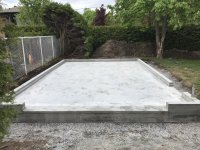
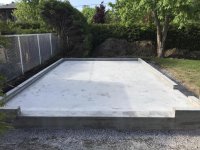
I took a series of pictures of the slab throughout the day and it does in fact look as if it is “drying”. The darker areas which showed signs or crazing are slowly turning to a very light grey and the crazing isn’t visible once this happens. The slab is beginning to look more uniform in appearance. The entire slab is very smooth to the touch and very little powder or dust is left on your hand when you wipe it. I really hope that this doesn’t result in any major issue down the line. I guess my game plan now is to leave the slab as is for the next year or so and see how it holds up. Eventually I will probably end up going with an epoxy coating.
These photos were taken throughout the day starting at about 11am and then every 2 hours from there.
Attachments

Last edited:
johnnyradiant
Well-known member
For what is visible I think the series needs to be done over a few days at the same time. The sun hitting it at different angles will change the look both to the eye and more so to the camera.