To avoid these ads, REGISTER NOW!

Test Light recommendations?

Hakeem

Well-known member
Joined
Jan 22, 2024
Messages
1,263
Location
Chicago
I’m enrolled in some automotive courses at my community college, and one of the items on the “Required Tool List” is a 12v test light. I was planning on getting the basic Lisle 28400 test light but it seems like there are a dizzying array of options.

I see some test lights are billed as “computer safe”, ie: they dont draw much charge and wont blow a sensitive piece of circuitry. On the other hand, if the test light doesnt draw much charge it doesnt test the ability of the circuit to handle a load.

Previous threads on GJ have touted the OTC 3363 3633 as the best test light to buy. Aside from the long cord, what makes it so desirable?

Some lights have two colors, for positive and ground. Is this feature worth the added expense?

Thanks in advance for any suggestions or guidance :cool:

E: wrong OTC part number
 
Last edited:

To avoid these ads, REGISTER NOW!

RTM

Well-known member
Joined
May 13, 2019
Messages
13,207
Location
SF Bay Area
I see some test lights are billed as “computer safe”, ie: they dont draw much charge and wont blow a sensitive piece of circuitry. On the other hand, if the test light doesnt draw much charge it doesnt test the ability of the circuit to handle a load.
In typical GJ fashion, you probably need both.

Mine are all incandescent, so not computer safe, and at least one is older than I am, so no help here.
 
Last edited:

txvwnut

Well-known member
Joined
Jan 1, 2015
Messages
7,631
Location
Bedford, Texas
Get the Lisle. When it comes to test lights you don't really need anything with a ton of extras. Some of the techs in my shop have a basic test light and some have ones with added options. Those are the ones that are always having trouble diagnosing an electrical issue as their fancy test light is giving them a false read.
 

inphx

Well-known member
Joined
Feb 23, 2012
Messages
1,284
Location
Phoenix/Scottsdale AZ
Solid advice, if you go lower down the quality/price food chain you would spend more time diagnosing the trinket test light than getting work done. The leads on the cheap ones seem to be soldered/crimped for single use.

BTW on rockauto.. if you search for the tool by part number they have great deals.. hard to browse, but if you know part number: https://www.rockauto.com/en/partsearch/?partnum=28400 $8.82 .
 
OP
H

Hakeem

Well-known member
Joined
Jan 22, 2024
Messages
1,263
Location
Chicago
That OTC number is a timing gun. The longer cord is nice, but a basic test light should be cheap as the ones I found more useful were things like Power Probe.
Apologies, i transposed a ‘3’ and a ‘6’. I meant the OTC 3633.

Solid advice, if you go lower down the quality/price food chain you would spend more time diagnosing the trinket test light than getting work done. The leads on the cheap ones seem to be soldered/crimped for single use.

BTW on rockauto.. if you search for the tool by part number they have great deals.. hard to browse, but if you know part number: https://www.rockauto.com/en/partsearch/?partnum=28400 $8.82 .
Yes! I don’t always take advantage but if I’m buying other parts I usually remember to take advantage of their tool deals. Big RockAuto fan here.
 

rust in the eye

Well-known member
Joined
Oct 2, 2017
Messages
2,797
Location
Chicagoland
I think the LIsle is a solid choice for a basic test light. The clamp looks decent, the bulb replaceable.
FWIW I prefer the plain cords over the coiled ones which seem to get tangled up in whatever I'm working on.
Power probe is a great tool if you care to spend significantly more.
 

theoldwizard1

Well-known member
Joined
Feb 22, 2011
Messages
43,216
Location
SE MI
The Lisle 28400 is a quality tool. Worth having in your tool box. 2 comments.

  • Replace the alligator/crocodile clip with a small pair of cheap (HF) locking plier (Vice Grip).
  • You will need one or probably 2 additional test lights made from standard automotive bulbs. One using an 1156 (or equivalent) single filament bulb that draws about 2A. The second one should use 2 bulbs and draw 4A-5A
Additionally, I recommend make a set of long lead negative and positive jumpers. Minimum 10'. (20' is better or make 2 of them so that hey can be joined together.)

I admit that I am a snob when it comes to test leads and clips ! The best clips are made by Mueller (They have been in that business for over 50 years; Pomona is a close second). For a low current (under 10A) clip designed to attach to a battery post/terminal I recommend either Mueller BU65 (add -0 for black and -2 for red) for insulated clips or Mueller BU25C (uninsulated, but colored boots are available). Several even larger size are available.

If you are making your own leads, use 18AWG (or 16AWG) "high strand count" silicon insulated wire. You can find this at reasonable prices on eBay. It is sold for RC models. Black and red are commonly available. Sometimes called "limp wire".

Pomona does make a nice (but EXPENSIVE) set of automotive test lead/probes/clips, 6530A - Amazon $190.

Screenshot 2025-01-16 104233.png

SEGUE - The most important items in that set are the back probes (yellow, lower left) and the piercing probes (yellow, lower right). You will eventually need additional piercing probes. The 'gator clips look identical to the Mueller BU65. Similar items are available from other vendors at lower prices.
 

rust in the eye

Well-known member
Joined
Oct 2, 2017
Messages
2,797
Location
Chicagoland
IMHO, not worth the money !

Learn how to use your test light (with extended leads and battery clips) as a "current limiter" to apply voltage/current to "device under test".
Value is subjective. I agree its rather expensive but you pay for convenience.
I enjoy the ability to detect or provide a ground as well as apply 12V+. The voltmeter is nice as well.
I've done way worse things with a hundred bucks.
Looks like they make a very basic one without meter for around $50, lots of knock offs at even less $$. Can't speak to quality but these aren't rocket science.
 

redwrench60

Well-known member
Joined
Sep 10, 2011
Messages
6,069
Location
East Tennessee
I always liked keeping 2 test lights on hand. One is a Snap on high impedance that only pulls like 46mA and another regular incandescent test light that I swapped a bright dome light into that pulls several amps to really load a circuit.
 

dscheidt

Well-known member
Joined
Apr 26, 2017
Messages
2,904
you really need more than one, because sometimes you care if you're getting a mA signal on a wire, and sometimes you want to know 'can this wire deliver enough amps to run the fuel pump" .
For the first sort, astro make one where the clamp is a pair of small vise-grips. highly recommend. This is the type the class will expect you to have, high amp ones are rare commercially. Mine is a headlamp bulb on a pigtail, but you can make them fancier.
 

theoldwizard1

Well-known member
Joined
Feb 22, 2011
Messages
43,216
Location
SE MI
... and another regular incandescent test light that I swapped a bright dome light into that pulls several amps to really load a circuit.
Those are called "festoon" bulbs.

Part number please ! I have looked high and low and can't find any that that draw more than about 1A. (Standard test light draws between 1/4A/250ma and 1/2A/500ma.)
 

CGarage

Well-known member
Joined
Nov 23, 2018
Messages
3,027
Location
United States/Switzerland
I’m enrolled in some automotive courses at my community college, and one of the items on the “Required Tool List” is a 12v test light. I was planning on getting the basic Lisle 28400 test light but it seems like there are a dizzying array of options.

I see some test lights are billed as “computer safe”, ie: they dont draw much charge and wont blow a sensitive piece of circuitry. On the other hand, if the test light doesnt draw much charge it doesnt test the ability of the circuit to handle a load.

Previous threads on GJ have touted the OTC 3363 3633 as the best test light to buy. Aside from the long cord, what makes it so desirable?

Some lights have two colors, for positive and ground. Is this feature worth the added expense?

Thanks in advance for any suggestions or guidance :cool:

E: wrong OTC part number


finn

Well-known member
Joined
Mar 27, 2005
Messages
16,297
Location
The UP, God's country
A Power Probe is more useful, albeit more expensive. I have the original and, I think, the Autel version.

That said, you can do a lot with an inexpensive test light. Look for one with a led bulb if you anticipate working on ECUs. Lisle has a good reputation, but some of the Chinese imports do the same thing for less.
 

AEAdam

Well-known member
Joined
May 27, 2023
Messages
2,780
Location
SE PA
1) I am SO jealous. I've always wanted to take the automotive course in my community college., I just can't squeeze it in currently. Its intense! Every night M-H 7-10pm.
2) I've never used a test light EVER. I always just use my multimeter. I think there are things test lights do faster, but I've always read the recommendation to have an incandescent bulb so you can get a sense for how much current. A multimeter does that easily.

I am not good at electrical and my opinion is worth less than nothing. But leave open the possibility that, like me, you may just end up using your multimeter, if even just for continuity checks, so maybe don't spend tons on the test light. And I think i buy the argument that it should not have LEDs or maybe should have some way of indicating the amount of current.

3) Did I mention I'm jealous?
 

2ndGearRubber

Well-known member
Joined
Mar 24, 2014
Messages
14,185
Location
Pittsburgh
If they do not specifically require "low current computer safe" or a power probe, do not bring one. That is not what they want, bring what is required. No LED ********, an actual test light.

The OTC in the OP is a good basic test lamp. Remember you are meeting a tool.list. Yes, you can do solver function equations on numerous calculators, not just a TI83+. The book and course work is written for that calculator, that's what's expected.

I probably have a dozen different test lights, all with a purpose. For a basic automotive 12v course you don't need to get crazy.
 
OP
H

Hakeem

Well-known member
Joined
Jan 22, 2024
Messages
1,263
Location
Chicago
Great posts and insights from everyone, please keep them coming! I ordered the Lisle but I love reading everyone’s opinions.

If it would be helpful, here is the tool list:
IMG_1626.jpeg


1) I am SO jealous. I've always wanted to take the automotive course in my community college., I just can't squeeze it in currently. Its intense! Every night M-H 7-10pm.
2) I've never used a test light EVER. I always just use my multimeter. I think there are things test lights do faster, but I've always read the recommendation to have an incandescent bulb so you can get a sense for how much current. A multimeter does that easily.

I am not good at electrical and my opinion is worth less than nothing. But leave open the possibility that, like me, you may just end up using your multimeter, if even just for continuity checks, so maybe don't spend tons on the test light. And I think i buy the argument that it should not have LEDs or maybe should have some way of indicating the amount of current.

3) Did I mention I'm jealous?

Honestly, i got the idea from you. you’ve always posted about wanting to take some courses at your local school, so i looked into it and sure enough - plenty of interesting classes available for a few hundred bucks a pop. I’m kicking around the idea of a career change to diesel mechanic so some night classes seem like a great way to get my feet wet and see if its something i want to do.

It’s a tough schedule here, too - 6p-11p Mon-Thurs. At least the subject matter is interesting. Oh yeah, the student discount on Snapon and Matco doesnt hurt either LOL

I hope you get the chance to enroll sometime, maybe once you finish the house you’re building. Nothing better in life than learning something new.
 

dscheidt

Well-known member
Joined
Apr 26, 2017
Messages
2,904
2) I've never used a test light EVER. I always just use my multimeter. I think there are things test lights do faster, but I've always read the recommendation to have an incandescent bulb so you can get a sense for how much current. A multimeter does that easily.

a multimeter does not replace a test light for load testing. Consider a simple case, a headlight that doesn't work. with a multimeter you can verify that you have 12V where you expect it. But it doesn't tell you why the bulb doesn't light -- and because it doesn't light, there's no current to measure. the bulb could be burnt out, the ground could be almost, but not quite, broken. Same for the hot. (yes, you can ohm out the bulb. But lots of loads aren't that easy, and you probably don't know what they're supposed to be, even if they are a pure resistance load.) hook the test clamp ground to the battery ground, put the probe on the hot side. if you have a high current test light, if it shines brightly, you know the hot can supply current. Reverse things, verify ground works. If one of those isn't lighting the bulb, you know where to start looking for problems. if they both work, you have a bulb or connector problem.

a current measuring multimeter is an essential tool (especially a clamp-on one), but the things you can do with one are different from a test light.
 
To avoid these ads, REGISTER NOW!

2ndGearRubber

Well-known member
Joined
Mar 24, 2014
Messages
14,185
Location
Pittsburgh
a multimeter does not replace a test light for load testing. Consider a simple case, a headlight that doesn't work. with a multimeter you can verify that you have 12V where you expect it. But it doesn't tell you why the bulb doesn't light -- and because it doesn't light, there's no current to measure. the bulb could be burnt out, the ground could be almost, but not quite, broken. Same for the hot. (yes, you can ohm out the bulb. But lots of loads aren't that easy, and you probably don't know what they're supposed to be, even if they are a pure resistance load.) hook the test clamp ground to the battery ground, put the probe on the hot side. if you have a high current test light, if it shines brightly, you know the hot can supply current. Reverse things, verify ground works. If one of those isn't lighting the bulb, you know where to start looking for problems. if they both work, you have a bulb or connector problem.

a current measuring multimeter is an essential tool (especially a clamp-on one), but the things you can do with one are different from a test light.

The ultimate move is substituting a similar load, test lamp, then use the meter to voltage drop. Or just use the test lamp and a current probe and confirm current is in the ballpark for the load.

I never understood the high impedance need. Test Lamp Tool J-35616-210, thats the GM computers safe high impedance test lamp. Only moves about 75ma less than a 168 bulb, which you can jam basically anywhere with impunity.

Plus side of the GM tool, it comes with banana jacks on both ends. So it's super convenient to use. If OP want to walk into class looking like a boss, the GM tool meets the list requirement. It's often backordered though.
 

redwrench60

Well-known member
Joined
Sep 10, 2011
Messages
6,069
Location
East Tennessee
Those are called "festoon" bulbs.

Part number please ! I have looked high and low and can't find any that that draw more than about 1A. (Standard test light draws between 1/4A/250ma and 1/2A/500ma.)
Went and looked and there’s literally no markings at all on that bulb. I got it out of the parts department at my old job or I’d get the P/N for you.

I’ll tell you this: can’t leave it stabbed in a underhood fuse and relay box lit for too long. It’ll melt a good test light body 😂 Ask me how I know.
 
OP
H

Hakeem

Well-known member
Joined
Jan 22, 2024
Messages
1,263
Location
Chicago
They specify high impedance, that's a computer safe version, not the proper verson that could actually apply a load.

So make sure you don't show up with incandescent.
Great info. This is from Ohm’s law, yes? IE: voltage remains constant, therefore current draw and impedance are inversely related, that kinda thing?

I’ll keep the Lisle for general diagnostic purposes and ask my instructor what he suggests for class.
 

theoldwizard1

Well-known member
Joined
Feb 22, 2011
Messages
43,216
Location
SE MI
If they do not specifically require "low current computer safe" or a power probe, do not bring one. That is not what they want, bring what is required. No LED ********, an actual test light.
In a previous life time, I did design ECU/PCM. Even back then, the smallest "driver" chips in the module could handle 500ma (1/2A). Even then, there was discussion about adding current limiting/shut down to the chips.

Those drivers were BJT. Everything now a days is a MOSFET. Less danger of burning one out.
 

theoldwizard1

Well-known member
Joined
Feb 22, 2011
Messages
43,216
Location
SE MI
I've never used a test light EVER. I always just use my multimeter. I think there are things test lights do faster, but I've always read the recommendation to have an incandescent bulb so you can get a sense for how much current. A multimeter does that easily.
A standard multimeter can NOT measure current unless you "break"/cut the circuit (wire) and place the leads between the voltage source and the load. If you choose to do this, be very careful to start your measurements with the HIGHEST amperage scale, typically 10A. It is possible to "over current" a multimeter and damage or blow the internal fuse.

You can buy (for reasonable $$) a "clamp on" meter that will measure current. Just make sure it does BOTH AC and DC (some only do AC).

SEGUE - A wick way to test for current draw in a vehicle is to test the VOLTAGE across the two metal pins on top of a fuse. It there is voltage, then there must be current. If you want to know how much current you will also need a calculator. The voltage across the fuse (typically in mV) divided by the nominal resistance of the fuse (see chart below) will tell you how much current is flowing.

Screenshot 2025-01-16 164600.png
 

theoldwizard1

Well-known member
Joined
Feb 22, 2011
Messages
43,216
Location
SE MI
Great info. This is from Ohm’s law, yes? IE: voltage remains constant, therefore current draw and impedance are inversely related, that kinda thing?
  • V=IR
  • I=V/R
  • R=V/I
(V = voltage, R = resistance, I = current)

Just remember that what you are measuring is what is between the 2 leads on your meter.
 

joel63

Well-known member
Joined
Oct 9, 2012
Messages
1,909
Location
Central FL
I always liked keeping 2 test lights on hand. One is a Snap on high impedance that only pulls like 46mA and another regular incandescent test light that I swapped a bright dome light into that pulls several amps to really load a circuit.
^^ IMHO ^^ This is the way to go.
 

Wrench97

Well-known member
Joined
Jun 23, 2018
Messages
12,130
Location
Southeastern Pa
I've used a OTC incandescent test light for the last 20+ years, it will not damage any modern(1990+) automotive computer circuit.
In fact it's what Detroit recommended to use for testing circuits on the early DDEC circuits when I went to their training in the mid 80's
 

2ndGearRubber

Well-known member
Joined
Mar 24, 2014
Messages
14,185
Location
Pittsburgh
Great info. This is from Ohm’s law, yes? IE: voltage remains constant, therefore current draw and impedance are inversely related, that kinda thing?

I’ll keep the Lisle for general diagnostic purposes and ask my instructor what he suggests for class.

Impedance, functionally on a test lamp, is just resistance. Impedance is defined as "opposition to current flow" which isn't really what a test lamp has. A meter has impedance, it's rated at X ohms, between each side of the meter leads on volts DC. There is no continuity between the meter leads on volts DC, the impedance is the resistance to that flow. You can test this by connecting one meter on volts DC, to another meter on Ohms, the resulting resistance is often quoted as "impedance" of a meter. The spec I got from a class was 10k Ohm, but I don't think it actually matters (see below). A test lamp has "impedance" only due to the size of the load which restricts current flow for a given voltage, and all test lamps flow current unless they're burnt out, thus I think impedance doesn't apply.

Ohms law describes the relationship between voltage, resistance, and current - which is where that comes from. The load represents resistance in the circuit. We care about current and voltage, generally don't bother with the resistance outside of niche cases. Consider a 2amp test lamp. We have 12v, ground, and "no" resistance elsewhere. You can hook up tail lamp wire, or starter main B+ cables, that lamp flows 2 amps. Current within a circuit is equal at all points. Kirchhoff's laws? You got 2 amps at the battery, through the wire, the bulb, the wire, back to the battery.

Your load is the throttling member. If you connect a wire from B+, to B-, you have a melted wire. The test lamp placed between the two terminals acts as a limitation of current flow. Same piece of wire that melted before, with a test lamp added in series, now works just fine.

The "high impedance" test lamp is nothing special. It flows like 150ma. It's just a baby bulb in a regular test lamp. Your generic 168/198 plate lamp bulb flows ~250.


In a previous life time, I did design ECU/PCM. Even back then, the smallest "driver" chips in the module could handle 500ma (1/2A). Even then, there was discussion about adding current limiting/shut down to the chips.

Those drivers were BJT. Everything now a days is a MOSFET. Less danger of burning one out.

I think people are worried unnecessarily. I'm not an EE, but I've stuck a lot of test lamps in a lot of places. The risk may be there, somewhere, but I've never seen or heard of it. Most things are current limited anyway.
 

wantedabiggergarage

Member Emeritus
Joined
Feb 25, 2006
Messages
3,897
Location
Independence, MO, USA.
a multimeter does not replace a test light for load testing. Consider a simple case, a headlight that doesn't work. with a multimeter you can verify that you have 12V where you expect it. But it doesn't tell you why the bulb doesn't light -- and because it doesn't light, there's no current to measure. the bulb could be burnt out, the ground could be almost, but not quite, broken. Same for the hot. (yes, you can ohm out the bulb. But lots of loads aren't that easy, and you probably don't know what they're supposed to be, even if they are a pure resistance load.) hook the test clamp ground to the battery ground, put the probe on the hot side. if you have a high current test light, if it shines brightly, you know the hot can supply current. Reverse things, verify ground works. If one of those isn't lighting the bulb, you know where to start looking for problems. if they both work, you have a bulb or connector problem.

a current measuring multimeter is an essential tool (especially a clamp-on one), but the things you can do with one are different from a test light.
It can, with the correct leads (load pro). However I am about the only one I ever knew that found them cheap (damaged freight store locally).
 

Outlier

Well-known member
Joined
Mar 15, 2015
Messages
105
Location
GA
I've used my Lisle 28400 test light on forklifts professionally for the last six months and I have wished the cord was longer on two different occasions. Other than that, no complaints.
 

2ndGearRubber

Well-known member
Joined
Mar 24, 2014
Messages
14,185
Location
Pittsburgh
It can, with the correct leads (load pro). However I am about the only one I ever knew that found them cheap (damaged freight store locally).

The issue with the load pro is fitment. Minimal length, a blunt probe rather than a banana jack which would have been a game changer. It's hard to use in a lot of applications. It's a decent design for the intended function, working on trailers where proper test leads would've been 100ft.
 

swsman

Well-known member
Joined
May 5, 2021
Messages
588
Location
Earthbound
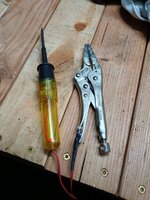
I have a couple basic ones, this one is my go to. Likely it has been in my tool box for over 20yrs.
Modified it with thicker, longer wire and as of recently using vice grips instead of alligator clip.

Eric O from South Main on YT uses automotive bulb in a connector to add a load to the circuit, need to make me one of those.


Attachments

  • IMG_20250110_005104727_HDR.jpg
    IMG_20250110_005104727_HDR.jpg
    960.5 KB · Views: 43
Last edited:

AEAdam

Well-known member
Joined
May 27, 2023
Messages
2,780
Location
SE PA
Great posts and insights from everyone, please keep them coming! I ordered the Lisle but I love reading everyone’s opinions.

If it would be helpful, here is the tool list:
IMG_1626.jpeg


Honestly, i got the idea from you. you’ve always posted about wanting to take some courses at your local school, so i looked into it and sure enough - plenty of interesting classes available for a few hundred bucks a pop. I’m kicking around the idea of a career change to diesel mechanic so some night classes seem like a great way to get my feet wet and see if its something i want to do.

It’s a tough schedule here, too - 6p-11p Mon-Thurs. At least the subject matter is interesting. Oh yeah, the student discount on Snapon and Matco doesnt hurt either LOL

I hope you get the chance to enroll sometime, maybe once you finish the house you’re building. Nothing better in life than learning something new.
You just made my day, Phil. This is the best thing I've read in a while here and my fantasy as you know.

These tools lists are super helpful and I hope everyone reads yours.

Interesting they are requesting inch sizes. The combo wrench set to 1" is particularly interesting. I don't think 1" is a std size. 15/16" is, but its a heavy hex series and probably rare on cars, but maybe heavy equipment.

I feel I have encountered actual inch sized flare nuts on metric cars.

Couple things missing from the list I suspect you will want to bring:
  • Brake specific tools - compressor, maybe drum brake tools, bleeder wrenches
  • Hose clamp pliers
  • A steel ruler is nice to have but cheap digital calipers are really better in my opinion
  • pick set
  • plastic pry bars - I can't do much without these. Use them on almost every job.
  • Razor blade/gasket scraper
  • Headlight
  • SHLF80, FHLF80 (or equiv)
  • dead blow hammer - I really like the slimline heads best. My current fav for carpentry is the Trusty Cook S3. It follows me around wherever I go. I'm always reaching for that.
Quick Anecdote I hope you will find helpful: One of my friends and heroes is an amazing aerospace engineer, with just an enormous depth of knowledge. He is the engineer all of you think an engineer should be. A few years ago, Ed decided to take the automotive course in our local CC. I think it took him 18 months.

He fell in love with automatic transmission repair. He just found transmissions fascinating and fun to work on. That portion of the program was held in a local transmission shop. If I recall correctly the shop owner pulled Ed aside and offered him a job. He had to refuse, but was flattered just the same. He's continued repairing transmissions for fun like a hobby.

Message: You never know what you may fall in love with in these sorts of classes. You'll get exposed to stuff maybe few of us do on a regular basis. Second, if you are interested in a career change, you might make some connections that help you do that!
 
To avoid these ads, REGISTER NOW!
Top Bottom