To avoid these ads, REGISTER NOW!

Testing a circuit breaker

bluedog225

Well-known member
Joined
Jan 31, 2012
Messages
3,260
Location
Texas
Holy smokes, I didn‘t think I could hate the interwebs more….😂

I’ve bounced around a half dozen sites telling me how to see if a circuit breaker has current passing through it.

Is there a safe way to test if it will trip when overloaded?

I picked up a seemingly new Siemens 100 amp breaker for my cabin at restore. I’m hesitant to throw it into service.

Thanks
 
To avoid these ads, REGISTER NOW!

rlitman

Well-known member
Joined
Oct 18, 2010
Messages
24,582
Location
Long Island
Does it appear physically damaged? Any signs of corrosion or overheated contacts? Can you switch it on and off, and does it click as expected. If that much checks out, I'd say you're good to go. There's not much that can go wrong in a sealed miniature circuit breaker. This is a QP type, right?
 
Last edited:

manwithtools

ALLIANCE MEMBER
Joined
Aug 24, 2015
Messages
13,695
Location
Lebanon, TN
Does it appear physically damaged? Any signs of corrosion? Can you switch it on and off, and does it click as expected. If that much checks out, I'd say you're good to go. There's not much that can go wrong in a sealed miniature circuit breaker. This is a QP type, right?
Agree with this. There's not too much to go wrong and if it's genuine Siemens and fairly clean I'd say it's likely fine.
 

LopezBart

Well-known member
Joined
Oct 13, 2023
Messages
2,525
Location
Lopez Island, WA
Holy smokes, I didn‘t think I could hate the interwebs more….😂

I’ve bounced around a half dozen sites telling me how to see if a circuit breaker has current passing through it.

Is there a safe way to test if it will trip when overloaded?

I picked up a seemingly new Siemens 100 amp breaker for my cabin at restore. I’m hesitant to throw it into service.

While I can certainly think of ways to do this, none of them are really safe since they end up using your cabin as a test bed.
Circuit breakers (esp. larger ones) are an important safety mechanism; for less than $100 new and without knowing that the used one was removed in good working order, I'd likely spring for a new one.
 

rlitman

Well-known member
Joined
Oct 18, 2010
Messages
24,582
Location
Long Island
We're not talking about Federal Pacific, so with a simple thermal-magnetic breaker that functions, they're pretty bullet proof. And they need to be when you expect them to have a 50+ year service life, installed in millions of locations.

To expound on what I posted above, being able to turn it off means the contacts aren't welded together and the spring is good, which means the breaker is able to open on it's own. The biggest concern I'd have is with the clips that hold onto the bus. Corrosion there can lead to a burnt bus bar.

Now if you have some electrical engineer friends over your shoulder to help, you CAN test the breaker safely. The "secret" is to test it at a very low voltage. Circuit breakers interrupt the circuit above a threshold current (which for an instantaneous break will be surprisingly high). But under a volt, the probably close to a thousand amps needed to trip that breaker magnetically (no, it won't simply trip as you pass 100A - breakers don't work that way) isn't nearly as dangerous as it would be at 240V. ;) But please don't take that as a recommendation from me to try something that silly.
 

micromind

Well-known member
Joined
Sep 24, 2023
Messages
3,019
Location
Fernley, Nevada, about 30 miles east of Reno.
To test a breaker that size, you'd need a breaker test set.

This is a device that can put hundreds of amps(the larger models can go several thousand amps) through a breaker at a low voltage, usually less than 5 volts.

Breakers trip on amps, voltage doesn't matter except low voltage doesn't stress the contacts anywhere near as much as operating voltage does.

For a small breaker like that, I'd give it good examination, especially smell the front end of it where it connects to the bus. If you smell anything that even remotely resembles burned plastic or an electrical arc, get rid of it.

Next I'd operate it a few times, uninstalled. Then with it closed (on), sort of slam it onto a table top, load end down. Not too hard of course but it should trip. If it doesn't, there's something wrong with the internal mechanism and it isn't safe to use.

If it does ok, I would have no problem installing it into a panel.
 
OP
B

bluedog225

Well-known member
Joined
Jan 31, 2012
Messages
3,260
Location
Texas
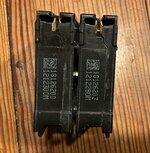
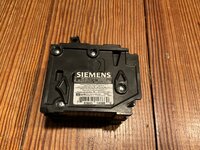
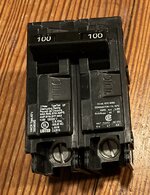
It looks new. Snaps well. No tool marks. No burned odor. No burned contacts.

Undisturbed “factory” grease in the fitting where it connects. Type QP.

Pics below.

One thing I’m not familiar with (probably because I haven’t looked), is the white material above the terminal screws in the photo. Is that kosher?

Thanks


IMG_0198.jpegIMG_0196.jpegIMG_0194.jpegIMG_0193.jpeg

IMG_0199.jpeg
 

sparky 1971

Well-known member
Joined
Oct 9, 2018
Messages
7,967
Location
Central Iowa
It looks new. Snaps well. No tool marks. No burned odor. No burned contacts.

Undisturbed “factory” grease in the fitting where it connects. Type QP.

Pics below.

One thing I’m not familiar with (probably because I haven’t looked), is the white material above the terminal screws in the photo. Is that kosher?

Thanks


IMG_0198.jpegIMG_0196.jpegIMG_0194.jpegIMG_0193.jpeg

IMG_0199.jpeg
Run it.
 

wyliesdiesels

Well-known member
Joined
Aug 14, 2012
Messages
19,994
Location
Modesto, CA
We're not talking about Federal Pacific, so with a simple thermal-magnetic breaker that functions, they're pretty bullet proof. And they need to be when you expect them to have a 50+ year service life, installed in millions of locations.

To expound on what I posted above, being able to turn it off means the contacts aren't welded together and the spring is good, which means the breaker is able to open on it's own. The biggest concern I'd have is with the clips that hold onto the bus. Corrosion there can lead to a burnt bus bar.

Now if you have some electrical engineer friends over your shoulder to help, you CAN test the breaker safely. The "secret" is to test it at a very low voltage. Circuit breakers interrupt the circuit above a threshold current (which for an instantaneous break will be surprisingly high). But under a volt, the probably close to a thousand amps needed to trip that breaker magnetically (no, it won't simply trip as you pass 100A - breakers don't work that way) isn't nearly as dangerous as it would be at 240V. ;) But please don't take that as a recommendation from me to try something that silly.
a breaker can open regardless of what the handle is doing.
 

wyliesdiesels

Well-known member
Joined
Aug 14, 2012
Messages
19,994
Location
Modesto, CA
It looks new. Snaps well. No tool marks. No burned odor. No burned contacts.

Undisturbed “factory” grease in the fitting where it connects. Type QP.

Pics below.

One thing I’m not familiar with (probably because I haven’t looked), is the white material above the terminal screws in the photo. Is that kosher?

Thanks
that is bakelite packing

is your breaker panel a siemens?
 
To avoid these ads, REGISTER NOW!

sparky 1971

Well-known member
Joined
Oct 9, 2018
Messages
7,967
Location
Central Iowa
I've got a pair of dykes that have tested at least three 20 amp circuit breakers in the last 40 years :)
I'm not going to suggest that method for a hundy though...
I do that to a newish pair of dykes at least twice a year. Sometimes more. I bet I've gone threw at least 20 pair. The last time it was the very first cut with a set I bought less than an hour before.
 

rlitman

Well-known member
Joined
Oct 18, 2010
Messages
24,582
Location
Long Island
It looks new. Snaps well. No tool marks. No burned odor. No burned contacts.

Undisturbed “factory” grease in the fitting where it connects. Type QP.

Pics below.

One thing I’m not familiar with (probably because I haven’t looked), is the white material above the terminal screws in the photo. Is that kosher?...
Circuit breakers are made from thermoset plastic (bakelite or something along those lines). It's a material that withstands high temperatures and does not melt. The packing could me more of the same, or possibly a type of fire-cement. With a small breaker like this, you want a good seal on the case so that any arcing that happens inside is safely contained within.

To me, the undisturbed factory grease is the most important part. Looks great to me.

a breaker can open regardless of what the handle is doing.
Yes, not disagreeing with you, but you mis-read me. My point about opening it via the handle was that this proves that it can open internally. Yes, it is possible for a breaker to open with the handle stuck in the closed position. The unorthodox thwap test above is an example of this. But there are situations where the breaker may be unable to open at all, and simply opening the handle eliminates those possibilities.
 

mm08822

Well-known member
Joined
Jan 13, 2012
Messages
5,872
Location
NJ
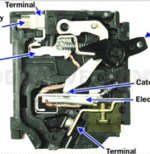
One thing I’m not familiar with (probably because I haven’t looked), is the white material above the terminal screws in the photo. Is that kosher?

IMG_0198.jpeg
The white fire-cement material is used to cover a factory adjustment screw (yellow highlight below). Nothing for the end-user to mess with.
1703356603737.png
 

toplessHO

Well-known member
Joined
Oct 20, 2014
Messages
14,011
Location
central florida
I do that to a newish pair of dykes at least twice a year. Sometimes more. I bet I've gone threw at least 20 pair. The last time it was the very first cut with a set I bought less than an hour before.
I tell the young pups
unless you can see that both ends arent connected to any power source,assume its "hot"
 

johnre

Well-known member
Joined
Dec 1, 2016
Messages
1,045
Location
Portland, OR
Products such as circuit breakers are over-engineered, tested when manufactured, and have a lot of QA steps and regulatory agency scrutiny applied when they are first designed.

They furthermore get regular feedback from the field while in use if there is any issue found - professionals such as insurance adjustors, fire investigators, etc. have avenues to make sure that their input is heard and gets a follow-up. How do you think Federal Pacific’s problems were found when you’re talking about parts-per-thousand?

There is no 100% assurance of anything. But some things you can trust better than others to just work.

I don’t haver to test the airbags on my vehicle, or the seat belt tensioning system. It’s just expected to work.
 
Last edited:

23ford

Well-known member
Joined
Jul 26, 2014
Messages
517
Location
Turley America
taught by old tim electrician to test a breaker by tuning it on outside the box take the breaker and strike on the other hand to see if it trips.........
 

foolishpride

Well-known member
Joined
Mar 21, 2009
Messages
343
Location
Southwestern Ohio
I have a primary injection tester capable of 5000a. It has never occured to me to test a breaker less than 400a.

Maybe I should flesh out our portfolio to residential breaker testing :unsure:
Why in the world would you have your own high current test set? I worked for a testing company for 31 years doing primary injection testing on low voltage circuit breakers up to 4000 amps. Hated doing those breaker jobs! Hard on your back!
 

ArcReactorKC

Well-known member
Joined
Jun 1, 2019
Messages
2,237
Location
Out in the county NE of KCMO
Why in the world would you have your own high current test set? I worked for a testing company for 31 years doing primary injection testing on low voltage circuit breakers up to 4000 amps. Hated doing those breaker jobs! Hard on your back!
I own a critical power company. We perform maintenance/upgrades/commissioning on automated switchgear, anything under 14.4kv (used to be 55kv but insurance...)
 
To avoid these ads, REGISTER NOW!
Top Bottom