To avoid these ads, REGISTER NOW!

Testing for ground faults

My Old Tools

Well-known member
Joined
Jun 4, 2014
Messages
5,450
Location
Hamrick Lake, TX
We are a small private lake community. Most of the homes are 25-50 years old or older. This area has never had codes or inspections. The lake is owned as common property and our association is liable. The docks are privately built and owned but are on association property. We want to start testing electric circuits that service docks. We know that most of the older docks are substandard. Is there a standard test for ground faults? Is there a way to tell if a circuit has ground fault protection when we may not have access to all panels? We will require GFCI on all docks after July 2024.

In my own case, I added a GFCI shore side to protect my boathouse. It immediately faulted. I ended up abandoning all of the existing wiring that was done with bare Romex and draped into the water under the boathouse. I rewired the whole thing high and dry.
 
To avoid these ads, REGISTER NOW!

mm08822

Well-known member
Joined
Jan 13, 2012
Messages
6,053
Location
NJ
For 15 and 20 Amp 120v circuits, a simple gfci recepectacle should indicate whether those recepts have functioning gfci (class A) protection. If it trips the gfci, then you could assume it has protection. Any further dead receptacles may or may not be protected by the tripped gfci device......breakers could be off, or maybe switched receptacles.

For other circuit amperages and voltages, it is a little more involved but can be done. Most likely these circuits are not protected.

From a liability perspective, you (the HOA) would be better of having each dock owner get their wiring inspected, functioning, upgraded by their own licensed electrical contractor and provide such documentation. Otherwise, if someone got injured due to shock or electrocution, your inspection was potentially inadequate and provided false information.
 

Chuckster in NJ

Well-known member
Joined
Jan 26, 2010
Messages
2,321
Location
Hunterdon County NJ
I would suggest calling a qualified electrician or electrical testing company to do the testing for faults and have them give you a certificate of approval "IF" it passes. Water and electric don’t mix.

Back to OP's question about how to do a "quick" test:
IMG_1333.jpeg
 

Norcal

Well-known member
Joined
Mar 16, 2008
Messages
13,770
There are testers that will trip a GFCI but a simple one is a Wiggy with one probe in the grounding slot, & the other in the hot slot, which is the shorter of the two if properly wired, it should trip immediately.

Edit: The suggestion in post #3 to have a testing company do testing is a good one and a very good CYA.
 

Gozo

Well-known member
Joined
Oct 10, 2013
Messages
255
Location
Central VA
Back to OP's question about how to do a "quick" test:
IMG_1333.jpeg
I thought a ground fault was detected by there being a mismatch between the current flow in the hot lead and the neutral, meaning some current was returning via the ground wire (which ideally shouldn’t carry load current). GFI usually trips around 3-5ma of ground current.
If there is a ground prong on a plug, it should be connected to the frame and show 0 ohms. The neutral prong shouldn’t be connected to the frame.
Maybe I’m reading your quick test description wrong or it got mixed up somewhere in translation.
 

mm08822

Well-known member
Joined
Jan 13, 2012
Messages
6,053
Location
NJ
This is the wrong procedure to check for ground faults:
IMG_1333.jpeg

You need to check that there is no continuity between ground and neutral after the source neutral is isolated from the main panel bond.
 
OP
M

My Old Tools

Well-known member
Joined
Jun 4, 2014
Messages
5,450
Location
Hamrick Lake, TX
Yes, with a GFCI I understand how to test. I wondering about testing those without GFCI protection, and how to detect the presence or absence of an upstream GFCI that isn't apparent. I assumed we would need to hire a licensed electrician to do the testing, I just wondered for myself how involved it may get. Thanks for the ideas provided.
 

dave*99

Well-known member
Joined
May 5, 2009
Messages
4,286
Location
Coastal NJ
I would suggest calling a qualified electrician or electrical testing company to do the testing for faults and have them give you a certificate of approval "IF" it passes. Water and electric don’t mix.

Back to OP's question about how to do a "quick" test:
IMG_1333.jpeg
I don't know what this test is for, but it's not for a ground fault.
The ground wire or plug prong SHOULD read very low resistance to the frame of the equipment.
 

wyliesdiesels

Well-known member
Joined
Aug 14, 2012
Messages
20,074
Location
Modesto, CA
I would suggest calling a qualified electrician or electrical testing company to do the testing for faults and have them give you a certificate of approval "IF" it passes. Water and electric don’t mix.

Back to OP's question about how to do a "quick" test:
IMG_1333.jpeg
This quick test is totally wrong.

The equipment’s metal frame and the EGC/ground wire SHOULD be connected…
 

dave*99

Well-known member
Joined
May 5, 2009
Messages
4,286
Location
Coastal NJ
In my own case, I added a GFCI shore side to protect my boathouse. It immediately faulted. I ended up abandoning all of the existing wiring that was done with bare Romex and draped into the water under the boathouse. I rewired the whole thing high and dry.

ESD is a serious and all too common problem. It has occurred very close to where I live.

There may be some useful info under the resources tab on this site.


The coast guard has some literature on the topic on the web.

This device is sometimes used to test the water in pools and marinas


Innovate1

Well-known member
Joined
Jul 28, 2014
Messages
4,299
Location
Illinois near St. Louis, Missouri
There are testers that will trip a GFCI but a simple one is a Wiggy with one probe in the grounding slot, & the other in the hot slot, which is the shorter of the two if properly wired, it should trip immediately.

Edit: The suggestion in post #3 to have a testing company do testing is a good one and a very good CYA.
The test in #3 is a terrible and inadequate way to test for ground faults. For one thing it checks ground continuity only and has pass/fail backwards. If the meter is used between the hot leads and ground it will find hard shorts but won't find high leakage or where conductors are barely separated because it uses only a few volts from the meter battery. Use a plug in GFCI tester or something like a megger that uses high voltage. I think the suggestion to use a qualified company to do the inspections is a good idea from a legal perspective. The HOA can pay or they can require each homeowner to pay. Should be a lot cheaper to do them all at once. If any fail it would be on the individual owners to correct their docks.
 
Last edited:

PCustoms

Well-known member
Joined
Jul 23, 2011
Messages
23,516
Location
VT
The test in #3 is a terrible and inadequate way to test for ground faults.

Others have already said it, but the test in post #3 is absolutely incorrect. It's totally backwards, following this test every single piece of equipment in my home or shop that has a 3 prong plug has "ground fault".

@Chuckster in NJ The post should be edited or deleted to remove misleading information.
 
Last edited:

RegeSullivan

Well-known member
Joined
Mar 30, 2014
Messages
695
Location
Canonsburg Pennsylvania (South of Pittsburgh)
Are you testing to fing existing ground faults? Or, are you testing for gfci protection? If the later a simple gfci tester should answer the question. If the former it would be a little more complicated and only tell the condition at the time of the test which is useless from a safety perspective.

I am very much in agreement with the folks here suggesting using a qualified electrician from both a safety and liability perspective.
 
To avoid these ads, REGISTER NOW!

Innovate1

Well-known member
Joined
Jul 28, 2014
Messages
4,299
Location
Illinois near St. Louis, Missouri
To be complete the test should include both ground continuity and GFCI. Ground continuity typically, at least in our tests for UL, uses 25A source and measures voltage drop and then resistance can be calculated. Equipment designed for this test is available but we typically use a DC power supply and multimeter with a 4 terminal connection to get accurate voltage measurement. This is for equipment not wiring so other methods may be common for wiring.
 

mm08822

Well-known member
Joined
Jan 13, 2012
Messages
6,053
Location
NJ
Are you testing to fing existing ground faults? Or, are you testing for gfci protection? If the later a simple gfci tester should answer the question. If the former it would be a little more complicated and only tell the condition at the time of the test which is useless from a safety perspective.

I am very much in agreement with the folks here suggesting using a qualified electrician from both a safety and liability perspective.
The state of the wiring and equipment is a moving target. At any given day, damage can occur or someone modifies the wiring - be it on the dock or boat. A one time inspection is only that - confirming the state of the system on that day, nothing about future state.

An inspection today and corrections made to existing inadequate wiring could eliminate some of the future injuries. Maybe the HOA needs to require re-certification at some frequency.
 

RPH

Well-known member
Joined
Dec 17, 2006
Messages
4,190
Location
Michigan Thumb
Hi pot test will test the integrity of the system. Having access to certified equipment and operator is the issue. Operator not much of a problem if they understand the process. Equipment another story.
Hi pot test will find weakness in the system.
 

mm08822

Well-known member
Joined
Jan 13, 2012
Messages
6,053
Location
NJ
Hi pot test will test the integrity of the system. Having access to certified equipment and operator is the issue. Operator not much of a problem if they understand the process. Equipment another story.
Hi pot test will find weakness in the system.
A hipot test will require gfci recepts and gfci cb's to be isolated. Also opening the supply nuetral so it doesnt ring through the bonding jumper in main panel. For old crusty equipment, this may become a black hole trying to disassemble hardware that has corroded together for the last umpteen years and then not being able to re-assemble.

Moisture present in the conductor insultation may create some interesting readings.
 

rancherbill

Well-known member
Joined
Oct 18, 2007
Messages
5,336
Location
Foothills County, Alberta, Canada
I would get a qualified electrician to READ THE CURRENT CODE BOOK relating to dock and associated equipment. Check and inspect everything. Replace anything that is not to the current code. Just because it was once OK doesn't mean it's OK today.

I was surprised when you said it had not been inspected. I know "Good Enough Electricians" around here have lots of problems on their installations. Did they work on yours?

The current code book has been revised, updated one death or fire at a time.
 
Last edited:

Fav Onefour

Well-known member
Joined
Jul 14, 2022
Messages
724
Location
MN cold and hot
For 15 and 20 Amp 120v circuits, a simple gfci recepectacle should indicate whether those recepts have functioning gfci (class A) protection. If it trips the gfci, then you could assume it has protection. Any further dead receptacles may or may not be protected by the tripped gfci device......breakers could be off, or maybe switched receptacles.

For other circuit amperages and voltages, it is a little more involved but can be done. Most likely these circuits are not protected.

From a liability perspective, you (the HOA) would be better of having each dock owner get their wiring inspected, functioning, upgraded by their own licensed electrical contractor and provide such documentation. Otherwise, if someone got injured due to shock or electrocution, your inspection was potentially inadequate and provided false information.
Aside from the process of actually testing wiring, the last paragraph is a big deal.
It's not real clear who truly owns the liability. I'd kinda assume the HOA will own the problem if something really happens.
It's time to get the process clarified. Something simple like a dock feed that is code. If the private docks are wonky, the feed shuts down. Simple terms, but you get the idea.
It's easier to manage responsibility with a clear line drawn in the sand. I'd hate to see the HOA on the hook for upgrading all the docks. It also means managing the liability of each dock. The process and associated rules could get messy and overbearing.
 

RPH

Well-known member
Joined
Dec 17, 2006
Messages
4,190
Location
Michigan Thumb
A hipot test will require gfci recepts and gfci cb's to be isolated. Also opening the supply nuetral so it doesnt ring through the bonding jumper in main panel. For old crusty equipment, this may become a black hole trying to disassemble hardware that has corroded together for the last umpteen years and then not being able to re-assemble.

Moisture present in the conductor insultation may create some interesting readings.
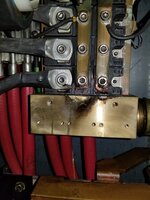
Moisture in the wiring will fault with voltage applied. True isolation is required but it is effective at finding faults. Sometimes the maximum smoke test is required. 480 vac bridge rectifier that outputs about 675 vdc. Condensation collected from too cold of cooling water. It goes with a large bang and immediate shut down.

Rectifier module.jpeg
 
OP
M

My Old Tools

Well-known member
Joined
Jun 4, 2014
Messages
5,450
Location
Hamrick Lake, TX
We actually had a dock burn to the water this summer due to old corroded wiring and a new underwater light added to a dock.

My goal is to eliminate electric shock drowning primarily, both from a liability stand point, but mostly to prevent a tragedy. Many of our places have been in families for generations. We now have grandkids swimming and playing. When many of these places were built, people couldn't spell GFCI. Most have a single 115/120v Romex running a lift, a light, and a battery charger. Those are generally not using wire for wet environments (common ROMEX) and touching water.

I know enough to do proper common electrical work, from panels/subpanels to 3 phase generation and distribution in my shop, but this type of testing is beyond my capabilities and certainly not certified.
 

PCustoms

Well-known member
Joined
Jul 23, 2011
Messages
23,516
Location
VT
Seems like your first step should be requiring all NM or NM-B ("Romex") outdoor insulations to be removed and replaced by a qualified electrician.

Next/concurrent step should be to implement GFCI circuit protection to all feeds

But, how does the HOA have the ability to mandate and enforce?
 

dave*99

Well-known member
Joined
May 5, 2009
Messages
4,286
Location
Coastal NJ
Sometimes a HOA will have some work done to a common area in the community and pass the cost to the members as an assessment. Things like fixing the community swimming pool etc. Perhaps that mechanism is available.

There have been proposals the the NEC code making panel to require isolation transformers at boat docks. I don't think it was ever accepted.

Georgia Institute of Technology
NEETRAC
National Electric Energy Testing, Research & Applications Center - College of Engineering
Is an engineering lab that has studied this problem extensively. I saw a presentation from Frank Lambert and he was recommending an isolation transformer be installed at docks.

 
Last edited:

RPH

Well-known member
Joined
Dec 17, 2006
Messages
4,190
Location
Michigan Thumb
Sometimes a HOA will have some work done to a common area in the community and pass the cost to the members as an assessment. Thinks like fixing the community swimming pool etc. Perhaps that mechanism is available.

There have been proposals the the NEC code making panel to require isolation transformers at boat docks. I don't think it was ever accepted.

Georgia Institute of Technology
NEETRAC
National Electric Energy Testing, Research & Applications Center - College of Engineering
Is an engineering lab that has studied this problem extensively. I saw a presentation from Frank Lambert and he was recommending an isolation transformer be installed at docks.

Interestingly, they suggest an isolated system like used in the hospital surgical units. Good paper though. I suggest people with this situation read it.
 
To avoid these ads, REGISTER NOW!
Top Bottom