To avoid these ads, REGISTER NOW!

% THD and Sine Wave WGEN12000DF

Rick Quebec

Member
Joined
Mar 2, 2023
Messages
12
Hi everyone! :)!
I would like to know if anyone has done any testing on the % of THD and the Sine Wave test on that Westinghouse WGEN12000DF Generator? I would really like to confirm that this generator produces exactly what it claims. Westinghouse does not want to provide me with the Benchmark documents or other testing.
Please give me your feedback.
 
To avoid these ads, REGISTER NOW!

Jack Ryan

Well-known member
Joined
Jun 2, 2022
Messages
339
Location
Adelaide, South Australia
Of course, the THD and "sine wave test" were done under test conditions. With a constant load, probably the rated load, with a specified and constant power factor, the THD is claimed to be less that, or equal to 5%.

Now connect some real loads - non-linear and intermittent - and you probably have ten times the distortion.

To a large extent, the THD specification is just a box to be ticked. There are many other factors to be taken into account.

Recommendations from people using the generator in a similar application might be the best you can do. Or from a trusted supplier who is aware of your application.

Jack
 
OP
R

Rick Quebec

Member
Joined
Mar 2, 2023
Messages
12
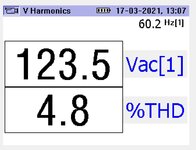
Hi Thanks for your answer. It's all a bit complex for me, plus I'm not an electronics engineer, and especially not an electrician. I would have liked to have results like this photos taken when someone was testing their own generator. (photos for information purposes only)

Some people say that they have already measured a WGEN11500 and WGEN12000 like mine above 7% THD. I'm not equipped with a Fluke which has the capacity to measure the level of THD and oscilloscope. (To much expensive)... That why I asked for an answers to the community hoping to find some surveys. I have my WGEN12000DF generator for almost 3 years and it works like a charm. I have nothing to say about this 12000w beast but I would have liked to have some proof to support it. Electronics these days are very expensive and a household appliance, TV heat pump, computers are very expensive and we especially do not want to damage them.
Thank you.
 

Attachments

  • 61r9KcfUtmL._SL1600_.jpg
    61r9KcfUtmL._SL1600_.jpg
    65.1 KB · Views: 5
  • Generac GP15000E No Load Hz.jpg
    Generac GP15000E No Load Hz.jpg
    82.6 KB · Views: 5

rlitman

Well-known member
Joined
Oct 18, 2010
Messages
24,613
Location
Long Island
There are multimeters that claim they measure THD.

On non-inverter generators, THD changes with load.
THD changes with load on all generators. Inverters are inherently "active" THD filters, but they have their limitations. Ideally you want to eliminate harmonic loads, because the no-load THD of a generator may be what the manufacturer states, but isn't helpful to the OP (even if that's the question posed).

At work, I chase harmonic issues with a clamp multimeter that can tell me THD (and harmonics) in both voltage (THDV) and current (THDI) forms. Knowing the THDV tells you what "noise" can be heard anywhere in the local electrical system. But knowing the THDI tells you what branch circuit is the source of the noise. Not a cheap tool though. I use an Amprobe ACDC-52NAV. I think Amprobe makes a few slightly cheaper THD reading clamp meters, but I also use mine for DC current measurements.
 

dave*99

Well-known member
Joined
May 5, 2009
Messages
4,268
Location
Coastal NJ
THD changes with load on all generators. Inverters are inherently "active" THD filters, but they have their limitations. Ideally you want to eliminate harmonic loads, because the no-load THD of a generator may be what the manufacturer states, but isn't helpful to the OP (even if that's the question posed).

At work, I chase harmonic issues with a clamp multimeter that can tell me THD (and harmonics) in both voltage (THDV) and current (THDI) forms. Knowing the THDV tells you what "noise" can be heard anywhere in the local electrical system. But knowing the THDI tells you what branch circuit is the source of the noise. Not a cheap tool though. I use an Amprobe ACDC-52NAV. I think Amprobe makes a few slightly cheaper THD reading clamp meters, but I also use mine for DC current measurements.
Have you tried measuring THDV on AC voltages less than 5V? I use the Fluke 345 and often need to measure THD on low voltages. I tried a few other meters but they do not give a THD reading with low voltage applied.

The Fluke 345 is discontinued. The Fluke 123B scope meter will do what I need, but it's heavier, bulkier etc.
 

rlitman

Well-known member
Joined
Oct 18, 2010
Messages
24,613
Location
Long Island
Have you tried measuring THDV on AC voltages less than 5V? I use the Fluke 345 and often need to measure THD on low voltages. I tried a few other meters but they do not give a THD reading with low voltage applied.

The Fluke 345 is discontinued. The Fluke 123B scope meter will do what I need, but it's heavier, bulkier etc.
I have not tried, and don't even deal with AC voltages that low (24VAC is the lowest I regularly work with, and 12VAC is the lowest I might encounter), but in thinking more about it I have something I can give it a try with. I have a 24VAC transformer feeding a variac that supplies my hot wire cutter, and I can easily turn that down and clip on components in parallel with the resistive wire to see what it does against an oscilloscope. I've got a few crazy days lined up, but if I remember to bring my clamp home from work next week, and maybe some large capacitors...

The Fluke 345 is an amazing tool, and my Amprobe isn't in it's class. But I'm using it to chase THDI, and it does that well, since large harmonics also require large currents. I have low expectations of good readings on single digit amps with a 600A clamp, but on the probes, I don't understand why it wouldn't work well.
 

dave*99

Well-known member
Joined
May 5, 2009
Messages
4,268
Location
Coastal NJ
We tested the Amprobe ACD-41PQ. Readings were all over the place compared to the Fluke 345.
We also tested the Amprobe ACD-50NAV. It did not provide THD readings below 10VAC.
I noticed you have the 52 so that's why I asked.
 

rlitman

Well-known member
Joined
Oct 18, 2010
Messages
24,613
Location
Long Island
Have you tried measuring THDV on AC voltages less than 5V?
Just did. Using the variac, I was able to try a range from 3.5VAC up to about 10VAC (beyond that and I was risking burning up the hot-wire), and while I had no trouble measuring the AC voltage, the THD mode only gave me "rdy", which means it wasn't reading it. Sorry, but at least now you know.
 

dave*99

Well-known member
Joined
May 5, 2009
Messages
4,268
Location
Coastal NJ
Just did. Using the variac, I was able to try a range from 3.5VAC up to about 10VAC (beyond that and I was risking burning up the hot-wire), and while I had no trouble measuring the AC voltage, the THD mode only gave me "rdy", which means it wasn't reading it. Sorry, but at least now you know.
Thank you I appreciate your help.
Dave
 

walta

Well-known member
Joined
Jan 13, 2017
Messages
2,311
Location
Dutzow Missouri
Does it make any difference in 2025? If you look inside any “sensitive” electronics almost the first thing that happens, is it hits a rectifier circuit that could not care less about distortion. The other loads are mostly motors anything that mostly goes positive and negative far enough at about 60 Hz is good enough so long as it does not dip on startup.

Before 1980 we really had some sensitive electronics that sometimes did count on the sinewave from the AC cord to work.

Walta
 
To avoid these ads, REGISTER NOW!

Jack Ryan

Well-known member
Joined
Jun 2, 2022
Messages
339
Location
Adelaide, South Australia
Does it make any difference in 2025? If you look inside any “sensitive” electronics almost the first thing that happens, is it hits a rectifier circuit that could not care less about distortion. The other loads are mostly motors anything that mostly goes positive and negative far enough at about 60 Hz is good enough so long as it does not dip on startup.

Before 1980 we really had some sensitive electronics that sometimes did count on the sinewave from the AC cord to work.

Walta
It depends.

Increasingly, it does not matter greatly but there remain sensitive loads.

Electric motors don't like unstable frequency or harmonics.
Certain types of lighting changes colour with an unstable supply and that upsets film makers and photographers.

No AVR, a mechanical AVR and even some electronic AVRs do not handle large changes of load well resulting in large voltage and frequency changes. Creating an arc with a heavy inverter welder can result in a significant drop in generator voltage. To maintain the arc, the supply current increases significantly causing the inverter switching components to overheat. Breaking the arc causes a large peak in voltage which can overload the rectifier filter capacitors.

Improvements are being made all the time but portable conventional generators are probably not going to get much better.

There is one thing though that can strain any household. The clock on many domestic stoves and microwaves relies on mains frequency for timing. A few glitches can put you into tomorrow!

Jack
 

rlitman

Well-known member
Joined
Oct 18, 2010
Messages
24,613
Location
Long Island
Does it make any difference in 2025? If you look inside any “sensitive” electronics almost the first thing that happens, is it hits a rectifier circuit that could not care less about distortion. The other loads are mostly motors anything that mostly goes positive and negative far enough at about 60 Hz is good enough so long as it does not dip on startup.

Before 1980 we really had some sensitive electronics that sometimes did count on the sinewave from the AC cord to work.

Walta
That depends on how intelligently the rectifier is designed. Rectifiers and DC don't solve the issue of harmonics by themselves. They do flip up the negative half of the wave, but that's not going to result in a waveform you can pretend to clean up with a capacitor and a choke and then feed straight into an integrated circuit. And unfortunately, that's what a lot of boiler controls do (many totally modern condensing boilers have circuit designs that feel like they're from the 80's), which is why so many of them have difficulties with generator power.

On the other end of the spectrum would be something like a dimmable LED that's designed to accept the total mess a thyristor feeds it, so not everything solid state cares about power quality.

It's been less than a decade since NTC thermistors regulating inrush on switching power supplies on things like televisions have become the norm, and the newest advances step past the passive control of full wave bridge rectifiers by active MOSFET control to gain back the diode power losses (that extra 1% could be what it takes to get an Energy Star rating).
 

Dagny

Well-known member
Joined
Jul 25, 2014
Messages
3,000
Location
Northern Wi.
I have a variable voltage transformer mounted in a 10 inch j box that I use for testing motors. Years ago a local clinic was having trouble with a centrifuge for spinning test tubes. Burned out every 4 to six weeks. I hooked it to my vvt set the voltage at about 90% and no more burn outs . I ordered them a smaller version that would do the same thing and had no more problems. I don't know if they were getting spikes or harmonics but the transformer seemed to smooth them out. there were not a lot of non linear loads then.
 

American Locomotive

Well-known member
Joined
Jan 8, 2017
Messages
10,966
Location
Rhode Island
Does it make any difference in 2025? If you look inside any “sensitive” electronics almost the first thing that happens, is it hits a rectifier circuit that could not care less about distortion. The other loads are mostly motors anything that mostly goes positive and negative far enough at about 60 Hz is good enough so long as it does not dip on startup.

Before 1980 we really had some sensitive electronics that sometimes did count on the sinewave from the AC cord to work.

Walta
Anything with "sophisticated" electronics does not care about dirty power. Almost anything complicated has a switch-mode power supply that rectifies the incoming AC into DC, chops it up into super noisy high frequency AC, and then rectifies and filters it back to DC. Those power supplies really won't care what the incoming power looks like.

Ironically, the things that seem to struggle with dirty power today are the "simpler" devices with electronics. Mainly because their manufacturers insist on putting the worst, most garbage power supplies in them. A lot of furnaces and low-end appliances for example have electronic controls with a power supply that's little more than a couple of zener diodes and some resistors. As a result, any noise and disturbances on the incoming mains get passed right into electronics.

As my own example: I have a digital clock that really dislikes old noisy generators - it gets its time reference from AC mains. Running on my old generator, I watched it count minutes almost like seconds. It was pretty comical.
 

PCustoms

Well-known member
Joined
Jul 23, 2011
Messages
23,005
Location
VT
As my own example: I have a digital clock that really dislikes old noisy generators - it gets its time reference from AC mains. Running on my old generator, I watched it count minutes almost like seconds. It was pretty comical.

Wow, what frequency was your generator running?
 

Jack Ryan

Well-known member
Joined
Jun 2, 2022
Messages
339
Location
Adelaide, South Australia
Anything with "sophisticated" electronics does not care about dirty power. Almost anything complicated has a switch-mode power supply that rectifies the incoming AC into DC, chops it up into super noisy high frequency AC, and then rectifies and filters it back to DC. Those power supplies really won't care what the incoming power looks like.
Often, that is the case, but not always.

The example of the inverter welder I gave earlier is one example where power quality matters. 5% and greater THD with a static load is rarely (if ever) going to be a problem. It is the response to step changes in load, running out of fuel and the combination of non-linear loads connected to the generator that cause problems.

Jack
 

Jack Ryan

Well-known member
Joined
Jun 2, 2022
Messages
339
Location
Adelaide, South Australia
Wow, what frequency was your generator running?
To be fair, much of the noise that causes this is not created by the generator but is the result of the non-linear loads connected to it. Portable generators have neither the angular momentum nor the supply headroom to compensate for it - unlike a typical mains connection.

Jack
 
To avoid these ads, REGISTER NOW!
Top Bottom