To avoid these ads, REGISTER NOW!

Between 265 & 485 SQ/FT The 12-Gauge Garage

Workspaces sized between 265 and 485 squarefeet.

Crown

Well-known member
Joined
Jan 21, 2014
Messages
238
Location
FLat land
You'd have an extra safety device if you're going to install a switch/button on your steeringwheel that needs to be pushed constantly to activate the low-drag position. Let go of the button and the wing goes back up into downforce-mode.

I think we (as much as you) can't wait to see it in action on the track.
 
To avoid these ads, REGISTER NOW!

Nolift911

Well-known member
Joined
May 16, 2011
Messages
1,009
Location
Lansdowne, VA
Maybe a dumb question (or I missed it somewhere else) but with the calculated down force, will those motors be strong enough at speed to work?
 
OP
J

Jack Olsen

Super Moderator
Staff member
Joined
Mar 22, 2009
Messages
6,678
Location
Los Angeles
It's not a dumb question. I discovered just how difficult that was with the first iteration of this project, where I thought it would be possible to push the front of the wing up while it pivoted on the rear mount. This was a good idea from a safety POV (the force of the oncoming air would work to push it back down if something broke), but what I didn't know was where the force was centered -- which is closer to the front of the wing than the back. Look at the blue area in these pictures:

McBeath1153805636.jpg


With the old set-up, moving the wing was easy when the wing was standing still, but just about impossible even at 50 mph. (And the downforce at 130 mph would have been several times as much, since lift increases exponentially with speed.)

So now I've got a pivot point right in the center of that area. So most of the force will go to that pivot. My motors will work on the rear of the wing, which will require a lot less effort. Will it still overwhelm these little Miata motors? Since I don't have any specs on them, the only way I'll find out is with some testing -- both off and on the track. Based on other uses of these motors and some advice I've gotten here, I am pretty sure this is going to work.

But we'll see.
 

Nolift911

Well-known member
Joined
May 16, 2011
Messages
1,009
Location
Lansdowne, VA
Pretty interesting, that is mondo force at speed. Are those electric motors working little hydraulic pumps or just gears?

I know Porsche has been doing this for years on the 964/993 Boxster and Turbos. I am sure they tested high speeds but the surface area for their spoilers vs. your 747 surface area is much different. I think they went to hydraulics at some point, not sure when?

This is very cool - once you get the rear wing figured out, refined and tuned it should be onto the front for some active aero there as well. :thumbup:

I see lap records being shattered in your near future.
 
OP
J

Jack Olsen

Super Moderator
Staff member
Joined
Mar 22, 2009
Messages
6,678
Location
Los Angeles
A quick question. I posted it in the fabrication forum, but I'll put it here too in case someone knows of a good way to do this.

I've got a 48" length of 1/2" diameter aluminum tubing (with 1/16" wall) that I would like to find a way to cut a lengthwise seam in. The goal is to open it up slightly at the seam and then re-compress it into a teardrop-like profile -- an aerodynamic shape.

I've been trying to think about the best way to make a straight cut through the stuff. I will need two 18" lengths, in the end. So if cutting it to size first would help, that's on the table too.

Here's what I'm talking about.

46a3b8.jpg
 
OP
J

Jack Olsen

Super Moderator
Staff member
Joined
Mar 22, 2009
Messages
6,678
Location
Los Angeles
Because: budget.

That would be 10X the cost. (Although it's actually a lot less than I thought it would be.)
 

Outlawmws

Well-known member
Joined
Aug 9, 2011
Messages
39,195
Location
The Badlands
:+1: on the table saw.

Carbide blade, set the fence, make a wood pusher that will help hold it in place, and a second one for holding into the fence/table blade.
 
OP
J

Jack Olsen

Super Moderator
Staff member
Joined
Mar 22, 2009
Messages
6,678
Location
Los Angeles
Got it. I used wood screws to compress it between two lengths of 2x4.

Thanks!

c30639.jpg


Now to see if I can shape it...
 
OP
J

Jack Olsen

Super Moderator
Staff member
Joined
Mar 22, 2009
Messages
6,678
Location
Los Angeles
Here's the basic shape. After this, I used the sander to bring the trailing end to more of a point:

bd468a.jpg


Installed:

9fbe46.jpg


And the weight of the pair of struts:

ccd9a4.jpg
 

lisiecki1

Well-known member
Joined
Feb 6, 2013
Messages
742
Location
SE Texas
Jack, you make me wish I lived in LA so I could hang out with you and work on your projects. Really awesome home engineering going on over there.
 

aggierailroad

Well-known member
Joined
Jan 8, 2012
Messages
581
Location
Houston, TX
It's my understanding that drag is proportional to the square of speed, meaning; it increases with speed, but not exponentially.

I, however, am not a physicist.

Awesome link: http://physics.info/drag/

It is an exponentially increasing force [the square term].

Here's a quick run I made for a 1994 Porsche Speedster running at Willow Spring's track conditions at the first of this month... [bored at work here...] Sorry, Jack, a '94 is all the quick info I could find.

Drag_zps402c3d11.jpg


That upward sweep is defined by the exponential term in the drag force equation. Even though it's a measly "squared" number, it has a powerful impact. Lucky for us it's not cubed!

Drag force = 1/2 x Drag Coefficient x Projected Area x Fluid Density (air) x Velocity squared
 
Last edited:

lisiecki1

Well-known member
Joined
Feb 6, 2013
Messages
742
Location
SE Texas
It is an exponentially increasing force [the square term].

Here's a quick run I made for a 1994 Porsche Speedster running at Willow Spring's track conditions at the first of this month... [bored at work here...] Sorry, Jack, a '94 is all the quick info I could find.

Drag_zps402c3d11.jpg


That upward sweep is defined by the exponential term in the drag force equation. Even though it's a measly "squared" number, it has a powerful impact. Lucky for us it's not cubed!

Drag force = 1/2 x Drag Coefficient x Projected Area x Fluid Density (air) x Velocity squared


It may be a lack of knowledge on my part. I've always understood "exponential" to mean (in this case) the faster you go, the larger the exponent (2x2=4, 4x4=16, 16x16, etc.). I was understanding drag to be more linear, as the equation remains constant at the power of 2; no matter how fast you travel.
 
Joined
Jun 24, 2014
Messages
4
Location
Ontario
It may be a lack of knowledge on my part. I've always understood "exponential" to mean (in this case) the faster you go, the larger the exponent (2x2=4, 4x4=16, 16x16, etc.). I was understanding drag to be more linear, as the equation remains constant at the power of 2; no matter how fast you travel.

Just an FYI, 2x2 = 4, 4x4=16, 16x16=256, these are all to the power of 2. Anything to the power of () is considered exponential. In x^2, just replace x with the numbers in your example and you'll see what I mean. Drag is not linear.

Anyway, this is fantastic. The remarkable attention to detail in this thread is awe inspiring. I love it! Can't wait for the next update here.
 

aggierailroad

Well-known member
Joined
Jan 8, 2012
Messages
581
Location
Houston, TX
It may be a lack of knowledge on my part. I've always understood "exponential" to mean (in this case) the faster you go, the larger the exponent (2x2=4, 4x4=16, 16x16, etc.). I was understanding drag to be more linear, as the equation remains constant at the power of 2; no matter how fast you travel.

You are thinking correctly, just don't "see it yet"

4x4=16 or 4 squared = 16

8x8=64 or 8 squared = 64

The power in reference is 2.

Hope that helps?
 

lisiecki1

Well-known member
Joined
Feb 6, 2013
Messages
742
Location
SE Texas
You are thinking correctly, just don't "see it yet"

4x4=16 or 4 squared = 16

8x8=64 or 8 squared = 64

The power in reference is 2.

I wasn't using those numbers in reference to velocity, I was using them to show an increase in exponent. Bad example on my part.

At any rate, Jack has his wing figured out and I'm going to stop hijacking his thread before I confuse him as much as I am.
 
OP
J

Jack Olsen

Super Moderator
Staff member
Joined
Mar 22, 2009
Messages
6,678
Location
Los Angeles
At any rate, Jack has his wing figured out...

Ha! I'm not even close. I'm out of the house today, but I'm trying to work out how I install a button into the hole in one of my steering wheel spokes. One problem? I remove the steering wheel in order to get into and out of the car. I'm thinking I might be able to wire it through the contacts for the horn, and work out a switch for horn or wing -- since I won't need the wing in street driving and you don't use a horn on the track.

Dish1392309631.jpg


BrighterWheel1386307935.jpg


Then the next trick is going to rig the switch with a SPDT relay I've got on hand. I might be 'pretty bright, for a screenwriter' when it comes to some stuff, but I'm dumb as a box of rocks when it comes to anything electrical. The motors have a 12V constant line in and a ground. Then they also have a 'trigger down' line that moves the wing down when it gets 12V, and a 'trigger up' that sends it back up when it gets 12V. The pop-up headlights the motors are designed for use a relay to send the up signal when the headlights go on, and the down signal when the headlights are switched off. I want to have the momentary-on button work like the headlight switch, so that the wing goes down when I press the button, and then the other circuit is triggered when I release it.

I know that's simple as can be for a lot of you reading this. But for me -- just a dim haze and a lot of echo sounds and confusion... :)

5b18d8.jpg


Anyone want to walk me through which wire goes where? Or whether this relay will work?

My first guess:

86 - Keyed 12V power
85 - Ground
30 - Button-switched 12V
87A - Wing Up to motor
87 - Wing Down to motor


But I might have 86 confused with 30 and vice versa.
 
To avoid these ads, REGISTER NOW!

lisiecki1

Well-known member
Joined
Feb 6, 2013
Messages
742
Location
SE Texas
Ah, this I do know.

85 and 86 are the coil power and ground, respectively. The power feed to 85 is the line your push-button would go on to activate the relay on/off (unless you prefer to switch the ground, in which case your button would go on 86). 85 and 86 should be interchangeable for power/ground.

30 is the main power feed for whatever you are going to switch.

87a is default on, switched off

87 is default off, switched on

The attachment is similar, but appears to have the 87 and 87a the opposite of the diagram on your relay.
 

Attachments

  • th.jpg
    th.jpg
    11.1 KB · Views: 103
Last edited:
OP
J

Jack Olsen

Super Moderator
Staff member
Joined
Mar 22, 2009
Messages
6,678
Location
Los Angeles
See? Easy when you know this stuff.

So:

86 - Button-switched 12V power
85 - Ground
30 - keyed 12V power for motors
87A - Wing Up to motor
87 - Wing Down to motor
 

lisiecki1

Well-known member
Joined
Feb 6, 2013
Messages
742
Location
SE Texas
See? Easy when you know this stuff.

So:

86 - Button-switched 12V power
85 - Ground
30 - keyed 12V power for motors
87A - Wing Up to motor
87 - Wing Down to motor


Correct, and if it operates the reverse of what you want after it's hooked up then all you'll have to do is swap 87 and 87a.
 

chris.817

Member
Joined
Aug 1, 2008
Messages
5
Jack,

85 and 86 are the trigger for the relay, so 86 gets 12v and 85 goes to ground via your switch.

30, 87 and 87a are the "business end" of the relay. 30 is the input to the "switch" which is 12v to feed the motor. 87a is the default output therefore Up. 87 is the momentary output caused by the trigger and therefore Down. So...

30, 86 - 12V
85 - Activation switch to ground. That is, ground to switch, switch to pin 30.
87a - Up
87 - Down
 
Last edited:

APEowner

Well-known member
Joined
Oct 2, 2009
Messages
4,164
Location
Sunny, New Mexico
In my Camaro I have a button on the wheel with a coiled cord that has a 1/4" plug on the end. On the dash there are three jacks. One is for the horn, one is for the line lock and one is for the 2way radio. I stick the plug into the appropriate one for street, drag strip or road course with spotter.
 

Alexbn921

Well-known member
Joined
Aug 22, 2013
Messages
579
Location
East Bay Nor Cal
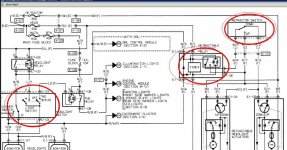
What happens if the head light motors don't cycle all the way to open, will they close? I don't know if these need a full cycle to flip a current reversing switch. There is a timer in the stock wiring to prevent that from happening and it would **** to get the wing stuck in a middle position. You would have to go full low drag to get it back to high down force.
 

Attachments

  • 2012-10-15_000040_hdlp.jpg
    2012-10-15_000040_hdlp.jpg
    147.7 KB · Views: 67
OP
J

Jack Olsen

Super Moderator
Staff member
Joined
Mar 22, 2009
Messages
6,678
Location
Los Angeles
Thanks! Running switched ground to 85 makes this even easier, since that what the horn circuit is already set up for. I can patch this into the horn wiring at the horn relay, and easily go from horn to wing (or both).

Alexbn921 is that the Miata's diagram? Does it runs a timer in the circuit? Is there a simple way to add that, or is it integrated into the Miata's headlamp relay? It doesn't seem like this will be a problem, but I'd rather learn too much now than go into a corner with a potential Achilles' heel.
 

Squankum

Well-known member
Joined
Mar 28, 2011
Messages
7,699
Location
Southeast
Hey, you won't need a light on the dash to tell you the wing is in low-drag mode, if you just set the horn up to blow in that wing position.


One option from the world of NASCAR is button on the steering wheel spoke, and then coil cord around the steering column that can cope with the steering wheel winding in both directions.

I didn't expect to find a temporary/velcro style:

http://www.racecommunications.com/velcro-push-to-talk-button/

Price, of course, is nutz.

P.S. I can't see one of your two pics today because I'm at work right now, so I haven't seen your switch, maybe.

P.P.S. Hey, this is the 21st century. Can't you make a smart phone app that listens to you (over the wind noise and coolantless engine thrumming) shouting, "WING UP!" and "WING DOWN!" Wait another four years, your son should be able to do that for you.
 
Last edited:

Alexbn921

Well-known member
Joined
Aug 22, 2013
Messages
579
Location
East Bay Nor Cal
Its a 1997 Miata wiring diagram. I think that the relays in red are outside the housing and the switch for the motor direction is inside the housing. It is easy to test: power the motors to the half way open position see if they will reset with power on the close circuit. I bet you could use a wire harness and relays from a junked Miata for the whole setup.
It would **** for your finger to slip off the button and it stick in a low drag setting.
 

DocRocket

Well-known member
Joined
Feb 24, 2011
Messages
278
Lift force, Drag force, and aerodynamic moment all scale with the square of the speed.

The power required to overcome the drag scales with the cube of the speed.

This will all hold as long as you are relatively low speed (under about 400-500 mph), for the land speed guys, compressibility will have the coefficient of drag (and lift, and moment) changing, upward, until you are over the speed of sound (around 700 mph, depending on temperature). For a road race car, you can consider the drag/lift/moment coefficients independent of speed.
 

OopsClunkThud

Active member
Joined
Apr 20, 2014
Messages
39
Location
San Francisco
Is the trailing edge of those rods welded back up or is the slot still there over the full length?

Thinking the slot would allow it to twist in compression. May be worth a few tacks along the length of it, if not done already.
 
OP
J

Jack Olsen

Super Moderator
Staff member
Joined
Mar 22, 2009
Messages
6,678
Location
Los Angeles
That's a good idea. I don't have aluminum wire or a tank of Argon, but I can put a bead of structural adhesive down that open edge. I'm not really worried about strength with the uprights -- but it certainly can't hurt to make them stronger.

Thanks again to everyone who helped with the relay wiring. I feel as though I almost, just about understand the thing now. :)

So today I wired in the steering wheel button and the 'in motion' light. I used the horn circuit's switch-to-ground functionality for the button. I added a second tab at the horn relay so that I can have the moveable wing, or the horn, or both.

This video I shot wasn't correctly aimed at the 'in motion' light -- but you'll see the glow and get the idea. The next testing will be done out on the road and (hopefully) at a decent speed.


Click the picture for the video.
 

lisiecki1

Well-known member
Joined
Feb 6, 2013
Messages
742
Location
SE Texas
Awesome!

How did you wire the light to only work when the wing is in motion, did I miss that in earlier conversation?

For the line to the horn, you could install a SPDT or DPDT switch in the dash to let you switch between the two without having to move wires back and forth.
 

Zeke

Well-known member
Joined
Aug 13, 2009
Messages
17,176
Location
Long Beach CA, the sewer by the sea.
You mentioned that you remove the wheel to get in and out of the car. I'm sure you know that stock cars have a wire to the wheel.

Now, with your knowledge of motors and controls, you can build an exhaust bypass. ;)
(I know how difficult that would be on a Porsche exhaust configuration. I just said it to plant that seed and frustrate you. :D)
 

Squankum

Well-known member
Joined
Mar 28, 2011
Messages
7,699
Location
Southeast
Now, with your knowledge of motors and controls, you can build an exhaust bypass. ;)
(I know how difficult that would be on a Porsche exhaust configuration. I just said it to plant that seed and frustrate you. :D)


Jack, did you know they're electrical gizmos now, too?

http://www.summitracing.com/search/product-line/summit-racing-electric-exhaust-cutouts

Yes! All those pounds the car lost in the tail light project? We shall dream up ways replace that weight with devices that add speed!

History lesson: you'll often hear people bellyache about the 964 RS America, for all of the spartan deletion of interior luxuries, not really being much lighter. Well, that's because many go-fast parts weigh more. Bigger wheels and tires, thicker sway bars, limited slip differential, etc etc. More weight was removed than you might think. The overall weight when it was done wasn't super light.

It would be nice to have all the go-fast parts and oodles of lightness, but until then, some lightness and all the go-fast parts make for pretty darned fast!
 
Last edited:
To avoid these ads, REGISTER NOW!
Top Bottom