bwap
Active member
Nice work, such a great idea!


Using a four-post lift makes much more sense, safety-wise. I'm not documenting this much because I would hate to see someone else try it and have it fail on them. I don't have the training to determine appropriate materials and methods -- I just have my gut 'sense' of what's going to work, which is (of course) a terrible way to build something with important structural issues.
I'll reply to posts individually a little later. But here's a design challenge I've been thinking about for the past couple of weeks.
The platform will be held up by steel pins when it's stationary. The only time I'd likely suffer catastrophic cable/sheave/structural failure with a big crunch would be while I'm actually raising or lowering the thing. Now, a four post lift uses a ratcheting tooth mechanism to prevent each corner from dropping suddenly, with an electric or hydraulic switch to retract the tooth while the lift is being lowered. I would like some kind of 'catch mechanism' like that. But I'd like it to have the following design features:
1) It's got to be able to catch a 1,000+ pound camper if a cable snaps.
2) Ideally, it would have some 'cushion' to its catching characteristics -- so that its deceleration isn't as destructive as a drop to the concrete.
3) It's got to independently operate on all four corners, since I don't know where the potential failure would be and I would like some redundancy -- if one corner's catch device fails, I'd like the other three to be able to work as they normally would.
4) I'd like it to operate automatically, without my having to remember to engage/disengage it.
5) I'd like the mechanism to be something ready-built and extensively tested, not something I build to mimic an existing device.
6) I'd like it to cost less than a hundred bucks for the whole deal.
Any suggestions? I looked at everything from mountain-climbing gear to variable-length legs that would swing down as the cradle rose. But I landed on something that I think will do the trick. I'll be interested to see if anyone lands on the same place.
...2) Ideally, it would have some 'cushion' to its catching characteristics -- so that its deceleration isn't as destructive as a drop to the concrete...


...A 300-lb passenger in a 100-mph crash isn't something I'd expect would snap a 3-point harness -- and that's 300-lb subjected to something like 92 G of sudden force. So I suspect the weight of this camper spread over four of them will be okay...
Re: the UV concern, it looks like they'll spend most of their time in the fully retracted (up) position, so they won't be exposed to much sun.My guess is that they're probably easily up to the task, and the little slack at the end is helpful. It gives the camper that tiny moment of acceleration that will get the belt moving fast enough to engage. If it were a tight fit, I'm, not sure it would lock up as reliably.
The concern I have is with UV. I don't think that stuff is designed to hold up outdoors. I wonder if some strategically applied paint would help.
A 300-lb passenger in a 100-mph crash isn't something I'd expect would snap a 3-point harness -- and that's 300-lb subjected to something like 92 G of sudden force. So I suspect the weight of this camper spread over four of them will be okay.

I'm going to get an exact weight of mine, now that I'm able to lift it up and set it down on my cornering scales. It's reportedly around 900 pounds empty. We'll see if that's true or just hype.How much does the Boler weigh?
Very cool idea and a great way to maximize available space. What do the neighbors think of your movable tree house?
It's possible that I'll get comfortable with it enough for that. We'll see. I'm adding a switch for the hoist that needs a key in order to operate. I don't want anything to happen that will make me regret this.Nice work. I'm thinking the kids are going to want to use it as a clubhouse when it's up in the air.
Thanks. You have a really tight space for a typical four post lift, also. If you were to go that route, I imagine you'd have to customize quite a bit and even trim the base plates.
Your frame is slender, and I imagine you could have some problems in an earthquake. You might consider the following additions to provide some resilience:
- Base plates welded to the leg feet
- Cross brace both sides
- Add gussets to the interior angles of the frame (Looking down from the sky, the frame could "twist" like a screw under external loads. Gussets can help the corner welds resist that.)
- Safety locks at height. (Depending on how high you are going to lift, you might also use auxiliary jack stands for the purpose. They could give you backup support in the event of a cable failure and would also provide some additional stability.)
I love the creativeness, and I can appreciate the work to build it.
Being lazy, I would have went with a dedicated ''tow vehicle'' like a ride on lawn mower, or small 4 wheeler.lol A hitch on the front to make backing it out easy. You could leave the tow vehicle hooked up, just pull the trailer in tongue first.
Are you planing on leaving it up?
My guess is that they're probably easily up to the task, and the little slack at the end is helpful. It gives the camper that tiny moment of acceleration that will get the belt moving fast enough to engage. If it were a tight fit, I'm, not sure it would lock up as reliably.
The concern I have is with UV. I don't think that stuff is designed to hold up outdoors. I wonder if some strategically applied paint would help.
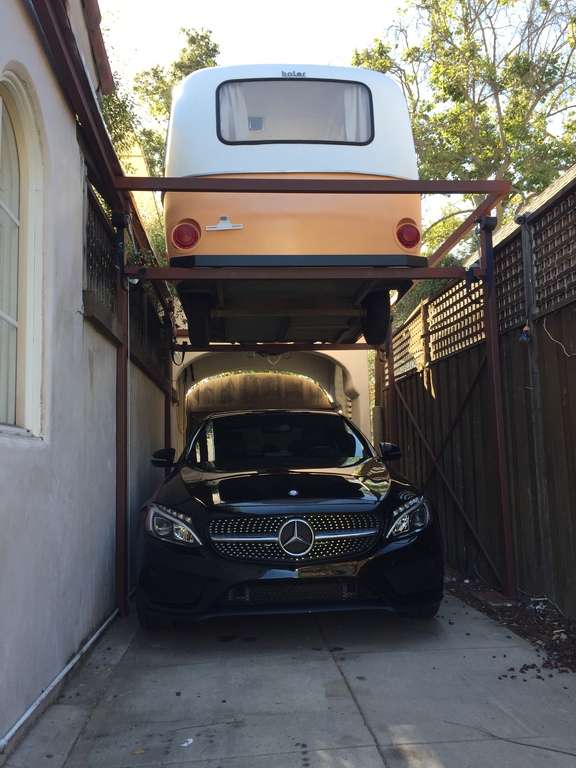
From the street, it looks like a skylight.
The lowest point on the trailer are the wheels, and they're a little more than six and a half feet up. The rest of the undercarriage is about 84" up.Well thought out and well done Jack! Looks good!
I'd bet you can't see that top from a drive by. How much head clearance do you have in the up position?
These are 'universal' belts, so they don't work with any kind of exterior inertial switch. They're rotary inertial (or whatever it's called). I've jerked them at different speeds and with different initial velocities, and I'm reasonably confident they'll all grab if the trailer drops down.There is another type with centrifugal latches, and if you pull on the belt too fast, it will engage. possibly they use both for double security, as I know if I'm on the brakes, it can also engage...

AAHH OK! I thought it would only have to be backed out of the driveway on the occasional track day.I can't pull it anywhere. I simply have no room. Here's how bad the situation was before this lift. I couldn't even take my trash cans out to the street without moving the trailer.
I knew you'd go up there..lolHere I am, filthy from cutting, drilling and welding in the 90° heat -- up inside the elevated camper. You can see the welder down below.


I have base plates and I poured a concrete footing for the legs that aren't on the driveway surface itself. The base plates are tied in with Tapcons.
lol It's like a TV cooking show where all the vegetables are peeled before the chef walks into the kitchen! It looks so easy that way. There's a little Hollywood magic behind this project. It looks like it went up so fast!
12 days, pretty much full-time. Before I got started I had everything I needed delivered (McMaster-Carr, Zoro, Amazon). The only thing I went out for was the steel. But even with everything on hand, it took me a surprising amount of time to put together.
The more time-consuming part was figuring out how I was going to do it. Being a non-engineer, it was a challenge for me just to work out how pulleys (sheaves, I learned to call them) can be put together to half the load by doubling the amount of rope used to move a load. Basic stuff to someone with even a small amount of education in this area -- but most of it was new to me. How much to reinforce the different components was something I put a lot of thinking into (not a lot of knowledge, but thinking at least). It's hard for me to understand something mechanical without seeing it in front of me.
But it was in the nineties most days and I was out in the sun for most of it, which was pretty brutal.
Still, I'm glad it's done.

Jack, that trailer is a great size. It's a great upgrade from tent or pop-up camping because you can stop at an overlook or roadside picnic park and have lunch and also have zero setup time in the rain. Our much heavier and cruder trailer was about the same size and our family of four used it until I was 12 and my brother was 14. Our trips lasted about 75 days so the extra two feet came in handy. Not being air tight (not even close) meant living with a lot of dust at times (like 2,000 miles of unpaved Alcan highway).

