Don't forget the nozzle size also.I think I kind of, sort of, understand what you're getting at, but I think most people here reading about blasting understand the basic principles involved, including the concept of a pressure regulator. When you and everyone else here talks about a compressor not being able to "keep up" with a blaster, they mean that the compressor cannot compress air into the tank fast enough to maintain the regulated pressure at which the gun is being operated.
I assume anyone desiring to blast understands that the gun will perform optimally at the desired (regulated) pressure, and suboptimally at any pressure below that. What you said is that you can't imagine a 10cfm compressor having enough pressure to effectively blast, which is incorrect and the source of a lot discouragement regarding blasting on GJ. A 10 cfm compressor will blast just as well as a 20 or 30 cfm compressor as long as the gun is operating at the desired regulate input pressure. The only thing that changes is how long one can blast before they fall off the reg. The OP understands they will not be able to blast constantly, and they know it will be slower, but they're also not trying to blast a vehicle frame, they're trying to blast a hand plane, which is a very reasonable and achievable goal for a suboptimal compressor.


You are using an out of date browser. It may not display this or other websites correctly.
You should upgrade or use an alternative browser.
You should upgrade or use an alternative browser.
The Abrasive Blasting Resource Thread
- Thread starter OccupantRJ
- Start date
Check out my post #987Don't forget the nozzle size also.

Okay... I decided to "put my money where my mouth is" and do some quick tests/math.
First of all, here is a link to a video I just shot showing how much air my blast gun setup uses. As discussed above, a lot of it depends on the jet/nozzle on the gun. This is the TP tools trigger gun with the medium air jet and medium (1/4") nozzle. As you can see in the video, I measure 17 CFM at approximately 100 psi. I realize most people are blasting at a lower pressure, but my flow meter is only accurate at 100 psi. That said, I realized after I shot the video that I could use a conversion factor, so I re-tested at 80 psi input and read 15.5 PSI on the meter, which converts to 14.1 CFM using the calculator on RCM's site here. That also puts us right within the 10 - 15 cfm range specified by TP Tools for this gun setup (though they don't specify the pressure to my knowledge).
So, assuming a compressor making 14.1 CFM at 80 psi will permit reasonable blasting performance for small scale applications, let's figure out how realistic that is with a much lower flow compressor that is commonly available. For discussion purposes, I'm going to choose this Harbor Freight Fortress 16 gallon, 175 PSI compressor. I chose this because it has a reasonable size tank (it's not a pancake), it makes decent flow for an oilless (4.5 CFM at 90PSI) and it's quiet at less than 70 db.
The question we really want to answer is, how long could I blast with the Fortress compressor using the pressure and flow settings from above, before the compressor would drop below the regulated pressure. First, let's calculate how long it would take to drain the tank from full (175 psi) to 80 psi without the pump running at all. Using Boyle's law, we calculate that we can compress 41.67 cubic feet of atmospheric pressure air into a 26 gallon (approx 3.5 cubic foot) tank at 175 psi. Using the same formula, we calculate that we can only compress 19 cubic feet of air in to the same volume tank at 80 psi. That's a difference of 22.67 cubic feet, so in other words, when we drain the tank from 175 to 80 psi, we're withdrawing a total of 22.67 cubic feet of air.
We calculated above that we need 14.1 cfm at 80 PSI to blast, so assuming the same gun/valve setup in our hypothetical, we will withdraw 14.1 cubic feet of air in 1 minute, or 22.67 cubic feet of air in 1.6 minutes (1 minute, 36 seconds). So we should be able to blast for 1:36 without the pump even running. But what if the pump is running?
Let's assume a cut in pressure of 100 psi. Using the math from above, we will withdraw 17.86 cubic feet of air from the tank before the motor kick is. That's about 1 minute and 15 seconds worth of blasting. At that point, the compressor kicks in and begins to offset some of the air we're withdrawing. The rate at which the pump will refill the tank will vary based on the tank pressure but since we know we will be withdrawing it faster than it is being replenished, we assume the tank will never reach higher than 100 psi (cut in pressure), and in fact, the spec pressure of 90 psi is a good average between the cut in pressure (100) and the regulated pressure (80). So if the compressor begins to offset the withdrawal of air at the advertised 4.5 cubic feet per minute, that reduces our effective withdrawal rate from 14.1 cfm to 9.6 cfm beginning once the motor kicks on.
So if we get 17.86 cubic feet out before the motor cuts in, that leaves an additional 4.78 cubic feet remaining we can withdraw before we drop below our regulated pressure. With the motor off, that would only take an additional 20ish seconds, but with the pump running, we get almost 30 seconds. So in total, it will take us about 1 minute, 45 seconds from the time we first squeeze the trigger, until the air in the tank drops below the "optimal" regulated pressure of 80 psi. From there, assuming you stop blasting, the HF spec sheet says you will refill the tank to 175 psi in a little over 2 minutes, at which point, you get another 1:45 of blasting*.
All that said, You will still be able to blast a little more after you drop below the regulated pressure. In fact, 80 psi is likely the high end for blasting with glass beads so you can probably expect reasonable performance down to, say, 50 psi. With that knowledge, I think it's reasonable to expect you could get about 2 minutes of acceptable constant blasting before you will notice your blasting is becoming ineffective and you need to let the compressor catch up. Also, in my use, I find I let go of the trigger on occasion to reposition the part, visually inspect it, etc. so those little pauses increase your effective blasting time.
So there you have it @AceofSpad3s. Just about 2 minutes on, 2 minutes off, assuming blasting at 80 psi with the medium jet/nozzle kit and a $400 harbor freight compressor. Lower the psi, and you will extend your working time. The TP tools small jet kit is rated for 4 - 8 CFM compressors, so you could likely extend your working time significantly (potentially even indefinitely, though you should mind the compressor's duty cycle) at the cost of a slower material removal rate.
*To validate all this math, I did a little experiment where I started with my tank (60 gallons) at 150 psi, pulled the trigger on the gun and held it until the compressor kicked on (125 psi). I timed it and it took 53 seconds. Boyle's law tells me I withdrew 13.64 cubic feet of air in that time, so that calculates out to a flow rate of 15.45 cfm, which is very close to the initial flow measured with the flow meter.
First of all, here is a link to a video I just shot showing how much air my blast gun setup uses. As discussed above, a lot of it depends on the jet/nozzle on the gun. This is the TP tools trigger gun with the medium air jet and medium (1/4") nozzle. As you can see in the video, I measure 17 CFM at approximately 100 psi. I realize most people are blasting at a lower pressure, but my flow meter is only accurate at 100 psi. That said, I realized after I shot the video that I could use a conversion factor, so I re-tested at 80 psi input and read 15.5 PSI on the meter, which converts to 14.1 CFM using the calculator on RCM's site here. That also puts us right within the 10 - 15 cfm range specified by TP Tools for this gun setup (though they don't specify the pressure to my knowledge).
So, assuming a compressor making 14.1 CFM at 80 psi will permit reasonable blasting performance for small scale applications, let's figure out how realistic that is with a much lower flow compressor that is commonly available. For discussion purposes, I'm going to choose this Harbor Freight Fortress 16 gallon, 175 PSI compressor. I chose this because it has a reasonable size tank (it's not a pancake), it makes decent flow for an oilless (4.5 CFM at 90PSI) and it's quiet at less than 70 db.
The question we really want to answer is, how long could I blast with the Fortress compressor using the pressure and flow settings from above, before the compressor would drop below the regulated pressure. First, let's calculate how long it would take to drain the tank from full (175 psi) to 80 psi without the pump running at all. Using Boyle's law, we calculate that we can compress 41.67 cubic feet of atmospheric pressure air into a 26 gallon (approx 3.5 cubic foot) tank at 175 psi. Using the same formula, we calculate that we can only compress 19 cubic feet of air in to the same volume tank at 80 psi. That's a difference of 22.67 cubic feet, so in other words, when we drain the tank from 175 to 80 psi, we're withdrawing a total of 22.67 cubic feet of air.
We calculated above that we need 14.1 cfm at 80 PSI to blast, so assuming the same gun/valve setup in our hypothetical, we will withdraw 14.1 cubic feet of air in 1 minute, or 22.67 cubic feet of air in 1.6 minutes (1 minute, 36 seconds). So we should be able to blast for 1:36 without the pump even running. But what if the pump is running?
Let's assume a cut in pressure of 100 psi. Using the math from above, we will withdraw 17.86 cubic feet of air from the tank before the motor kick is. That's about 1 minute and 15 seconds worth of blasting. At that point, the compressor kicks in and begins to offset some of the air we're withdrawing. The rate at which the pump will refill the tank will vary based on the tank pressure but since we know we will be withdrawing it faster than it is being replenished, we assume the tank will never reach higher than 100 psi (cut in pressure), and in fact, the spec pressure of 90 psi is a good average between the cut in pressure (100) and the regulated pressure (80). So if the compressor begins to offset the withdrawal of air at the advertised 4.5 cubic feet per minute, that reduces our effective withdrawal rate from 14.1 cfm to 9.6 cfm beginning once the motor kicks on.
So if we get 17.86 cubic feet out before the motor cuts in, that leaves an additional 4.78 cubic feet remaining we can withdraw before we drop below our regulated pressure. With the motor off, that would only take an additional 20ish seconds, but with the pump running, we get almost 30 seconds. So in total, it will take us about 1 minute, 45 seconds from the time we first squeeze the trigger, until the air in the tank drops below the "optimal" regulated pressure of 80 psi. From there, assuming you stop blasting, the HF spec sheet says you will refill the tank to 175 psi in a little over 2 minutes, at which point, you get another 1:45 of blasting*.
All that said, You will still be able to blast a little more after you drop below the regulated pressure. In fact, 80 psi is likely the high end for blasting with glass beads so you can probably expect reasonable performance down to, say, 50 psi. With that knowledge, I think it's reasonable to expect you could get about 2 minutes of acceptable constant blasting before you will notice your blasting is becoming ineffective and you need to let the compressor catch up. Also, in my use, I find I let go of the trigger on occasion to reposition the part, visually inspect it, etc. so those little pauses increase your effective blasting time.
So there you have it @AceofSpad3s. Just about 2 minutes on, 2 minutes off, assuming blasting at 80 psi with the medium jet/nozzle kit and a $400 harbor freight compressor. Lower the psi, and you will extend your working time. The TP tools small jet kit is rated for 4 - 8 CFM compressors, so you could likely extend your working time significantly (potentially even indefinitely, though you should mind the compressor's duty cycle) at the cost of a slower material removal rate.
*To validate all this math, I did a little experiment where I started with my tank (60 gallons) at 150 psi, pulled the trigger on the gun and held it until the compressor kicked on (125 psi). I timed it and it took 53 seconds. Boyle's law tells me I withdrew 13.64 cubic feet of air in that time, so that calculates out to a flow rate of 15.45 cfm, which is very close to the initial flow measured with the flow meter.
Last edited:
dkmc
Well-known member
Good reference information for this thread. True CFM requirements for efficient abrasive blasting can be deceiving. I checked out the RCM website, and got sticker shock on their flow meter prices, no surprise.Okay... I decided to "put my money where my mouth is" and do some quick tests/math.
The RCM meters are awesome, and they're often available at much discounted prices on eBay. You just want to be sure you get one with a recent ish calibration certificate, or that you have some way to independently confirm calibration. I have enough of them now with overlapping ranges that I can cross check them against each other for "good enough" values, but I'm not performing laboratory experiments here. Otherwise, I have spoken with RCM about sending them in for calibration and they definitely do it but it's not cheap.Good reference information for this thread. True CFM requirements for efficient abrasive blasting can be deceiving. I checked out the RCM website, and got sticker shock on their flow meter prices, no surprise.
Interesting read with numbers as well.Okay... I decided to "put my money where my mouth is" and do some quick tests/math.
First of all, here is a link to a video I just shot showing how much air my blast gun setup uses. As discussed above, a lot of it depends on the jet/nozzle on the gun. This is the TP tools trigger gun with the medium air jet and medium (1/4") nozzle. As you can see in the video, I measure 17 CFM at approximately 100 psi. I realize most people are blasting at a lower pressure, but my flow meter is only accurate at 100 psi. That said, I realized after I shot the video that I could use a conversion factor, so I re-tested at 80 psi input and read 15.5 PSI on the meter, which converts to 14.1 CFM using the calculator on RCM's site here. That also puts us right within the 10 - 15 cfm range specified by TP Tools for this gun setup (though they don't specify the pressure to my knowledge).
So, assuming a compressor making 14.1 CFM at 80 psi will permit reasonable blasting performance for small scale applications, let's figure out how realistic that is with a much lower flow compressor that is commonly available. For discussion purposes, I'm going to choose this Harbor Freight Fortress 16 gallon, 175 PSI compressor. I chose this because it has a reasonable size tank (it's not a pancake), it makes decent flow for an oilless (4.5 CFM at 90PSI) and it's quiet at less than 70 db.
The question we really want to answer is, how long could I blast with the Fortress compressor using the pressure and flow settings from above, before the compressor would drop below the regulated pressure. First, let's calculate how long it would take to drain the tank from full (175 psi) to 80 psi without the pump running at all. Using Boyle's law, we calculate that we can compress 41.67 cubic feet of atmospheric pressure air into a 26 gallon (approx 3.5 cubic foot) tank at 175 psi. Using the same formula, we calculate that we can only compress 19 cubic feet of air in to the same volume tank at 80 psi. That's a difference of 22.67 cubic feet, so in other words, when we drain the tank from 175 to 80 psi, we're withdrawing a total of 22.67 cubic feet of air.
We calculated above that we need 14.1 cfm at 80 PSI to blast, so assuming the same gun/valve setup in our hypothetical, we will withdraw 14.1 cubic feet of air in 1 minute, or 22.67 cubic feet of air in 1.6 minutes (1 minute, 36 seconds). So we should be able to blast for 1:36 without the pump even running. But what if the pump is running?
Let's assume a cut in pressure of 100 psi. Using the math from above, we will withdraw 17.86 cubic feet of air from the tank before the motor kick is. That's about 1 minute and 15 seconds worth of blasting. At that point, the compressor kicks in and begins to offset some of the air we're withdrawing. The rate at which the pump will refill the tank will vary based on the tank pressure but since we know we will be withdrawing it faster than it is being replenished, we assume the tank will never reach higher than 100 psi (cut in pressure), and in fact, the spec pressure of 90 psi is a good average between the cut in pressure (100) and the regulated pressure (80). So if the compressor begins to offset the withdrawal of air at the advertised 4.5 cubic feet per minute, that reduces our effective withdrawal rate from 14.1 cfm to 9.6 cfm beginning once the motor kicks on.
So if we get 17.86 cubic feet out before the motor cuts in, that leaves an additional 4.78 cubic feet remaining we can withdraw before we drop below our regulated pressure. With the motor off, that would only take an additional 20ish seconds, but with the pump running, we get almost 30 seconds. So in total, it will take us about 1 minute, 45 seconds from the time we first squeeze the trigger, until the air in the tank drops below the "optimal" regulated pressure of 80 psi. From there, assuming you stop blasting, the HF spec sheet says you will refill the tank to 175 psi in a little over 2 minutes, at which point, you get another 1:45 of blasting*.
All that said, You will still be able to blast a little more after you drop below the regulated pressure. In fact, 80 psi is likely the high end for blasting with glass beads so you can probably expect reasonable performance down to, say, 50 psi. With that knowledge, I think it's reasonable to expect you could get about 2 minutes of acceptable constant blasting before you will notice your blasting is becoming ineffective and you need to let the compressor catch up. Also, in my use, I find I let go of the trigger on occasion to reposition the part, visually inspect it, etc. so those little pauses increase your effective blasting time.
So there you have it @AceofSpad3s. Just about 2 minutes on, 2 minutes off, assuming blasting at 80 psi with the medium jet/nozzle kit and a $400 harbor freight compressor. Lower the psi, and you will extend your working time. The TP tools small jet kit is rated for 4 - 8 CFM compressors, so you could likely extend your working time significantly (potentially even indefinitely, though you should mind the compressor's duty cycle) at the cost of a slower material removal rate.
*To validate all this math, I did a little experiment where I started with my tank (60 gallons) at 150 psi, pulled the trigger on the gun and held it until the compressor kicked on (125 psi). I timed it and it took 53 seconds. Boyle's law tells me I withdrew 13.64 cubic feet of air in that time, so that calculates out to a flow rate of 15.45 cfm, which is very close to the initial flow measured with the flow meter.
Not arguing with the numbers at all but I am rather impressed at the results.
What compressor set up do you have? One similar to the HF you linked?
Thanks for taking the time to do this.
If time permits this weekend I want to time my set up as I may be surprised as to how many CFM I am using. I don’t think I can go over 1 min without my compressor kicking in.
dkmc
Well-known member
I've got just the acrylic 'floating ball' type for ball park checking of my blasting machinery. No lab reports due here....The RCM meters are awesome, and they're often available at much discounted prices on eBay. You just want to be sure you get one with a recent ish calibration certificate, or that you have some way to independently confirm calibration. I have enough of them now with overlapping ranges that I can cross check them against each other for "good enough" values, but I'm not performing laboratory experiments here. Otherwise, I have spoken with RCM about sending them in for calibration and they definitely do it but it's not cheap.

I have a 5hp 60 gallon compressor making about 15 cfm, however I did have a 2hp, 26 gallon compressor that made about 7 cfm when I first setup my blast cabinet.Interesting read with numbers as well.
Not arguing with the numbers at all but I am rather impressed at the results.
What compressor set up do you have? One similar to the HF you linked?
Thanks for taking the time to do this.
If time permits this weekend I want to time my set up as I may be surprised as to how many CFM I am using. I don’t think I can go over 1 min without my compressor kicking in.
A rotameter is a stone simple device. Very useful for checking against other meters. Here's a short video of me comparing a King rotameter to one of my RCM meters.I've got just the acrylic 'floating ball' type for ball park checking of my blasting machinery. No lab reports due here....
That said, in my experience, a rotameter will read differently when it is the last thing in the system venting to free air vs being in line with other hoses and fittings down stream. I have never been able to get one to read accurately when plumbed in the middle of my system.
dkmc
Well-known member
Interesting. I'm a bit of a data junkie so this is a topic I like discussing.A rotameter is a stone simple device. Very useful for checking against other meters. Here's a short video of me comparing a King rotameter to one of my RCM meters.
That said, in my experience, a rotameter will read differently when it is the last thing in the system venting to free air vs being in line with other hoses and fittings down stream. I have never been able to get one to read accurately when plumbed in the middle of my system.
I'll see if I can run a test. Should be simple enough to set up two scenarios with the rotameter in the middle of the system and at the end of the line.Interesting. I'm a bit of a data junkie so this is a topic I like discussing.
Okay @dkmc, hot off the press. I set up an experiment to test my observations/theory about using a rotameter to measure flow.Interesting. I'm a bit of a data junkie so this is a topic I like discussing.
In test 1, I configured the system with the rotameter at the end of the line, venting to free air. I installed a ball valve that I opened until the meter was reading 15 CFM. I then removed the handle from the ball valve so I couldn't accidentally change it mid test. I then shot this video demonstrating the setup.
I then swapped the order of the system, placing the 25' 1/2" diameter hose and pre-adjusted ball valve downstream from the rotameter. No other changes were made. The elements in the system were identical in both scenarios, it was only the order that changed. I then shot this video.
In case you don't have the time, or in case my voice sounds to you like nails on a chalkboard, here are the results:
Test 1 (hose and restrictor valve upstream of flow meter):
- 15 CFM at 100 PSI
Test 2 (hose and restrictor valve downstream of flow meter):
- 5 CFM at 100 PSI.
This is consistent with observations I have made prior to this test. This very thing threw me for a loop when I was first setting up my blasting setup because I was measuring significantly less flow than I was expecting. It was actually here on GJ that someone suggested my results might change if I moved the meter to the end of the line and voila!
I have noticed before that the meter itself says "SCFM - Air at STP". To me, STP is standard temperature and pressure, so perhaps that's the gotcha. The meter must see "standard pressure (1 atm?)" downstream in order to read accurately. By adding any kind of restriction upstream, we're creating "back pressure", and it takes more flow to push the float. It seems like this is just a property inherent to variable area flow meters.
Edit: While I had everything setup, I decided to run the same test with a differential pressure flow meter. I reversed the order this time, first installing the hose and restrictor valve downstream from the meter. Here is a link to that video. I then swapped the hose and valve ahead of the meter and replicated the test. Video here.
Results:
Test 1 (hose and restrictor valve downstream of flow meter):
- 15 CFM at 100 PSI
Test 2 (hose and restrictor valve upstream of flow meter):
- 38 CFM at 100 PSI.
A quick note to say that I recognize my testing conditions are not perfect. For example, the rotameter should be reading at standard temperature, which is around 68 Fahrenheit. Meanwhile, the RCM meter should be reading at 80 Fahrenheit. Fortunately, it's around 75 degrees here in sunny California and sticking a Fluke thermometer with a type K probe in the end of the hose while flowing air reads 74 degrees. With that said, I don't feel the need to convert to find the adjusted mass flow rate because there are likely other things about my setup that are adding even more error. Again, this is a shop, not a lab.
Last edited:
dkmc
Well-known member
Just checked in here as I seldom get notifications to new posts. Nice testing, and a great fix of data for a data junkie like me! Perplexing issues for sure. Which scenario gives true results? I'll have to absorb this data and contemplate a bit. Thanks for the testing efforts!Okay @dkmc, hot off the press. I set up an experiment to test my observations/theory about using a rotameter to measure flow.
In test 1, I configured the system with the rotameter at the end of the line, venting to free air. I installed a ball valve that I opened until the meter was reading 15 CFM. I then removed the handle from the ball valve so I couldn't accidentally change it mid test. I then shot this video demonstrating the setup.
I then swapped the order of the system, placing the 25' 1/2" diameter hose and pre-adjusted ball valve downstream from the rotameter. No other changes were made. The elements in the system were identical in both scenarios, it was only the order that changed. I then shot this video.
In case you don't have the time, or in case my voice sounds to you like nails on a chalkboard, here are the results:
Test 1 (hose and restrictor valve upstream of flow meter):
- 15 CFM at 100 PSI
Test 2 (hose and restrictor valve downstream of flow meter):
- 5 CFM at 100 PSI.
This is consistent with observations I have made prior to this test. This very thing threw me for a loop when I was first setting up my blasting setup because I was measuring significantly less flow than I was expecting. It was actually here on GJ that someone suggested my results might change if I moved the meter to the end of the line and voila!
I have noticed before that the meter itself says "SCFM - Air at STP". To me, STP is standard temperature and pressure, so perhaps that's the gotcha. The meter must see "standard pressure (1 atm?)" downstream in order to read accurately. By adding any kind of restriction upstream, we're creating "back pressure", and it takes more flow to push the float. It seems like this is just a property inherent to variable area flow meters.
Edit: While I had everything setup, I decided to run the same test with a differential pressure flow meter. I reversed the order this time, first installing the hose and restrictor valve downstream from the meter. Here is a link to that video. I then swapped the hose and valve ahead of the meter and replicated the test. Video here.
Results:
Test 1 (hose and restrictor valve downstream of flow meter):
- 15 CFM at 100 PSI
Test 2 (hose and restrictor valve upstream of flow meter):
- 38 CFM at 100 PSI.
A quick note to say that I recognize my testing conditions are not perfect. For example, the rotameter should be reading at standard temperature, which is around 68 Fahrenheit. Meanwhile, the RCM meter should be reading at 80 Fahrenheit. Fortunately, it's around 75 degrees here in sunny California and sticking a Fluke thermometer with a type K probe in the end of the hose while flowing air reads 74 degrees. With that said, I don't feel the need to convert to find the adjusted mass flow rate because there are likely other things about my setup that are adding even more error. Again, this is a shop, not a lab.
Correct results are given by using the respective meters as intended. That's why the two meters agreed on the same value of 15 cfm when they were used under their (approximately) correct pressure conditions. In the case of a rotameter, which you mentioned you have, it will need to be used at the pressure specified on the gauge, or else you will need to correct the reading using a chart or calculator.Just checked in here as I seldom get notifications to new posts. Nice testing, and a great fix of data for a data junkie like me! Perplexing issues for sure. Which scenario gives true results? I'll have to absorb this data and contemplate a bit. Thanks for the testing efforts!
Here's a great link that explains.
Last edited:
Strouty
Well-known member
OK, so I bought something without thinking about it too much, might be a mistake. I am trying to setup an outdoor blasting area that will semi contain the dust from coal slag so it doesn't end up on everything. I know it is dusty, I know, I know. Anyways, curious to see what people think about possibly making this fume extractor help keep the dust down???


dkmc
Well-known member
No knowledge of how the fume extractor works, but fumes and dust are different things.....is what comes to mind.OK, so I bought something without thinking about it too much, might be a mistake. I am trying to setup an outdoor blasting area that will semi contain the dust from coal slag so it doesn't end up on everything. I know it is dusty, I know, I know. Anyways, curious to see what people think about possibly making this fume extractor help keep the dust down???
Strouty
Well-known member
I think that it technically is a combination setup, it had pretty big particles in the bin where solids would drop out. There are cartridge filters inside, I suspect that it may need a different style filter to be fully effective. The biggest issue is going to be power, I have to drill out the lock so I can get inside, but so far based on the disconnect and wires going into the blower, the motor could be as big as 30 HP. That is about 15 HP too many for my current setup. I have been looking for a diesel generator to run three phase things, but then I would be running the diesel generator and diesel air compressor to do any blasting. I am going to keep investigating, but I may have bought a big paperweight.
Strouty
Well-known member
Lincoln was helpful, it took them a while to get the manuals to me, but now I know more about the unit. It has a 25 HP motor and the same blower unit was used with three different HP options, 15, 20, and 25. I guess it puts out 450 CFM up to 900 CFM, although I am not sure that is a statistic that maters, I suspect it is more about suction that can be created by the blower, maybe not. I just know that I saw units claiming 500 CFM running 2 HP motors. The great part is that the manual talks about what it can be used for.

Spotted this on FB MP, I don't like it when they list it for a dollar and get mad when I say I'll come by and pick it up. (2) 7.5 hp 3 phase motors. I like this also.
Attachments

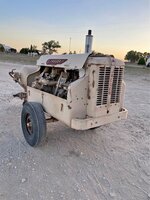
Spotted this on FB MP;
Sand blasting cabinet with reclaimer. Hardly used, needs new gloves. Cabinet door width: 42in Cabinet door length: 61 1/2in, $3K.
Sand blasting cabinet with reclaimer. Hardly used, needs new gloves. Cabinet door width: 42in Cabinet door length: 61 1/2in, $3K.
Attachments


dkmc
Well-known member
Similar to the one I picked up .....post 973. I paid $500Spotted this on FB MP;
Sand blasting cabinet with reclaimer. Hardly used, needs new gloves. Cabinet door width: 42in Cabinet door length: 61 1/2in, $3K.
OP
OccupantRJ
Well-known member
I just dropped back in to say hi and to check on you guys that are having a blast. I am 6 weeks post operative on a right total knee replacement, and am now walking slowly without an assistive device. Maybe I can get back out in the shop before too many more moons, but plans are to have the left knee done after more recovery, so it will still be a while yet.
Relevant material: Blasting seems to either ****, or it blows.
Carry on!
Relevant material: Blasting seems to either ****, or it blows.
Carry on!
dkmc
Well-known member
Hello RJ! Good to see a post here from you. You're gonna feel like the bionic man with your new knees and pain tapering off when they heal. Back in 2016 I talked my GF into getting both done at the same time. She didn't like me much for several weeks, but now she'd glad she had both done and over with. Pain free these days. Hope to see you on here a bit more in the future.I just dropped back in to say hi and to check on you guys that are having a blast. I am 6 weeks post operative on a right total knee replacement, and am now walking slowly without an assistive device. Maybe I can get back out in the shop before too many more moons, but plans are to have the left knee done after more recovery, so it will still be a while yet.
Relevant material: Blasting seems to either ****, or it blows.
Carry on!
The only part of me that doesn't hurt is my newer to me left knee. Hang in there my friend, I'm not a Dr but I'm sure I need two new hips also.
Last edited:
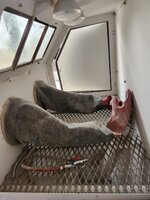
I have a soda blast cabinet that I bought years ago and seriously I've never used it. I thought I would use it all the time but no... Now it takes up a huge amount of space in my garage! It has the cabinet, vacuum system, pressure pot and a long hose for blasting things outside. What's something like this worth?
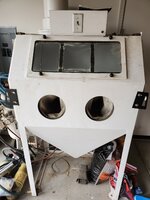
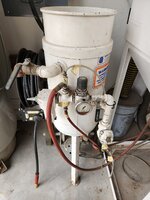
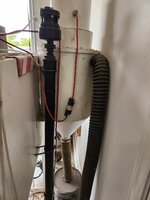

Last edited:
dkmc
Well-known member
Post many picsI have a soda blast cabinet that I bought years ago and seriously I've never used it. I thought I would use it all the time but no... Now it takes up a huge amount of space in my garage! It has the cabinet, vacuum system, pressure pot and a long hose for blasting things outside. What's something like this worth?
Sold my Grimmer Schmidt V8 compressor last weekend.
JHForman
Well-known member
Since we are discussing compressors here, this is what im running, I use it in constant run mode with my pressure pot cabinet, and it keeps up just fine. it even cycles. 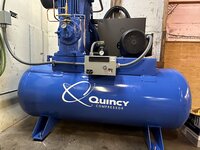
I still want a Quincy 5120.Since we are discussing compressors here, this is what im running, I use it in constant run mode with my pressure pot cabinet, and it keeps up just fine. it even cycles.
JHForman
Well-known member
I still want a Quincy 5120.
I know where ones sitting(in a body shop) thats no longer used lol
JHForman
Well-known member
you could road trip for this one ?

Quincy Model 5120 Air Compressor Pump With 20hp Motor. | eBay
Find many great new & used options and get the best deals for Quincy Model 5120 Air Compressor Pump With 20hp Motor. at the best online prices at eBay! Free shipping for many products!
www.ebay.com
dkmc
Well-known member
Is that an early ROC 325? I should get mine runningSince we are discussing compressors here, this is what im running, I use it in constant run mode with my pressure pot cabinet, and it keeps up just fine. it even cycles.
JHForman
Well-known member
-18 ROC, It had a cracked tank so I picked up an IR t-30 and made my quincy pump fit it and used the aftercooler off the t-30 also. @The Tool Tyrant helped me get it up and running, i probably woulda gave up and found something else if it wasnt for him!Is that an early ROC 325? I should get mine running
I call it a resto mod compressor lol
dkmc
Well-known member
Mine is a -12 The tank got leaked on for years, it's toast as well.


The Tool Tyrant
ALLIANCE MEMBER
JHForman missed your question (he works late...LOL) It's a 350 ROC 18Is that an early ROC 325? I should get mine running
Question, how does a Quincy Natural Gas 4125 differ from an plane old air compressor?
Last edited:
dkmc
Well-known member
Ah I see....I should get my 370 running....lolJHForman missed your question (he works late...LOL) It's a 350 ROC 18

The Tool Tyrant
ALLIANCE MEMBER
Ya, you should...don't be a slacker!Ah I see....I should get my 370 running....lol


dkmc
Well-known member
Ask the seller for the most important pic......the one of the crank case cover with the data plate infoHelp ID this Quincy? 25 hp motor.