

You are using an out of date browser. It may not display this or other websites correctly.
You should upgrade or use an alternative browser.
You should upgrade or use an alternative browser.
The Bicycle (Specialty) Tools Thread
- Thread starter neersighted
- Start date
slowtwitch73
Well-known member
What pads on Shimano? The metallic are a pita.. I only run resin.I feel like I constantly have to lever bleed Shimanos. I've also had bad luck with their pads not breaking in. I've always been a Shimano guy, but I think my next bike will be Sram for a change.
Sram brakes no longer totally ****.. we have a mixed stable and the Srams are pretty easy keepers... no rub, no noise. Dot fluid *****.
But, they still can't hold a candle to Shimano for lever feel imo... both the actual lever and the cycling of it.
My son is lusting for Maguras....
Bigblue&Goldie
Well-known member
Metallic. I need to try something else. I've always liked Shimano lever feel, but I feel like I'm always screwing with the newer Shimano's (all XT, single and dual piston). My old Shimano stuff was bombproof and I never touched it.What pads on Shimano? The metallic are a pita.. I only run resin.
Sram brakes no longer totally ****.. we have a mixed stable and the Srams are pretty easy keepers... no rub, no noise. Dot fluid *****.
But, they still can't hold a candle to Shimano for lever feel imo... both the actual lever and the cycling of it.
My son is lusting for Maguras....
sram have their issues as well. Neither is perfect. Everytime I think I want to try magura I read about their issues and decide to just stick with the issues I know.
I've tried them all and have ended up with Shimano. SRAM has been the worst and I will no longer buy them. Maguras have great feel and power but their plastic lever bodies always seem to end up leaking. On my mountain bike I replaced the Magura levers with Shimano and kept the Magura calipers. The mountain bike forums rave about the "Shigura" set up. I have tens of thousands of miles on Shimano road hydraulic brakes and my only issue has been a leaky caliper which was replaced under warranty.
Last edited:
No problems on SRAM either. Maybe the road stuff is different. MTB Sram stuff has been decent. The SRAM dub BBs are kinda meh though, bearings are way to small. I don't mind press fit either, but Shimano has that stuff figured out.
Gebirgekind
Well-known member
I know this isn't totally tool related but sort of...
Shimano brake levers. I am not a pro bike shop guy but we have a lot of bikes (currently 20+ in the garage I think) and I do all the work on our bikes. Most of our bikes are shimano brakes and I am mostly happy with them all things considered. I have been running into an issue pretty much forever where the lever appears to be leaking from the lever piston. I am presuming this is due to dirt and grit getting in there and getting under the seals and allowing it to leak. In the past I thought the levers were just toast and I would replace them. I have now started cleaning them super good and then they seem to work fine after a bleed. Is this just a shimano brake thing, are we not cleaning them well enough in general (need to make some maintenance adjustments), is there something else I should be doing?
I don't see that shimano considers that part serviceable but I see there are Chinese companies that make replacement pistons, I have never torn one of these apart to see how "serviceable" the levers are. Can these be disassembled nad cleaned and seals replaced without ruining them, or is my method of cleaning the "option"?
What are you pros seeing and doing here? I know my LBS's are just telling me to replace the levers when they are leaking. I have been unimpressed by the local shops for multiple reasons and that is one big reason I started doing my own work.
Typical of Shimanos, and you're doing right by gently cleaning. There is a part number for the diaphragm unit, Y1XK98030, but Shimano doesn't seem to push the levers as really serviceable. I guess now that bikes cost $10,000 they figure a $60 replacement lever is a good deal
 . From a shop perspective, the labor and time cost of replacing the innards significantly outweighs simply putting a new one on, that's why mechanics generally recommend replacement - same for autos really. For a home tech though it might be worth it for a $10 part; here's a link to the XT parts diagram for reference: https://dassets.shimano.com/content/dam/global/cg1SHICCycling/final/ev/ev/EV-BL-M8100-4504B.pdf
Sram has their issues too and everyone has their own preferences depending on riding style, etc. The RSC models with adjustable contact point are the only ones worth it IMO.
Magura suffers from savvy marketing and some top sponsored riders who get a new set of brakes every weekend. They can feel great but don't like to hold up. Shiguras are cool, but mostly just because they're cool. I'll take mineral oil over DOT any day though - but what do I know, I still run mini-V's on my gravel bike
 .
.I started experimenting recently with 1/4” ratchets and bits instead of hex keys, and it’s honestly been a game changer. We’ve tended away from that in the bike industry for some reason but I’ve found a roto ratchet really nice for things like seatpost bolts, stems, cockpit controls, etc. I’m curious what others’ experiences have been?
I’ll load up a couple ratchets depending on the bike so I’m not swapping sockets out very much. The one-piece here are Hazet and Stahlwille from Germany, and the long are Snap-on and Ko-ken to keep colors differentiated between hex and torx.
For the travel box this little Titan roto bit ratchet is super!
That is a fine set of tools! I've been using hex sockets for years and I still often reach for my trusty Eklind folding allen wrench tool for quick things even though I probably have a better tool for the job. The hex sockets are great for the higher torque 6mm and 8mm stuff. I use a short 3/8 breaker bar and hex socket for removing pedals and cranks and my torque wrenches mostly are 3/8. I also recommend the 3/8 drive bit holders for either 1/4 or 5/16 bits. Very versatile tool. Use whatever bit you need and great in a pinch if you need to sacrifice a bit rather than ruin a bit socket to extract a seized fastener.
I've also been experimenting with different tool combos which keeps things interesting. Recently my Chapman bit set came in handy with my Shimano hydraulic brake screws. Real tiny hex head and easy to strip out if overtightened. Well one was a bit overtightened and could not remove it with a standard L hex key as it would just bend but the Chapman bit made it a non issue. I suppose a fancy reinforced hex key like the ones Wera sells might have have been able to do the job but I don't have those. Just the old-school Bondhus and Eklind hex and torx key sets.

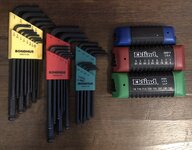
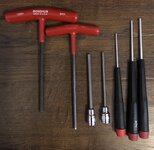


HannibalLecter
Well-known member
- Joined
- Aug 26, 2023
- Messages
- 420
Why does dot oil ****? That's why everything with 4 wheels and 2 wheels and an engine runs on DOT? These are old wives tales...What pads on Shimano? The metallic are a pita.. I only run resin.
Sram brakes no longer totally ****.. we have a mixed stable and the Srams are pretty easy keepers... no rub, no noise. Dot fluid *****.
But, they still can't hold a candle to Shimano for lever feel imo... both the actual lever and the cycling of it.
My son is lusting for Maguras....
DOT fluid ***** because it's caustic, corrosive (to some things), and is good at ruining paint. Mineral oil is harmless and cleans up with dish soap. Functionally, there's no meaningful performance difference between the two for bikes. I just don't like dealing with DOT fluid on my bikes.
slowtwitch73
Well-known member
^^ yup.
It won't damage anything in the time it takes to bleed brakes and then spray things down with rubbing alcohol. A rag and a spray bottle of isopropyl are 2 of the "tools" I always have to bleed any bike brakes. Just wipe away any drips as I go, no biggie.DOT fluid ***** because it's caustic, corrosive (to some things), and is good at ruining paint. Mineral oil is harmless and cleans up with dish soap. Functionally, there's no meaningful performance difference between the two for bikes. I just don't like dealing with DOT fluid on my bikes.
SRAM's system is so much cleaner and easier to bleed anyways that it makes DOT a non-issue. Shimano's nonsense with the cup and pressing a hose onto a barb fitting (which is a mess) is no comparison to SRAM's bleeding edge system which is virtually leak free at the caliper end.
To each their own. I have the Shimano bleeding procedure down to about 2 minutes per axle, so I find the whole process quick, easy, and non-hazardous for my skin or the bike. At the end of the day, both systems work great once you figure out the subtitles, so run what you prefer and get out riding!It won't damage anything in the time it takes to bleed brakes and then spray things down with rubbing alcohol. A rag and a spray bottle of isopropyl are 2 of the "tools" I always have to bleed any bike brakes. Just wipe away any drips as I go, no biggie.
SRAM's system is so much cleaner and easier to bleed anyways that it makes DOT a non-issue. Shimano's nonsense with the cup and pressing a hose onto a barb fitting (which is a mess) is no comparison to SRAM's bleeding edge system which is virtually leak free at the caliper end.
HannibalLecter
Well-known member
- Joined
- Aug 26, 2023
- Messages
- 420
Both can be cleaned with dish soap and its not even that good of a paint stripper either (maybe if you leave it for hours). If you are dealing with brake fluid outside the bike that much better to leave this to the pros (not directed to you). Dot vs mineral shouldn't even be the 20th reason when choosing between brake systems.Also a word of advise, stay away from magura if you don't like plastic levers and brakes that can't be adjusted not to rubDOT fluid ***** because it's caustic, corrosive (to some things), and is good at ruining paint. Mineral oil is harmless and cleans up with dish soap. Functionally, there's no meaningful performance difference between the two for bikes. I just don't like dealing with DOT fluid on my bikes.
HannibalLecter
Well-known member
- Joined
- Aug 26, 2023
- Messages
- 420
Wait until you try magura that you must continually push fluid through the caliper because the use of a valve is unknown to them. But yes, bleeding edge on high end model sram is very niceIt won't damage anything in the time it takes to bleed brakes and then spray things down with rubbing alcohol. A rag and a spray bottle of isopropyl are 2 of the "tools" I always have to bleed any bike brakes. Just wipe away any drips as I go, no biggie.
SRAM's system is so much cleaner and easier to bleed anyways that it makes DOT a non-issue. Shimano's nonsense with the cup and pressing a hose onto a barb fitting (which is a mess) is no comparison to SRAM's bleeding edge system which is virtually leak free at the caliper end.
slowtwitch73
Well-known member
LMFAODot vs mineral shouldn't even be the 20th reason when choosing between brake systems.
HannibalLecter
Well-known member
- Joined
- Aug 26, 2023
- Messages
- 420
Careful you will fall off your chairLMFAO
SRAM are well known for sticky pistons, even from new. Shimano has wandering bite point issues, although bleed quality seems to fix that.
Clearly the answer is Hope. Cnc’d in the UK. Rebuild parts available going back over 20 years.
Clearly the answer is Hope. Cnc’d in the UK. Rebuild parts available going back over 20 years.
Gebirgekind
Well-known member
Nah, might as well skip right over Hope to Trickstuff  !
!

!HannibalLecter
Well-known member
- Joined
- Aug 26, 2023
- Messages
- 420
Shimano has also problems with leaking dura ace and grx calipers. Hayes have also good brakes. Hope for brakes maybe is ok, hubs are poorly designedSRAM are well known for sticky pistons, even from new. Shimano has wandering bite point issues, although bleed quality seems to fix that.
Clearly the answer is Hope. Cnc’d in the UK. Rebuild parts available going back over 20 years.
Shimano has also problems with leaking dura ace and grx calipers. Hayes have also good brakes. Hope for brakes maybe is ok, hubs are poorly designed
What’s wrong with the hubs? I haven’t seen a broken one yet and the flexibility to change spacers/end caps when frame standards change is very useful.
My only complaint is using the dust seal to retain the cassette, then needing a pusher tool to reseat it
HannibalLecter
Well-known member
- Joined
- Aug 26, 2023
- Messages
- 420
Something about the preload I think. Also they are very heavy. Mapdec has some insights on these. I am talking about the hope pro5 and similar. And they come only in 32 holes.What’s wrong with the hubs? I haven’t seen a broken one yet and the flexibility to change spacers/end caps when frame standards change is very useful.
My only complaint is using the dust seal to retain the cassette, then needing a pusher tool to reseat it
If I was to buy hubs again I'd just go with bitex ones. Even the dt240 don't seem to worth it
Last edited:
I'm skimming this thread, but I don't see what I'm looking for. What are you guys using for vises? Being able to rotate the jaws would make working on forks a lot more clean, but these seem pretty overkill: https://www.harborfreight.com/5-in-multi-purpose-vise-with-anvil-58157.html
Big, old Wilton that I was given. If I had to buy one, I'd go on Craiglist / Marketplace and find one that needs a repaint - hit it with a wire wheel and a coat of spray paint.I'm skimming this thread, but I don't see what I'm looking for. What are you guys using for vises? Being able to rotate the jaws would make working on forks a lot more clean, but these seem pretty overkill: https://www.harborfreight.com/5-in-multi-purpose-vise-with-anvil-58157.html
I'm skimming this thread, but I don't see what I'm looking for. What are you guys using for vises? Being able to rotate the jaws would make working on forks a lot more clean, but these seem pretty overkill: https://www.harborfreight.com/5-in-multi-purpose-vise-with-anvil-58157.html
I normally just use my bike stands clamp for working on things like forks since it rotates and has soft plastic/rubber grips. I don't really need to cut forks very often. I also just have a basic Craftsman vise I picked up for pennies but I don't really use it for bike wrenching. I do have a saw guide for cutting forks I could clamp in a vise but I don't use it and prefer to cut steerer tubes free hand.
Gebirgekind
Well-known member
^This. The bike stand is perfect for any fork service. We switched to pipe cutters in the shop for cutting steer tubes too. But yeah, any old vice for odd projects will do - I was lucky to get my Grandfather's Wilton bullet and I picked up another small Columbian on marketplace for the outside shed.I normally just use my bike stands clamp for working on things like forks since it rotates and has soft plastic/rubber grips. I don't really need to cut forks very often. I also just have a basic Craftsman vise I picked up for pennies but I don't really use it for bike wrenching. I do have a saw guide for cutting forks I could clamp in a vise but I don't use it and prefer to cut steerer tubes free hand.
slowtwitch73
Well-known member
I put forks in a Park bike stand.I'm skimming this thread, but I don't see what I'm looking for. What are you guys using for vises? Being able to rotate the jaws would make working on forks a lot more clean, but these seem pretty overkill: https://www.harborfreight.com/5-in-multi-purpose-vise-with-anvil-58157.html
But a vise with appropriate tube blocks for the steerer works.
The annoying thing about most pipe cutters is they mushroom the metal both sides of the cut.
^This. The bike stand is perfect for any fork service. We switched to pipe cutters in the shop for cutting steer tubes too. But yeah, any old vice for odd projects will do - I was lucky to get my Grandfather's Wilton bullet and I picked up another small Columbian on marketplace for the outside shed.
Pipe cutter for aluminum is the way to go for speed. For carbon I just have my own method that works for me that likely no one else does. I use a carbon cutting blade a compact hacksaw rather than the standard hacksaw. I use a couple layers of masking tape for my line andI'll score a line around the steerer tube and cut my way around rather than cutting all the way through at once as I feel like I can confidently make a very flush cut. I won't clamp much which lets me rotate the steerer through this process. I'll touch up with a bit of sandpaper and bevel the edges.
duneslider
Well-known member
I'm a tile guy so I use a wet saw to cut carbon, works fantastic and very fast.Pipe cutter for aluminum is the way to go for speed. For carbon I just have my own method that works for me that likely no one else does. I use a carbon cutting blade a compact hacksaw rather than the standard hacksaw. I use a couple layers of masking tape for my line andI'll score a line around the steerer tube and cut my way around rather than cutting all the way through at once as I feel like I can confidently make a very flush cut. I won't clamp much which lets me rotate the steerer through this process. I'll touch up with a bit of sandpaper and bevel the edges.
duneslider
Well-known member
Curious what your thoughts are on bike repair stands. I have a feedback sports portable stand, no real complaints with it as a portable stand but I am getting tired of it as my at home repair stand. I would like a nice floor mounted single post stand. Anyone have thoughts on these shop stands? I'm really only seeing Unior and ParkTool. The Unior seems expensive and I can't see that it is significantly better. Those electric parktool stands are cool but way over kill for my garage.
I'm also not sure what makes more sense, bolting to the floor, or mounting it to a large steel plate.
I'm also not sure what makes more sense, bolting to the floor, or mounting it to a large steel plate.
slowtwitch73
Well-known member
Steel plate.... somewhat mobile.
kppolich
Well-known member
I made this one, best of both worlds.
great clamp, but tucked away and easily re-mountable in other locations.

great clamp, but tucked away and easily re-mountable in other locations.
duneslider
Well-known member
I actually saw that in your build thread and like that one a lot. I have a bench mount stand that I used for fork work but I am in need of a good adjustable floor mount that I don't trip on and that doesn't tip over. I had an extra large xc bike that I was bleeding magura's on (yes I still think they are sort of a pain to bleed) and with all the gymnastics of trying all sorts of angles to get the bubbles out I had to weight down the stand so it didn't tip over.I made this one, best of both worlds.
great clamp, but tucked away and easily re-mountable in other locations.
I have a similar ish stand made by park. It is basically the clamp plus a little plate stee welded on. You can mount it to a table, build a flange to mount it in a vise or diy your own stand.
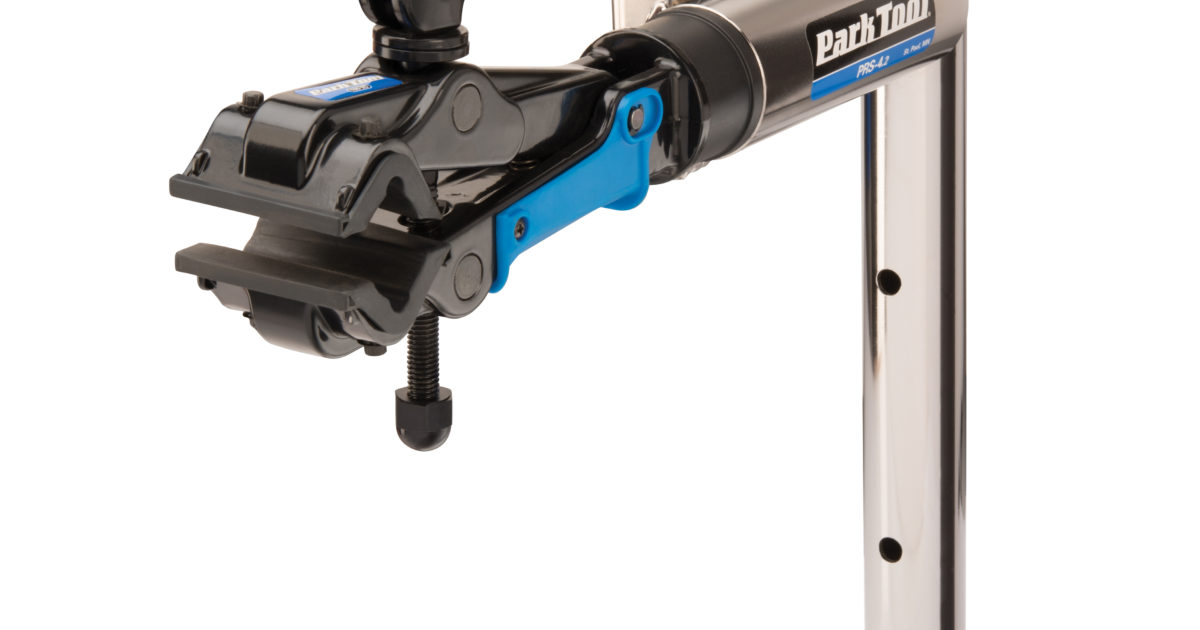
 www.parktool.com
Bench / Wall Mount
Space-saving repair stands that are perfect for a garage or small shop.
www.parktool.com
Odd-job
Well-known member
Hi guys, am trying to remove a multi layer mass of dried sealant caked on the back of my bike's seat tube/chainstays (clear coated carbon so acetone or other strong solvents are probably a no go). The internet has proved a little less than useful this time around, but have been using an abrasive cleaning stick (used to clean sandpaper) to rid tires of dried sealant and easier to reach spots such as on the down tube. Does anyone make something that can go on a rotary tool like a die grinder to make life easier? I see decal eraser wheels for drills that might work? Ideally I would find something cone shaped. Although anything would be better than trying to use this abrasive cleaning stick as a ***** on the bike. Any thoughts welcomed (other than giving up on tubeless).


Grant Gunderson
Well-known member
That’s an impressive amount of sealant! I’ve had god luck with wetting a rag with simple greene. I’d recommend the aircraft version as it won’t react as easily with aluminum parts.
Hi guys, am trying to remove a multi layer mass of dried sealant caked on the back of my bike's seat tube/chainstays (clear coated carbon so acetone or other strong solvents are probably a no go). The internet has proved a little less than useful this time around, but have been using an abrasive cleaning stick (used to clean sandpaper) to rid tires of dried sealant and easier to reach spots such as on the down tube. Does anyone make something that can go on a rotary tool like a die grinder to make life easier? I see decal eraser wheels for drills that might work? Ideally I would find something cone shaped. Although anything would be better than trying to use this abrasive cleaning stick as a ***** on the bike. Any thoughts welcomed (other than giving up on tubeless).
What brand of sealant is it? As others have mentioned, isopropyl alcohol and elbow grease can work well. I have not tried them, but brands like Silca and Muc-Off make a sealant remover spray.
I'm curious - can you tell us why you want to stay tubeless?... Any thoughts welcomed (other than giving up on tubeless).
I gave up on tubeless tires because of messes like that and went back to tubes. Seating the bead, even with a mondo 60 gal compressor was a PITA, too, depending on the tire brand/fit mostly. Tubeless is not at all good for occasionally-ridden bikes - the sealant solidifies in one spot.
Crepe rubber blocks, like you mentioned, seemed to work the best but lots of effort. I've never seen cylinders that could maybe be modified to mount on a drill mandrel. I'd think turning the square crepe blocks on a lathe would be dangerous.
I wonder if soft urethane skateboard wheels mounted on a mandrel would work? Or crepe sheet material glued to a sanding cylinder? Maybe just rubber mandrels meant for sanding sleeves?
acer66
Well-known member
Interesting, not sure how many years I am on tubeless but I never had a big enough issue to even remotely to consider going back to tubed tires.I'm curious - can you tell us why you want to stay tubeless?
I gave up on tubeless tires because of messes like that and went back to tubes. Seating the bead, even with a mondo 60 gal compressor was a PITA, too, depending on the tire brand/fit mostly. Tubeless is not at all good for occasionally-ridden bikes - the sealant solidifies in one spot.
Crepe rubber blocks, like you mentioned, seemed to work the best but lots of effort. I've never seen cylinders that could maybe be modified to mount on a drill mandrel. I'd think turning the square crepe blocks on a lathe would be dangerous.
I wonder if soft urethane skateboard wheels mounted on a mandrel would work? Or crepe sheet material glued to a sanding cylinder? Maybe just rubber mandrels meant for sanding sleeves?
To the OP, on the mtb my cleaning habits are limited to chain, stanchions and such everything else is left to take care of itself.
Meaning it will fall off eventually if ridden enough.
