They cut you off from buying more? Or just for now?
for the month

They cut you off from buying more? Or just for now?
Why? Don't they want to sell the GD things?for the month
It may be a combination of low margins and enough demand from other customers. Consider as an example, they get 20 units in stock this month. The unit has say a 10% margin (likely higher but I'm using this as an example). So they really don't make much on each unit. However, the typical new buyer also buys $100 in high margin accessories. So each sale results in better than 10% margins. Jxj comes in and buys all 20 units. Jxj isn't likely buying any of the margin padding accessories so the net profit per sale is lower. Also it means 15 potential buyers are frustrated/made unhappy because the printer they want is OOS. The limit tries to balance things out.Why? Don't they want to sell the GD things?
i did buy .6 nozzles.
every single one they had.

Admitting that you have a problem is the first step…

Jeep, I gotta ask, at what point does it become less expensive to pay for injection molding tooling? I wonder about print farms turning out the same part over and over and what the break even point is for injection molding vs 3D printing? I'm sure you've explored that
PorcroCenter had a change of heart?
We had that discussion a while back in this thread. I work in the world of injection molded parts but for a number of reasons we can't use 3D printing in our products (we use it a lot for R&D).Jeep, I gotta ask, at what point does it become less expensive to pay for injection molding tooling? I wonder about print farms turning out the same part over and over and what the break even point is for injection molding vs 3D printing? I'm sure you've explored that
I think your mold prices are very low. Yes, you can get some quick turn, low cost molds in that price range but most decent molds are going to be several tens of thousands. We have quite a few multi-cavity molds that are around $1m. However, those are very good molds... and weigh around 10k lbs.Injection molding is cheap for the single item price, but tooling up and labor will kill you. This is from my memory of looking into replicating an expensive unobtainium part before 3D printing. A reasonably good single cavity mold can set you back easy $5K. More complex, or multi cavity, $10K. The sky is the limit for injection mold prices. Then there's setup and takedown labor. Which was $1K per hour and dependent on the machine they used. The material costs were insignificant. Since I needed 3, I milled them out of Delrin and called it good.
I asked jeepxj the same question. It really depends on a lot of factors. My parts have details and require materials that are not practical out of an FDM printer. I think Slant 3D's youtube channel tries to make the strongest case for when 3D printing makes sense.@Citation what would you say is the sweet spot for IM in terms of units? I have seen a few makers in the last few years using 3d printing to make moulds for home-build benchtop IMs, and a few Kickstarter type single mould units for benchtop IM.
Makes me wonder sometimes if there's not a potential "pro-sumer" market for small shop level IM set ups that's being left untapped for people who are starting to exceed beyond the volume of traditional 3d printing.
i did buy .6 nozzles.
every single one they had.
Damn, that's a lot of nozzles!
I asked jeepxj the same question. It really depends on a lot of factors. My parts have details and require materials that are not practical out of an FDM printer. I think Slant 3D's youtube channel tries to make the strongest case for when 3D printing makes sense.
So assume you have a part that can be made with either method. Then I think it would be a combination of a numbers game (cost/part, upfront costs, cost of mold machine vs print farm etc). Both jeepxj and Slant 3D make a strong point about flexibility. A mold is largely a fixed thing. This is good in that parts out of it should be very consistent. However, it also means you have committed to that shape. 3D printing allows for almost no cost rolling changes.
There also might be a customer perception issue. As a consumer I shouldn't care if my new plastic part is printed vs molded (vs even machined). However, when I see something selling a 3D print part I often think, why wouldn't I just print it myself. Thus I'm personally less willing to buy a 3D print part vs a molded one. That isn't rational but customer perceptions often aren't. Perhaps I can rationalize some of it by saying the surface finishes aren't as good and often the material properties are inferior to solid injected plastic. Do note that this last part goes into each method has it's benefits. 3D printing can do geometry that can't be molded such as internal cavities, very thick sections, no draft (slanted sides) since mold release isn't a concern. However, molding can create much better surfaces right up to optical quality. Molding dimensional tolerances are much better. We typically assume 0.005-0.007 for standard tolerances over parts that are less than 6" long. Local tolerances down to 0.001 can be done.
I factor on 3,000 hours usable per machine. in reality its much more but thats a good start. I think we have one passing 13,000 hours or so.Jeep- do you factor the cost of your print farms equipment and operating expense into your injection molding trade study? Seems like 800 machines would be very costly to procure and maintain....
Just curious what the numbers look like overall. Not suggesting you haven't thought of all of that, you're pretty smart and I'm sure you've done the business case analysis for an 800 machine print farm. Capital is capital, and I was just wondering about the cost trades of make vs buy. FWIW, I worked in Aerospace for over 30 years and when I started we made darn near everything in house- where we controlled our destiny, but over the course of that 30 years, the MBAs took over from the engineers running the place, we became and systems integrator, ie we bought pretty much every assembly and just did the final integration and checkout of the systems before we sold them to the end customer. I hated it, we no longer controlled our factories and were at the mercy of suppliers that didn't have the same motivation or intimate knowledge of the products that us old timers had. I'm a huge supporter of vertical integration. I think that is one thing that made the country a manufacturing powerhouse back in the day. Companies like Ford even had its own glass making operation. GE was everything from scoop to nuts. Now it's all about which VC firm has the money to buy the stuff from a contract manufacture that has no idea how the product they are producing works or how the parts are suppose to fit together. Anyway, I'm off topic, Love to see you Cost trade on Make Vs Buy though. Thanks


I certainly wouldn't recommend an actual Ender 3 at this point. An Ender 3 V3SE or V3KE would be OK and in your price range. However, I wouldn't recommend either of those given the Flashforge 5M is $240 from their ebay store https://www.ebay.com/itm/256427778820 <- disclaimer, I bought mine from this listing last year. The 5M is a really nice printer within your budget. The open frame is OK for PLA printing but can be an issue with other materials. However, you can, for about $45 print/buy an enclosure kit. The kit includes hardware and plexiglass panels. You print the other parts. I did it to keep dust off my print bed. Since the printer is in my office I don't print materials that need the enclosure. Some of the outgassing from the materials are not good for you.Well, next month I've budgeted for an Ender 3 or anything in its price range at $250 or under (maybe THIS month if I put some cash I keep in my wallet back in the account), so looks like ever since I started getting curious about 3D printing looking at my community college's Makerbot way back in 2017, I'm finally getting started on my own.
My Ender 3 Pro has been slowly, but steadily pumping out the halfassed **** I design since 2019.I certainly wouldn't recommend an actual Ender 3 at this point.
True, but a Flashforge 5M can do it at least 4 times faster, and with more consistent quality than the Ender 3 Pros. For about the same price. And with zero tweaking. I have a bunch of Ender printers and really love them, but my 5Ms are a whole different animal.My Ender 3 Pro has been slowly, but steadily pumping out the halfassed **** I design since 2019.
It looks nice. Lots more nice to haves. When my Ender STB, then maybe that one.True, but a Flashforge 5M can do it at least 4 times faster, and with more consistent quality than the Ender 3 Pros. For about the same price. And with zero tweaking. I have a bunch of Ender printers and really love them, but my 5Ms are a whole different animal.
I think the other thing about 3D printing vs injection molding is that with 3D printing you are making the products as they are needed, not having to store 10000 items until they sell. Looking at the FSS website, there is currently 241 products, so that is a lot of variability, not to mention some color options, and revisions, custom orders, etc. So instead of having shelves to store products, your shelves are holding printers to make the products as needed.
Yeah an item can blow up and cause a backlog, but those fly traps are showing a 3 week leadtime. What would that be if you had to get a new order from a factory to injection mold and ship?
Exactly, forecasting demand is a challenge on the best of days.
I watch the Slant3D stuff also, so it's interesting to see you putting a lot of that into practice as well and seemingly being quite successful. Thank you for taking us along on this journey.
Getting into the Filament sales business should add an interesting twist to the business!
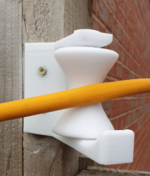
They are very stout. I filled them 100% during print. Overkill? Maybe. Waiting on the fence for install.Did you print one out Jeff? if so, how do you like this model?
I've been meaning to try one out for a while now.


