
You are using an out of date browser. It may not display this or other websites correctly.
You should upgrade or use an alternative browser.
You should upgrade or use an alternative browser.
The Everything 3D Printer Thread
- Thread starter BoilermakerFan
- Start date
Grant Gunderson
Well-known member
At that point, I would think a used injection molding machine would start to become more economical!x2d with ams ordered.
more p1s's on the way.
more h2s.
it just dont stop
kaymccampbell
Well-known member
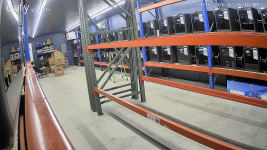
The machine after refurbishment, would probably cost more than his current physical plant, and each mold, which he would need several of, would cost what one rack of printers does. And if he desired to make changes or add new products, after a 30 day turnaround time, if he's lucky, he'd be ready to test his first batch.At that point, I would think a used injection molding machine would start to become more economical!
mike93lx
ALLIANCE MEMBER
So you are saying he also needs a 5 axis cnc, right?The machine after refurbishment, would probably cost more than his current physical plant, and each mold, which he would need several of, would cost what one rack of printers does. And if he desired to make changes or add new products, after a 30 day turnaround time, if he's lucky, he'd be ready to test his first batch.
350 Parts to mold.At that point, I would think a used injection molding machine would start to become more economical!
china molds run 4k a pop.
the math doesnt math.
It's mind blowing how Prusa sells anything these days. Their bed slinger is $709 for a kit and $1,000 assembled.
kaymccampbell
Well-known member
They've got a pretty rabid fanbase.It's mind blowing how Prusa sells anything these days. Their bed slinger is $709 for a kit and $1,000 assembled.
Black300zx
Well-known member
I remember asking you about Injection molding a year or two ago, I think when you were starting to make large filament orders.350 Parts to mold.
china molds run 4k a pop.
the math doesnt math.
It seems like you have a high-mix/low-ish volume business which makes a print farm a really good fit. Glad to see it taking off like it is
I remember asking you about Injection molding a year or two ago, I think when you were starting to make large filament orders.
It seems like you have a high-mix/low-ish volume business which makes a print farm a really good fit. Glad to see it taking off like it is
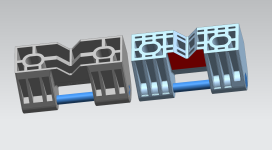
in fairness I have done a mold for a product already to get it out of the print farm. injection molding just isnt a fit for everything.

67CarGuy
Well-known member
Latest print: a slew of 25mm cubes so the newly refinished cutting boards can "rest" while getting some air across their bottoms after oiling. Who doesn't like air across their bottom after oiling, after all?
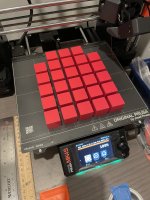
Latest print: a slew of 25mm cubes so the newly refinished cutting boards can "rest" while getting some air across their bottoms after oiling. Who doesn't like air across their bottom after oiling, after all?
why not a triangle top so the contact area is much smaller?
Firebrick43
Well-known member
why not a triangle top so the contact area is much smaller?
My thoughts exactlywhy not a triangle top so the contact area is much smaller?
Black300zx
Well-known member
I have a nice stack of these...they're dirt cheap and awesome
Black300zx
Well-known member
Is that a part which is a reused component across a number of assemblies?Mold work:
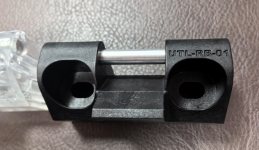
Is that a part which is a reused component across a number of assemblies?
no. but volume dictated it really. i think 100,000 made so far?
67CarGuy
Well-known member
Well, TBH I thought of that about halfway through the printing... and the pyramids likely would have printed faster, too. Perhaps time for me to break out of my simple shapes designing and experiment a bit more!
moab11
Well-known member
Quick search showed these, look quick and simple, no need to reinvent the wheel
Poolshark314
Well-known member
Couldn't find anything for Gladiator GearWall mounts and Milwaukee M18 batteries so came up with this snap in design:
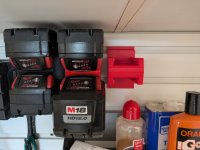
Pretty happy with it and it fit every battery size I could throw at and is very sturdy. Working on M12 next, here is my model for anyone in need:
Pretty happy with it and it fit every battery size I could throw at and is very sturdy. Working on M12 next, here is my model for anyone in need:
Old tool guy
Well-known member
- Joined
- Apr 13, 2023
- Messages
- 3,578
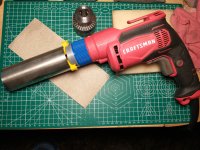
Can you please explain what that does. I recognize a lathe-type chuck and an electric drill, but can’t make the connection.I made myself a 2" 3 jaw spiral chuck for sanding:
It's working way better than I expected it to.

pcrov
Well-known member
Can you please explain what that does. I recognize a lathe-type chuck and an electric drill, but can’t make the connection.
It holds larger stock so I can spin it while using sandpaper to clean it up.
Old tool guy
Well-known member
- Joined
- Apr 13, 2023
- Messages
- 3,578
Got it.
You know what’s funny … the drill looks like you printed it.
You know what’s funny … the drill looks like you printed it.
67CarGuy
Well-known member
I didn't reinvent the wheel, I reinvented the cube!
Quick search showed these, look quick and simple, no need to reinvent the wheel

I've got a coolant funnel for bleeding coolant systems and the adapter I use the most broke. When it happened I was legit bummed for about 15 minutes because I forgot I could DIY a replacement. They aren't expensive but I need the funnel asap for a project.
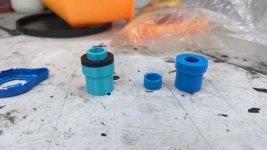
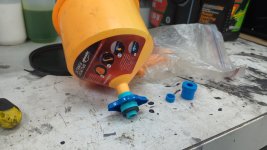
It's printed out of ASA and I made the walls a little thicker than the original so it should hold up fine.
It's printed out of ASA and I made the walls a little thicker than the original so it should hold up fine.
moab11
Well-known member
fixes like this are the best part about owning a 3d printer
mike93lx
ALLIANCE MEMBER
This is cool. 5axis 3d printing
several years ago, I talked to a guy who ran a shop in a university art school. They'd gotten a 3d printer, and was surprised that the thing he'd helped the most people with printing were funnels, most with threads on the end. So much so, his staff had written a tutorial "so, you want to print a funnel?", that included a parametric model so the user could specify their dimensions, and get a workable design.I've got a coolant funnel for bleeding coolant systems and the adapter I use the most broke. When it happened I was legit bummed for about 15 minutes because I forgot I could DIY a replacement. They aren't expensive but I need the funnel asap for a project.
It's printed out of ASA and I made the walls a little thicker than the original so it should hold up fine.
mike93lx
ALLIANCE MEMBER
I recently came across a video regarding settings for support and starting messing with it a bit.
I had a few failed prints when playing with z offset, but just increasing support top layers to 3 and rectilinear have made removal much easier.
Anyone had luck with other settings to improve?
The price point of the X2D has me really close to swapping out a P1S for one. Clean and easy support removal could save me an hour and a big mess with each wheelchair
I had a few failed prints when playing with z offset, but just increasing support top layers to 3 and rectilinear have made removal much easier.
Anyone had luck with other settings to improve?
The price point of the X2D has me really close to swapping out a P1S for one. Clean and easy support removal could save me an hour and a big mess with each wheelchair
pcrov
Well-known member
I forget where I found these settings but they've been an improvement over the defaults for me with PETG.Anyone had luck with other settings to improve?
- Top and bottom Z distance 0.28
- Top interface spacing 0.0
- Support/object xy distance 0.45
mike93lx
ALLIANCE MEMBER
What nozzle and layer height are you running with those dimensions? Should they be a certain ratio to layer height?I forget where I found these settings but they've been an improvement over the defaults for me with PETG.
Sometimes using normal supports (rather than tree) with concentric interface pattern helps too.
- Top and bottom Z distance 0.28
- Top interface spacing 0.0
- Support/object xy distance 0.45
pcrov
Well-known member
0.4 nozzle and usually 0.2 layer height. I don't know if ratio vs absolute matters. The extent of my testing was "oh that's an improvement, I'll use that" and never dug further.What nozzle and layer height are you running with those dimensions? Should they be a certain ratio to layer height?
mike93lx
ALLIANCE MEMBER
That's with a 0.8 nozzle, right? I'm still slimming it with 0.6's.32 layer height -> .34 z offset
Is the +0.02mm delta consistent with other layer heights?
That's with a 0.8 nozzle, right? I'm still slimming it with 0.6's
Is the +0.02mm delta consistent with other layer heights?
no thats .6 standard.
.4 -> .42
niget2002
Well-known member
I'm really looking forward to seeing more about this

 www.bondtech.se
INDX By Bondtech - tool-changer solution for multimaterial 3D printing
The INDX By Bondtech is the technology that changes everything. The leading solution for tool changers that supports multi material color and nozzle.
www.bondtech.se
mike93lx
ALLIANCE MEMBER
My 0.6 profiles all do a 0.30 layer height.no thats .6 standard.
.4 -> .42
moab11
Well-known member
seems very similar to what bambu lab uses on the H2CI'm really looking forward to seeing more about this
INDX By Bondtech - tool-changer solution for multimaterial 3D printing
The INDX By Bondtech is the technology that changes everything. The leading solution for tool changers that supports multi material color and nozzle.
mike93lx
ALLIANCE MEMBER
I think the sunlu is the way to go.
The sunlu drier showed up.
It gets points for being easier to install and smaller than the eibos. It will run up to 70C vs 65C for the Eibos, although I haven't validated either.
Beyond that, I'm not sure yet
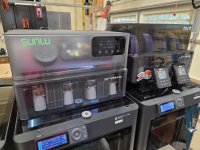
The 24 hr timeout on the eibos is a PIA when running a lot, and the form factor eats up lots of space. I have no need for dual temp, so having two chambers doesn't help
niget2002
Well-known member
It is, but it'll work with klipper, which means I could figure out how to get it working on my current printer.seems very similar to what bambu lab uses on the H2C