

You are using an out of date browser. It may not display this or other websites correctly.
You should upgrade or use an alternative browser.
You should upgrade or use an alternative browser.
The Flex Head Ratchet Thread - Locking vs Not - Discussion
- Thread starter CGarage
- Start date
Under_Pressure
Well-known member
My Proto long flex palm control round heads are probably my most used ratchets now- certainly in 1/2" (3/8 has some competition from a Koken roto ratchet). No lock, no detent, and I wouldn't have it any other way. As noted, the heads are far from "floppy-" they stay where you put them to a reasonable degree, but of course will move when sufficiently bumped or with a particularly heavy socket. But for the way I use them, it works well. I'm not a professional auto tech working flat rate, or even a ******** modern car DIYer. If you spend your days working in cramped engine bays and want to lock the head at a certain angle to access this one faster that you can't really see or get your hands in to help, I can certainly see the advantage. I'm more of a heavy duty/industrial kind of guy, so often my flex goes on places where a fixed handle would work, by itself or perhaps with a short extension. But with the flex, I will put it on the bolt/nut and just let the handle find the angle where it is most comfortable to deliver the torque I need. And once broken loose I might change that angle to gain a little speed.
I just saw a ratchet in my own picture I forgot I had. The 3/8 Dr in the the 1/4" body.
Yes, I love the Matco 3/8 in a 1/4 body and the 3/8" Nepros "small body". Picture has a few other 3/8's for scale.
Attachments

I have both in 1/4 and 3/8 comfort grips, and a roto SO bit ratchet. Back-drag on rotos is heavier than pear heads.OT: What differences do you notice between the SO and Icon Rotos???
Biggest thing is 3x+ the price for a SO! The SO heads are quiet a bit thinner and have less back-drag. The Icon reverse is a bit clumsier.
But, SO doesn't make a 1/2" roto last I looked so its Icon there. I also have a Carlyle 1/2 roto. Pretty similar to the Icon (about 2" shorter) but I don't like QR ratchets so It rarely gets used.
Mr Ratchet
Well-known member
I have all three types of flex heads. My detent ones have the teeth/grooves instead of the partial holes/cups. I prefer the locking by a large margin. Especially, a good locking design like the Armstrong/Gearwrench/Matco lever type. With this design you can leave it in the unlocked position and have it flop around as much as you want. Tightening and loosing the hinge bolt allows more or less flop as needed. Leave it locked and you have a long handle fixed head ratchet for the most part.
All but one of my flex head ratchets are locking and they spend most of their life locked but there are times when you want it unlocked or nonlocking, so you can constantly change the angle to dodge different obstructions and get a bigger swing
I'm also the weirdo that likes the snapon locking mech, it's faster to adjust and relock than the lever type and I've never run into a situation where the button gets in the way. But it is easy to bump back to locked but for me is a minor annoyance that happens like once a year
I've got
3/8 locking matco
3/8 locking snapon
1/2 locking snapon
1/4 and 3/8 locking 84t gearwrench (they have detents when unlocked)
1/4 stick locking EZ Red (can't be left unlocked)
My only nonlocking is a 3/8 SK round head (no detents)... but I just ordered two extra long nonlocking snapon ratchets
Also have a 1/4 snapon roto/swivel ratchet that's nonlocking
I'm also the weirdo that likes the snapon locking mech, it's faster to adjust and relock than the lever type and I've never run into a situation where the button gets in the way. But it is easy to bump back to locked but for me is a minor annoyance that happens like once a year
I've got
3/8 locking matco
3/8 locking snapon
1/2 locking snapon
1/4 and 3/8 locking 84t gearwrench (they have detents when unlocked)
1/4 stick locking EZ Red (can't be left unlocked)
My only nonlocking is a 3/8 SK round head (no detents)... but I just ordered two extra long nonlocking snapon ratchets
Also have a 1/4 snapon roto/swivel ratchet that's nonlocking
finn
Well-known member
SnapOn Roto head, Matco fixed, SnapOn Flex non locking, SK fixed, HF composite, and then SnapOn locking flex bringing up the rear, not counting the clunky Craftsman raised panel.
There are probably another half dozen in there, like some of the Craftsman professional, but that’s the general order.
There are probably another half dozen in there, like some of the Craftsman professional, but that’s the general order.
Mac makes or at least made a 1/2" roto. I picked one up at a pawn shop thinking it would be as handy as my SK 3870. It wasn't and just sits in my tool box.What do you use a 1/2” drive Roto ratchet for???
The SO has a slightly smaller/thinner head. I often run 2 ratchets rather than swap between two socket sizes on one ratchet, and was just going to buy another Icon 1/4" before I saw a decent deal on the SO 1/4" roto around my birthday, so I made it a present to myself. Mainly I was curious how a Dual-80 felt in such a small pacakge.OT: What differences do you notice between the SO and Icon Rotos???
Honestly, they're both great - great feel of the mechanism, great handle, etc. The SO selector was a bit smoother out of the box than the Icon, but the Icon "broke in" to be fine. I tend to grab the Icon because it was the first one in the box, but that's about it.
bsaint
Well-known member
People like the roto head because you're on the same plane exactly perpendicular to the anvil. Makes its super easy to use. They are nice except the heads are super wide.
Spinning on lug nuts with those plastic covered protective sockets. I don't use an impact on my expensive aftermarket wheels or spline-drive lug nuts. For example, the McGard spline lug nut sockets specifically exclude impact wrenches.What do you use a 1/2” drive Roto ratchet for???
It's funny - I over-did it in terms of analysis on the 3/8" and (especially) 1/4" rotos, assuming (correctly) that 98% of my use would be on those sizes. During that time, I rejected the Pittsburgh model because it had a fair mount of backdrag and I didn't like the feel of the mechanism or the handle. As I decided on what I was adding, I threw a Pittsburgh 1/2" roto in my cart because it was cheap and figured it would come in handy here and there. I don't use it much, but it has been really great on some longer 1/2" bolts to be able to go into "spin" mode and a couple odd angles where I needed to apply some force.What do you use a 1/2” drive Roto ratchet for???
It's funny - I over-did it in terms of analysis on the 3/8" and (especially) 1/4" rotos, assuming (correctly) that 98% of my use would be on those sizes. During that time, I rejected the Pittsburgh model because it had a fair mount of backdrag and I didn't like the feel of the mechanism or the handle. As I decided on what I was adding, I threw a Pittsburgh 1/2" roto in my cart because it was cheap and figured it would come in handy here and there. I don't use it much, but it has been really great on some longer 1/2" bolts to be able to go into "spin" mode and a couple odd angles where I needed to apply some force.
My analysis was similar, that 98% of the use would be in 1/4 and 3/8 drive sizes.....
Will pick one up in 1/2.
I wonder who makes the thinnest roto....
Ton ton
Well-known member
I don't have one yet. It's on my list though.What do you use a 1/2” drive Roto ratchet for???
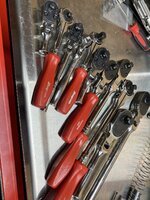
What manufacturers are these flex heads that you are using?
They’re all Snap On with the exception of a Wright 3340.
The 3340 has a very small head and is the ball detent type flex.
Attachments
Billgluckman
Well-known member
- Joined
- May 18, 2014
- Messages
- 93
I don’t even use a fixed head ratchet anymore. I’ve never understood why you’d want a locking flex head over free flex head. I’m sure it would come in handy somehow at some point but when I’m ratcheting I like complete freedom of of my swing.
The snapon Roto head is far better mechanism,uses 2 pawls and far stronger and smoother than the heart spring and single pawl .
Apex Tools ripped design of snapons roto head machanism right down to the selector plastic dial in its first roto head ratchets sold under GW and Cresent, they were a steal buy at times . * Current Apex roto has devolved to cheap and easy heart spring design and it be bad experience purchasing one of those*
Icon is one of best heart spring mechanism easily available at moment as decent enough spec/manufacture effort .
Other options look at is Koken and KTC Japan, KTC do some nice long handle versions, Koken is nice as knurled grip and sensible back drag
Apex Tools ripped design of snapons roto head machanism right down to the selector plastic dial in its first roto head ratchets sold under GW and Cresent, they were a steal buy at times . * Current Apex roto has devolved to cheap and easy heart spring design and it be bad experience purchasing one of those*
Icon is one of best heart spring mechanism easily available at moment as decent enough spec/manufacture effort .
Other options look at is Koken and KTC Japan, KTC do some nice long handle versions, Koken is nice as knurled grip and sensible back drag
Another reason avoid QR roto heads is current common heart sring QR design means they non serviceable as the machine screw replaced by the QR button and that retained by the detent ball and the ratchet selector cover is also retained by press forming when manufactured under the QR button .I have both in 1/4 and 3/8 comfort grips, and a roto SO bit ratchet. Back-drag on rotos is heavier than pear heads.
Biggest thing is 3x+ the price for a SO! The SO heads are quiet a bit thinner and have less back-drag. The Icon reverse is a bit clumsier.
But, SO doesn't make a 1/2" roto last I looked so its Icon there. I also have a Carlyle 1/2 roto. Pretty similar to the Icon (about 2" shorter) but I don't like QR ratchets so It rarely gets used.
the early model carlyle was non QR, the longer handle is nice on icon but it really just grip extends further so likely be using warranty if reefed on it or palm punching end of grip try impact loosen a fastener .
Last edited:
Sure about that? My Carlyle 1/2 roto QR is most definitely repairable: Model R12S100, kit RK12S.Another reason avoid QR roto heads is current common heart sring QR design means they non serviceable as the machine screw replaced by the QR button and that retained by the detent ball and the ratchet selector cover is also retained by press forming when manufactured under the QR button .
the early model carlyle was non QR, the longer handle is nice on icon but it really just grip extends further so likely be using warranty if reefed on it or palm punching end of grip try impact loosen a fastener .
The shank on my 1/4, 3/8, and 1/2 Icon rotos extends almost to the end of the grip. All fairly recent purchases.
Is it not the complete head that comes as that repair kit, you not able strip/clean the internals .Sure about that? My Carlyle 1/2 roto QR is most definitely repairable: Model R12S100, kit RK12S.
The shank on my 1/4, 3/8, and 1/2 Icon rotos extends almost to the end of the grip. All fairly recent purchases.
I didn't buy Carlyle purely as the mechanism was non stripable (done a post showing the way that design sealed)
My icon 1/2 roto the shaft is 2" shorter than grip, had it over a year .
EDIT:
Kt is complete head but it different design again and does have torx screw in the QR button which looks promising .

Last edited:
I just took mine completely apart with a Torx 7 and a little heat to break the locktite. There's a spring and a 10mm nut under the blue cap. Remove nut and selector lifts off to reveal the usual heart spring and single pawl.Is it not the complete head that comes as that repair kit, you not able strip/clean the internals .
I didn't buy Carlyle purely as the mechanism was non stripable (done a post showing the way that design sealed)
My icon 1/2 roto the shaft is 2" shorter than grip, had it over a year .
EDIT:
Kt is complete head but it different design again and does have torx screw in the QR button which looks promising .
#2 on the OP's list, only because it's what I have. In hindsight, I would've spent a little more for the locking tools. Not a pro, so what I have will do. I have a set of Toptul swivel heads that, sadly, I've never used. They're buried in the tool chest. I'll dig them out when the weather breaks. If I like them, they'll get dirty. If not, I'll give them to my grandson.
that a design change for the better . The first QR they had was standard infar style factory press sealed which not great for long term daily use plus having access means you can reduce back drag slightly and clean/relube keeping it functional far longer .I just took mine completely apart with a Torx 7 and a little heat to break the locktite. There's a spring and a 10mm nut under the blue cap. Remove nut and selector lifts off to reveal the usual heart spring and single pawl.
SRU1436
ALLIANCE MEMBER

I have the Teton flex head ratchets. I don’t like using them, the head flexes too much for me. I will probably dI’ve into the locking flex head pool and see if I like them. Deciding between the mac or snap on. I know they are a lot but I feel like spoiling myself. I don’t own any Mac ratchets, and I like they way their locking flex head is. I’m just a home gearhead and dont do it as a profession.
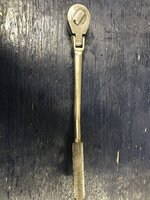
There are times when you need to lean on the ratchet and don’t want it to flex. Typically when you are undoing something with poor access.I don’t even use a fixed head ratchet anymore. I’ve never understood why you’d want a locking flex head over free flex head. I’m sure it would come in handy somehow at some point but when I’m ratcheting I like complete freedom of of my swing.
To answer the OP’s question about what type of ratchet I prefer…it depends. In 1/4 I prefer non locking soft grip flex head, because you can flex it to 90* and use it as a spinner handle once the fastener is cracked. In 3/8” I prefer a regular fr80 non flex because old habits die hard, followed by a long locking flex head, because it’s insanely useful to get into tight spots and crack fastners. In 1/2 I prefer a long non flex for general use (the extra leverage is useful) follows by a 24” flex head, which acts like a ratchet breaker bar. Simple huh!
joel63
Well-known member
Are they all 3/8 drive.They’re all Snap On with the exception of a Wright 3340.
The 3340 has a very small head and is the ball detent type flex.
Very nice collection of flex heads rats.
VolvoRyan
Well-known member
I don’t even use a fixed head ratchet anymore. I’ve never understood why you’d want a locking flex head over free flex head. I’m sure it would come in handy somehow at some point but when I’m ratcheting I like complete freedom of of my swing.
The "better" locking flex head designs can be locked or unlocked. Thus, it can be a flex head ratchet when you need to wiggle the handle around an obstruction. When it's locked, you've got one less variable to control for when dealing with awkward work pieces. The trick here is not only to get a locking mechanism that lets you have it both ways, but one that also doesn't get in the way.
-Ryan
Are they all 3/8 drive.
Very nice collection of flex heads rats.
Thank you sir. They range from 1/4 to 1/2, from left to right.
Shaners256
Well-known member
I've never used a locking flex head ratchet before, but I do like the non-locking, as you can break a fastener with the handle perpendicular to the socket, and then you can turn the handle so it is parallel to the socket and quickly remove the fastener like using a speed wrench.
APEowner
Well-known member
I have non-locking SnapOn flex heads in 1/4", 3/8" and 1/2". I have multiples of the 1/4" and 3/8". They are my go to ratchets. I have never once thought that a locking version would solve a problem I have.
I've never used a locking flex head ratchet before, but I do like the non-locking, as you can break a fastener with the handle perpendicular to the socket, and then you can turn the handle so it is parallel to the socket and quickly remove the fastener like using a speed wrench.
This works really well for me with my SK flex roundheads. My modern ratchets don't seem to function as well in that capacity.
BTW: I have quite a few modern, compact, high tooth count ratchets in both locking and non-locking and those SK's are my favorites by far. If there's room, that's where I reach.
I have been using my new Snap-on locking flex ratchets. I have come to the conclusion that I like non-locking better. I didn't realize how often I change angles on the fly and a locking head prevents that. I can leave it unlocked but it doesn't take much to accidentally bump the lever and lock it back. When I have a long extension or a heavy socket, the lock feature is handy.
I would consider a Matco but there's no driver near me. I don't want to pay tool truck prices without a tool truck.
I would consider a Matco but there's no driver near me. I don't want to pay tool truck prices without a tool truck.
Tynee
Well-known member
1) In my home garage, my go-to ratchets are fixed head, a 70's era FV71, a T72, and an S710.Discuss:
1) Do you prefer a traditional FIXED-head ratchet OR one of the 3 flex-head ratchet types described above as your go-to, front line ratchet choice? What industry do you work in?
2) Of the (3) three versions of flex-head ratchet described above, which do you use / prefer and why?
3) Is a flexible head ratchet or ball-detent flexible head ratchet ever required ***in place of*** a locking flex head ratchet? Are there instances where angle adjustment of the handle is needed during tightening / loosening that makes the mechanical locking flex head a poor choice?
Please discuss.
2) I own only 3 flex head ratchets, an extra long locking Carlyle in 3/8 and 1/2, and a stubby 3/8 Craftsman with detents. I also own flex head ratcheting wrenches with no detents from Tekton.
There are absolutely situations where a flex head is helpful, I'm not sure I'd say necessary, but I don't feel strongly enough about it to argue the point, especially give them limited range of my experience. When I need a flex head, I've always preferred the locking ones with the detent style being a distant second, and the hinge joint being reserved for only those times when nothing but a ratcheting wrench will do the job.
I've never looked into the locking style that you have the option to leave unlocked. I can see where that would be handy, but I'm not sure I'd ever leave it unlocked. I prefer to press the tool head onto the fastener as I turn, and I can do that with one hand if the flex head is locked in place.
It's funny that in about 40 or so years of wrenching on stuff I've never come across a situation where a flex head ratchet was the tool I needed to get the job done. Not saying they aren't great for a use but just never had the occurrence where i could not get it done with one that just had a shorter handle or switched to a wrench. I recently got one of the long handle flex head Icon 3/8's and every time I still reach over it to grab the rubbery black crappy HF ones because I don't want to scratch up the shiny Icon ratchet, lol. I am sure I will eventually run across one situation where I can finally see the payoff but I'm still waiting. I think with the advent of the electric ratchet like the M12 stuff it's kind of been more a game changer for me than flex head ratchets.
I have my eye on the 13" long 3/8" drive 90T locking Gearwrench, but it has been in very short supply the last few months. It has showed up briefly at Amazon, for prices over $100. I can wait for prices to come back to around $75.This was my situation. I did some research and found out that Matco had one of the best locking flex head ratchets on the market. But no easy ordering for me. Then learned that Gearwrench was nearly identical to Matco and available off Amazon. I ordered the Gearwrench set posted above and got a 1/4, 3/8, and 1/2 inch locking flex head ratchet for the price of 1 Matco locking flex head. Quality is really nice on the Gearwrench 90T.
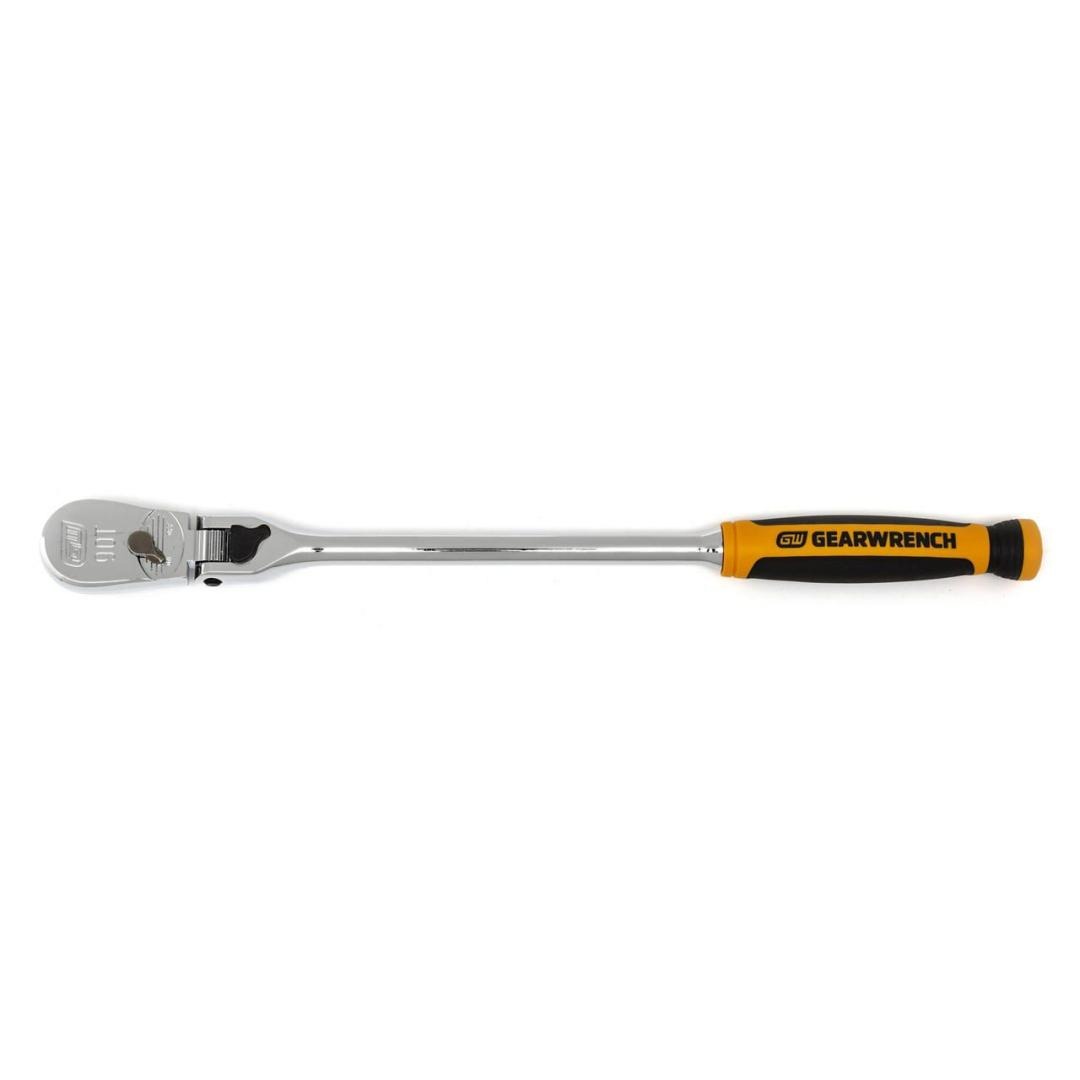
81267T 3/8" Drive 90-Tooth Dual Material Locking Flex Head Teardrop Ratchet 13" - Gearwrench
Count on GEARWRENCH to get the job done. Get the 81267T 3/8" Drive 90-Tooth Dual Material Locking Flex Head Teardrop Ratchet 13" here.
I have a pair of Bonney flex's (old streamline style and the standard Triangle-era T-703K one - the bottom two in the pic) but the one I grab for when needing a flex is an S-K roto-head I converted with one of the DT90 gear kits..
Attachments


Last edited:
71firebird400
Well-known member
- Joined
- Oct 25, 2016
- Messages
- 142
Non-Locking is my preference.
VolvoRyan
Well-known member
Don’t forget the Gearwrench 90T equivalent to the Matco. It is excellent and the designs are nearly identical.
Having owned both, they are FAR, FAR, FAR, (did I mention FAR) different? GearWrench 90T is locking, and has the ball detent.... but the ball detent is very stiff. Matco does not have the stiff detents. The other major difference is that the Gearwrench 90T is garbage. It is the most jiggly wiggly flex ratchet I have ever purchased.
Seriously, all three drive-size GearWrench 90T locking flex ratchets suffered the same maladies.
-Ryan