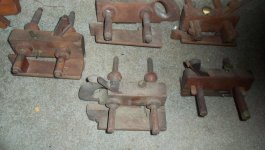
I know that many of the members and visitors to the Garage Journal come here for more reasons than I could ever list. I'm sure the population consists of professional craftsman and techs, to relatively skilled DIYers, and those who are just figuring out tools and getting started. To some extent or another, I think we all have an interest in tools and that's why we keep coming back. It seems like a lot of the focus here is on mechanic's tools. I've learned a lot more about them than I ever knew just by reading your posts. My "continuing education" here has certainly caused me to look more closely at my ratchets, sockets, wrenches, etc., and the way I think about using these tools, and others, more effectively and efficiently when I'm engaged in a project around the house, or if I'm just out in the shop tinkering with an old car or machine.
That being said, every now and then it's nice to see something a little different, so I thought I might occasionally post some information about hand planes. I know there must be some woodworkers here, and I'm sure there are some DIYERs and non-woodworkers who might benefit from seeing and hearing about these very useful tools. I should note here that I'm a hand plane collector. In the coming months, I'd like to present some great hand planes that every DIYER should own and use, and maybe a few others that collectors might enjoy too.
I'm definitely not an expert on all old hand planes. There were so many different manufacturers and types of planes being made out of many different materials, and it would take one a lifetime to learn everything. I'll mainly focus on my passion.....old Stanley cast iron planes. I wouldn't call myself an expert on those either, but I'm learning more and more all the time. I'll try to show them to you in pictures, explain their uses, and give you a little history about each one. In between my ramblings, I REALLY hope that you will share your planes too.
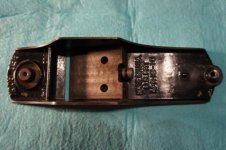
I guess I'll start it off with one of my favorites, the Stanley Bedrock #604 Smoother. It was manufactured by Stanley between 1900 and 1943. The plane depicted below is a "type 8" and was most likely produced between 1927 and 1930. It's about nine inches long and has a two inch wide cutting iron. Back in the day this was one of Stanley's premium bench planes, hence the "Bedrock" name. The Bedrock series of bench planes was a little nicer than Stanley's more common bench planes. Maybe we can discuss some of the differences in a later post. The #604's primary use was to "smooth" the surface of a piece of wood, and it was probably the last plane one would need to use just prior to applying a finish to the wood. I say this because with its iron properly sharpened, and the plane properly tuned, it could leave a finished surface that needed little or no sanding. It's capable of taking a very fine shaving and leaving the wood feeling clean and silky smooth. Still, this plane could easily accommodate many general planing jobs. Today, any DIYER might find it handy to use for planing down the edge of a cabinet door that sticks. The key to using this, and any other plane, is making sure the cutting iron is SUPER sharp. That's half the battle. Although the Bedrock series of bench planes are generally coveted by collectors and users alike, some sizes, like this #604, are available via online auctions, flea markets, and garage sales. A plane this size is one I would recommend to any DIYer. It's versatile, fairly rugged, and compact.
Thanks and I hope to post more in the future.
Jim C.
That being said, every now and then it's nice to see something a little different, so I thought I might occasionally post some information about hand planes. I know there must be some woodworkers here, and I'm sure there are some DIYERs and non-woodworkers who might benefit from seeing and hearing about these very useful tools. I should note here that I'm a hand plane collector. In the coming months, I'd like to present some great hand planes that every DIYER should own and use, and maybe a few others that collectors might enjoy too.
I'm definitely not an expert on all old hand planes. There were so many different manufacturers and types of planes being made out of many different materials, and it would take one a lifetime to learn everything. I'll mainly focus on my passion.....old Stanley cast iron planes. I wouldn't call myself an expert on those either, but I'm learning more and more all the time. I'll try to show them to you in pictures, explain their uses, and give you a little history about each one. In between my ramblings, I REALLY hope that you will share your planes too.
I guess I'll start it off with one of my favorites, the Stanley Bedrock #604 Smoother. It was manufactured by Stanley between 1900 and 1943. The plane depicted below is a "type 8" and was most likely produced between 1927 and 1930. It's about nine inches long and has a two inch wide cutting iron. Back in the day this was one of Stanley's premium bench planes, hence the "Bedrock" name. The Bedrock series of bench planes was a little nicer than Stanley's more common bench planes. Maybe we can discuss some of the differences in a later post. The #604's primary use was to "smooth" the surface of a piece of wood, and it was probably the last plane one would need to use just prior to applying a finish to the wood. I say this because with its iron properly sharpened, and the plane properly tuned, it could leave a finished surface that needed little or no sanding. It's capable of taking a very fine shaving and leaving the wood feeling clean and silky smooth. Still, this plane could easily accommodate many general planing jobs. Today, any DIYER might find it handy to use for planing down the edge of a cabinet door that sticks. The key to using this, and any other plane, is making sure the cutting iron is SUPER sharp. That's half the battle. Although the Bedrock series of bench planes are generally coveted by collectors and users alike, some sizes, like this #604, are available via online auctions, flea markets, and garage sales. A plane this size is one I would recommend to any DIYer. It's versatile, fairly rugged, and compact.
Thanks and I hope to post more in the future.
Jim C.
Attachments


Last edited: