To avoid these ads, REGISTER NOW!

The Milwaukee addiction thread! :)

danski0224

Well-known member
Joined
Jan 29, 2005
Messages
13,352
Location
Near Naperville, IL
Hi all - curious about a Milwaukee product offering. I'm looking for a M18 Fuel left handed circular saw, but want it in 7.25" and preferably brushless. I found the 2730-20, but that's 6.5" and I can't seem to find any others in the larger size I want. I have couple of the M18 XC5.0 Red Lithium batteries already, but wouldn't mind another one or two if a set contained them. I do a lot of woodworking for my home, so I have many other saws, but sometimes a cordless saw would be the best for the project at that time.

The primary/sole reason for the larger size is that I already have a couple of blades for my corded DeWalt, so I don't want to have to purchase additional blades. At the end of the day, it wouldn't be that big of a deal if I did have to pick up another blade or two though. My DeWalt has been great, but I never liked that the blade was on the right side (because I'm a lefty), and am looking for a cordless circular saw anyway for some more versatility.

Thanks in advance,

TC

I am right handed and prefer left blade saws. This allows me to see the blade.

So, I am surprised as a lefty, you want a left blade saw.

Milwaukee makes a corded left blade sidewinder.

In cordless, the only left blade saws are the rear handle saw and the smaller 6.5" saw that comes in many of the tool kits. That little saw kicks some **** though.

The rear handle saw isn't a true worm drive like the Skil version. And, at $269.00, is a little rich.

Maybe Milwaukee will release a left blade regular cordless sidewinder.

A track saw would be really nice too.
 
To avoid these ads, REGISTER NOW!

DFB

Well-known member
Joined
Sep 7, 2016
Messages
5,765
Location
Southern VT/Western Mass
I think the line cut view on the 7 1/4 Milwaukee circular is amazing and way better than any other right side saw I have used in the past, I was really fond of my little 6 1/2" left side Makita saw for long time just because of the line of site for a cut, but using the 2731 circ has turned that back around for me

And the plus is I get a bigger more powerful unit that's really lightweight to use :D
 

danski0224

Well-known member
Joined
Jan 29, 2005
Messages
13,352
Location
Near Naperville, IL
I have the 1st gen Fuel 7.25 saw, and I'm not impressed with the cut line view.

The 6.5 saw fills most of my needs, gets used far more often, and it was a letdown when I broke out the bigger one.

If Milwaukee releases a left blade 7.25, I'd be interested.
 

DFB

Well-known member
Joined
Sep 7, 2016
Messages
5,765
Location
Southern VT/Western Mass
What is the rationale for right vs left?

I would think Left would predominate and Right would be rarer.

Large powerful and heavy rear handle worm drive saws excluded here...the left side sidewinder saws have generally been lighter smaller blades for more accurate trim crosscuts.

Seems to me IF there was a big need for 7 1/4" left blade sidewinders in the industry there would be plenty of them on the market by now including corded options.

Honestly TGJ here is about the only place I really ever hear people wanting a lefty 7 1/4" sidewinder and I dunno if its just new guys to using tools or what


Though I totally agree by "seeing" the blade and line but not having to look over the saw can make better cut for many people and I'm not at all trying to insult anyone but sounds like that could be just compensation for maybe a lack of skill handling a standard right side blade saw. But certain situations like let say doing some plywood rips using both type of saws left and right blade can often make it easier just for reach and angle as your walking the saw thru a long cut

My GC buddy after all this time knowing him still sometimes awes me with the things he'll do with a standard 7-1/4" sidewinder, notching wood, dado cuts, fast, accurate rips...makes it all look easy.

Unless its total cabinet/furniture in a lot a carpentry work a saw is sometimes all you need to get the job done.

And with the sawdust blower and light it's easier than its ever been IMO :beer:
 
Last edited:

danny_barkley

Well-known member
Joined
May 17, 2013
Messages
800
Location
FL
Large powerful and heavy rear handle worm drive saws excluded here...the left side sidewinder saws have generally been lighter smaller blades for more accurate trim crosscuts.

Seems to me IF there was a big need for 7 1/4" left blade sidewinders in the industry there would be plenty of them on the market by now including corded options.

Honestly TGJ here is about the only place I really ever hear people wanting a lefty 7 1/4" sidewinder and I dunno if its just new guys to using tools or what


...

And with the sawdust blower and light it's easier than its ever been IMO :beer:

Why have 'em(left bladed) in 6 1/2 but not 7 1/4? There's got to be some logic here as to the why?
 

Ign

Well-known member
Joined
Jul 7, 2006
Messages
12,769
Location
Butte Peak ND
I have the 1st gen Fuel 7.25 saw, and I'm not impressed with the cut line view.

The 6.5 saw fills most of my needs, gets used far more often, and it was a letdown when I broke out the bigger one.

If Milwaukee releases a left blade 7.25, I'd be interested.

The 2830 is 7.25 and left blade, so what am I missing on your wish list?
 

kctyphoon

Banned
Joined
Jun 9, 2014
Messages
9,102
Location
Jersey/Staten Island
There is a point you'll eventually hit where you just don't need any new tools. You'll have everything you need, including a bunch of specialized stuff, in good quality versions you like to use, and the appeal and excitement looking through a tool site/catalog will just sort of go away. Not that you will ever stop entirely, but it will just be very specialized stuff, replacing things that wear out, and the occasional game changing tool that's not just a gimmick like most. You really know you've hit that point when you are building yourself tools/jigs you really can't find commercially out of brass and walnut, and you are buying upgrades for plumbing tools.

Phase 2 is shop optimization. You will get rid of a bunch of stuff you don't use, and you'll start redesigning your storage to be more efficient and cleaner while working. Earlier shop projects will get replaced.

Phase 3 is a brand new dream shop. I've not made it this far yet, when I do there will some large stationary power tools I'll finally have room to buy/replace so I suspect there will be some more phase 1/2 all over again but not too much.

Phase 4 is when you realize your getting too old, and your body hurts too much to care about phase 3 anymore. Throw a good back injury in there, and a lifetime of pain killers - youll be surprised how soon you can hit phase 4.
 

jmhinkle

Well-known member
Joined
Feb 6, 2019
Messages
452
Location
Portland, OR
Phase 4 is when you realize your getting too old, and your body hurts too much to care about phase 3 anymore. Throw a good back injury in there, and a lifetime of pain killers - youll be surprised how soon you can hit phase 4.

I can agree with this totally. I hit phase 2 and 4 at the same time and I don't consider myself remotely old at 44. One random back injury really changes what you can physically do without serious thought or calling in help. As much as I still have dreams of Phase 3, I just can't do a lot of the work I used to that previously made it need more than just a want. If I end up finding a place with a big shop it will be for car/toy collecting more than fun projects anymore.
 

danski0224

Well-known member
Joined
Jan 29, 2005
Messages
13,352
Location
Near Naperville, IL
The 2830 is 7.25 and left blade, so what am I missing on your wish list?

It's quite a bit larger (longer) than the plain old right blade saw.

I have the "old" Fuel version, and did not realize that the rear handle saw is about the same price as the 2732 version.

If the rear handle version goes on sale sometime, maybe.
 

jmhinkle

Well-known member
Joined
Feb 6, 2019
Messages
452
Location
Portland, OR
Left blade saws are usually rear handled because they were worm drive for more power. The new brushless motors aren't worm drive, but keep to that profile as is what is most common.

I'm not sure why we are having this discussion yet again when we just went through it about a month ago.
 

mobiledynamics

Well-known member
Joined
Mar 14, 2010
Messages
5,034
Location
Gotham City
re: injuries. A few years back , I was out in the yard and had the shovel to break some dirt. Shovel ontop, foot on the heelrest and decided to go all in - heave ho down with the leg....unbeknowest there was a stone fairly shallow. Reverberted up the steel, up the lee and still, 3-4 years later, everyone in awhile, the knee acts up for a few days !
 

DFB

Well-known member
Joined
Sep 7, 2016
Messages
5,765
Location
Southern VT/Western Mass
Why have 'em(left bladed) in 6 1/2 but not 7 1/4? There's got to be some logic here as to the why?

Ya I thought for different reasons this was covered before too

Well circular saws and (most other power saws in general) certainly can be inherently dangerous, and the industry standard of right side blades on basic consumer grade saws IMO still is that for it keeps the blade farther away from the body for the majority of users who in general are right handed. (Honestly southpaws have problems with a lot things as right hand seems to be more dominate)

With a left had saw for a right hand user you CAN get your fingers closer to blade no matter what by doing crosscuts as you often hold the work piece with your left hand and possibly if one ever lost balance for some reason and fell into or thru your workpiece hold onto the saw and especially maybe with long rip cuts there could be that chance of an exposed moving blade and with a left saw blade would be facing the operator vs being pushed away to the outside.

Obviously work should properly supported plywood cuts on horses so the kerf doesn't close under tension and jam the saw the blade or have the either cut piece fall, doing crosscuts trim boards should be clamped solid. But alas not everybody does these things of course.

One other point with the top handle sidewinder the body position is more over the saw where as with a more professional user oriented rear handle your more inclined to be pushing away from your body.

And here's another thing and I don't know if ever seen it done or even concept it, but its a pretty standard OP with many people and not really safe but it happens. My GC buddy does it a lot when making a narrow rip cut of the edge in sheet goods. He sometimes uses his thumb and forefinger like a sawguide keeping the base straight as he moves along. Now with right side blade there is probably close to 5 inches distance between the edge of the saw plate and the blade...So reverse that (a left side blade) and its definitely less than 2 inches on most saws :shocking:


Just as an FYI my pal did cut 3 fingers long before I knew him on table saw in back in his college days. He's 65 now been a carpenter all life. So he is the first one to be aware where his fingers are at all times in relation to the blade.
 

Ign

Well-known member
Joined
Jul 7, 2006
Messages
12,769
Location
Butte Peak ND
^^^^don't worry ol' Gass will be trying to convince the CPSC his flesh-detecting technology should also be mandatory for handheld circulars.....just give him a handsome royalty....and circulars will now start at $350 for a base model and replacement cartridges are only $30....or maybe $50....each.

But it's a small price to pay for safety, right? ;)
 

DFB

Well-known member
Joined
Sep 7, 2016
Messages
5,765
Location
Southern VT/Western Mass
^^^We don't need no stinking safety badges :D


Gawd the kerf opener and blade guard that came on that 10" Ryobi table saw we have down in the barn at work will give you fits.

I remember when I bought my old blue Ryobi Chop saw second hand at the flea mkt many years ago...I thought the blade guard was broke because it didn't rotate down and cover the blade when went to make a cut closer inspection showed that the guy before me had jammed a shim of wood up in the aluminum housing that effectively wedged the plastic guard so it didn't move. Another fine feature that ya can't see jack with it working like it should.

Radial arms were best

my 7 1/2" 2 bar radial arm siding trim saw if your not being careful the blade can walk itself right over the top of 3/4" board never cutting it and land on the other side :eyecrazy:
 

Farmall450

Well-known member
Joined
Dec 23, 2011
Messages
13,355
Location
Marengo, Illinois
I am right handed and prefer left blade saws. This allows me to see the blade.

So, I am surprised as a lefty, you want a left blade saw.

Milwaukee makes a corded left blade sidewinder.

In cordless, the only left blade saws are the rear handle saw and the smaller 6.5" saw that comes in many of the tool kits. That little saw kicks some **** though.

The rear handle saw isn't a true worm drive like the Skil version. And, at $269.00, is a little rich.

Maybe Milwaukee will release a left blade regular cordless sidewinder.

A track saw would be really nice too.

Agreed. I'm lefty and prefer blade right (ie the premium DeWalt 7-1/4) but rightys often complain (rightfully so) it's a lefty saw, despite handles and manufacturer stating otherwise. Perhaps it's legal reason that they want you on the opposite side of the blade?
 

DerekV

Well-known member
Joined
Oct 12, 2016
Messages
1,070
Location
Central TX
Rapid charging to 80%, especially from a low state, isn't really bad.


“Bad” in your explanation is subjective. The fact is, slower charging will always be better for battery longevity when all other conditions are equal. It’s literally no different than high vs. low current discharge where the former will degrade a battery faster than the latter.

I’d rather save all of the wear and tear for when I’m using them in the tools. At least I’m getting something out of it (more work over the life of the battery).
 
To avoid these ads, REGISTER NOW!

M635_Guy

Well-known member
Joined
Dec 5, 2019
Messages
4,333
Location
NC
“Bad” in your explanation is subjective. The fact is, slower charging will always be better for battery longevity when all other conditions are equal. It’s literally no different than high vs. low current discharge where the former will degrade a battery faster than the latter.

I’d rather save all of the wear and tear for when I’m using them in the tools. At least I’m getting something out of it (more work over the life of the battery).
"Bad" in my explanation is relative, but not subjective.

And the charge vs. discharge condition is not the same since chargers provide a very specific set of conditions that can help extend the lifespan of a battery. Given what Milwaukee does on battery warranties (3 years - think the bigger ones might be 5 years), they have every incentive to optimize for lifespan.

I work in the tech industry and have a fair bit of exposure to the workings of batteries as it relates to lifespan degradation due to charging. The use definitely isn't the same, but charging should be very similar. Given what Milwaukee is doing to mitigate over-heating batteries, etc. it's entirely possible they have awareness for things like cycle-count and remaining capacity that can allow fast charging with minimal impact to the lifespan of the battery.
 

DerekV

Well-known member
Joined
Oct 12, 2016
Messages
1,070
Location
Central TX
"Bad" in my explanation is relative, but not subjective.


And the charge vs. discharge condition is not the same since chargers provide a very specific set of conditions that can help extend the lifespan of a battery. Given what Milwaukee does on battery warranties (3 years - think the bigger ones might be 5 years), they have every incentive to optimize for lifespan.


I work in the tech industry and have a fair bit of exposure to the workings of batteries as it relates to lifespan degradation due to charging. The use definitely isn't the same, but charging should be very similar. Given what Milwaukee is doing to mitigate over-heating batteries, etc. it's entirely possible they have awareness for things like cycle-count and remaining capacity that can allow fast charging with minimal impact to the lifespan of the battery.


It’s subjective because it is your opinion that the trade off of battery longevity for faster charging isn’t really bad enough to justify slower charging. That’s a fine position to take and I’m sure many would accept this trade off without batting an eye...as they say, there are bigger fish to fry. And while rapid charging might not have a warranty-threatening impact for Milwaukee (which isn’t saying much given the relatively short 2-3 year term lengths), it has an impact that can be measured. That is a fact. The impact can vary depending on many variables, yes, but all things considered charging at a slower rate is unquestionably better for longevity.

Good lithium batteries have potential to perform like new for several years, decades even, if managed accordingly. I’m sure you know that given your workplace exposure. Not trying to get in a battle of credentials, but FWIW I dealt with lithium battery energy management and maintenance at my last job (also tech industry). Milwaukee sources high quality cells and uses sound management logic for a balance of great performance with good longevity. Let’s face it though: 2 years for CP packs and 3 years for XC & HD packs is not a long time. Milwaukee knows they can afford rapid charging because in such small warranty window, they can be confident that degradation will not be a problem, or THE problem for that matter. Stretch that out to 5-10+ years and the quick-charged packs will have measurably less runtime and/or performance (i.e. more sag) than ones charged at a slower rate of the same age, use, and cycles. Remember, we’re not talking about liquid cooled packs with sophisticated (aka beyond “too hot = don’t charge, not too hot = charge”) temperature regulated controlled charging here.

I drew the discharge parallel because I figured that‘d be an easy way to understand the point I’m making. Just because something has the ability to do something doesn’t mean it’s best to live in that condition. People seem to have an easy time acknowledging the correlation between discharge rates and wear. All you have to do now is remove the “dis” from “discharge” :D and boom, my point!

And just like charging, discharging has operational parameters built into the logic, too. Given the right conditions, the pack should be allowed to output more than it would in less than perfect conditions, assuming the tool can command it. Either way, the pack experiences some wear and tear when it’s being used. At least in this scenario the user is getting something out of it — work and/or tool performance. The packs aren’t performing ANY work when sitting on the charger — why consciously induce additional stress (stress = wear) on them if you can easily avoid it? That’s my point :thumbup:
 

M635_Guy

Well-known member
Joined
Dec 5, 2019
Messages
4,333
Location
NC
It’s subjective because it is your opinion that the trade off of battery longevity for faster charging isn’t really bad enough to justify slower charging. That’s a fine position to take and I’m sure many would accept this trade off without batting an eye...as they say, there are bigger fish to fry. And while rapid charging might not have a warranty-threatening impact for Milwaukee (which isn’t saying much given the relatively short 2-3 year term lengths), it has an impact that can be measured. That is a fact. The impact can vary depending on many variables, yes, but all things considered charging at a slower rate is unquestionably better for longevity.

Good lithium batteries have potential to perform like new for several years, decades even, if managed accordingly. I’m sure you know that given your workplace exposure. Not trying to get in a battle of credentials, but FWIW I dealt with lithium battery energy management and maintenance at my last job (also tech industry). Milwaukee sources high quality cells and uses sound management logic for a balance of great performance with good longevity. Let’s face it though: 2 years for CP packs and 3 years for XC & HD packs is not a long time. Milwaukee knows they can afford rapid charging because in such small warranty window, they can be confident that degradation will not be a problem, or THE problem for that matter. Stretch that out to 5-10+ years and the quick-charged packs will have measurably less runtime and/or performance (i.e. more sag) than ones charged at a slower rate of the same age, use, and cycles. Remember, we’re not talking about liquid cooled packs with sophisticated (aka beyond “too hot = don’t charge, not too hot = charge”) temperature regulated controlled charging here.

I drew the discharge parallel because I figured that‘d be an easy way to understand the point I’m making. Just because something has the ability to do something doesn’t mean it’s best to live in that condition. People seem to have an easy time acknowledging the correlation between discharge rates and wear. All you have to do now is remove the “dis” from “discharge” :D and boom, my point!

And just like charging, discharging has operational parameters built into the logic, too. Given the right conditions, the pack should be allowed to output more than it would in less than perfect conditions, assuming the tool can command it. Either way, the pack experiences some wear and tear when it’s being used. At least in this scenario the user is getting something out of it — work and/or tool performance. The packs aren’t performing ANY work when sitting on the charger — why consciously induce additional stress (stress = wear) on them if you can easily avoid it? That’s my point :thumbup:
I think we're not as far off as reading this might imply, but the net of it for me is that the cycle count these are designed to is unlikely to offer but so much. For most people non-professional users, the lifespan of these batteries is likely to far exceed the warranty (for the most part) and is much more likely to be shorted by people who discharge a bar or two and then recharge the battery (esp. on a quick-charger).

I'm guessing most of us are awash in freaking chargers, so I suppose we can make the choice between a rapid charge (if you own one) used for long/big/multiple-tool tasks, and the standard charger (which still probably charges faster than you'd like given your goals).

FWIW, I eschew the rapid charger that came with my phone and charge it nice & slow via a regular (slow) USB port when I charge overnight. I always wake up at some point during the night, and have gotten in the habit of eyeballing the phone and unplugging it from the slow charger if it's full, so I get it ;)
 

Bolster

Well-known member
Joined
Jul 8, 2008
Messages
4,056
Location
Mexifornia
I’m interested in the battery discussion, thanks guys. In particular (forgive the ellipses) this:

… charging normally from 80% back to 100% both cause "wear" on the battery and reduce the life-span….Use your batteries until they say they need to be charged, or at least use them more than halfway down before you charge, and you'll have longer-lasting batteries. That's true of phones, PC's, etc. too...the lifespan of these batteries is likely to far exceed the warranty (for the most part) and is much more likely to be shorted by people who discharge a bar or two and then recharge the battery (esp. on a quick-charger).

My understanding is mostly in line: That the danger to Li-ion is in overcharging, so a Li-ion will last longer if you don’t charge completely to full; i.e., partial charges are better. Some sources say to aim for 85% full. However, terminating early is difficult or impossible with consumer grade chargers, since they usually charge to full and there’s no way to know when 85% is reached. Stress occurs to the battery as it is charging in the high-voltage threshold near the end of the charge—which coheres to M635’s advice above to not constantly recharge in the upper ranges. (Sources: https://batteryuniversity.com, https://www.edn.com/, https://batterymanguide.com/, https://www.plugincars.com/) I pull my Li-ions off the charger as soon as I see green, but that's likely far past 85%.

On the other end, Li-Ions don’t like to be drained too far down, either. (https://batterymanguide.com/, https://www.wikihow.com/Maintain-Lithium-Battery, Powerextra battery user manual.) “Lithium-ion packs prefer a partial cycle rather than a deep discharge.” (https://www.plugincars.com/)

But can you charge a Li-Ion that’s partly low, with no penalty? Some sources say so: “The Li-Ion battery can be charged at any time without reducing its service life.” (Powerextra battery user manual.) “Charge your [LiIon] battery often rather than letting it run all the way down. While some older batteries may get damaged if you charge them too often, lithium batteries function better if you keep them charged.” (https://www.wikihow.com/Maintain-Lithium-Battery)

Some sources say “No fast charging. Li-ion battery works and performs better with a low and slow charging process. Fast charging can raise the volume of current to the battery which can stress it out and cause damage and harm.” (https://batterymanguide.com/) “Regular use of fast charging will cost you about 1 percent of capacity per year.” (https://www.plugincars.com/).

The picture I get is: for max life, aim to keep a Li-ion between empty and full, and charge slow. If time is money and you need a fast charge, then 1% per year loss of capacity is an affordable penalty for a Milwaukee battery...more costly on a Tesla.
 
Last edited:

kctyphoon

Banned
Joined
Jun 9, 2014
Messages
9,102
Location
Jersey/Staten Island
I think I’d be good with 10% loss over TEN YEARS for the benefit of only needing half (or less) of a charge time with a rapid charger, at EVERY charge.

Debates like these go nowhere - cause no researchers can ever produce actual real world comparison numbers over years, on a large scale. Its always theories, and forecasted results since it’s ALWAYS subjective and NO battery ever lives the exact same life as another.. My advice is to give up debating, and just cause someone published an article doesnt make either side gospel. Nobody will win this.

A few years ago i posted how it would be nice to be able to use 1 or 2 lithium packs from a cordless tool as a jump pack. I got a page of results from “experts” “explaining” how it would be impossible for a small battery to jump a car. Yet here we are.
 
Last edited:

M635_Guy

Well-known member
Joined
Dec 5, 2019
Messages
4,333
Location
NC
I’m interested in the battery discussion, thanks guys. In particular (forgive the ellipses) this:


My understanding is mostly in line: That the danger to Li-ion is in overcharging, so a Li-ion will last longer if you don’t charge completely to full; i.e., partial charges are better. Some sources say to aim for 85% full. However, terminating early is difficult or impossible with consumer grade chargers, since they usually charge to full and there’s no way to know when 85% is reached. Stress occurs to the battery as it is charging in the high-voltage threshold near the end of the charge—which coheres to M635’s advice above to not constantly recharge in the upper ranges. (Sources: https://batteryuniversity.com, https://www.edn.com/, https://batterymanguide.com/, https://www.plugincars.com/) I pull my Li-ions off the charger as soon as I see green, but that's likely far past 85%.

On the other end, Li-Ions don’t like to be drained too far down, either. (https://batterymanguide.com/, https://www.wikihow.com/Maintain-Lithium-Battery, Powerextra battery user manual.) “Lithium-ion packs prefer a partial cycle rather than a deep discharge.” (https://www.plugincars.com/)

But can you charge a Li-Ion that’s partly low, with no penalty? Some sources say so: “The Li-Ion battery can be charged at any time without reducing its service life.” (Powerextra battery user manual.) “Charge your [LiIon] battery often rather than letting it run all the way down. While some older batteries may get damaged if you charge them too often, lithium batteries function better if you keep them charged.” (https://www.wikihow.com/Maintain-Lithium-Battery)

Some sources say “No fast charging. Li-ion battery works and performs better with a low and slow charging process. Fast charging can raise the volume of current to the battery which can stress it out and cause damage and harm.” (https://batterymanguide.com/) “Regular use of fast charging will cost you about 1 percent of capacity per year.” (https://www.plugincars.com/).

The picture I get is: for max life, aim to keep a Li-ion between empty and full, and charge slow. If time is money and you need a fast charge, then 1% per year loss of capacity is an affordable penalty for a Milwaukee battery...more costly on a Tesla.

Most batteries/devices are set up so they won't drain the battery all the way, and likely there's some designed-in buffer on capacity as well by Milwaukee. These days, there's not much reason to worry about that.

It is true that not going all the way down is a good thing, but you don't want to go 80%-->100% all the time either - as you noted that induces significant incremental wear on the battery. Also, quick charging above 80% poses safety risks - if your cells are defective/etc. it can cause overheating and even fires (which the PC industry found out several years ago).

I agree with the 85% target - I've got an app on my phone that monitors use and charging, and will give you a notification when 85% is reached so you can unplug it. The phone manages power pretty well. I do end some days at 6%, but top off if I'm concerned I won't make it all day. My PC has a power-management app that will let you set a level where it will start to charge (e.g. 70%, 60%, whatever) so even if you leave you desk and come back you won't charge from 92% back to full (over and over and over...).

One of my favorite bits from the show The Good Place is that in this little corner of 'heaven' the frozen yogurt shop has all kinds of unusual yogurt flavors ("Hot Shower", "No Traffic", etc.), but the best one by far is "Full Battery" :)

I think I’d be good with 10% loss over TEN YEARS for the benefit of only needing half (or less) of a charge time with a rapid charger, at EVERY charge.

Debates like these go nowhere - cause no researchers can ever produce actual real world comparison numbers over years, on a large scale. Its always theories, and forecasted results since it’s ALWAYS subjective and NO battery ever lives the exact same life as another.. My advice is to give up debating, and just cause someone published an article doesnt make either side gospel. Nobody will win this.

A few years ago i posted how it would be nice to be able to use 1 or 2 lithium packs from a cordless tool as a jump pack. I got a page of results from “experts” “explaining” how it would be impossible for a small battery to jump a car. Yet here we are.
I think this is a pretty interesting conversation - nobody is throwing rocks
k0WNDf.gif
(I'm not looking to "win" either)

FWIW, manufacturers track warranty rates really closely, and I'd guess most will test any warranty returns (mine does - literally every one) for various things to verify root-cause. Helps with vendor selection, design, etc., helps improve process to avoid no-defect replacements and there are often warranties from the cell-suppliers to the manufacturer too (rebates above a certain failure rate). There are a variety of design-level tests that very accurately predict long-term large-scale performance, and the failure/warranty claim rate is tracked against those. Batteries are an expensive warranty item, especially when they're built-in, but even just shipping the replacement out and getting the old one back is a serious outlay of cash. Because of that, batteries get a lot of scrutiny (at least from good makers/brands).

I'd love to have the option of a slow charge to a defined level (or just Slow/Full, Slow/85%) and a Turbo button for when I need a full charge as quickly as possible. Highly doubt we'll never see that.

Given the lack of options, I just don't worry about it for my tools.
 
Last edited:

danski0224

Well-known member
Joined
Jan 29, 2005
Messages
13,352
Location
Near Naperville, IL
My Milwaukee M18 batteries have already given more service life than the Milwaukee NiCd 18V batteries, Makita 12V NiCd/NiMh batteries and WAY more than those ****** V18 batteries.

Yes, I would want the best life from the batteries, but there aren't any real options other than the OEM chargers.
 

Ign

Well-known member
Joined
Jul 7, 2006
Messages
12,769
Location
Butte Peak ND
I switched everything to Rapid Chargers a couple years ago - 2 in the house, 4 in the shop wall-mounted plus the 3-bay for mobile work

Indeed, knowledge is power and if people want to spend their time geeking out on on-paper theory, fine. I use my stuff and move on, I've just got better things to do.
 

DFB

Well-known member
Joined
Sep 7, 2016
Messages
5,765
Location
Southern VT/Western Mass
As relates the post about only charging 85% capacity

The rapid charger does start blinking green that the batteries ready before ever reaching 100% capacity
 

Bolster

Well-known member
Joined
Jul 8, 2008
Messages
4,056
Location
Mexifornia
I think this is a pretty interesting conversation - nobody is throwing rocks (I'm not looking to "win" either)...

...I'd love to have the option of a slow charge to a defined level (or just Slow/Full, Slow/85%) and a Turbo button for when I need a full charge as quickly as possible. Highly doubt we'll never see that...

Agree on #1 - interesting to me too. A civil conversation, and I've learned a lot from it. We all win if we can learn to manage batteries in a way that suits us, whether geek or not. I'm now fully motivated to not "top off" my Li-Ions.

Agree on #2 - that would be awesome. DFB notes rapid charger goes green flash before 100%. Do we know at what state of charge green flash occurs?

No researchers can ever produce actual real world comparison numbers over years, on a large scale. Its always theories, and forecasted results since it’s ALWAYS subjective and NO battery ever lives the exact same life as another..

LOL, I take it you didn't major in statistics. Your assertion of subjectivity is fighting words to a statistician...but don't worry...linemen usually win physical confrontations with statisticians.
 
Last edited:

danny_barkley

Well-known member
Joined
May 17, 2013
Messages
800
Location
FL
Agree on #1 - interesting to me too. A civil conversation, and I've learned a lot from it. We all win if we can learn to manage batteries in a way that suits us, whether geek or not. I'm now fully motivated to not "top off" my Li-Ions.

Agree on #2 - that would be awesome. DFB notes rapid charger goes green flash before 100%. Do we know at what state of charge green flash occurs?

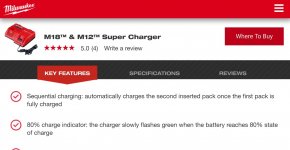
I think they Flash Green at 80%
 

darkzero

Well-known member
Joined
Oct 20, 2011
Messages
3,317
Location
SoCal
Interesting that the Rapid has this feature but the Multi and the Super do not mention it.

The SC does. Just doesn't mention it in the same area on the page that the Rapid does.
 

Attachments

  • Screenshot_20200105-160600.jpg
    Screenshot_20200105-160600.jpg
    88.8 KB · Views: 33

DFB

Well-known member
Joined
Sep 7, 2016
Messages
5,765
Location
Southern VT/Western Mass
Interesting that the Rapid has this feature but the Multi and the Super do not mention it.

Ya it's mentioned on the Milwaukee site for "SUPER" charger

https://www.milwaukeetool.com/Products/Batteries-and-Chargers/M18-Batteries-and-Chargers/48-59-1811

But no the standard multi charger never had that feature. Must be all to do with the heat produced with the faster and higher amperage charging systems.

Guess it didn't need it or wasn't concepted for it's original intentions 5.0AH and smaller in general for the M18 batteries. Heat generally never seemed to me to be any issue until I got a 9.0.

I wont even charge that one on standard multi. Tried that like once

Conversely I normally don't put anything smaller than a 5.0 or sometimes a 4.0 on my rapid but that's just me.

I'm 5 years now on some of my batteries both M12 and M18 always "full charged" them with standard Multi or M12 single charger. Nothing shows any ill effects...no loss of power, runtime, or have any actually gone bad,

Found two 2.0 compacts fully dead recently (my bad/forgot about them ) and thought maybe they had both seen that bright light and left for good but just like Lazarus (John 11:43–44). they were resurrected to live again :D
 

DerekV

Well-known member
Joined
Oct 12, 2016
Messages
1,070
Location
Central TX
I'd love to have the option of a slow charge to a defined level (or just Slow/Full, Slow/85%) and a Turbo button for when I need a full charge as quickly as possible. Highly doubt we'll never see that.

Given the lack of options, I just don't worry about it for my tools.


Agreed, charging options would be awesome. I think Bosch has a few different charging modes, including a “storage” mode. Pretty cool.

Milwaukee doesn’t want to give us that control though. No money in that! Oh well, use the tools and move on...
 

DerekV

Well-known member
Joined
Oct 12, 2016
Messages
1,070
Location
Central TX
Guess it didn't need it or wasn't concepted for it's original intentions 5.0AH and smaller in general for the M18 batteries. Heat generally never seemed to me to be any issue until I got a 9.0.


I’ve only charged my 9.0s on standard chargers (go figure :D ) and while the charger gets warm (whatever, it’s a charger), the packs are always no hotter than what they were when I popped em on :thumbup:
 

DerekV

Well-known member
Joined
Oct 12, 2016
Messages
1,070
Location
Central TX
Some sources say to aim for 85% full. However, terminating early is difficult or impossible with consumer grade chargers, since they usually charge to full and there’s no way to know when 85% is reached.


I can’t speak for the rapid or super chargers or any of the HO battery packs, but if you’re using the standard charger, popping the pack off a few seconds after the 4th light bar on the fuel gauge comes on will yield a charge of ~19.6v, which is 3.92v/cell, which is a good SOC for very decent run time when you use it next while also being a very decent storage voltage. A great middle ground. This is only really feasible if your camping in front of the charger though.

Quick note about the fuel gauge 3-to-4 bar transition and the ~19.6v: the pack voltage seems to differ slightly depending on CP/XC/HD packs and the production date...don’t ask why, that’s just what I’ve observed with various M18 packs.
 

navin

Well-known member
Joined
Jan 5, 2012
Messages
101
Anyone use their m12 hackzall for trimming/pruning branches, etc... Or should I step it up to the m18 hackzall?

I'm sure I can find other uses for it, but right now it's the best one I have and also an easy way to convince the old lady.
 
To avoid these ads, REGISTER NOW!
Top Bottom