It's been a while! Back with a car-centric update - this time on the BMW 8-series.
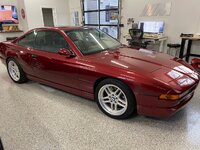
I've been an E31 owner seven times over and have covered most of the available models. '91 850 Auto, '94 850 CSi, '91 850 6-speed, '93 850 6-speed, another '93 850 6-speed, a '93 850 Auto and my current one, an M62-swapped 6-speed 840Ci in Avus Blue.
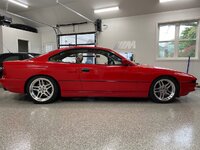
My first was bought in 2008, a Canadian-market model with an option I didn't quite appreciate at the time - sport seats. I know opinions on E31 sport seats vary a lot - but I'm a fan. A big, big fan - given I loved the way they felt in the car. I'm 6'1 and 175 pounds, so they fit me well - and I just love the adjustability of a normal BMW sport seat. From the original 850:
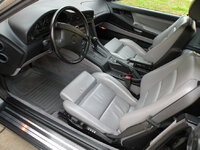
If I were smart, I would have pulled the sport seats from my original car and kept them around for the future, but I'm not smart. Instead, I've spent the last 16 years pining for the day where I'd own another car with a set.
Just recently, a buddy of mine moved from the US to the UK. That sort of opened the door to me thinking about finding a set overseas. I started looking on eBay for a set he could actually lay eyes on - specifically in the UK. With those being RHD cars, I knew there would be work to do in making them operate correctly. The threads I've read over the years make the process seem impossible, so I figured I'd do a quick write-up on the process I followed.
In terms of purchasing and getting the seats here - it was surprisingly easy. I've imported cars from Europe and I'd say the seat import was FAR easier. I used Brendon at Dubstocksales in the UK to facilitate shipment to the US. The eBay seller palletized the seats and sent them over to Brendon to prep for shipment. Brendon then shipped them out via FedEx, telling me it'd be roughly 4 weeks in transit. It ended up being 8 days! I wasn't even home when my wife sent me this photo:

Whoops - did I mention I was buying some seats from Europe.
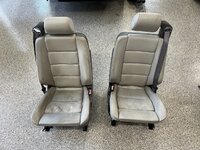
Unpacking the palette revealed a set of sport seats in poor to fair condition. I've refinished a ton of seats in my life so the overall condition didn't concern me. That said, they were absolutely filthy.
I then set out to take as many pictures as possible (not nearly enough) of the car wiring and where the powered harness connected on my current LHD passenger seat.
The set from the UK was powered, was RHD and had memory seats on the driver's side (right). The passenger seat was not a memory seat, obviously. My car was obviously reversed (memory on left, non-memory on right). So the initial task was to migrate the non-memory harness from my current seat to the new passenger seat. Here are the photos of the US passenger seat with the non-memory harness.
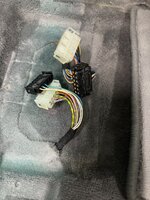


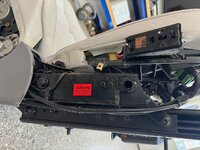
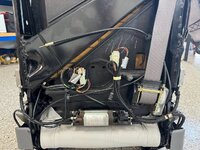
Taking the harness out was surprisingly straightforward. It's held in by a series of 30 or so zip ties, mostly tied to the existing motor cabling. Snip, snip, snip.
The old driver's seat had memory attachments to the motors, but I ignored that when installing the harness onto the new passenger side. Everything goes in the exact way the old one came out - with a couple adjustments.
1) The UK seat didn't have wiring to the seat belt receptacle, but I migrated the receptacle and the wiring to match the US seat.
2) The thigh extension wiring was present on the US harness, but unused. Since the seat harness had memory, I had to splice into that one memory connector to power the thigh extension. Easy.
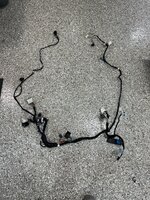
Here's the process mid-stream. It helps to have the two seats side-by-side. Nothing hard at all, just mildly time consuming.
For the new driver side, I pulled the harness from the memory-enabled US seat. I haven't migrated it over to the UK seat yet, but the process should be similar to the opposite direction, except you need to migrate the attachments on the motors that drive the memory function. In doing so, the cabling will need to be trimmed to match the new length needed.
I mainly wanted to get to a point this weekend where I could test both seats in the car, so I left the non-memory UK harness in place.
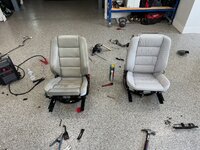
Here are the two seats prior to cleaning. Gross.
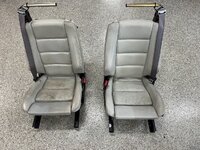
And a quick 50/50 after some deep, deep cleaning. Also gross.

Both seats cleaned. Obviously, still quite a bit to do to fill cracks, repair gouges and re-dye it all, but it's looking loads better.
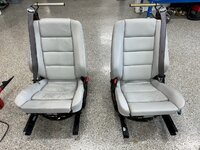
Test fitted into the car. No warning lights, all functions work (except mirror adjustment, which apparently relies on the memory functions).


Part two of the seat project happened this past weekend. After installing the seats and going for a drive, I recognized the mirror adjustment simply wasn't going to work unless I migrated the memory harness from my US seat to the new driver's seat. I really worked hard at talking myself into NOT doing it, but knew I had to.
I didn't get many photos of the memory harness swap, beyond the following two pictures that illustrate the only semi-challenging part of the move - the memory attachments on the motors.
With motor
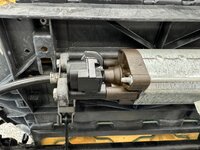
Without motor
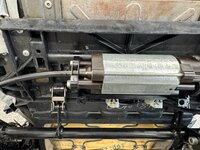
You can see the black piece that sits between the bracket and the motor. There are a total of four of these memory modules that need to be migrated. The easiest is the one embedded in the rails, as swapping the rails is trivial. The one that sits under the thigh extension was also relatively easy - as the drive cables don't need to change, the sheathing around the cable just needs to be trimmed back. The motor in the rear is also easy, because there is already a dummy motor spacer in place - so it's a direct swap.
The only one I struggled with was the up/down motor at the front of the base. It comes out easy enough, but going back in was fiddly.
Then it's time to install the full memory harness onto the seat. Everything goes in just as it should on the US seat, with the exception of the thigh extension power harness. There is no place to plug that in on the US memory harness, so I stole the harness from the non-memory seat which plugs into the memory module. It provided the power I needed for the thigh extension motor.
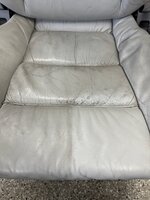
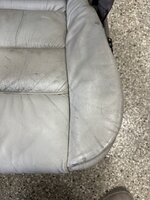
After the harness work was done, I turned my attention to the leather refurb. The passenger seat (old driver) was rough. Deep cracking, splitting, a small hole - it needed quite a bit of filler. Some before shots of the worst of the two.

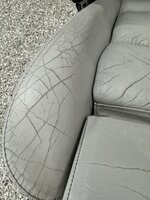


I use the Leather Master's filler to repair seats. It fills in the cracks nicely but remains flexible during the dye process. I have two different products from them - crack filler and deep crack/hole repair. Very similar, the latter is just a bit more robust.
After the filler/before sanding


After the filler, I typically will sand the filler down as much as I can. The new driver's seat didn't need much. The new passenger definitely did.
After that process, time for dye. I've done the dyeing process dozens of times in my life now - it's always so satisfying. This dye job took a full four hours from start to finish. Lots of light coats all while aiding the drying process with a heat gun on low (never close to the seat).
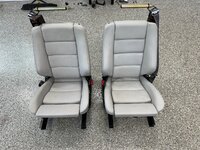


From there, I prepped the driver's seat to receive it's trim. I had two trim parts for each spot, so I picked the best option for each.

I loved seeing the seat fully trimmed. I got really, really excited at this point.


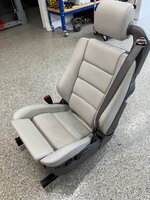
I then did my first install of the driver's seat with full memory, holding my breath as I tested each function. Everything works perfectly. Full movement in every direction, mirrors work again and the memory functions work perfectly.

The final install was a breeze and the project is now complete. An absolute dream come true.

In terms of cost, I paid $700 for the seats and $1500 to get them here. The rest is just time and effort.