To avoid these ads, REGISTER NOW!

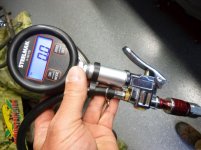
The New Astro Dial Face Tire Inflator

CobraRed

Well-known member
Joined
May 30, 2014
Messages
670
Anyone else get this email? Haven't seen a new inflator type in awhile.
I personally use the digital one but know peeps that prefer dial face.

http://www.astrotools.com/index.php/tpms-dial-tire-inflator-w-stainless-hose-0-65psi.html

First one I've seen with a stainless hose besides Snap-On:

L6TLUTv.jpg
 
To avoid these ads, REGISTER NOW!
OP
C

CobraRed

Well-known member
Joined
May 30, 2014
Messages
670
the 60psi Joes Racing one is the only other one I've seen that's similar. Rubber hose and no mention of accuracy, tho.

All these inflators with that go to 180-200psi and barely readable hash marks, what are people inflating??
 

WhataTool

Well-known member
Joined
Sep 8, 2015
Messages
472
180psi isn't even bicycle or 18-wheeler tire territory. I'm not sure why so many are that high.
 

thatguysb

Well-known member
Joined
Aug 5, 2015
Messages
178
I have a regular Harbor freight unit. Works excellent. It maxes out at 120psi.
 

bwringer

Well-known member
Joined
Jan 1, 2013
Messages
10,318
Location
Indianapolis
If someone made an inflator with a right-angle chuck, they would instantly sell about a zillion to motorcyclists.

That straight-on chuck is utterly useless, and the common angled "ball" chuck is very nearly useless.
 

hancock1701

Well-known member
Joined
Jun 30, 2014
Messages
187
Location
Orange, CA
Yeah, I've been looking for one that doesn't go to high, maybe 60psi so I can easily fill and read my tires around 30psi, but couldn't find it.
 

hancock1701

Well-known member
Joined
Jun 30, 2014
Messages
187
Location
Orange, CA
Sorry, didn't pay enough attention. Thanks for pointing that out. I might get this when my HF one breaks then.
 

Astro_Pneumatic_Tools

Well-known member
Joined
Oct 30, 2013
Messages
2,113
Location
South El Monte
Besides the psi range, how is this different to their other inflator?

The simplified dial face:
- PSI only, no BAR. This also allows us to push the hash-marks all the way out on the edge of the face and have the readings on the inside, making for more room between the psi marks which means 30psi and 30.5psi are night and day.

But mainly the hose and air pressure sensor. The hose is braided stainless by popular demand, and the pressure sensor is much more sensitive - something we've been working on for awhile.

3081
Resolution: 2psi
Accuracy: +/- 1.2psi

3082
Resolution: 1psi
Accuracy: +/- <1psi, or 1.5% on average.


_________
Chris
Product Manager
image.php
 

BD1

Well-known member
Joined
Mar 18, 2007
Messages
4,602
Location
north side
I'm assuming the schrader needs to be in for this to operate. That would be slick for quick filling tires that were just mounted.
 

94blu1500

Well-known member
Joined
Jul 19, 2013
Messages
51
I'm assuming the schrader needs to be in for this to operate. That would be slick for quick filling tires that were just mounted.

That looks like same style chuck as the blue point tire inflator/gauge and should work without the schrader valve in the stem.

I really like the look of the astro gauge and would buy one if I wasn't constantly working with tires that are 90-100 psi
 
Last edited:

crucible

Well-known member
Joined
Apr 15, 2012
Messages
927
Location
Northern Virginia
Last edited:

gungatim

Well-known member
Joined
Jan 8, 2013
Messages
8,101
Location
west mich
If someone made an inflator with a right-angle chuck, they would instantly sell about a zillion to motorcyclists.

That straight-on chuck is utterly useless, and the common angled "ball" chuck is very nearly useless.

Agreed. I ended up making my own to my own specs.

start with a Milton blow gun, remove the brass nozzle end. screw in 1/4" pipe to your length, adapt down to 1/8", then a guage that only goes to 100psi, tee'd to the 1/8" small 45 deg. angle head inflator.

works great for anything except innertubes on wheelbarrows that are completely flat.

You can use it one handed (no floppy hose do deal with) and the other nice thing is you can customize where the guage is, size, etc. to what you like most. If you don't have all the parts laying around like I did, you can buy new for <$25 and make it from scratch...
 

Astro_Pneumatic_Tools

Well-known member
Joined
Oct 30, 2013
Messages
2,113
Location
South El Monte
I'm assuming the schrader needs to be in for this to operate. That would be slick for quick filling tires that were just mounted.

Not at all. If you pull on the lever, air comes out whether attached to anything or not. Works great on just mounted tires w/out schrader's.

That looks like same style chuck as the blue point tire inflator/gauge and should work without the schrader valve in the stem.

I really like the look of the astro gauge and would buy one if I wasn't constantly working with tires that are 90-100 psi

Our 3081's are massively popular - which go to 180psi, could possibly meet your needs.

http://www.astrotools.com/index.php/dial-tire-inflator.html

Agreed. I ended up making my own to my own specs.

start with a Milton blow gun, remove the brass nozzle end. screw in 1/4" pipe to your length, adapt down to 1/8", then a guage that only goes to 100psi, tee'd to the 1/8" small 45 deg. angle head inflator.

works great for anything except innertubes on wheelbarrows that are completely flat.

You can use it one handed (no floppy hose do deal with) and the other nice thing is you can customize where the guage is, size, etc. to what you like most. If you don't have all the parts laying around like I did, you can buy new for <$25 and make it from scratch...

All of our inflators are standard 1/4npt - so you can effectively put almost any attachment on you like.


_____________
Chris
Product Manager
image.php
 

engineer2

Well-known member
Joined
Dec 13, 2009
Messages
11,824
Location
Chicago burbs
What goes so high?
Racing bicycle tires ~90 to 140 psi
Commercial airliner tires ~150 to 280 psi (a few go even higher)
 
To avoid these ads, REGISTER NOW!
OP
C

CobraRed

Well-known member
Joined
May 30, 2014
Messages
670
What goes so high?
Racing bicycle tires ~90 to 140 psi
Commercial airliner tires ~150 to 280 psi (a few go even higher)

So... 0.5% of the market? That's what all the manufacturers are designing for?
 

knobby

Well-known member
Joined
Feb 2, 2010
Messages
663
Location
down by the river under a Jeep

engineer2

Well-known member
Joined
Dec 13, 2009
Messages
11,824
Location
Chicago burbs
So... 0.5% of the market? That's what all the manufacturers are designing for?
Most manufactures should give you a choice of ranges to fit the application.
Some of them might want their gauge to survive being connected to a 150 psi air compressor.
Some may figure the average consumer won't notice any inaccuracies using a 200 psi gauge for a 36 psi tire.:rolleyes:
 
OP
C

CobraRed

Well-known member
Joined
May 30, 2014
Messages
670
Some of them might want their gauge to survive being connected to a 150 psi air compressor.

In what way does hooking up an inflator with a 65psi gauge to a 150psi compressor make the inflator not survive?
 

404

Well-known member
Joined
Aug 23, 2014
Messages
3,463
Location
Mass
The reason the gauges go so high is so that the user will not bend the needle when he pushes the trigger with no tire attached. I fixed this on mine by putting in a 60 psi gauge and a regulator set to 59 psi.

Due to the mechanism dial pressure gauges are most accurate at the middle of the scale, since I fill to 35 I chose a 60 scale. If a person fills to 50, choose a 100 scale.
 
OP
C

CobraRed

Well-known member
Joined
May 30, 2014
Messages
670
The reason the gauges go so high is so that the user will not bend the needle when he pushes the trigger with no tire attached. I fixed this on mine by putting in a 60 psi gauge and a regulator set to 59 psi.

???

Are people under the assumption that these inflators' gauges measure the compressor pressure at any point?

If the inflator's hose is hooked up to a tire, it will read 0 psi (or just a lower than accurate psi level) when the lever is pressed and an accurate 35psi when you let go (for instance). If it's not hooked up to anything it will be 0psi when you press the lever and 0 psi when you let go.

Maybe Astro can clear this up?
 

engineer2

Well-known member
Joined
Dec 13, 2009
Messages
11,824
Location
Chicago burbs
The valve in most inflators are designed to protect the gauge from over-pressurization. When you pull the trigger, it lets air into the tire but it also closes the passage to the gauge.

Notice, you don't get a "live" reading as the tire fills up. The gauge usually goes to zero and when you release the trigger, you get the tire pressure reading.

If some clown uses the tire chuck to read pressure from a compressor or a high-pressure tire and they over-pressurize the gauge, it will often ruin it. Putting a high pressure gauge on it avoids warranty returns, bent needles, and covers 99% of the applications.
 

Astro_Pneumatic_Tools

Well-known member
Joined
Oct 30, 2013
Messages
2,113
Location
South El Monte
???

Are people under the assumption that these inflators' gauges measure the compressor pressure at any point?

If the inflator's hose is hooked up to a tire, it will read 0 psi (or just a lower than accurate psi level) when the lever is pressed and an accurate 35psi when you let go (for instance). If it's not hooked up to anything it will be 0psi when you press the lever and 0 psi when you let go.

Maybe Astro can clear this up?

The valve in most inflators are designed to protect the gauge from over-pressurization. When you pull the trigger, it lets air into the tire but it also closes the passage to the gauge.

Notice, you don't get a "live" reading as the tire fills up. The gauge usually goes to zero and when you release the trigger, you get the tire pressure reading.

If some clown uses the tire chuck to read pressure from a compressor or a high-pressure tire and they over-pressurize the gauge, it will often ruin it. Putting a high pressure gauge on it avoids warranty returns, bent needles, and covers 99% of the applications.

Both correct.
All of our inflators can take roughly 200-220psi in, but are limited by their max reading for what you're measuring.
Sure you can damage the 65psi inflator if you're using it on a high pressure tire it's not made for, but we feel the few warranties we'll have to cover from this are worth the increased resolution and accuracy the average tech's going to benefit from when dealing with TPMS systems all day.

__________
Chris
Product Manager
image.php
 

404

Well-known member
Joined
Aug 23, 2014
Messages
3,463
Location
Mass
???

Are people under the assumption that these inflators' gauges measure the compressor pressure at any point?

If the inflator's hose is hooked up to a tire, it will read 0 psi (or just a lower than accurate psi level) when the lever is pressed and an accurate 35psi when you let go (for instance). If it's not hooked up to anything it will be 0psi when you press the lever and 0 psi when you let go.

Maybe Astro can clear this up?

I cannot speak for Astro, but yes, if one pulls the trigger with no tire attached one will get the compressor pressure. Why is that a surprise?
 
OP
C

CobraRed

Well-known member
Joined
May 30, 2014
Messages
670
Astro already did speak. And not only is that not true, it would be a fairly useless feature to have on your inflator.
 

logical

Well-known member
Joined
Aug 31, 2005
Messages
2,469
Location
Northern fringe of the Motor City Suburbs
I cannot speak for Astro, but yes, if one pulls the trigger with no tire attached one will get the compressor pressure. Why is that a surprise?

Exactly...its a diverter valve (a "Y") with a pressure gage attached to one leg, an air hose to the other, and a tire to the bottom of the "Y", release the lever (closing the valve to the compressor and opening the path to the gage and its now just like any other pressure gage. If it's not connected to an air hose and the lever isn't pulled, it is just a gage. If the gage was broken and not leaking, its just an on/off valve between the compressor and the tire. The gage never sees pressure from the compressor directly.
 
Last edited:

radrush

Well-known member
Joined
Oct 30, 2010
Messages
828
Location
Atlanta, GA
I like the STEELMAN (97977) High Accuracy Digital Tire Inflato

Ranges from 0 - 100 PSI (+/- 0.25 percent PSI accuracy).
Reads in PSI, Bar, kPa and kg/cm2.
Features automatic temperature/pressure compensation and peak/valley/track pressure reading modes.
 

Attachments

  • attachment-2.jpg
    attachment-2.jpg
    87.2 KB · Views: 88
Last edited:
OP
C

CobraRed

Well-known member
Joined
May 30, 2014
Messages
670
I like It's a STEELMAN (97977) High Accuracy Digital Tire Inflato

Ranges from 0 - 100 PSI (+/- 0.25 percent PSI accuracy).
Reads in PSI, Bar, kPa and kg/cm2.
Features automatic temperature/pressure compensation and peak/valley/track pressure reading modes.

Wow, that's badass.

Digital tho, a lot easier to make a precision digital gauge.
 

M6erfan

Well-known member
Joined
Dec 6, 2014
Messages
10,170
Location
'Merica!
I like It's a STEELMAN (97977) High Accuracy Digital Tire Inflato

Ranges from 0 - 100 PSI (+/- 0.25 percent PSI accuracy).
Reads in PSI, Bar, kPa and kg/cm2.
Features automatic temperature/pressure compensation and peak/valley/track pressure reading modes.

:drool:
 

Ign

Well-known member
Joined
Jul 7, 2006
Messages
12,769
Location
Butte Peak ND
I'd love to see something that goes to 80psi accurately for typical Load Range E tires but is still easy to read.

Also not aware of any bike clinchers that go over 120. Sew-ups and tubeless should be even less, that's the point.
 
OP
C

CobraRed

Well-known member
Joined
May 30, 2014
Messages
670
I'd love to see something that goes to 80psi accurately for typical Load Range E tires but is still easy to read.

Also not aware of any bike clinchers that go over 120. Sew-ups and tubeless should be even less, that's the point.

Are there many tire pressure monitoring systems for load E range tires?
 

Farmall450

Well-known member
Joined
Dec 23, 2011
Messages
13,371
Location
Marengo, Illinois
I'd love to see something that goes to 80psi accurately for typical Load Range E tires but is still easy to read.

Also not aware of any bike clinchers that go over 120. Sew-ups and tubeless should be even less, that's the point.

I agree. Lots of 3/4 and 1 ton trucks and vans out there.
 
To avoid these ads, REGISTER NOW!
Top Bottom