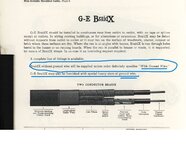
It allows the installation of knob and tube?
Not ****** likely. A ground is mandatory.
I can't think of any instance where it would be used, even as an extension of an existing circuit, but it's permissible.
394.1 Scope
This article covers the use, installation, and construction specifications of
concealed knob-and-tube wiring.
394.10 Uses Permitted
Concealed knob-and-tube wiring shall be permitted to be installed in the hollow
spaces of walls and ceilings, or in unfinished attics and roof
spaces as provided by
394.23, only as follows:
- For extensions of existing installations
- Elsewhere by special permission
394.12 Uses Not Permitted
Concealed knob-and-tube wiring shall not be used in the following:
- Commercial garages
- Theaters and similar locations
- Motion picture studios
- Hazardous (classified) locations
- Hollow spaces of walls, ceilings, and attics where such spaces are insulated by loose, rolled, or foamed-in-place insulating material that envelops the conductors
394.17 Through or Parallel to Framing Members
Conductors shall comply with
398.17 where passing through holes in structural members. Where passing through wood cross members in plastered partitions, conductors shall be protected by noncombustible, nonabsorbent, insulating tubes extending not less than 75 mm (3 in.) beyond the wood member.
394.19 Clearances
(A) General
A clearance of not less than 75 mm (3 in.) shall be maintained between conductors and a clearance of not less than 25 mm (1 in.) between the conductor and the surface over which it passes.
(B) Limited Conductor Space
Where
space is too limited to provide these minimum clearances, such as at meters,
panelboards,
outlets, and switch points, the individual conductors shall be
enclosed in flexible nonmetallic tubing, which shall be continuous in length between the last support and the
enclosure or
terminal point.
(C) Clearance From Piping, Exposed Conductors, and So Forth
Conductors shall comply with
398.19 for clearances from other
exposed conductors, piping, and so forth.
394.23 In Accessible Attics
Conductors in unfinished attics and roof
spaces shall comply with
394.23(A) or (B).
Informational Note: See
310.14(A)(3) for temperature limitation of conductors.
(A) Accessible by Stairway or Permanent Ladder
Conductors shall be installed along the side of or through bored holes in floor joists, studs, or rafters. Where run through bored holes, conductors in the joists and in studs or rafters to a height of not less than 2.1 m (7 ft) above the floor or floor joists shall be protected by substantial running boards extending not less than 25 mm (1 in.) on each side of the conductors. Running boards shall be securely fastened in place. Running boards and guard strips shall not be required where conductors are installed along the sides of joists, studs, or rafters.
(B) Not Accessible by Stairway or Permanent Ladder
Conductors shall be installed along the sides of or through bored holes in floor joists, studs, or rafters.
Exception: In buildings completed before the wiring is installed, attic and roof spaces that are not accessible by stairway or permanent ladder and have headroom at all points less than 900 mm (3 ft), the wiring shall be permitted to be installed on the edges of rafters or joists facing the attic or roof space.
394.30 Securing and Supporting
(A) Supporting
Conductors shall be rigidly supported on noncombustible, nonabsorbent insulating materials and shall not contact any other objects. Supports shall be installed as follows:
- Within 150 mm (6 in.) of each side of each tap or splice, and
- At intervals not exceeding 1.4 m (41/2 ft).
Where it is impracticable to provide supports, conductors shall be permitted to be fished through hollow
spaces in dry locations, provided each conductor is individually
enclosed in flexible nonmetallic tubing that is in continuous lengths between supports, between boxes, or between a support and a box.
(B) Securing
Where solid knobs are used, conductors shall be securely tied thereto by tie
wires having insulation equivalent to that of the conductor.
394.42 Devices
Switches shall comply with
404.4 and
404.10(B).
394.56 Splices and Taps
Splices shall be soldered unless
approved splicing
devices are used. In-line or strain splices shall not be used.
394.104 Conductors
Conductors shall be of a type
identified in Table 310.4(1).