To avoid these ads, REGISTER NOW!

The Trouble Shooter - Condenser Tester

Provincial

Well-known member
Joined
Sep 21, 2011
Messages
6,883
Location
Near Salem, OR
I posted this years ago and no one could help. I have had this tester for 20+ years and it does test the capacitance of condensers well. I wonder what light bulb goes in the standard Edison base socket. I haven't been able to determine what voltage passes through this circuit, which tests leakage through the condenser insulation.

The tool also tests voltage and works properly.

I have a General Tool Catalog from the late 1930's that features this tester, so I know it was made about that time.
 

Attachments

  • Condenser Tester Resized.JPG
    Condenser Tester Resized.JPG
    47.4 KB · Views: 100
To avoid these ads, REGISTER NOW!

Larryjones

Well-known member
Joined
Oct 11, 2015
Messages
494
Location
WV
Looks like a medium base socket. I would try any incandescent bulb and see what happens. My guess is it took one of those little 7 1/2 watt bulbs. Maybe it has a schematic inside showing the bulb.
 

gungatim

Well-known member
Joined
Jan 8, 2013
Messages
8,101
Location
west mich
can you post a bigger or close up of the socket? I picked up a few boxes of vintage auto parts from the 50's, lots of old bulbs in different sizes/voltages and odd bases. maybe I've got something that would fit.

I've got a small condenser tester that blinks but it is the size of a large tuna can. I could pull it apart and see what's inside if that helps...I think it is from JC Whitney circa early 60's or late 50's...
 

Mechanical Noise

Well-known member
Joined
Apr 25, 2014
Messages
2,635
Location
Southeast of O'Hare
Could be a neon bulb. Neon bulbs operate with a much lower current and would make a much more sensitive leakage tester than an incandescent. The bulb would be used as a "fail" indicator. If the bulb stays lit, the condenser is too leaky.
 
OP
P

Provincial

Well-known member
Joined
Sep 21, 2011
Messages
6,883
Location
Near Salem, OR
Could be a neon bulb. Neon bulbs operate with a much lower current and would make a much more sensitive leakage tester than an incandescent. The bulb would be used as a "fail" indicator. If the bulb stays lit, the condenser is too leaky.

I've been leaning toward this theory, since I can't get a reading across the terminals of the socket. I don't know where to find such a bulb, especially to "borrow" as an experiment.

Thanks, to all those who have replied. You have given me some things to try! :)
 
OP
P

Provincial

Well-known member
Joined
Sep 21, 2011
Messages
6,883
Location
Near Salem, OR
can you post a bigger or close up of the socket? I picked up a few boxes of vintage auto parts from the 50's, lots of old bulbs in different sizes/voltages and odd bases. maybe I've got something that would fit.

I've got a small condenser tester that blinks but it is the size of a large tuna can. I could pull it apart and see what's inside if that helps...I think it is from JC Whitney circa early 60's or late 50's...

Thanks for the offer, but I'll bet your tester is solid state and wouldn't operated in the same manner.

The bulb socket is a regular household light base. The surrounding recess isn't much larger than the base, which indicates to me that the bulb is about the size of the old screw-in fuses they used to use in homes. It may have been a special bulb, or something used in industry.
 
OP
P

Provincial

Well-known member
Joined
Sep 21, 2011
Messages
6,883
Location
Near Salem, OR
Looks like a medium base socket. I would try any incandescent bulb and see what happens. My guess is it took one of those little 7 1/2 watt bulbs. Maybe it has a schematic inside showing the bulb.

Unfortunately, there is no schematic inside. :sad:

So the bulb you are speaking of is like a Scoreboard bulb? Sort of like a night light with a standard base? :headscrat
 
OP
P

Provincial

Well-known member
Joined
Sep 21, 2011
Messages
6,883
Location
Near Salem, OR
Thanks to everyone for the ideas! Does anyone have an idea of what I should use for a resistance to simulate a leaking condenser to test various light bulbs for suitability?
 

Mechanical Noise

Well-known member
Joined
Apr 25, 2014
Messages
2,635
Location
Southeast of O'Hare
I've been leaning toward this theory, since I can't get a reading across the terminals of the socket. I don't know where to find such a bulb, especially to "borrow" as an experiment.

Thanks, to all those who have replied. You have given me some things to try! :)

You could tack solder a common NE-2/resistor combination across a screw in base from a light bulb or maybe across the tester's socket. The resistor may be redundant if there's an internal resistor. But a redundant resistor won't be a showstopper if you're on the right track.


I'm assuming this tester is line powered.
 

Larryjones

Well-known member
Joined
Oct 11, 2015
Messages
494
Location
WV
Unfortunately, there is no schematic inside. :sad:

So the bulb you are speaking of is like a Scoreboard bulb? Sort of like a night light with a standard base? :headscrat

Yep, one of those little fellas
7.5watt%20S11%20White.jpg
 
To avoid these ads, REGISTER NOW!

larry_g

Well-known member
Joined
Apr 28, 2007
Messages
16,930
Location
oregon
http://www.radiomuseum.org/r/centurye_in_circuit_condenser_tester_ct_1.html

The above site has some downloadable schematics. and I found one that has a light in it. Maybe you can put your model number in and come up with the correct schematic. That said I know a guy in Corvallis that has a huge collection of old electrical stuff and may be able to help. PM me if your interested.

lg
no neat sig line
 
Last edited:

gungatim

Well-known member
Joined
Jan 8, 2013
Messages
8,101
Location
west mich
Thanks for the offer, but I'll bet your tester is solid state and wouldn't operated in the same manner.

The bulb socket is a regular household light base. The surrounding recess isn't much larger than the base, which indicates to me that the bulb is about the size of the old screw-in fuses they used to use in homes. It may have been a special bulb, or something used in industry.

I don't think it's solid state, the date on the instructions is 1957. I did not take it apart yet, but I think it is just a regular bulb like what old electronic equipment used, small bayonet, 120v. it plugs in to AC, you connect the condenser, and the light blinks. you count the blinks and compare to the chart to find the mfd rating. I would be an appliance bulb would work for you, but the wattage is likely needing to be correct or the blinks would not correspond correctly. do you have the blink chart for reference?
 

Mechanical Noise

Well-known member
Joined
Apr 25, 2014
Messages
2,635
Location
Southeast of O'Hare
There's a simple schematic for a homebrew condenser tester on this page from a 1937 issue of Popular Science:

https://books.google.com/books?id=u...=onepage&q=neon bulb condenser tester&f=false

This is pretty typical of depression era test equipment. They liked to keep things simple and the parts count low. Actually, the schematic is oversimplified, as a neon bulb requires a series resistor in this type of circuit. Maybe all the common neon bulbs back then had the resistor in the base.

Whatever you have, it's probably easy enough to trace out the circuit by inspection.
 

ttpete

Well-known member
Joined
Mar 8, 2011
Messages
6,737
Location
Dearborn, MI
There's a simple schematic for a homebrew condenser tester on this page from a 1937 issue of Popular Science:

https://books.google.com/books?id=u...=onepage&q=neon bulb condenser tester&f=false

This is pretty typical of depression era test equipment. They liked to keep things simple and the parts count low. Actually, the schematic is oversimplified, as a neon bulb requires a series resistor in this type of circuit. Maybe all the common neon bulbs back then had the resistor in the base.

Whatever you have, it's probably easy enough to trace out the circuit by inspection.

Screw base neons had the resistor, bayonet bases didn't.

I never bothered to test ignition condensers. They were replaced with new along with the points. Back in the days of leaded fuel, plugs only lasted for about 15K miles, and points and condenser were also replaced at the same time.
 
OP
P

Provincial

Well-known member
Joined
Sep 21, 2011
Messages
6,883
Location
Near Salem, OR
Thanks again for your inputs.

I have uploaded full size photos of the internals to Photobucket. Here is a link: http://s854.photobucket.com/user/Jock_OR/library/Condenser%20Tester

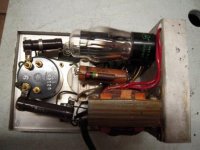
The tube is a Sylvania VT-80 rectifier.

I was able to do some testing and discovered that the bulb socket drove the VOM tester crazy. The digital showed an unstable voltage on AC and about 330 volts on DC. The analog VOM maxxed out on both AC and DC, over 600 volts. I am afraid to put a bulb in the socket!

Here is a photo of the internals. There are more views on photobucket.
 

Attachments

  • Trouble Shooter Internals.comp.jpg
    Trouble Shooter Internals.comp.jpg
    33.9 KB · Views: 23
OP
P

Provincial

Well-known member
Joined
Sep 21, 2011
Messages
6,883
Location
Near Salem, OR
By the way, I am mostly interested in just making the old thing work from curiosity.

Some obsolete condensers are so hard to find that it makes sense to test them. This one is probably not accurate enough to rely on for that.
 

gungatim

Well-known member
Joined
Jan 8, 2013
Messages
8,101
Location
west mich
Thanks again for your inputs.

I have uploaded full size photos of the internals to Photobucket. Here is a link: http://s854.photobucket.com/user/Jock_OR/library/Condenser%20Tester

The tube is a Sylvania VT-80 rectifier.

I was able to do some testing and discovered that the bulb socket drove the VOM tester crazy. The digital showed an unstable voltage on AC and about 330 volts on DC. The analog VOM maxxed out on both AC and DC, over 600 volts. I am afraid to put a bulb in the socket!

Here is a photo of the internals. There are more views on photobucket.

be careful with working on tube equipment, the 600 volts is typical for the plate voltage in the tube, and there are several lethal voltages that need to be checked, plate, bias, filament, etc.

hope you get it working, although people typically just replaced the condensers, I have found working on older equipment where points and condensers are not readily available cheap (especially old boat motors), it is helpful to check the old one before spending $60 for ordering the odd or rare ignition parts...
 

Mechanical Noise

Well-known member
Joined
Apr 25, 2014
Messages
2,635
Location
Southeast of O'Hare
Thanks again for your inputs.

I have uploaded full size photos of the internals to Photobucket. Here is a link: http://s854.photobucket.com/user/Jock_OR/library/Condenser%20Tester

The tube is a Sylvania VT-80 rectifier.

I was able to do some testing and discovered that the bulb socket drove the VOM tester crazy. The digital showed an unstable voltage on AC and about 330 volts on DC. The analog VOM maxxed out on both AC and DC, over 600 volts. I am afraid to put a bulb in the socket!

Here is a photo of the internals. There are more views on photobucket.

At least it has a transformer and the wires look like they have vinyl insulation, which strongly suggests post WW2 construction. There's probably no need to be poking around in the backside with the power on.

I have no explanation why your meters are reading different voltages. 300V makes sense, as this was a typical output voltage with an 80 rectifier. Note -- This is almost certainly a full wave rectifier circuit and the voltage across the transformer secondary will be over 600V.

I don't know how much effort you want to put into fixing this. Effort would include learning the basic theory on how it works and how you can proceed safely. I'm not trying to discourage you if you think fixing these sort of things are fun, but don't expect that all the effort will result in some wonderfully useful tool.

Testing old paper capacitors is kinda pointless, now. They're all leaky, the paper deteriorates with age. The only difference is that some are alot leakier than others.
 

Mechanical Noise

Well-known member
Joined
Apr 25, 2014
Messages
2,635
Location
Southeast of O'Hare
By the way, I am mostly interested in just making the old thing work from curiosity.

Some obsolete condensers are so hard to find that it makes sense to test them. This one is probably not accurate enough to rely on for that.

It's probably accurate enough for a GO/NO GO leakage test. But I'd be shocked if ANY NOS paper dielectric condenser is as good as new. I suppose a leakage test would be useful for sorting between the paper dielectric condensers and any better quality plastic dielectric condensers.

You could always use a modern 600V film/foil capacitor to replace an old condenser. Just match the capacitance and hang it across the point wire terminal on the coil and ground.

I had a Delta Mark 2 CD ignition box which was supposed to work down to 6V. Points last forever and no condenser to worry about.
 

ttpete

Well-known member
Joined
Mar 8, 2011
Messages
6,737
Location
Dearborn, MI
It's probably accurate enough for a GO/NO GO leakage test. But I'd be shocked if ANY NOS paper dielectric condenser is as good as new. I suppose a leakage test would be useful for sorting between the paper dielectric condensers and any better quality plastic dielectric condensers.

You could always use a modern 600V film/foil capacitor to replace an old condenser. Just match the capacitance and hang it across the point wire terminal on the coil and ground.

I had a Delta Mark 2 CD ignition box which was supposed to work down to 6V. Points last forever and no condenser to worry about.

Condensers aren't too fussy about where they're located. It was common to see one of the big brass Mallory condensers attached outside the distributor or even on the ignition coil.
 

radioman5959

New member
Joined
Oct 13, 2016
Messages
2
I have one of these testers with the correct bulb, it is neon, bulb has 105 -125 on base which is probably the working voltage. A GE NE-0011 has the same (split cylinder )type p-1 filament. It's working voltage is 210-250 Volts. A picture of one is on Kilokat's antique light bulb site.
 
Last edited:
To avoid these ads, REGISTER NOW!
Top Bottom