To avoid these ads, REGISTER NOW!

The worst job...

MushCreek

Well-known member
Joined
Jan 14, 2015
Messages
9,780
Location
Upstate South Carolina
...in my shop is automotive rust repair. Gahhh! It's disheartening, frustrating, and just plain hard to do well. If I was a younger man, I'd apprentice myself to a shop that does metal restoration. I'm working (slowly) on a '72 F-250. Pretty solid, but not perfect. I welded in new floors. Good thing they're covered up; they look like ****. Next, I'm fixing 'a few small rust spots' on the underside of the hood. I kept cutting, and cutting, and cutting, until I replaced a section over two feet long. I made a patch, and wrestled into place. Can't get to it from the underside, so a challenge trying to get it in place and hold it there for welding.

Then comes the welding. OK, I **** at auto body welding. I've watched all sorts of tutorials, including ones posted here. I've tried every setting from not enough to get the wire warm up to thermonuclear blast. In the videos, they get nice, neat flat little welds. Just dots, then more dots, then connect them together. I get it. Mine don't do that. I pull the trigger for the shortest possible interval, and blow a 1/8" hole in the metal. I attempt to patch that, ending up with a 1/4" hole. Eventually, the hole is 1/2" across, and I very carefully add dots of weld to the old weld until it's closed up again. Rinse and repeat. Instead of a 'stack of dimes', my welds come out like a crooked row of marbles. Then I grind away 5 pounds of weld to see what I've got underneath. Sigh.

The last time I did one of these old Fords, it ended up rusting out in the exact same places that I repaired, despite liberal applications of the latest and greatest rust stopping goop. I could just buy a new hood for $900, and may still do that someday, but for now, it's not in the budget. Tomorrow is another day, and I'll be back at it. Gotta get this old truck back on the road while I can still drive. I'm looking forward to the mechanical stuff, and getting away from body work.
 
To avoid these ads, REGISTER NOW!

moto-uno

New member
Joined
Jun 24, 2020
Messages
2
Location
carport
Are you using .025" wire ? I'm far from great at it , but my Lincoln SP-125 allows me to get away with it .
I'm also using Argon Co2 gas mix . Peter
 
OP
M

MushCreek

Well-known member
Joined
Jan 14, 2015
Messages
9,780
Location
Upstate South Carolina
No, the smallest wire my machine (40 y/o Lincoln 200) will push is .030. I'm running Argon/CO2 as well. I'm wondering if my machine is just too crude for fine work. I've thought about picking up a small cheap machine just for sheet metal work.
 

Bodj Built

Well-known member
Joined
Feb 3, 2016
Messages
1,165
Location
Moorpark, CA
No, the smallest wire my machine (40 y/o Lincoln 200) will push is .030. I'm running Argon/CO2 as well. I'm wondering if my machine is just too crude for fine work. I've thought about picking up a small cheap machine just for sheet metal work.

That's most likely your issue. Pick up a cheap HF unit with gas or a cheapo Lincoln 140 from Home Depot (what I have and use for thin stuff).
 

MoonRise

Well-known member
Joined
Nov 5, 2010
Messages
4,030
Location
NJ
+9 on using 0.025" wire on auto body work and C25 gas.

And practice. Practice some more. And more. :lol:

General rule-of-thumb is 1 amp for each .001" thickness. 20 gauge steel is about .036", so you are down around ~35 amps to weld that, give-or-take.

Hmm, 'old' Lincoln 200 amp MIG? SP200 perhaps? The manual says that the machine can be used with 0.025 wire, claims that you use the same drive roll for 0.025 - 0.035 solid wire. Just have to make sure you use the right contact tips for your gun.

Manual also claims the machine can dial down to ~50 ipm. Lincoln docs say that 0.025 L-56 wire at ~35 amps and ~15 V withC25 is ~100 ipm, so if your machine actually is an SP200 you -might- be able to use that machine. Same doc says 0.030 L-56 wire is ~35 amps and ~15 V with C25 at ~75 ipm, so your machine might be a little close to the lower limits on WFS. And any inconsistency in WFS can quickly change your arc and attempted weld puddle/bead from too-little to insta-hole.

A spot/stitch timer option sometimes helps to dial in a consistent arc time instead of trying to manually be ultra-consistent. On sheet metal, a quarter or half second timing difference can again change the weld/puddle from 'close' to insta-hole.

Or get a 'modern' small wire feed welder. But you might be up near the cost that replacement truck hood, unless you find a decent price on a decent used machine. Or go 'off-brand' instead of Red, Blue, or Yellow.
 
OP
M

MushCreek

Well-known member
Joined
Jan 14, 2015
Messages
9,780
Location
Upstate South Carolina
I think it is an SP200. Big, heavy thing, made in 1984. I tried .025 wire and it wouldn't push it, but then, it's probably the original drive roll, and worn out. I'll have to see if drive rolls are still available for it. It has the spot/stitch timer, but I've never tried it to see if it works.
 

garfunkle24

Well-known member
Joined
Mar 18, 2008
Messages
3,429
Location
Saskatoon, Canada
You guys see a lot of 0.025" wire down there? Up here everyone has 0.023" then next is 0.030."

If it is LITERALLY blowing holes the instant you hit the trigger then yeah, that ain't gonna work. The machine is wildly incorrectly set or malfunctioning.

If you're not experienced enough to know, do you have any friends who are decent weldors and could run a couple of beads and see what they think?

I assume that unit can do DCEN or DCEP, is that configured correctly? Is the wire feeding well? Feed issues are very common. Dirty liner, rusty wire etc. Doesn't take much.
 

428PI

Well-known member
Joined
Jul 14, 2018
Messages
1,976
Location
Peabody, KS
I thought this thread was about the worst job you had to perform and I was going to write something about gloves and removing rotten dog food that a rat put into the ductwork of a pickup but that will have to wait for another time.
 

chris142

Well-known member
Joined
Dec 19, 2011
Messages
6,533
Location
apple valley,ca
A friend of mine has a full time job buying trucks here in California ,taking them apart,putting them on a train to the east coast.

Might be an easier repair than trying to fix rust.
 

Rccrawlerguy

Well-known member
Joined
Dec 11, 2011
Messages
255
I think it is an SP200. Big, heavy thing, made in 1984. I tried .025 wire and it wouldn't push it, but then, it's probably the original drive roll, and worn out. I'll have to see if drive rolls are still available for it. It has the spot/stitch timer, but I've never tried it to see if it works.
My dad has a SP185 (same vintage as yours). (same vintage as me. lol) doing exhaust work at his shop, we use .023 wire. I would suggest looking for new drive rolls. Ours are old( not sure if they are original...but probably so) . That sucker does awesome on exhaust and body.
 

Jswain

Well-known member
Joined
Apr 26, 2013
Messages
2,463
Location
Calgary, AB
I think it is an SP200. Big, heavy thing, made in 1984. I tried .025 wire and it wouldn't push it, but then, it's probably the original drive roll, and worn out. I'll have to see if drive rolls are still available for it. It has the spot/stitch timer, but I've never tried it to see if it works.
Have you ever changed out the liner in the gun? Or blown it out with air, or even just pull it and see if it's kinked?

How long is the whip?

.023/.025 wire for sheet metal makes a huge difference, enough to figure out how to make it work.
 
OP
M

MushCreek

Well-known member
Joined
Jan 14, 2015
Messages
9,780
Location
Upstate South Carolina
The gun is new-ish, with less than a 10 lb. spool through it since I bought it. The drive roller wouldn't grab the small wire at all. I never looked into it any further, as I assumed it was the wrong size.
 
To avoid these ads, REGISTER NOW!

MoonRise

Well-known member
Joined
Nov 5, 2010
Messages
4,030
Location
NJ
re: wire diameter

For all practical purposes, 0.023 and 0.025" wire are the same thing. :) You could call the wire 0.024" +/- 0.001" and that would cover the size call out.

Manual for the SP200:

https://ch-delivery.lincolnelectric...t/ed10ae1cf3534464be7d8a4cc08a3ca7?v=c54783cf

From the manual and from other Lincoln/other wire feed welders that I've dealt with or seen, the 'little' drive rolls often have two grooves with the smallest one for 0.023/0.025 wire and the other groove for 0.030 and 0.035 solid wire. If you have the drive roll set up for the 0.030/0.035 groove, no wonder it wouldn't feed 0.023/0.025 wire. :lol:

A quick search and someone on fleabay is selling a NIB (new in bag) drive roll kit for an SP200. https://www.ebay.com/itm/335141687086 Notice in the picture that one face of the drive roll is stamped .023/.025 😁

Also remember to align the guide tubes properly and to set the drive roll tension.

Welding sheet metal is not the same as welding thicker stuff where you can run a continuous bead. As you know, make ONE weld dot. Move to another place on the seam and weld another dot. Repeat until done, with possible workpiece adjustment and/or persuasion (aka planishing) as needed along with possible dot grinding. Look at the LONG thread here on GJ from MP&C about body work including welding body panels. Great read. Did I mention that it is a LONG thread? :LOL:
 
OP
M

MushCreek

Well-known member
Joined
Jan 14, 2015
Messages
9,780
Location
Upstate South Carolina
I've read that thread, and understand it. My dots come out too tall, not flat like they're supposed to. My drive roller has one groove, but lo and behold, there was another drive roller stored in the cabinet, with both grooves. I bought some .023 wire, but TWO different welding suppliers didn't have .023 tips in stock. They're the long Tweco tip- 14 series. I can order some on ebay.
 

KSJeff

Well-known member
Joined
Dec 19, 2011
Messages
764
Location
Andover, Kansas
I have to do a couple of wheel areas on a 96 ford truck and I'm going to glue and screw. I'll probably plug weld the screw holes, but that's it. I watched this guy do it..


MoonRise

Well-known member
Joined
Nov 5, 2010
Messages
4,030
Location
NJ
I've read that thread, and understand it. My dots come out too tall, not flat like they're supposed to. My drive roller has one groove, but lo and behold, there was another drive roller stored in the cabinet, with both grooves. I bought some .023 wire, but TWO different welding suppliers didn't have .023 tips in stock. They're the long Tweco tip- 14 series. I can order some on ebay.
I'd tend more to order from places other than fleabay. Personal preference. I'd go to The jungle place, or other online supply places (IOC, Baker's Gas, etc).

Tweco 14-23 contact tip, common item. You can get them in the skinny tapered style or the regular cylindrical style.

The right drive roller makes a BIG difference in feeding the wire. Especially in the small diameter 0.024" +/- 0.001" size. :lol:

Also, use the right stick-out. Short-circuit transfer mode you need a pretty close stick-out, about 1/2". If you are used to running bigger wires and bigger machines (or spray transfer), the stick-out in short circuit MIG is much smaller.

Too tall of a bead dot could be too low of a voltage setting (because you are leery of blowing through the sheet metal), too low of a WFS (amps, again because you are leery of blowing a hole in the sheet), or too long of a weld dwell time (piling up too much metal). Or a combination.

The smaller wire diameter when welding sheet metal helps too.

Small wire, just enough volts and amps/WFS (only need ~35 amps for 20 gauge steel), straight at the sheet not angled, small stick out, C25 gas, good fit-up, sometimes a copper backer (spoon or bar or strip) helps if you have access to the back side, and practice.

Quick zap and done on that dot. Move and repeat. Planish and/or grind, planish more. Repeat hundreds of times more, don't get impatient and try to run an actual weld bead on the seam/joint. Just lots and LOTS of individual dots, but each weld dot has to be a weld with proper penetration and wet-out.

Patch panel weld thread https://www.garagejournal.com/forum/threads/welding-in-patch-panels.53534/
 

KSJeff

Well-known member
Joined
Dec 19, 2011
Messages
764
Location
Andover, Kansas
I've read that thread, and understand it. My dots come out too tall, not flat like they're supposed to. My drive roller has one groove, but lo and behold, there was another drive roller stored in the cabinet, with both grooves. I bought some .023 wire, but TWO different welding suppliers didn't have .023 tips in stock. They're the long Tweco tip- 14 series. I can order some on ebay.
You can run a .025 tip. Harbor freight sells them if you have one close.
 
OP
M

MushCreek

Well-known member
Joined
Jan 14, 2015
Messages
9,780
Location
Upstate South Carolina
I finally got .023 tips and wire, but it didn't help. The steel is perfectly clean. When I pull the trigger, sometimes I get a proper little 'bzzzzt', but more often, I get 'sputsputsputsput'. Almost like dirty steel. I've tried settings all over the map. The feeder seems to be working properly. It does the same thing when I weld structural steel, but if I just keep the trigger on, it settles down and welds. On thin sheet metal, the same technique results in big holes. This truck is my LAST foray into auto restoration anyway, so I guess I'll just muddle through. I wish I knew a skilled welder that could come to my place and try my welder to see if it's capable of doing this kind of work. I can't tell if it's the machine or the operator. Of course, if I knew a skilled welder locally, I could just have HIM do it!

Today was particularly frustrating because the cheap patch panels I bought aren't even close to the same shape as the original. I ended up tacking an area, then beating the next section into place and tacking, etc., etc. Luckily, it's the insode bottom corner of the doors, so looks aren't that important. I'll just blend it in with filler. Shoulda just puttied it up and not bothered trying to do a metal repair.
 

Jswain

Well-known member
Joined
Apr 26, 2013
Messages
2,463
Location
Calgary, AB
When's the last time you took your ground leads apart and cleaned them all up? Maybe take some pics of your setup, from your metal, front panel of machine, inside machine, gas gauges etc.

If your ground lead is long enough and you have some fairly thick pipe you could try to wrap 3-8 tight wraps around it with the ground lead to adjust inductance, it might help smooth the arc a bit.
 

NYBODYMAN

Well-known member
Joined
Sep 10, 2013
Messages
4,847
Location
NY
I have to do a couple of wheel areas on a 96 ford truck and I'm going to glue and screw. I'll probably plug weld the screw holes, but that's it. I watched this guy do it..

Just be aware of what is known as "ghosting" from the glued on panel. Basically, after time, the materials shrink and you will likely see the outline of the patch.

Also, instead of mig welding the screw holes, you can force panel bond (glue) into the holes and let it dry then sand it down. I would also spray epoxy primer before any filler and/or use a layer of fiberglass filler prior to regular body filler.
 

MoonRise

Well-known member
Joined
Nov 5, 2010
Messages
4,030
Location
NJ
Probably skip trying to play around with adding inductance to the welding circuit by wrapping the ground lead around a heavy wall steel pipe or a solid steel bar. Adding inductance slows down the amperage rise time and makes the weld take LONGER to get going. Sometimes that's good and helpful on thick(er) workpieces to help wet out the toes, but not so good on thin sheet metal where you have to quickly make a weld bead 'dot' before blowing a hole right through the thin sheet metal.

Try some practice welds on some sheet metal and on some maybe ~1/8" thick scrap pieces. Get the machine parameters dialed in there before attempting to weld on the actual vehicle sheet metal. That whole 'one variable at a time' thing. :beer:

And a +99 on what your settings are and on checking the condition of the torch lead and the workpiece (aka 'ground') lead and clamp and all the connections of the leads to the machine.

Low voltage and low amperage MIG is pretty unforgiving on any 'bad' electrical connections, and an iffy ground connection to the workpiece can REALLY mess with your welds and the ability to even make the welds or make them well or even halfway decent.


This one he runs into and comments on having a bad/iffy ground connection, causing sputtering and arc/bead problems.


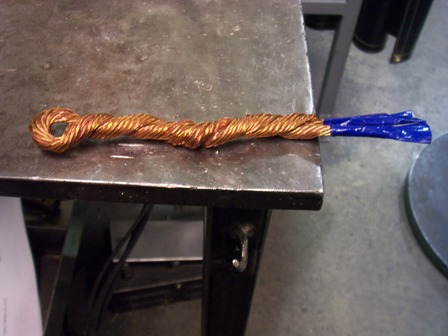
Another page where he mentions the importance of the ground clamp connection to the workpiece and a work-around (aka 'hack') to get a better clamp connection to the workpiece using a piece of heavy braided copper


Honest Bob

Well-known member
Joined
Jul 3, 2010
Messages
263
Location
Easton, PA
.023/.025 wire/tip, clean grounds, clean welding area, clean tip, and working gas delivery. I was able weld perfectly fine on my Hobart 210 (which supposedly is borderline too powerful according to the internet). I did have wire feed, and a bad new in box gas regulator issues I had to work out.

Even once I got everything ironed out it was still a slog, you just have to soldier on.
 
OP
M

MushCreek

Well-known member
Joined
Jan 14, 2015
Messages
9,780
Location
Upstate South Carolina
Okay; getting better. I cleaned the grounds, particularly the clamp itself. I upped the voltage, which seems contrary, and had to speed up the wire, too. If my math (and the dial) is accurate, I should be at bout 17.5 V., and about 400 on the wire speed. I also learned to come straight at it, rather than on an angle. I'm welding on the bottom 4" of a door skin; for some reason, no one makes a door skin for the whole thing. I'm using .023 wire.
 
To avoid these ads, REGISTER NOW!
Top Bottom